great depression
Flashback Friday: War Begins & Ends 1914-1919
Much like June 14, June 28 is also a very interesting day. It marks the beginning and ending of The Great War or, The War to End All Wars. Though true that the guns fell silent on the eleventh hour of the eleventh day of the eleventh month with the signing of the Armistice in a railroad car in Compiègne, France, today’s date serves as solid markers in the timeline. ~Vic

On this day in 1914, Archduke Franz Ferdinand of Austria and his wife Sophie are shot to death by a Bosnian Serb nationalist during an official visit to the Bosnian capital of Sarajevo. The archduke traveled to Sarajevo […] to inspect the imperial armed forces in Bosnia and Herzegovina, annexed by Austria-Hungary in 1908. The annexation had angered Serbian nationalists, who believed the territories should be part of Serbia. A group of young nationalists hatched a plot to kill the archduke during his visit to Sarajevo and, after some missteps, 19-year-old Gavrilo Princip was able to shoot the royal couple at point-blank range, while they traveled in their official procession, killing both, almost instantly.
The assassination set off a rapid chain of events, as Austria-Hungary immediately blamed the Serbian government for the attack. As large, powerful Russia supported Serbia, Austria asked for assurances that Germany would step in on its side against Russia, and its allies, including France and possibly Great Britain. On July 28, Austria-Hungary declared war on Serbia and the fragile peace between Europe’s great powers collapsed, beginning the devastating conflict now known as the First World War.
[Source]

World War I officially ended with the signing of the Treaty of Versailles [on this day in] 1919. The treaty, negotiated between January and June […] in Paris, was written by the Allies with almost no participation by the Germans. The negotiations revealed a split between the French, who wanted to dismember Germany to make it impossible for it to renew war with France and, the British and Americans, who did not want to create pretexts for a new war. The eventual treaty included 15 parts, […] 440 articles, […] reassigned German boundaries and assigned liability for reparations.
The German government signed the treaty under protest. The U.S. Senate refused to ratify the treaty and the U.S. government took no responsibility for most of its provisions.
For five years the French and the Belgians tried to enforce the treaty quite rigorously […]. In 1924, however, Anglo-American financial pressure compelled France to scale down its goals and end the occupation. […] The French assented to modifying important provisions of the treaty in a series of new agreements. Germany in 1924, and 1929, agreed to pay reparations under the Dawes Plan and the Young Plan but, the Great Depression led to the cancellation of reparations in 1932. Hitler denounced the treaty altogether in 1935.
One can never know whether either rigorous Franco-British enforcement of the original treaty or a more generous treaty would have avoided a new war.
[Source]

05-07-2019
Wayback Wednesday: The Gold Repeal Resolution 1933
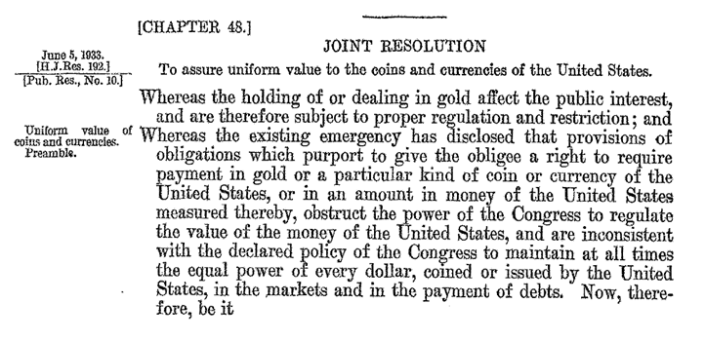
Eighty-six years ago, today, following President Franklin Roosevelt‘s signing of Executive Order 6102 on April 5, and Executive Order 6111 on April 20, the 73rd U.S. Congress enacted House Joint Resolution 192 (48 Stat. 112), abolishing payment in gold. These steps eventually led to the Gold Reserve Act of 1934. The ownership of gold coins, gold bullion and gold certificates was forbidden. The Executive Order(s) required all persons to deliver on, or before, May 1, 1933, all but small amounts of gold. Violation of the order was punishable by fine up to $10,000 or up to ten years in prison, or both.
From The History Channel:
On June 5, 1933, the United States went off the gold standard, a monetary system in which currency is backed by gold, when Congress enacted a joint resolution nullifying the right of creditors to demand payment in gold. The United States had been on a gold standard since 1879 […] but, bank failures during the Great Depression of the 1930s frightened the public into hoarding gold […].
Soon after taking office in March 1933, Roosevelt declared a nationwide bank moratorium in order to prevent a run on the banks by consumers lacking confidence in the economy. He also forbade banks to pay out gold or to export it. According to Keynesian economic theory, one of the best ways to fight off an economic downturn is to inflate the money supply. And, increasing the amount of gold held by the Federal Reserve would in turn increase its power to inflate the money supply. Facing similar pressures, Britain had dropped the gold standard in 1931 and Roosevelt had taken note.
On April 5, 1933, Roosevelt ordered all gold coins and gold certificates in denominations of more than $100 turned in for other money. It required all persons to deliver all gold […] owned by them to the Federal Reserve by May 1 for the set price of $20.67 per ounce. In 1934, the government price of gold was increased to $35 per ounce, effectively increasing the gold on the Federal Reserve’s balance sheets by 69 percent. This increase in assets allowed the Federal Reserve to further inflate the money supply.

From Peter Schiff:
After the bombing of Pearl Harbor, President Franklin D. Roosevelt called Dec. 7, 1941, “A date that will live in infamy.” When it comes to the US monetary system, June 5, 1933, should share that ignoble title because that date marks the beginning of a slow death of the dollar.
Roosevelt signed Executive Order 6102 […] touted as a measure to stop hoarding but, was, in reality, a massive confiscation scheme. Even in the heat of Roosevelt’s confiscation scheme, government troops did not break into people’s homes… Ironically, all the gold actually collected by the Treasury was willfully surrendered in a wave of misguided patriotism, while many ‘law-breakers’ simply kept their gold.
The purpose of Roosevelt’s executive order was to remove constraints on inflating the money supply. The Federal Reserve Act required all notes have 40% gold backing [but], the Fed was low on gold and up against the limit. By increasing its gold stores, the Fed could circulate more notes.
Roosevelt’s [actions] in 1933 set off a dollar devaluation that continues to this day. In 1913, prices were only about 20% higher than in 1775 and around 40% lower than in 1813, during the War of 1812. Whatever the mandates of the Federal Reserve, it is clear that the evolution of the price level in the United States is dominated by the abandonment of the gold standard in 1933 and the adoption of fiat money, subsequently. One hundred years after its creation, consumer prices are about 30 times higher than what they were in 1913.
In 1964, the minimum wage stood at $1.25. To put it another way, a minimum wage worker earned five silver quarters for every hour worked. Today, you can’t even buy a cup of coffee with those five quarters [but], the melt-value of those five silver quarters, today, stands close to $15! Roosevelt’s moves, culminating in the June 5 congressional resolutions, initiated a process of monetary deformation that led straight to Nixon’s abomination at Camp David, Greenspan’s panic at the time of the 1998 Long-Term Capital Management crisis and, the final destruction of monetary integrity and financial discipline during the BlackBerry Panic of 2008.
The legacy of June 5, 1933 continues today. The dollar continues to devalue. That means over the long-term, the price of gold in US dollars will almost certainly continue to rise.
Yay for us. ~Vic
 Cosmic-Observation