conspiracy
Throwback Thursday: Losing King 1968

Fifty-one years ago, today, a powerful voice & soul was extinguished. I wasn’t even two years old when he was killed. He was only 39. He wasn’t a perfect person (who is?) but, his message was.
From The History Channel:
Just after 6:00p.m. on April 4, 1968, Martin Luther King, Jr. is fatally shot while standing on the balcony outside his second-story room at the Lorraine Motel in Memphis, Tennessee. The civil rights leader was in Memphis to support a sanitation workers’ strike and, was on his way to dinner when a bullet struck him in the jaw and severed his spinal cord. King was pronounced dead after his arrival at a Memphis hospital.
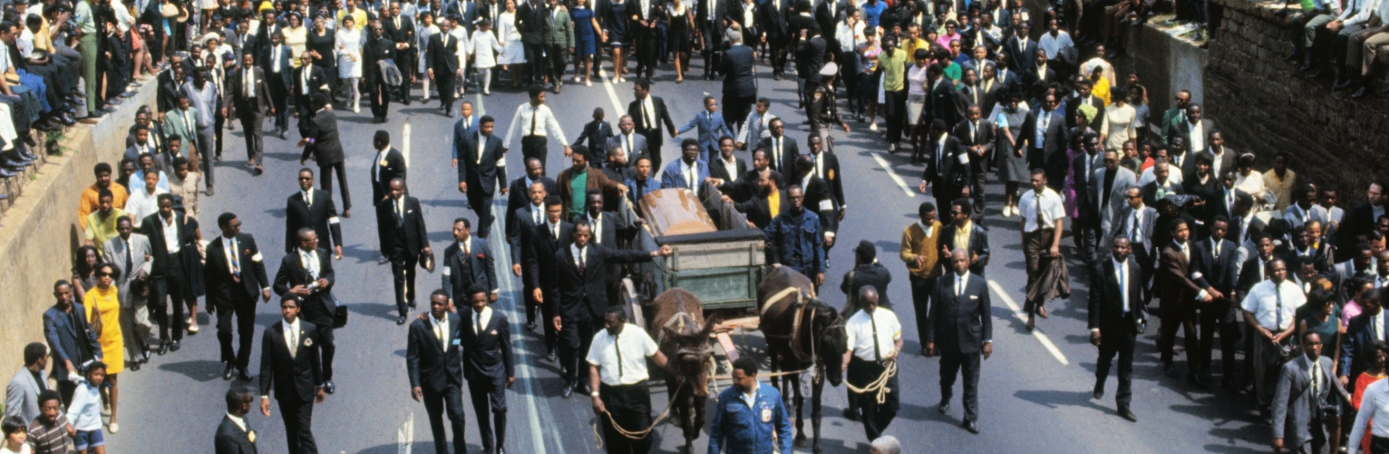
As word of the assassination spread, riots broke out in cities all across the United States and, National Guard troops were deployed in Memphis and Washington, D.C. On April 9, King was laid to rest in his hometown of Atlanta, Georgia. Tens of thousands of people lined the streets to pay tribute to King’s casket as it passed by in a wooden farm cart drawn by two mules.
From Wikipedia:
The King family and others believe the assassination was the result of a conspiracy involving the U.S. government, Mafia and Memphis police, as alleged by Loyd Jowers in 1993. They believe that Ray was a scapegoat. In 1999, the family filed a wrongful death lawsuit against Jowers for the sum of $10 million. During closing arguments, their attorney asked the jury to award damages of $100, to make the point that “it was not about the money.” During the trial, both sides presented evidence alleging a government conspiracy. The government agencies accused could not defend themselves or respond because they were not named as defendants. Based on the evidence, the jury concluded Jowers, and others, were “part of a conspiracy to kill King” and awarded the family $100. The allegations and the finding of the Memphis jury were later rejected by the United States Department of Justice in 2000 due to lack of evidence.

After the assassination of President Kennedy in 1963, King told his wife, Coretta Scott King, “This is what is going to happen to me also. I keep telling you, this is a sick society.”
Senator Robert F. Kennedy was the first to tell his audience in Indianapolis that King had died. He stated:
“For those of you who are black, and are tempted to be filled with hatred and mistrust of the injustice of such an act, against all white people, I would only say that I can also feel in my own heart the same kind of feeling. I had a member of my family killed but, he was killed by a white man.
His speech has been credited as preventing riots in Indianapolis when the rest of the country was not so lucky.
On March 10, 1969, James Earl Ray pleaded guilty (on his birthday) and was sentenced to 99 years in the Tennessee State Penitentiary. He died in prison at the age of 70 on April 23, 1998, twenty-nine years and 19 days after King’s assassination.
Many documents regarding an FBI investigation remain classified and will stay secret until 2027.
I’ve seen the Promised Land.
Wayback Wednesday: Paul Harvey’s Espionage Charge 1951

Sixty-eight years ago, today, radio legend Paul Harvey did something no one expected and got into a bit of trouble over it. In the wee hours of February 6, 1951, without any authorization, Harvey trespassed on the Argonne National Laboratory grounds, engaging in what reporters term as participatory journalism.
Conducting classified research, the laboratory was heavily secured; all employees and visitors needed badges to pass a checkpoint, many of the buildings were classified, and the laboratory itself was fenced and guarded. Such alluring secrecy drew visitors both authorized […] and unauthorized. Shortly past 1 a.m. on February 6, 1951, Argonne guards discovered reporter Paul Harvey near the 10-foot (3.0 m) perimeter fence, his coat tangled in the barbed wire. Searching his car, guards found a previously prepared four-page broadcast detailing the saga of his unauthorized entrance into a classified “hot zone.” He was brought before a federal grand jury on charges of conspiracy to obtain information on national security and transmit it to the public, but was not indicted.
Harvey’s “escapade” prompted the U.S. attorney for Illinois to empanel a grand jury to consider an espionage indictment; Harvey “went on the air to suggest he was being set up”; the grand jury subsequently declined to indict Harvey.
From The Washington Post’s Joe Stephens:
Previously confidential files show that Harvey […] enjoyed a 20-year friendship with FBI Director J. Edgar Hoover, often submitting advance copies of his radio script for comment and approval. […] the real twist, suitable for one of Harvey’s signature “Rest of the Story” vignettes, is how they met…on opposite sides of an espionage investigation.
The news is contained in nearly 1,400 pages of FBI files, released to The Washington Post in response to a one-year-old Freedom of Information Act request.
The Cold War beginning of the Harvey-Hoover bond was an incident from 1951, when Harvey was 32. He routinely hammered officials for being lax on security, in particular those in charge of the Argonne National Laboratory, which conducted nuclear testing 20 miles west of Chicago. After wrapping up his television broadcast on the evening of Feb. 5, 1951, Harvey set out to prove his case and make some career-enhancing headlines for himself.
Harvey guided his black Cadillac Fleetwood toward Argonne, arriving sometime past midnight. He parked in a secluded spot, tossed his overcoat onto the barbed wire topping a fence, then scampered over. […] seconds after Harvey hit the ground, security officers spotted him, documents show. Harvey ran until, caught in a Jeep’s headlights, he tripped and fell. As guards approached, Harvey sprang to his feet and waved.
Guards asked whether Harvey realized he was in a restricted area. “Harvey replied no, that he thought he might be at the airport because of the red lights,” one report says. Under questioning, Harvey eventually dropped his cover story but refused to elaborate, saying he wanted to tell his tale before a congressional committee.”
Two months after the incident, a federal grand jury officially declined to indict Harvey. Nothing in Harvey’s file suggests Hoover did anything to help. But Harvey appears to have been grateful for something.
It’s a long, in-depth article and, apparently, Harvey intended to lie to the audience about ‘how it went down’.
So. There you have it…the rest of the story. ~Vic
 Cosmic-Observation