february 5
Wayback Wednesday: Tybee Island Bomb Accident 1958

Silkscreen Image For T-shirts
America lost a bomb. I’m not kidding. Sixty-two years ago, today, the United States Air Force dropped a nuclear bomb in the water off the coast of Tybee Island, very close to Savannah, Georgia. A North American Aviation F-86 Sabrejet fighter plane and a Boeing B-47 Stratojet strategic bomber collided during practicing exercises and, in fear of a detonation in the event of a crash, the crew jettisoned the bomb. They still haven’t found it and it is assumed to be somewhere at the bottom of Wassaw Sound.
The B-47 bomber was on a simulated combat mission from Homestead Air Force Base in Florida. It was carrying a single 7,600-pound bomb. At about 2:00am EST, an F-86 fighter collided with the B-47. The F-86 crashed after the pilot ejected from the plane. The damaged B-47 remained airborne, plummeting 18,000 feet from 38,000 feet when [the pilot] regained flight control. The crew requested permission to [drop] the bomb in order to reduce weight and prevent the bomb from exploding during an emergency landing. Permission was granted and the bomb was jettisoned at 7,200 feet […]. The crew did not see an explosion when the bomb struck the sea. They managed to land the B-47 safely at […] Hunter Air Force Base. The pilot, a Colonel Howard Richardson, was awarded the Distinguished Flying Cross after this incident.

Some sources describe the bomb as a functional nuclear weapon but, others describe it as disabled. If it had a plutonium nuclear core installed, it was a fully functional weapon. If it had a dummy core installed, it was incapable of producing a nuclear explosion but, could still produce a conventional explosion. […] The Air Force maintains that its nuclear capsule, used to initiate the nuclear reaction, was removed before its flight aboard B-47. […] the bomb contained a simulated 150-pound cap made of lead. However, according to 1966 Congressional testimony by Assistant Secretary of Defense W.J. Howard, the Tybee Island bomb was a “complete weapon, a bomb with a nuclear capsule” and one of two weapons lost that contained a plutonium trigger. Nevertheless, a study of the Strategic Air Command documents indicates that Alert Force test flights in February 1958 with the older Mark 15 payloads were not authorized to fly with nuclear capsules on board.
The collision, and its aftermath, also drives the plot of the novel Three Chords & The Truth by Craig McDonald, published in November 2016.
Missing For 50 Years (BBC News)
This Day In Aviation (This site claims the bomber was from MacDill Air Force Base)
Lost H-Bomb: RIP (Savannah Now Archive)
The Case of the Missing H-Bomb (Counterpunch Archive)
The Colonel and the Bomb (The Atlantic)
Movie Monday: The Lonely Villa 1909
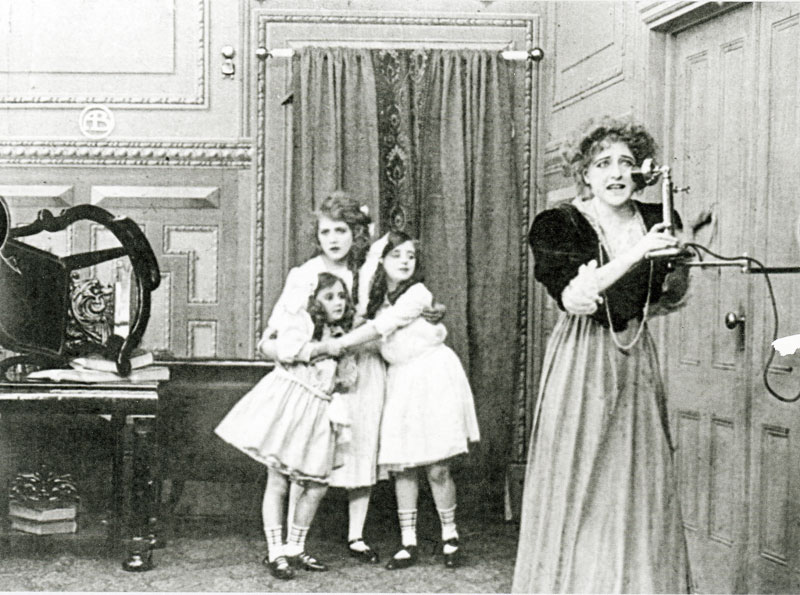
One-hundred and ten years ago, today (exactly, believe it or not), the silent short crime-drama, The Lonely Villa, was released. A film directed by D. W. Griffith, it starred David Miles, Marion Leonard, Mary Pickford (in one of her very early roles), Gladys Egan and Adele DeGarde and, was based on the Andre de Lorde French play from 1901: Au Téléphone.
D. W. Griffith and Mary Pickford, along with Charlie Chaplin and Douglas Fairbanks, founded United Artists on February 5, 1919, as a studio where actors could control their own interests instead of being beholden to commercial studios. It is now a subsidiary of MGM and Annapurna Pictures and, as of February 5, 2019 (its 100th anniversary), it was rebranded as United Artists Releasing.
From IMDB:
A gang of thieves lure a man out of his home so that they can rob it and, threaten his wife and children. The family barricade themselves in an interior room but, the criminals are well-equipped for breaking in. When the father finds out what is happening, he must race against time to get back home.
Trivia Bit
♦ During the shot of the father leaving the hotel, a dip can be seen in the road in the background. Today, that is currently the exit for the George Washington Bridge and the location of the hotel is now an apartment complex.
Tune Tuesday: Evelyn Knight & The Stardusters 1949

Seventy years ago, today, the #1 song on Billboard (pre-hot 100 era) was A Little Bird Told Me by Evelyn Knight, backed up by the Stardusters. Written by Harvey Oliver Brooks, the song was recorded by five different artists with Knight’s version being the only number one. Harvey Brooks was the first black American to write a major motion picture’s complete score: I’m No Angel, starring Mae West.

The Stardusters with Mary McKim
In 1950, this particular song was the subject of a landmark court case between Supreme Records in Los Angeles and Decca Records in London, England. Supreme Records founder Albert Patrick sued Decca over copyright infringement as his company had recorded and released the song with singer Paula Watson before Decca’s version was released with Knight & The Stardusters. Patrick was furious and filed for $400,000 claiming plagiarism of the arrangement.
The court ruled in favor of the defense stating that musical arrangements were not copyrightable, as style could not be protested under the law. The case opened the door for cover versions. Supreme went bankrupt shortly afterwards and Paula Watson went to work for Decca.
 Cosmic-Observation