nineteenth amendment
Wayback Wednesday: Leser vs. Garnett 1922

The Nineteenth Amendent to the U.S. Constitution was ratified on August 18, 1920, with Tennessee being the last state to vote in favor of, achieving the 3/4 majority needed to amend. One would think that this event would have been the end of any argument against a woman’s right to vote but, one more hurdle had to be cleared.
Ninety-seven years ago, today, the U.S. Supreme Court made a ruling on the constitutionality of the amendment.
From Cornell Law (some case-law text):
On October 12, 1920, Cecilia Streett Waters and Mary D. Randolph, citizens of Maryland, applied for and were granted registration as qualified voters in Baltimore City. To have their names stricken from the list Oscar Leser and others brought this suit in the court of common pleas. The only ground of disqualification alleged was that the applicants for registration were women, whereas the Constitution of Maryland limits the suffrage to men. Ratification of the proposed amendment to the federal Constitution, now known as the Nineteenth, 41 Stat. 362, had been proclaimed on August 26, 1920, 41 Stat. 1823, pursuant to Revised Statutes, § 205 (Comp. St. § 303). The Legislature of Maryland had refused to ratify it. The petitioners contended, on several grounds, that the amendment had not become part of the federal Constitution. […] the case comes here on writ of error. That writ must be dismissed but, the petition for a writ of certiorari, also duly filed, is granted. The laws of Maryland authorize such a suit by a qualified voter against the board of registry. Whether the Nineteenth Amendment has become part of the federal Constitution is the question presented for decision.

There were three claims:
[1] The power to amend the Constitution did not cover this amendment due to its character.
“[…] the amendment “destroyed State autonomy” because it increased Maryland’s electorate without the state’s consent.”
[2] Several states that had ratified the amendment had constitutions that prohibited women from voting, rendering them unable to ratify an amendment to the contrary.
[3] The ratifications of Tennessee and West Virginia were invalid, because they were adopted without following the rules of legislative procedure in place in those states.
Justice Brandeis delivered the opinion of the Court:
[1] This amendment is in character and phraseology precisely similar to the Fifteenth. For each, the same method of adoption was pursued. One cannot be valid and the other invalid. That the Fifteenth is valid, although rejected by six states, including Maryland, has been recognized and acted on for half a century.
[2] […] But the function of a state Legislature in ratifying a proposed amendment to the federal Constitution, like the function of Congress in proposing the amendment, is a federal function derived from the federal Constitution and, it transcends any limitations sought to be imposed by the people of a state.
[3] The question raised may have been rendered immaterial by the fact that since the proclamation the Legislatures of two other states—Connecticut and Vermont—have adopted resolutions of ratification. But, a broader answer should be given to the contention. The proclamation by the Secretary certified that, from official documents on file in the Department of State, it appeared that the proposed amendment was ratified by the Legislatures of 36 states and, that it ‘has become valid to all intents and purposes as a part of the Constitution of the United States.’ As the Legislatures of Tennessee and of West Virginia had power to adopt the resolutions of ratification, official notice to the Secretary, duly authenticated, that they had done so, was conclusive upon him, and, being certified to by his proclamation, is conclusive upon the courts.
Quote From Time Magazine:
“So, while the 19th Amendment granted women the right to vote, Leser made sure that the right could actually be used, even where the state constitution said otherwise. It’s not one of the more famous Supreme Court decisions in American history but, without it, the electorate would be, well, lesser.”
As an addendum to the above, Maryland finally ratified the amendment on March 29, 1941 but, didn’t certify that until February 25, 1958, two days shy of an exact 36 year delay. And, I am sad to say that my home state of North Carolina didn’t ratify until May 6, 1971, making it third to last behind South Carolina (ratified July 1, 1969 but, not certified until August 22, 1973) and Mississippi (ratified March 22, 1984).
Little video snippet regarding this case:
And, I grew up watching Schoolhouse Rock, I just had to put this up:
Throwback Thursday: Silent Sentinels 1917
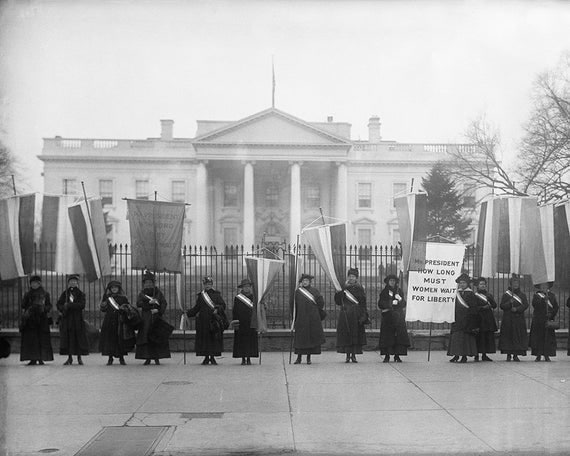
One hundred and two years ago, today, a group of women, organized by Women’s Rights Activist Alice Paul and the National Woman’s Party (NWP), began a picketing and protest campaign in front of the White House during the Wilson Presidency. Known as the Silent Sentinels, the protest began after a meeting with the President regarding suffrage proved fruitless with Wilson stating to the women to “…concert public opinion on behalf of women’s suffrage.” The silent protest was a new strategy for the National Suffrage Movement and served as a constant reminder of Wilson’s lack of support.

Originally founded as the Congressional Union for Woman Suffrage (CUWS) after the 1913 woman suffrage parade, they broke away from the National American Woman Suffrage Association (NAWSA), a more moderate group. CUWS only lasted three years and morphed into the NWP. The Suffragist was their weekly newsletter, containing essays, progress reports and notes on the President’s continuing indifference.
There were differing public reactions. Some approved, assisting with holding banners, bringing beverages and donating money. Some opposed their actions, including the leader of the NAWSA, Carrie Chapman Catt, whom preferred political tactics via individual states instead of a national amendment. She feared a male voter backlash.

Anti-suffragist mobs could be violent (worsening after the US entered World War I) spurred by the more insulting banners that compared Wilson to Kaiser Wilhelm. The New York Times called the protests “…silly, silent and offensive.” Massachusetts Representative Joseph Walsh referred to them as “…bewildered, deluded creatures with short skirts and short hair…” and “…nagging, iron-jawed angels.”
They were harassed, arrested, tortured and abused. Hunger strikes were met with forced feeding. On the night of November 14, 1917, known as the “Night of Terror“, the superintendent of the Occoquan Workhouse (prison), W.H. Whittaker, ordered the nearly forty guards to brutalize the suffragists. The treatment stories angered many Americans, creating more support. The protesters were finally released November 27 & 28, 1917, Alice Paul having spent five weeks there.
President Wilson finally announced his amendment support on January 8, 1918. The House barely passed the amendment the next day but, the Senate waited until October to vote. It failed by two votes. Protester arrests resumed August 6, 1918 and, by December, protestors were starting fires and burning Wilson effigies in front of the White House. Alice Paul encouraged people to vote against anti-suffrage Senators during the 1918 elections. The House, again, passed the amendment on May 21, 1919 and the Senate followed June 4 ending the six-day-a-week protest. The Nineteenth Amendment was adopted August 18, 1920.
See Iron Jawed Angels film.

 Cosmic-Observation