Military
Gulf of Tonkin Resolution 1964

On this day in 1964, Congress approved the Gulf of Tonkin Resolution, effectively entering the U.S. into a conflict that still affects us to this day. This resolution, brought about by the questionable Gulf of Tonkin Incident (also referred to as the USS Maddox incident), gave President Johnson the legal justification for sending U.S. troops to Vietnam, under the guise of assisting a country under the treat of communist aggression.
From This Day In Military History:
“The resolution marked the beginning of an expanded military role for the United States in the Cold War battlefields of Vietnam, Laos and Cambodia. By 1964, America’s ally, South Vietnam, was in serious danger of falling to a communist insurgency. The insurgents, aided by communist North Vietnam, controlled large areas of South Vietnam and no amount of U.S. military aid and training seemed able to save the southern regime. During the presidencies of Dwight D. Eisenhower and John F. Kennedy, hundreds-and then thousands-of U.S. military advisers had been sent to South Vietnam to train that nation’s military forces. In addition, hundreds of millions of dollars in military and economic assistance had been given to South Vietnam. The administration of President Lyndon B. Johnson made the decision that only direct U.S. military intervention in the conflict could turn the tide. However, Johnson was campaigning in the presidential election of 1964 as the “responsible” candidate who would not send American troops to fight and die in Asia. In early August, a series of events occurred that allowed Johnson to appear statesmanlike while simultaneously expanding the U.S. role in Vietnam. On August 2, North Vietnamese torpedo boats attacked an American destroyer in the Gulf of Tonkin. Johnson responded by sending in another destroyer. On August 4, the two destroyers reported that they were under attack. This time, Johnson authorized retaliatory air attacks against North Vietnam. He also asked Congress to pass the Gulf of Tonkin Resolution. This resolution declared, “The United States regards as vital to its national interest and to world peace the maintenance of international peace and security in Southeast Asia.” It also gave Johnson the right to “take all necessary measures to repel any armed attack against the forces of the United States and to prevent further aggression.” The House passed the resolution by a unanimous vote. The vote in the Senate was 88 to 2. Johnson’s popularity soared in response to his “restrained” handling of the crisis. The Johnson administration went on to use the resolution as a pretext to begin heavy bombing of North Vietnam in early 1965 and to introduce U.S. combat troops in March 1965. Thus began a nearly eight-year war in which over 58,000 U.S. troops died. In a wider sense, the Gulf of Tonkin Resolution can be considered America’s Cold War policy toward all of Southeast Asia at the time. The resolution was also another example of the American government’s less than candid discussion of “national security” matters during the Cold War. Unspoken during the Congressional debate over the resolution was the fact that the commanders of the U.S. destroyers could not state with absolute accuracy that their ships had actually been attacked on the night of August 4, nor was any mention made of the fact that the U.S. destroyers had been assisting South Vietnamese commandos in their attacks on North Vietnamese military installations. By the late 1960s, the tangle of government deceptions and lies began to unravel as public confidence in both Johnson and the American military effort in Vietnam began to erode.”
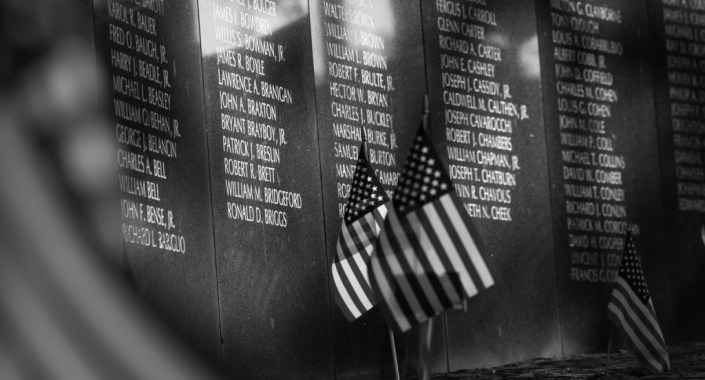

[My father was in college from 1963 to 1967 and was in the ROTC. I was born at the beginning of his senior year. He came very, very close to going to Vietnam as a 2LT. He became more and more disturbed by reports and stories of what was actually happening over there. The young men that had graduated before him and entered combat…weren’t coming home. Many of the officers that he had started out with during his early years with the ROTC…weren’t coming back. The ones that did manage to return spoke of a “war without direction or purpose” and horrible “death traps”. My father had a crisis of faith, in a way. As a 2LT in the Army, he would have been an officer that could, potentially, send other young men under him to their deaths. If friends were telling him that the purpose of the war was not completely understood, how could he, in good conscience, participate. He took his concerns to his ROTC CO. That conversation devolved into a shouting match, complete with threats. My father resigned his ‘impending’ commission, despite the protestation of an older officer, stating that “Men like you, we need. We need the common sense approach and conscience you display. You would be a voice of reason and strength that could steady the others.” He would hear none of it. He turned in his uniforms, graduated…and never looked back. My father is still alive, today, because of his decision not to participate. He was never sent a draft card. ~Vic
Addendum: My father passed away on August 25, 2022]
Gulf of Tonkin Resolution 1964

On this day in 1964, Congress approved the Gulf of Tonkin Resolution, effectively entering the U.S. into a conflict that still affects us to this day. This resolution, brought about by the questionable Gulf of Tonkin Incident (also referred to as the USS Maddox incident), gave President Johnson the legal justification for sending U.S. troops to Vietnam, under the guise of assisting a country under the treat of communist aggression.
From This Day In Military History:
“The resolution marked the beginning of an expanded military role for the United States in the Cold War battlefields of Vietnam, Laos and Cambodia. By 1964, America’s ally, South Vietnam, was in serious danger of falling to a communist insurgency. The insurgents, aided by communist North Vietnam, controlled large areas of South Vietnam and no amount of U.S. military aid and training seemed able to save the southern regime. During the presidencies of Dwight D. Eisenhower and John F. Kennedy, hundreds-and then thousands-of U.S. military advisers had been sent to South Vietnam to train that nation’s military forces. In addition, hundreds of millions of dollars in military and economic assistance had been given to South Vietnam. The administration of President Lyndon B. Johnson made the decision that only direct U.S. military intervention in the conflict could turn the tide. However, Johnson was campaigning in the presidential election of 1964 as the “responsible” candidate who would not send American troops to fight and die in Asia. In early August, a series of events occurred that allowed Johnson to appear statesmanlike while simultaneously expanding the U.S. role in Vietnam. On August 2, North Vietnamese torpedo boats attacked an American destroyer in the Gulf of Tonkin. Johnson responded by sending in another destroyer. On August 4, the two destroyers reported that they were under attack. This time, Johnson authorized retaliatory air attacks against North Vietnam. He also asked Congress to pass the Gulf of Tonkin Resolution. This resolution declared, “The United States regards as vital to its national interest and to world peace the maintenance of international peace and security in Southeast Asia.” It also gave Johnson the right to “take all necessary measures to repel any armed attack against the forces of the United States and to prevent further aggression.” The House passed the resolution by a unanimous vote. The vote in the Senate was 88 to 2. Johnson’s popularity soared in response to his “restrained” handling of the crisis. The Johnson administration went on to use the resolution as a pretext to begin heavy bombing of North Vietnam in early 1965 and to introduce U.S. combat troops in March 1965. Thus began a nearly eight-year war in which over 58,000 U.S. troops died. In a wider sense, the Gulf of Tonkin Resolution can be considered America’s Cold War policy toward all of Southeast Asia at the time. The resolution was also another example of the American government’s less than candid discussion of “national security” matters during the Cold War. Unspoken during the Congressional debate over the resolution was the fact that the commanders of the U.S. destroyers could not state with absolute accuracy that their ships had actually been attacked on the night of August 4, nor was any mention made of the fact that the U.S. destroyers had been assisting South Vietnamese commandos in their attacks on North Vietnamese military installations. By the late 1960s, the tangle of government deceptions and lies began to unravel as public confidence in both Johnson and the American military effort in Vietnam began to erode.”

[My father was in college from 1963 to 1967 and was in the ROTC. I was born at the beginning of his senior year. He came very, very close to going to Vietnam as a 2LT. He became more and more disturbed by reports and stories of what was actually happening over there. The young men that had graduated before him and entered combat…weren’t coming home. Many of the officers that he had started out with during his early years with the ROTC…weren’t coming back. The ones that did manage to return spoke of a “war without direction or purpose” and horrible “death traps”. My father had a crisis of faith, in a way. As a 2LT in the Army, he would have been an Officer that could, potentially, send other young men under him to their deaths. If friends were telling him that the purpose of the war was not completely understood, how could he, in good conscience, participate. He took his concerns to his ROTC CO. That conversation devolved into a shouting match, complete with threats. My father resigned his ‘impending’ commission, despite the protestation of an older officer, stating that “Men like you, we need. We need the common sense approach and conscience you display. You would be a voice of reason and strength that could steady the others.” He would hear none of it. He turned in his uniforms, graduated…and never looked back. My father is still alive, today, because of his decision not to participate. He was never sent a draft card. ~Victoria]
Story Sunday: The Roswell Incident 1947

Seventy-one years ago, today, something happened in Roswell, New Mexico. The Roswell Daily Record printed the story of the crash of a flying saucer on a ranch roughly 30 miles outside of Roswell proper. The Sacramento Bee picked up the story and printed statements from the Roswell Army Air Field.
Over the years, I’ve seen documentaries and read accounts of the initial debris field pieces that were retrieved from the owner of the land. I’ve seen the interviewees on camera and read their statements. I also know that there was a concerted effort by our military to keep what they found out of any more newspapers and, to quickly change the narrative to the weather balloon story.
I’ve actually been to Roswell, NM, spending the night in a local motel just for the complete experience in September of 2002. It’s cattle ranch territory and it smells that way especially in the morning. I’ve been to the Roswell UFO Museum. It is really quite fascinating to walk through it. Some of it is tongue-in-cheek but, there is a lot of information despite the government’s desire to make it “a joke”. A local waitress in a diner, where my *then* husband and I went for breakfast, said that the whole thing was a blessing and a curse. It brought in tourism dollars but, it was also a sore point for some of the older residents whom, at that time, still remembered the events when they happened. As she poured our coffee, she leaned over and told us that there were many locals that swore it was a craft…information passed quietly from neighbor to neighbor, family descendant to family descendant, much like Native American verbal history, handed down through time. Frankly, I never believed the official story. There were too many questions left unanswered and too many things that didn’t add up. Plus, our government lies to us all the time. Why should this be any different.
Fast forward to October of 2013… I stumble across Chris Thomas, his books, his interviews, his videos and, his articles and essays. Well, well, well… Guess what? ~Vic
From The Universal Soul, pages 82 & 83 (an excerpt):
[…] these were a race we have come to call The Greys. The Greys originate on a star system many galaxies distant from us. […] their own name for themselves does not translate into anything pronounceable by the human voice box. These beings have been observing Earth for many centuries […] The Greys behave a little like human teenagers in that they have a certain level of knowledge but, cannot quite put it into context. The first real contact we had with these beings was with the Roswell crash in New Mexico in 1948 [sic]. This was an event where a Grey ship malfunctioned and crashed into the desert near the town of Roswell. As with just about anything that happens in America, the military took control. The crash provided them with an alien ship and three survivors. The Greys were reluctant to become involved in human affairs but, the American military had three of their beings. So began a relationship […] The American military looking for ‘advanced’ technology to give them global military advantage and, in return, the Greys received free access to the genetic material available on Earth.
[Note: Chris Thomas is many things but, not the best typist. His books have a few typos.]
From The Human Soul: Universal Soul 2, pages 125 & 126 (an excerpt):
Their home galaxy is too far distant for us to have a name for it. This race is responsible for some of the human and animal abductions that have taken place on Earth in the past 40 years. As they were causing some disruption to human plans, they have, effectively, been banned from our solar system since 2000. This race has been working with the American miliary since the Roswell crash in 1947 and has given over a great deal of its technology in exchange for permission to carry out some animal experimentation and medical examinations of people.
From Project Human Extinction: The Ultimate Conspiracy, pages 128-131 (an excerpt):
During the Second World War, a great many ‘unidentified’ flying craft were observed as the skies were watched with far more zeal than was previously necessary. Several of these craft were shot down but, because it was war time and it was known that Hitler was developing many innovative weapons, it was assumed that crashed UFOs were Nazi in origin. During the war, the American military began to experiment with many forms of weapons and energy devices and, in particular, energy devices that would help shield ships or aircraft from the newly developed enemy radar. […] the technology was kept for later experiments which the American military began in the late 1940s. In 1948 [sic], the experiments began in a region of New Mexico, although this time, the machinery was land based […] They ran experiments for three days and each day at least one UFO fell out of the sky, the most famous one being the crash at Roswell. There is so much disinformation spread about this race that the only way of finding out any form of truth is to look to the Akashic. In exchange for new ‘alien’ technology, the American military ‘granted’ the Greys permission to abduct and study human physiology. Since 2000, the Greys have been asked not to travel to our solar system, a request with which they have generally been happy to comply.
From Synthesis, page 40:
Their first real contact with Earth was the Roswell crash […] The military have mainly been interested in Grey technology which the military mainly use for psychic attack purposes. The Greys are very interested in human physiology and are responsible for some human and animal abductions. Please note: the vast majority of human and animal abductions, and mutilations, have been carried out by the military.
Still believe our government? Still believe our military? If you are unsure of what the Akashic is, that will be for another post. ~Vic
Military Monday: Korean War Begins 1950

The United States, acting under the auspices of the United Nations, quickly sprang to the defense of South Korea and fought a bloody and frustrating war for the next three years. Korea, a former Japanese possession, had been divided into zones of occupation following World War II. U.S. forces accepted the surrender of Japanese forces in southern Korea, while Soviet forces did the same in northern Korea. Like in Germany, however, the “temporary” division soon became permanent. The Soviets assisted in the establishment of a communist regime in North Korea, while the United States became the main source of financial and military support for South Korea. On June 25, 1950, North Korean forces surprised the South Korean army (and the small U.S. force stationed in the country), and quickly headed toward the capital city of Seoul. The United States responded by pushing a resolution through the U.N.’s Security Council calling for military assistance to South Korea. (Russia was not present to veto the action as it was boycotting the Security Council at the time.) With this resolution in hand, President Harry S. Truman rapidly dispatched U.S. land, air, and sea forces to Korea to engage in what he termed a “police action.” The American intervention turned the tide, and U.S. and South Korean forces marched into North Korea. This action, however, prompted the massive intervention of communist Chinese forces in late 1950. The war in Korea subsequently bogged down into a bloody stalemate. In 1953, the United States and North Korea signed a cease-fire that ended the conflict. The cease-fire agreement also resulted in the continued division of North and South Korea at just about the same geographical point as before the conflict. The Korean War was the first “hot” war of the Cold War. Over 55,000 American troops were killed in the conflict. Korea was the first “limited war,” one in which the U.S. aim was not the complete and total defeat of the enemy, but rather the “limited” goal of protecting South Korea. For the U.S. government, such an approach was the only rational option in order to avoid a third world war and to keep from stretching finite American resources too thinly around the globe. It proved to be a frustrating experience for the American people, who were used to the kind of total victory that had been achieved in World War II. The public found the concept of limited war difficult to understand or support and the Korean War never really gained popular support.
- ← Previous
- 1
- …
- 4
- 5
 Cosmic-Observation