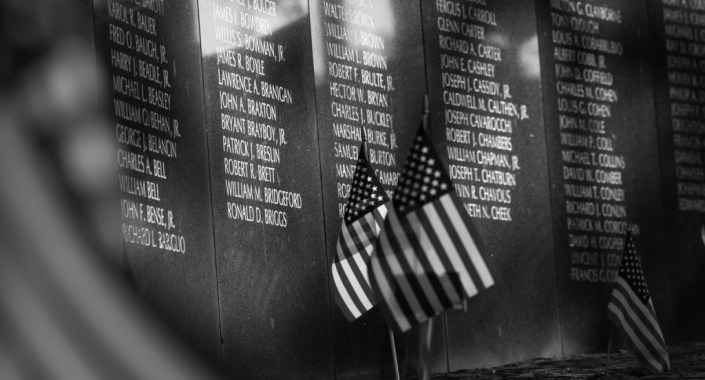
[…] Veterans of this time period are gaining the respect that was not so freely given upon their return. Involving five U.S. presidents, crossing nearly two decades and 500,000 U.S.military personnel, it left an indelible mark on the American psyche. Returning Veterans did not always receive respectful welcomes upon their arrive on American soil. There were 58,000 killed, never to return. National Vietnam War Veterans Day recognizes the military service of these men and women who answered the call to service their country when she needed them. They didn’t make the decisions to go to war.
U.S. Sens. Pat Toomey, R-Pa., and Joe Donnelly, D-Ind., introduced legislation in 2017 to honor Vietnam Veterans with a day on the anniversary of the withdrawal of military units from South Vietnam. President Donald Trump signed the Vietnam War Veterans Day Act on March 28, 2017, calling for U.S. flags to be flown on March 29 for those who served.
[…] in January 1973, representatives of the United States, North and South Vietnam and, the Vietcong signed a peace agreement in Paris, ending the direct U.S. military involvement in the Vietnam War. Its key provisions included a cease-fire throughout Vietnam, the withdrawal of U.S. forces, the release of prisoners of war and, the reunification of North and South Vietnam through peaceful means. The South Vietnamese government was to remain in place until new elections were held and North Vietnamese forces in the South were not to advance further nor be reinforced.
Two months after the signing of the Vietnam peace agreement, the last U.S. combat troops [left] South Vietnam as Hanoi [freed] the remaining American prisoners of war held in North Vietnam. In Saigon, some 7,000 U.S. Department of Defense civilian employees remained behind to aid South Vietnam in conducting what looked to be a fierce and ongoing war with communist North Vietnam. […] before the last American troops departed on March 29, the communists violated the cease-fire and, by early 1974, full-scale war had resumed. At the end of 1974, South Vietnamese authorities reported that 80,000 of their soldiers and civilians had been killed in fighting during the year […].
On April 30, 1975, the last few Americans still in South Vietnam were airlifted out of the country as Saigon fell to communist forces.
Addendum
I live with a Vietnam Seabee Veteran. He was in-country at Camp Haskins, Red Beach, Da Nang harbor during Khe Sanh, Tet and the Battle of Hue. Thankfully, he was not directly affected but, he was nearly blown out of a guard tower when the USMC Da Nang Air Base was attacked in January 1968. He keeps a wad of shrapnel and an empty grenade in the office as a reminder of what nearly got him. He’s told me stories of returning home and being flipped off by civilians. He was never spit on, like some stories I’ve heard but, he certainly wasn’t welcomed back. ~Vic
The Battle of New Bern (also known as the Battle of New Berne) was fought on 14 March 1862, near the city of New Bern, North Carolina, as part of the Burnside Expedition of the American Civil War. The US Army’s Coast Division, led by Brigadier General Ambrose Burnside and accompanied by armed vessels from the North Atlantic Blockading Squadron, were opposed by an undermanned and badly trained Confederate force of North Carolina soldiers and militia led by Brigadier General Lawrence O’B. Branch. Although the defenders fought behind breastworks that had been set up before the battle, their line had a weak spot in its center that was exploited by the attacking Federal soldiers. When the center of the line was penetrated, many of the militia broke, forcing a general retreat of the entire Confederate force. General Branch was unable to regain control of his troops until they had retreated to Kinston, more than 30 miles (about 50 km) away. New Bern came under Federal control, and remained so for the rest of the war.
Hatteras Island, on the outer shore of North Carolina, fell to Union forces in August, 1861. Roanoke Island, just to the north, was captured on February 8, 1862. Elizabeth City on the mainland followed days later. With the freedom to navigate unmolested through Albemarle and Pamlico Sounds, Brig. Gen. Ambrose E. Burnside’s command looked for other strategic targets of opportunity. The city of New Bern was a significant target, as the Atlantic and North Carolina Railroad that connected the coast with the interior passed through there. On March 11, 1862, Burnside’s force embarked from Roanoke Island to rendezvous with Union gunboats at Hatteras Inlet for a joint expedition against New Bern. On March 13th, the fleet sailed up the Neuse River and disembarked infantry south of the Confederate defenses, about 4,000 men behind breastworks at Fort Thompson. The defenders, a mix of North Carolina infantry, cavalry and artillery, were commanded by Brig. Gen. Lawrence Branch. On March 14th, the brigades of Brig. Gens. John G. Foster, Jesse Reno, and John G. Parke attacked along the railroad and after four [sic] hours of fighting, drove the Confederates out of their fortifications. The Federals captured several nearby gun positions and occupied a base that they would hold to the end of the war, in spite of several Confederate attempts to recapture it.
On March 13th 1862, 11,000 Union troops led by General Ambrose Burnside, along with 13 heavily-armed gunboats led by Commodore Stephen Rowan, landed at Slocum’s Creek, now part of the Cherry Point Marine Corps Air Station. Their objective was [the] capture of the town of New Bern because of its strategic position and the fact that the Atlantic and North Carolina railroad was also located here. Union strategists hoped to use New Bern as a stepping off point to cutting off the main Confederate north-south railroad supply line at Goldsboro.
Awaiting the Union forces were about 4,500 inexperienced and ill-equipped Confederate troops commanded by General Laurence [sic] O’Bryan Branch, a politician with virtually no military experience. Branch positioned his infantry regiments, one cavalry regiment, local militia and three gun batteries to defend a line extending from Fort Thompson on the Neuse River and running approximately one mile west to the Weatherby Road at the eastern edge of Brice’s Creek. Extending Branch’s right wing to the railroad tracks was the 26th North Carolina Regiment commanded by Colonel Zebulon Vance, later governor of North Carolina.
Despite support from Commodore Rowan’s gunboats, this attack stalled. However, a regiment of General Parke’s brigade flanked the position of a militia battalion in the vicinity of Wood’s brickyard adjoining the railroad. Parke’s infantry drove these poorly armed, fresh militiamen from their position leaving the right flank of the 35th North Carolina Regiment exposed. The Confederate line was broken between the 26th and the 35th regiments, and the Union forces pushed through forcing the retreat of the Confederate troops.
The Battle of New Bern was the baptism of fire for the 26th North Carolina. Later, in July 1863, the 26th lost 588 of 800 men at the Battle of Gettysburg, sustaining the largest numerical losses of any unit, North or South, during the entire course of the war.
Estimated casualties for the battle: 1080 total. The fierce battle in the swamps and along the railroad five miles south of New Bern, proved to be a major victory for the Union and led to the ensuing occupation of New Bern for the remainder of the Civil War. Although Union forces never seized and held the rail line at Goldsboro, their presence in New Bern required the Confederacy to divert troops to the railroad’s defense that might have been used in the critical battles in Virginia. For General Ambrose Burnside, the New Bern victory was a factor in his subsequently being given command of the Army of the Potomac and leadership in the Union disaster at Fredericksburg.
One-hundred and fifty-seven years ago, today… ~Vic
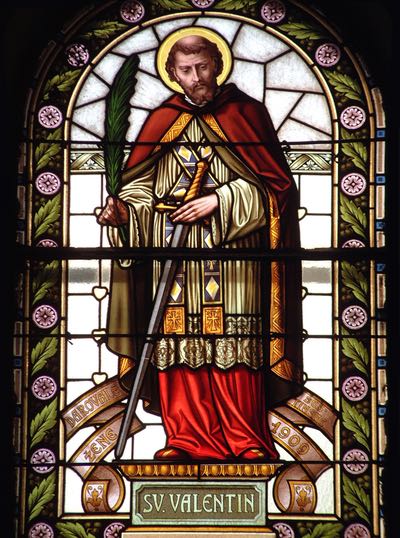
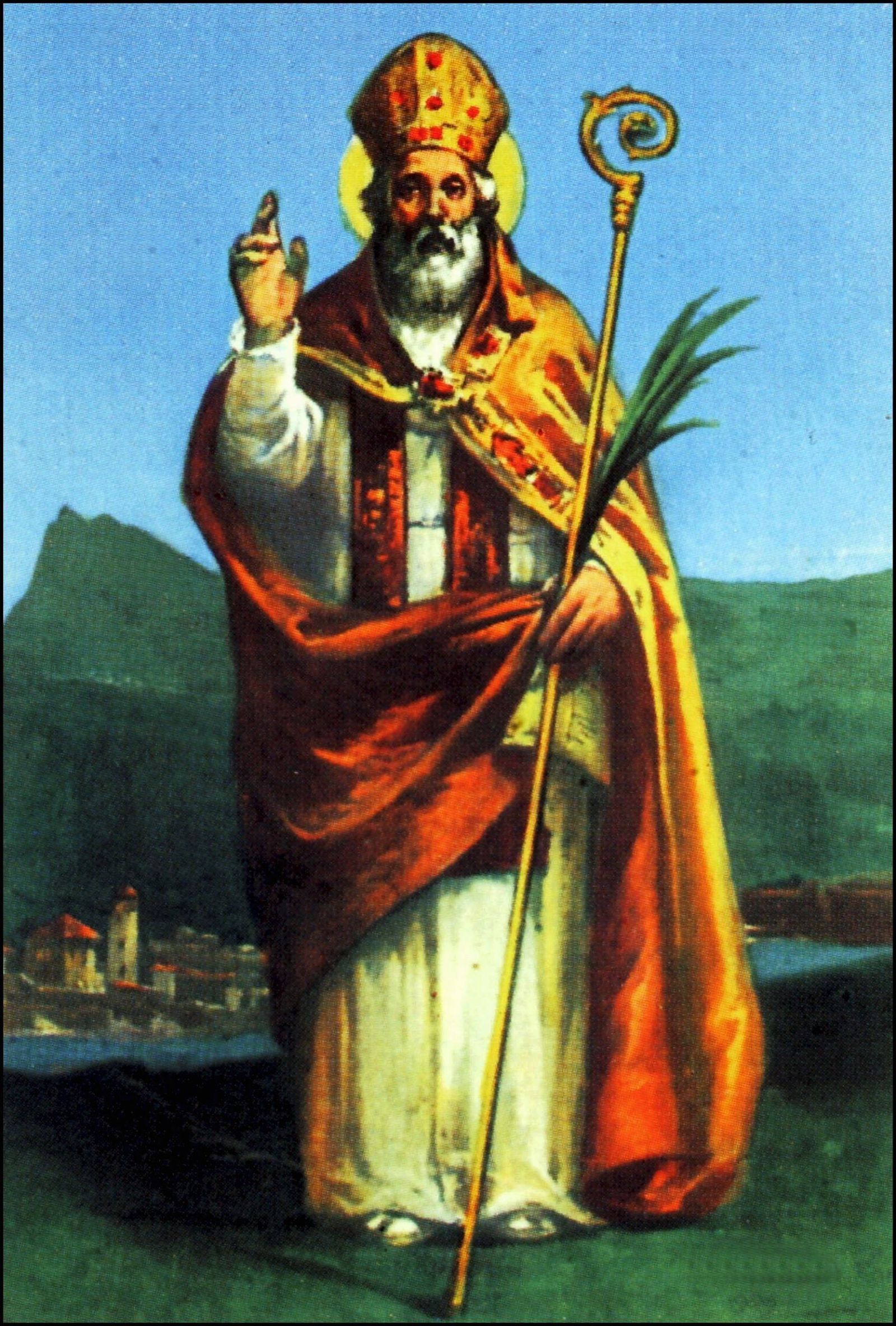
There are SO many stories regarding the origins of the Valentine’s Day we celebrate. The most common story about this elusive man was that he was a priest and bishop in Rome in the 3rd century. The Roman Emperor of the time was Claudius Gothicus (Claudius II), the first of the tough, soldier emperors, that ruled with an iron fist and was known for his cruelty. From The History Channel:
Under the rule of Claudius the Cruel, Rome was involved in many unpopular and bloody campaigns. The emperor had to maintain a strong army but, was having a difficult time getting soldiers to join his military leagues. Claudius believed that Roman men were unwilling to join the army because of their strong attachment to their wives and families. To get rid of the problem, Claudius banned all marriages and engagements in Rome. Valentine, realizing the injustice of the decree, defied Claudius and continued to perform marriages for young lovers in secret. When Valentine’s actions were discovered, Claudius ordered that he be put to death. Valentine was arrested and dragged before the Prefect of Rome who condemned him to be beaten to death with clubs and, to have his head cut off. The sentence was carried out on February 14, on or about the year 270. Legend also has it that while in jail, Valentine left a farewell note for the jailer’s daughter, who had become his friend, and signed it “From Your Valentine.”
[…] he was arrested and thrown in prison by Emperor Claudius II. He was put under vigilance of prefect Asterius, director of the confine who had challenged Valentine, before, regarding his alleged healing powers. Asterius, a ruthless man, requested Valentine to restore the gift of sight to his daughter, Julia, who was born a blind girl. Valentine placed his hands over her eyes, prayed to God and Julia was able to see. Asterius, in awe of Valentine’s power converted to Christianity, along with 46 members of his family. He, then, also freed all Christians who were confined in his prison. The emperor, aware of what had happened, ordered Valentine and Asterius to be beheaded. The penalty was probably executed, on February 14, 271 AD. Sometime before his execution, Valentine wrote a letter, signed “from your Valentine”, saying goodbye to Julia, the daughter of Asterius with whom he had fallen in love. This would become the first record in history of a “Valentine’s Day letter”.
According to the popular hagiographical identity, and what is believed to be the first representation of St. Valentine, the Nuremberg Chronicle, St. Valentine was a Roman priest martyred during Claudius’ reign. […] A relationship between the saint and emperor began to grow, until Valentine attempted to convince Claudius of Christianity. Claudius became (en)raged and sentenced Valentine to death, commanding him to renounce his faith or be beaten with clubs and beheaded. St. Valentine refused to renounce his faith and, Christianity, and was executed outside the Flaminian Gate on February 14, 269. However, other tales of St. Valentine’s life claim he was executed either in the year 269, 270, 273 or 280. Another variation of the legend of St. Valentine says he refused to sacrifice to pagan gods, was imprisoned and, while imprisoned, he healed the jailer’s blind daughter. Whoever he was, Valentine did really exist, because archaeologists have unearthed a Roman catacomb and an ancient church dedicated to St. Valentine. In 496AD, Pope Gelasius marked February 14th as a celebration in honor of his martyrdom.
The Catholic Church’s official list of recognized saints, the Roman Martyrology, lists seven Valentines: a martyr (a possible Roman priest or Terni bishop) buried on the Via Flaminia (February 14); a priest from Viterbo (November 3); a bishop from Raetia who died in about 450 (January 7); a fifth-century priest and hermit (July 4); a Spanish hermit who died in about 715 (October 25); Valentine Berrio Ochoa, martyred in 1861 (November 24); and Valentine Jaunzarás Gómez, martyred in 1936 (September 18). Valentine did not appear in the official Church calendar for centuries, however “Martyr Valentinus the Presbyter and those with him at Rome” remains on the list of saints proposed for veneration by Catholics. In the Eastern Orthodox Church, Saint Valentine the Presbyter is celebrated on July 6, and Hieromartyr Saint Valentine (Bishop of Interamna, Terni in Italy) is celebrated on July 30. Clearly they are viewed as two separate people. Notwithstanding that, conventionally, members of the Greek Orthodox Church named Valentinos (male) or Valentina (female) celebrate their name on February 14th.
The Modern
So, how did we get the day of celebration we have now? That is nearly as obscure as the saint that the day is based on.
English 18th-century antiquarians Alban Butler and Francis Douce, noting the obscurity of Saint Valentine’s identity, suggested that Saint Valentine’s Day was created as an attempt to supersede the pagan holiday of Lupercalia (mid-February in Rome). This idea has lately been dismissed by other researchers, such as Professor Jack B. Oruch of the University of Kansas, Henry Ansgar Kelly of the University of California, Los Angeles and Associate Professor Michael Matthew Kaylor of the Masaryk University. Many of the current legends that characterize Saint Valentine were invented in the 14th century in England, notably by Geoffrey Chaucer and his circle, when the feast day of February 14 first became associated with romantic love.
[…] University of Kansas English professor, the late Jack B. Oruch, had a different theory […] Through research, he determined that the poet Geoffrey Chaucer linked love with St. Valentine for the first time in his 14th-century works “Parlement of Foules” and “The Complaint of Mars.” Therefore, Oruch claimed that Chaucer invented Valentine’s Day as we know it today. At the time, February 14 also happened to be considered the first day of spring since it was the beginning of birds’ mating season—perfectly appropriate for a celebration of affection.
Addendum
According to Catholic Online and Catholic Saints, Saint Valentine is the Patron Saint of epilepsy, fainting, (a non-specific) plague, bee keepers, affianced couples, betrothed couples, engaged couples, love, lovers, happy marriages, young people and travelers. Whew! That is quite a lot to keep up with.
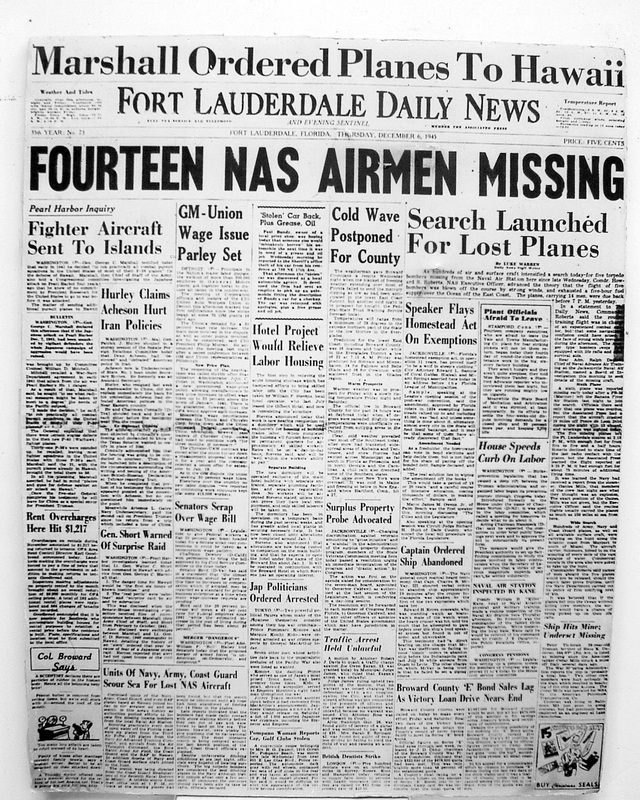
Seventy-three years ago, today, the infamous Flight 19 disappeared over the Bermuda Triangle in what was supposed to be a routine, three-hour exercise of combat training and navigation. Four TBM-1Cs and one TBM-3 Grumman Avenger torpedo bombers took off from NAS Fort Lauderdale at 14:10pm. Twenty-seven year old Navy Lieutenant Charles Carroll Taylor was the flight leader and pilot of FT-28, the TBM-3.
“Two hours after the flight began, the leader of the squadron, who had been flying in the area for more than six months, reported that his compass and back-up compass had failed and, that his position was unknown. The other planes experienced similar instrument malfunctions. Radio facilities on land were contacted to find the location of the lost squadron but, none were successful. After two more hours of confused messages from the fliers, a distorted radio transmission from the squadron leader was heard at 18:20pm, apparently calling for his men to prepare to ditch their aircraft simultaneously because of lack of fuel.”
“Radio conversations between the pilots were overheard by base and other aircraft in the area. The practice bombing operation is known to have been carried out because at about 15:00pm, a pilot requested and was given permission to drop his last bomb. Forty minutes later, another flight instructor, Lieutenant Robert F. Cox in FT-74, forming up with his group of students for the same mission, received an unidentified transmission.
Photo Credit: nasflmuseum.com
An unidentified crew member asked Powers (Marine Corps Captain Edward Joseph Powers, Jr., pilot of FT-36), for his compass reading. Powers replied: “I don’t know where we are. We must have got lost after that last turn.” Cox then transmitted: “This is FT-74, plane or boat calling ‘Powers’ please identify yourself so someone can help you.” The response after a few moments was a request from the others in the flight for suggestions. FT-74 tried again and a man identified as FT-28 (Lt. Taylor) came on. “FT-28, this is FT-74, what is your trouble?” “Both of my compasses are out”, Taylor replied, “and I am trying to find Fort Lauderdale, Florida. I am over land but it’s broken. I am sure I’m in the Keys but, I don’t know how far down and, I don’t know how to get to Fort Lauderdale.”
FT-74 informed the NAS that aircraft were lost, then advised Taylor to put the sun on his port wing and fly north up the coast to Fort Lauderdale. […] no bearings could be made on the flight and the IFF (transmitter) could not be picked up. Taylor was told to broadcast on 4805 kHz. This order was not acknowledged so he was asked to switch to 3000 kHz, the search and rescue frequency. Taylor replied: “I cannot switch frequencies. I must keep my planes intact.”
As the weather deteriorated, radio contact became intermittent and it was believed that the five aircraft were actually, by that time, more than 200 nmi (230 mi; 370 km) out to sea east of the Florida peninsula. Taylor radioed “We’ll fly 270 degrees west until landfall or running out of gas” and requested a weather check at 17:24pm. By 17:50pm, several land-based radio stations had triangulated Flight 19’s position as […] north of the Bahamas and well off the coast of central Florida.”
There is some question as to the exact time of Taylor’s last transmission (18:20pm or 19:04pm) but, he was heard saying “All planes close up tight…we’ll have to ditch unless landfall…when the first plane drops below 10 gallons, we all go down together.” By that time, the sun had set and the weather was much worse.
“Two PBM Mariner flying boats were dispatched from NAS Banana River in Melbourne, Florida (now Patrick Air Force Base), carrying rescue equipment. Less than a half hour after take-off (at approximately 19:27), one of the PBM’s (Trainer 49/BuNo 59225) radioed the tower that they were nearing Flight 19’s last assumed position. The rescue plane with a crew of 13 men was never heard from again.”
“At 21:15pm, the tanker SS Gaines Mills reported it had observed flames from an apparent explosion leaping 100 ft (30 m) high and burning for 10 minutes. Captain Shonna Stanley reported unsuccessfully searching for survivors through a pool of oil and aviation gasoline. The escort carrier USS Solomons also reported losing radar contact with an aircraft at the same position and time.”
A 500 page Navy investigation was published a few months later. Initially, blame was placed upon Lt. Taylor for mistaking the Bahamas for the Florida Keys and not listening to his subordinate officers. The report was amended to ’cause unknown’ when Taylor’s mother stated that the Navy had no evidence for their conclusions…no planes and no bodies. Lt. Taylor was listed as ‘not at fault’ as his compasses were not working. The disappearance of PBM-5 Trainer 49 was attributed to a mid-air explosion.
On this day in 1964, Congress approved the Gulf of Tonkin Resolution, effectively entering the U.S. into a conflict that still affects us to this day. This resolution, brought about by the questionable Gulf of Tonkin Incident (also referred to as the USS Maddox incident), gave President Johnson the legal justification for sending U.S. troops to Vietnam, under the guise of assisting a country under the treat of communist aggression.
“The resolution marked the beginning of an expanded military role for the United States in the Cold War battlefields of Vietnam, Laos and Cambodia. By 1964, America’s ally, South Vietnam, was in serious danger of falling to a communist insurgency. The insurgents, aided by communist North Vietnam, controlled large areas of South Vietnam and no amount of U.S. military aid and training seemed able to save the southern regime. During the presidencies of Dwight D. Eisenhower and John F. Kennedy, hundreds-and then thousands-of U.S. military advisers had been sent to South Vietnam to train that nation’s military forces. In addition, hundreds of millions of dollars in military and economic assistance had been given to South Vietnam. The administration of President Lyndon B. Johnson made the decision that only direct U.S. military intervention in the conflict could turn the tide. However, Johnson was campaigning in the presidential election of 1964 as the “responsible” candidate who would not send American troops to fight and die in Asia. In early August, a series of events occurred that allowed Johnson to appear statesmanlike while simultaneously expanding the U.S. role in Vietnam. On August 2, North Vietnamese torpedo boats attacked an American destroyer in the Gulf of Tonkin. Johnson responded by sending in another destroyer. On August 4, the two destroyers reported that they were under attack. This time, Johnson authorized retaliatory air attacks against North Vietnam. He also asked Congress to pass the Gulf of Tonkin Resolution. This resolution declared, “The United States regards as vital to its national interest and to world peace the maintenance of international peace and security in Southeast Asia.” It also gave Johnson the right to “take all necessary measures to repel any armed attack against the forces of the United States and to prevent further aggression.” The House passed the resolution by a unanimous vote. The vote in the Senate was 88 to 2. Johnson’s popularity soared in response to his “restrained” handling of the crisis. The Johnson administration went on to use the resolution as a pretext to begin heavy bombing of North Vietnam in early 1965 and to introduce U.S. combat troops in March 1965. Thus began a nearly eight-year war in which over 58,000 U.S. troops died. In a wider sense, the Gulf of Tonkin Resolution can be considered America’s Cold War policy toward all of Southeast Asia at the time. The resolution was also another example of the American government’s less than candid discussion of “national security” matters during the Cold War. Unspoken during the Congressional debate over the resolution was the fact that the commanders of the U.S. destroyers could not state with absolute accuracy that their ships had actually been attacked on the night of August 4, nor was any mention made of the fact that the U.S. destroyers had been assisting South Vietnamese commandos in their attacks on North Vietnamese military installations. By the late 1960s, the tangle of government deceptions and lies began to unravel as public confidence in both Johnson and the American military effort in Vietnam began to erode.”
[My father was in college from 1963 to 1967 and was in the ROTC. I was born at the beginning of his senior year. He came very, very close to going to Vietnam as a 2LT. He became more and more disturbed by reports and stories of what was actually happening over there. The young men that had graduated before him and entered combat…weren’t coming home. Many of the officers that he had started out with during his early years with the ROTC…weren’t coming back. The ones that did manage to return spoke of a “war without direction or purpose” and horrible “death traps”. My father had a crisis of faith, in a way. As a 2LT in the Army, he would have been an officer that could, potentially, send other young men under him to their deaths. If friends were telling him that the purpose of the war was not completely understood, how could he, in good conscience, participate. He took his concerns to his ROTC CO. That conversation devolved into a shouting match, complete with threats. My father resigned his ‘impending’ commission, despite the protestation of an older officer, stating that “Men like you, we need. We need the common sense approach and conscience you display. You would be a voice of reason and strength that could steady the others.” He would hear none of it. He turned in his uniforms, graduated…and never looked back. My father is still alive, today, because of his decision not to participate. He was never sent a draft card. ~Vic
Addendum: My father passed away on August 25, 2022]







 Cosmic-Observation