August’s full moon is called the Full Sturgeon Moon, after the primitive fish that used to be abundant in North America’s lakes and rivers during the summer months. Having remained mostly unchanged since the earliest fossil records, sturgeons are ancient living fossils that can grow up [to] 3.5 meters long, or as long as two adult humans stacked on top of each other. Nowadays, however, it’s almost impossible to see a sturgeon during the Full Sturgeon Moon. While they used to thrive, sturgeons are now considered […] critically endangered […]. Though sturgeons are extremely long-lived, the females can live up to be 150 years old, sturgeons might not be around for much longer. They might have survived the dinosaurs but, they might not be able to survive human beings and our hunger for luxurious delicacies like caviar.
I got squat for a Moon shot. We’ve got Isaias spinning around here. I also don’t have any previous years shots but, I did a post two years ago. So, I’ve trotted over to Unsplash. Another name given to the Sturgeon Moon is Red Moon. Full illumination occurred at 11:59am EDT. Howl for me! ~Vic
Also known as the Second Treaty of Indian Springs or Treaty with the Creeks, one-hundred, ninety-five years ago, today, it was signed by the Muscogee and the U.S. government at the Indian Springs Hotel (now a museum).
The U.S. and the Muscogee had, previously, signed the Treaty of Indian Springs of 1821. On January 8, the Muscogee agreed to cede their land holdings east of the Flint River to the state of Georgia in exchange for $200,000, paid in installments.
[…] Duncan Campbell and James Meriwether, U.S. Commissioners, [wrote] to Georgia Governor George M. Troup regarding obstacles the commissioners [faced] in treating with the Creeks. They [related] that proceedings [were] being conducted orally since the written method [had] failed. Also, the publication of negotiations held at Tucabatchee (Tuckabatchee or Tuckabatchie) and Pole Cat Springs [had] spread alarm throughout the nation as [had] the persistent “interference” of the Cherokees. Campbell and Meriwether negotiated the Treaty of Indian Springs [of] 1825 that was unauthorized by a majority of Creeks and, later, abrogated by the United States.
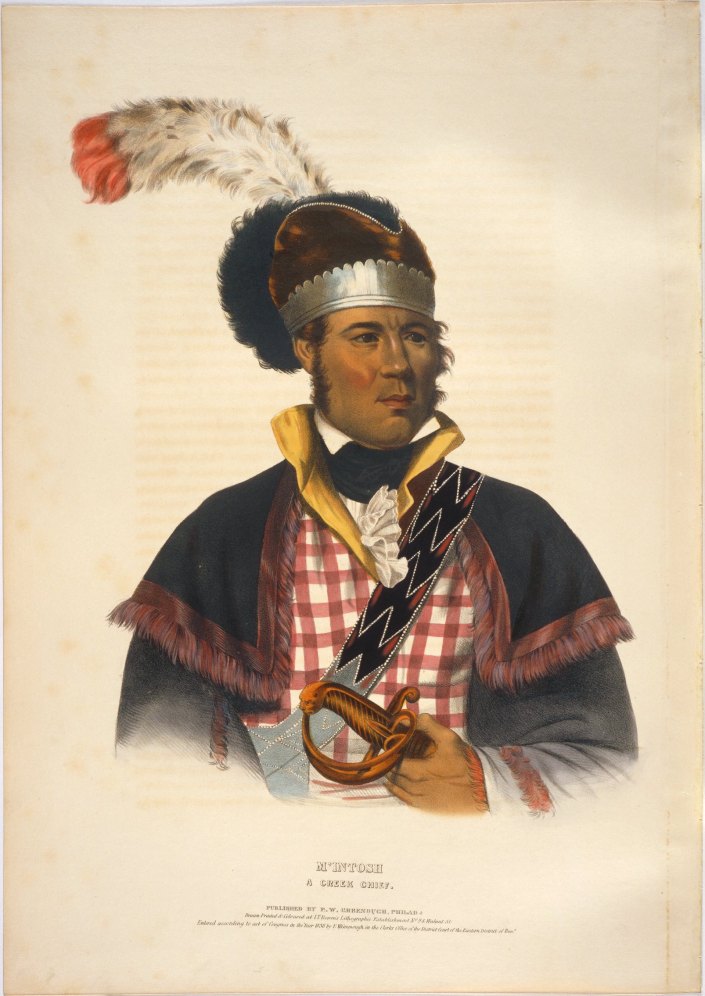
Image Credit: Georgia Encyclopedia William McIntosh
Tustunnuggee Hutke (White Warrior)
The treaty that was agreed [to] was negotiated with six chiefs of the Lower Creek, led by William McIntosh. McIntosh agreed to cede all Muscogee lands east of the Chattahoochee River, including the sacred Ocmulgee National Monument (Historic Park), to Georgia and Alabama and, accepted relocation west of the Mississippi River to an equivalent parcel of land along the Arkansas River. In compensation for the move to unimproved land, and to aid in obtaining supplies, the Muscogee nation would receive $200,000 (again), paid in decreasing installments over a period of years. An additional $200,000 was paid directly to McIntosh.
Outcome:
Governor Troup, and most Georgians, were in favor of the treaty and his inside man was his first cousin…William McIntosh. McIntosh paid the highest price. According to a Creek law, that McIntosh, himself, had supported, a sentence of execution awaited any Creek leader who ceded land to the United States without the full assent of the entire Creek Nation. Just before dawn on April 30, 1825, Upper Creek chief Menawa, accompanied by 200 Creek warriors (The Law Menders), attacked McIntosh at Lockchau Talofau (Acorn Bluff/McIntosh Reserve) to carry out the sentence. They set fire to his home, shot and stabbed him to death and, [killed] the elderly Coweta chief Etomme Tustunnuggee. Chillie McIntosh, the chief’s oldest son, had also been sentenced to die but, he escaped by diving through a window. Later that day, the Law Menders found [Samuel and Benjamin Hawkins, Jr.] (McIntosh’s sons-in-law), who were also signatories. They hanged Samuel and shot Benjamin but, he escaped.
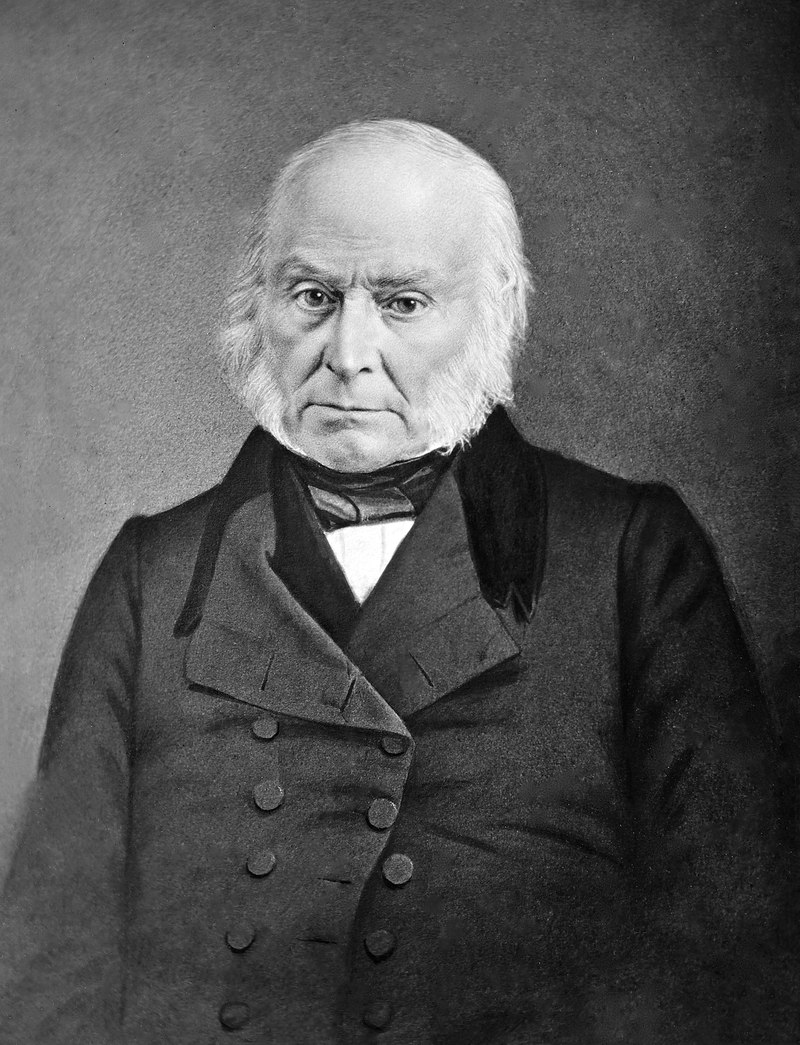
A large majority of chiefs and warriors objected that McIntosh did not have sufficient authority to sign treaties or cede territory. [The] Creek Nation sent a delegation, led by Opothleyahola and [included] Menawa, to lodge an official complaint. Federal investigators (appointed by President John Quincy Adams) agreed and the U.S. government negotiated a new land cession in the 1826 Treaty of Washington. The Creeks did not, however, have their territory restored in the new treaty.
Though the Creek did retain a small tract of land on the Georgia-Alabama border and the Ocmulgee National Monument, Governor Troup refused to recognize the new treaty. [He] authorized all Georgian citizens to evict the Muscogee and ordered the land surveyed for a lottery, including the piece that was to remain in Creek hands. He threatened an attack on Federal troops if they interfered with the [previous] treaty and challenged [the President]. The president intervened with Federal troops but, Troup called out the state militia, and Adams, fearful of a civil war, conceded.




 Cosmic-Observation