havana
Wayback Wednesday: Invasion Of Grenada 1983

Getty Image
Phil Kukielski
IINSTP
Forty years ago, today…this happened during my senior year of high school. I remember it well. I also enjoyed Heartbreak Ridge in 1986, even though the scene with the pay telephone and the credit card call for fire support, that actually happened, was the 82nd Airborne Division, not the Marines. ~Vic
The United States Invasion of Grenada began at dawn on October 25, 1983. The United States and a coalition of six Caribbean nations invaded the island nation of Grenada, 100 miles north of Venezuela. Code-named Operation Urgent Fury by the U.S. military, it resulted in military occupation within a few days. It was triggered by the strife within the People’s Revolutionary Government, which resulted in the house arrest and execution of the previous leader, [the] second Prime Minister of Grenada, Maurice Bishop, [leading to] the establishment of the Revolutionary Military Council, with Hudson Austin as chairman. The invasion resulted in the appointment of an interim government, followed by elections in 1984.
Wikipedia Summary
Grenada gained independence in 1974. Maurice Bishop became [Prime Minister] as a result of a coup in 1979 and, he had pursued left-wing policies with Soviet and Cuban aid since then. In Washington, D.C., he was seen as a communist collaborator and a new airport under construction in Grenada was deemed a transfer point for weapons destined for Latin American revolutionaries. Bishop’s assassination, by a more hard-line Military Revolutionary Council on October 19, 1983, was taken as the signal to act. Publicly justified by the need to protect U.S. students in Grenada, Operation Urgent Fury was hastily thrown together. The only resistance was likely to come from a contingent of Cubans, claimed to be construction workers by Havana.
♦ The Invasion of Grenada (The History Guy/April 20, 2019)
♦ Operation Urgent Fury: The 1983 US Invasion of Grenada (War History Online/Nikola Budanovic/December 2, 2017)
♦ How Grenada Reshaped The US Military (Informal Institute For National Security Thinkers & Practitioners/Phil Kukielski/September 8, 2013)
US Invades Grenada AP Archive
Heartbreak Ridge Trailer
Flashback Friday: Spain Declares War 1898
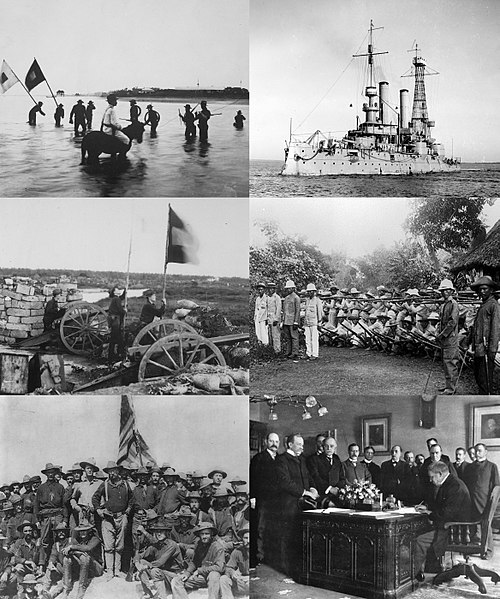
Top Right: USS Iowa
Middle Left: Spanish flag replaced at Fort Malate
Middle Right: Filipino soldiers in Spanish uniforms outside Manila.
Bottom Left: Roosevelt & The Rough Riders @ San Juan Hill
Bottom Right: The signing of the Treaty of Paris (1898)
Collage Credit: Barbudo
Wikipedia & Wikimedia
I posted about Hillsborough’s Old Courthouse this past Tuesday. The first picture was a marker about the Kentucky Expedition, led by Daniel Boone in 1775. The information was fashioned out of metal from the USS Maine, the very ship sunk in Havana Harbor that touched off the Spanish-American War. Spain declared war on the U.S. one-hundred, twenty-two years, ago, today and, the U.S. declared war the following day. Historically, the day of declaration is retroactively moved to April 21 as that was the day Spain severed diplomatic relations and the U.S. Navy began a Cuban blockade (the first of two). At the time of my Town Tuesday post, I didn’t realize that I actually posted it on the same day as the corrected date.
After first landing on an island then called Guanahani, Bahamas (San Salvador), on [October 12], Christopher Columbus commanded his three ships […] to land on Cuba’s northeastern coast on [October 28], 1492. Columbus claimed the island for the new Kingdom of Spain and named it Isla Juana after Juan, Prince of Asturias.
*************
The main issue was Cuban independence. Revolts had been occurring for some years in Cuba against Spanish rule. Hostilities began in the aftermath of the explosion of the USS Maine in Havana Harbor in Cuba, leading to U.S. intervention in the Cuban War of Independence.*************
The growing popular demand for U.S. intervention became an insistent chorus after the (still) unexplained sinking [of the Battleship Maine], which had been sent to protect U.S. citizens and property after anti-Spanish rioting in Havana. [P]olitical pressures from the Democratic Party pushed [President] McKinley into a war that he had wished to avoid. McKinley signed a joint Congressional resolution demanding Spanish withdrawal and authorizing the President to use military force to help Cuba gain independence […].

Image Credit: Artist Victor Gillam
Historical Society of Pennsylvania
May 7, 1898
The ensuing, ten-week war, fought in both the Caribbean and the Pacific, was pathetically one-sided, since Spain had readied neither its army, nor its navy, for a distant war with the formidable power of the United States.
*************
An army of regular troops, and volunteers, under General William Shafter, with Theodore Roosevelt (then, Assistant Secretary of the Navy) and his 1st Volunteer Cavalry, (The Rough Riders), landed on the coast, east of Santiago and, slowly advanced on the city […]. Madrid sued for peace after two Spanish squadrons were sunk in Santiago de Cuba and Manila Bay and a third, more modern, fleet was recalled home to protect the Spanish coasts.*************
The result was the 1898 Treaty of Paris. In it, Spain renounced all claim to Cuba, ceded Guam and Puerto Rico to the United States and, transferred sovereignty over the Philippines to the United States for $20 million.
♦ In 1976, Admiral Hyman G. Rickover commissioned a private investigation into the [USS Maine] explosion and, the National Geographic Society did an investigation in 1999, using computer simulations. All investigations agreed that an explosion of the forward magazines caused the destruction of the ship but, different conclusions were reached as to how the magazines could have exploded.
♦ [T]heodore Roosevelt, who eventually became Vice President and, later, President of the United States […] was, posthumously, awarded the Medal of Honor in 2001 for his actions in Cuba and, became the only U.S. President to win the award.
♦ The defeat and loss of the last remnants of the Spanish Empire was a profound shock to Spain’s national psyche […]. [There was a] philosophical and artistic re-evaluation of Spanish society known as the Generation of ’98.
Sources:
Cuba: Population, History and Resources 1907 (Google Books)
Destruction of the Maine (PDF Library of Congress)
Spain Declares War Against The United States (On This Day Website)
Spanish-American War (The History Channel)
What Destroyed The USS Maine (The Spanish-American War Centennial Site)
Cuba: A New History (Web Archive)
Battle of San Juan Hill (Wikipedia)
Cuban War of Independence (Wikipedia)
Generation of ’89 (Wikipedia)
Spanish-American War (Wikipedia)
Treaty of Paris (1898) (Wikipedia)
The Story of the USS Maine
Smithsonian Channel Explosion of the USS Maine
History Channel Spanish-American War Documentary
 Cosmic-Observation