new york times
Throwback Thursday: Losing King 1968

Fifty-one years ago, today, a powerful voice & soul was extinguished. I wasn’t even two years old when he was killed. He was only 39. He wasn’t a perfect person (who is?) but, his message was.
From The History Channel:
Just after 6:00p.m. on April 4, 1968, Martin Luther King, Jr. is fatally shot while standing on the balcony outside his second-story room at the Lorraine Motel in Memphis, Tennessee. The civil rights leader was in Memphis to support a sanitation workers’ strike and, was on his way to dinner when a bullet struck him in the jaw and severed his spinal cord. King was pronounced dead after his arrival at a Memphis hospital.
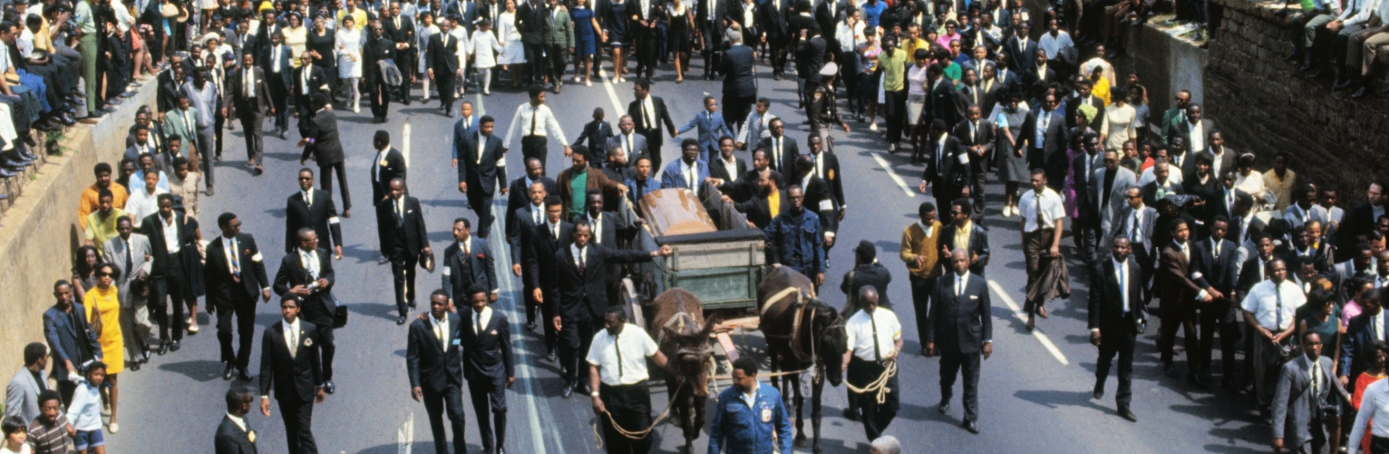
As word of the assassination spread, riots broke out in cities all across the United States and, National Guard troops were deployed in Memphis and Washington, D.C. On April 9, King was laid to rest in his hometown of Atlanta, Georgia. Tens of thousands of people lined the streets to pay tribute to King’s casket as it passed by in a wooden farm cart drawn by two mules.
From Wikipedia:
The King family and others believe the assassination was the result of a conspiracy involving the U.S. government, Mafia and Memphis police, as alleged by Loyd Jowers in 1993. They believe that Ray was a scapegoat. In 1999, the family filed a wrongful death lawsuit against Jowers for the sum of $10 million. During closing arguments, their attorney asked the jury to award damages of $100, to make the point that “it was not about the money.” During the trial, both sides presented evidence alleging a government conspiracy. The government agencies accused could not defend themselves or respond because they were not named as defendants. Based on the evidence, the jury concluded Jowers, and others, were “part of a conspiracy to kill King” and awarded the family $100. The allegations and the finding of the Memphis jury were later rejected by the United States Department of Justice in 2000 due to lack of evidence.

After the assassination of President Kennedy in 1963, King told his wife, Coretta Scott King, “This is what is going to happen to me also. I keep telling you, this is a sick society.”
Senator Robert F. Kennedy was the first to tell his audience in Indianapolis that King had died. He stated:
“For those of you who are black, and are tempted to be filled with hatred and mistrust of the injustice of such an act, against all white people, I would only say that I can also feel in my own heart the same kind of feeling. I had a member of my family killed but, he was killed by a white man.
His speech has been credited as preventing riots in Indianapolis when the rest of the country was not so lucky.
On March 10, 1969, James Earl Ray pleaded guilty (on his birthday) and was sentenced to 99 years in the Tennessee State Penitentiary. He died in prison at the age of 70 on April 23, 1998, twenty-nine years and 19 days after King’s assassination.
Many documents regarding an FBI investigation remain classified and will stay secret until 2027.
I’ve seen the Promised Land.
Movie Monday: Shoulder Arms 1918

Today, we are going waaaaaaay back…to 1918. On this date, Shoulder Arms, a Charlie Chaplin piece, was a very popular film. Was it a ‘number one’? Hard to tell. This film pre-dates the Academy Awards by 11 years. Starring Sir Charles Spencer Chaplin, Edna Purviance, Sydney Chaplin (Charlie’s elder, half-brother) and Tom Wilson, it is, primarily, a dream sequence set in France during World War I.
Plot from IMDB:
Charlie is in boot camp in the “awkward squad.” Once in France, he gets no letters from home. He finally gets a package containing limburger cheese, which requires a gas mask and which he throws over into the German trench. He goes “over the top” and captures thirteen Germans (“I surrounded them”) then, volunteers to wander through the German lines disguised as a tree trunk. With the help of a French girl, he captures the Kaiser and the Crown Prince and, is given a statue and victory parade in New York. Then…fellow soldiers wake him from his dream. [edited for grammar]
From an archived New York Times article:
“”The fool’s funny,” was the chuckling observation of one of those who saw Charlie Chaplin’s new film. “Shoulder Arms”, at the Strand, yesterday and, apparently, that’s the way everybody felt. There have been learned discussions as to whether Chaplin’s comedy is low or high, artistic or crude but, no one can deny that when he impersonates a screen fool, he is funny. Most of those who go to find fault with him remain to laugh. They may still find fault but, they will keep on laughing. In “Shoulder Arms”, Chaplin is as funny as ever.” [edited for grammar]
Trivia Bits:
♦ Many in Hollywood were nervous that one of their most famous peers was going to tackle the subject of WWI. It was released shortly before the Armistice so, it did not help boost national morale but, it did end up as one of Charles Chaplin’s most popular films and, it was particularly popular with returning doughboys.
♦ Released two weeks and one day before the end of World War I.
- ← Previous
- 1
- 2
 Cosmic-Observation