paris
TV Tuesday: The Flame Is Love 1979

Forty years ago, today, the television film The Flame Is Love aired on NBC. Based on the Barbara Cartland novel of the same name, it starred Linda Purl, Shane Briant, Timothy Dalton, Richard Johnson and Joan Greenwood. Directed and co-produced by Michael O’Herlihy, it was written by Hindi Brooks (teleplay) and filmed in Ireland.
Synopsis from The Movie Database:
This sudsy made-for-TV melodrama is based on a Barbara Cartland novel and follows the romantic exploits of an American heiress who sets sail for exciting Paris at the turn-of-the-century. She is traveling there to meet her fiance but, ends up falling in love with a French journalist.
Synopsis from the actual novel:
Reluctant to accept her arranged marriage to an English Duke she has never met, beautiful, young, American oil heiress, Emmeline Nevada Holtz, nicknamed “Vada” after the state, travels to Paris to buy her trousseau before meeting her husband-to-be. When her travelling companion, Nancy Sparling, has an accident and hurts her leg, Vada assumes her name to avoid unwelcome attention. [She] travels on with just her elderly maid, determined to make the most of her last chance to explore Bohemian Paris and, the wonders of the city that she had heard and read so much about. At her hotel she finds a handsome intruder in her suite, not a thief as she at first thinks but, a journalist looking to interview the famous heiress Emmeline. Smitten by this charismatic Frenchman and his talk of poetry, Vada finds herself agreeing to go with him to the Soleil d’Or, wellspring of the Symbolist movement. Soon, they are deeply and uncontrollably in love, a love that is surely doomed by her deception, her betrothal to the Duke and, now, a terrifying ordeal at a Satanist Black Mass on the dark side of the City of Light.
Timothy Dalton’s character Marquis de Guaita is based on Stanislas de Guaita, the founder of Kabbalistic Order of the Rose-Cross (Rosicrucians).
The Complete Movie
Flashback Friday: Paris, Lithuania & Tarnów 1940
June 14 was a banner day for the countries of France, Lithuania and Poland. Except for reading the words, we, today, have no clue what these people went through. ~Vic

[Source]
Paris started mobilizing for war in September 1939 when Nazi Germany, and their allied Soviet Union, according to the Ribbentrop-Molotov Treaty, invaded Poland. […] the war seemed far away until May 10, 1940, when the Germans attacked France and quickly defeated the French army. The French government departed Paris on June 10 and the Germans occupied the city on June 14.
In the spring of 1939, war with Germany already seemed inevitable. On March 10, the city began to distribute gas masks to civilians and on March 19, signs were posted guiding Parisians to the nearest shelters. On August 31, anticipating bombardment, the French government began to evacuate 30,000 children out of the city […]. On September 1, news reached Paris that Germany had invaded Poland, and France, as expected, promptly declared war on Germany. […] in February 1940, ration cards for food were issued [..].
The French defense plan was purely passive, waiting for the Germans to attack. After eight months of relative calm, […] the Germans struck France on May 10, 1940, bypassing the Maginot Line and slipping through the Ardennes. On June 3, the Germans bombed Paris and its suburbs for the first time […]. On June 8, the sound of distant artillery fire could be heard in the capital. On 10 June, the French government fled Paris […]. On June 12, the French government, in Tours, declared Paris to be an open city [and] that there would be no resistance. At 5:30 in the morning of June 14, the first German advance guard entered the city […]. By the end of the afternoon, the Germans had hung a swastika flag at the Arc de Triomphe […].
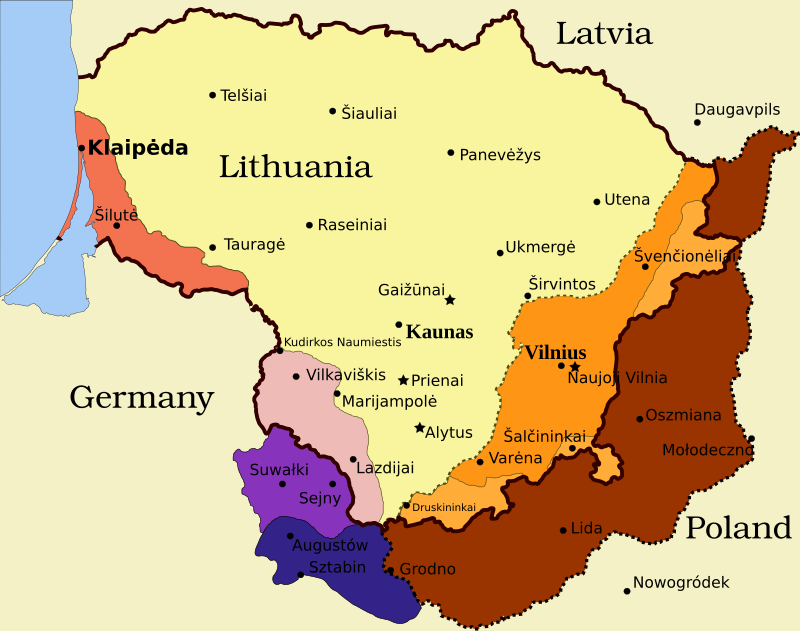
According to the Soviet–Lithuanian Mutual Assistance Treaty, Lithuania agreed to allow Soviet military bases (marked in black stars) in exchange for a portion of the Vilnius Region (in orange).
[Source]
The Soviet Union issued an ultimatum to Lithuania before midnight of June 14, 1940. The Soviets, using a formal pretext, demanded to allow an unspecified number of Soviet soldiers to enter the Lithuanian territory and to form a new pro-Soviet government […]. The ultimatum and subsequent incorporation of Lithuania into the Soviet Union stemmed from the division of Eastern Europe into the German and Russian spheres of influence in the Molotov–Ribbentrop Pact of August 1939. Lithuania, along with Latvia and Estonia, fell into the Russian sphere. Despite the threat to the independence, Lithuanian authorities did little to plan for contingencies and were unprepared for the ultimatum. With Soviet troops already stationed in the country according to the Mutual Assistance Treaty, it was impossible to mount effective military resistance. On June 15, Lithuania unconditionally accepted the ultimatum and lost its independence.

[Source]
The first mass transport of prisoners by Nazi Germany to Auschwitz Concentration Camp was organized in occupied Poland on June 14, 1940, during World War II. The transport departed from the southern Polish city of Tarnów and, consisted of 728 Poles and 20 Polish Jews. They were dubbed ‘political prisoners’ and members of the Polish resistance. Most were Catholics, since the mass deportations of Jews had not yet begun. All were sent to Auschwitz by the German Security Police. They were transported there from a regular prison in Tarnów where they had been incarcerated as enemies of the Nazi regime. Numbers were tattooed on the prisoners’ arms in the order of their arrival […]. These inmates were assigned the numbers 31 through 758, with numbers 1 through 30 having been reserved for a group of German criminals who were brought to Auschwitz from Sachsenhausen on May 20 and became the first Auschwitz kapos.
 Cosmic-Observation