gold rush
Movie Monday: Cripple Creek Bar Room Scene 1899

Photo Credit: pinterest.com
One-hundred, twenty years ago, in May, Edison’s Black Maria Studio, considered to be the first movie studio in America, produced the short, non-actuality film Cripple Creek Bar-Room Scene.
An IMDB Summary:
A vignette of a bar-room/liquor-store in the West [with] no plot, per se. However, this short is usually regarded as the first “Western” in the sense that it depicts a western scene.
The film lasted one minute, had no action and the role of a barmaid was played by a man.
Summary From The Library of Congress:
Shows tap room of the “Miners Arms”, stout lady at the bar and three men playing stud horse. Old toper with a silk hat asleep by the stove. Rough miner enters, bar maid serves him with Red Eye Whiskey and he proceeds to clean out the place. Barmaid takes a hand with a siphon of vichy and, bounces the intruder with the help of the card players, who line up before the bar and take copious drinks on the house.

Photo Credit: silentology.wordpress.com & pinterest.com
From Silentology:
So the film’s supposed to be set in one of the rough mining towns that were part of the Wild West. Also, it was definitely named “Cripple Creek” for a reason. Cripple Creek, Colorado, was a real-life ranch town that experienced a major gold rush in the late 19th century. In 1890, Robert Miller Womack struck gold and, six years later, the town had swelled from a mere 500 souls to well over 30,000 gold-fevered prospectors. All in all, something in the range of a half-billion dollars worth of gold would be extracted from the area.
The Black Maria was completed in early 1893 in West Orange, NJ and, when Edison built a new, rooftop movie studio in New York City, it ceased operation in January 1901. It was torn down in 1903.
Wayback Wednesday: SS Central America 1857
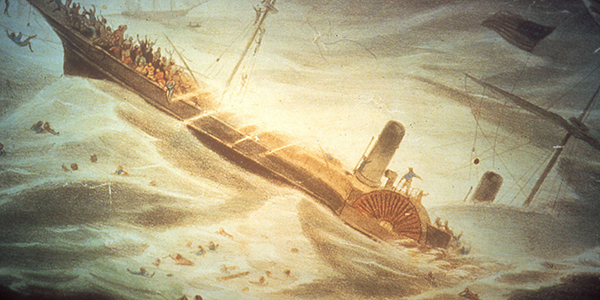
In 1857, caught in a Category 2 Hurricane, the SS Central America sank 160 miles off the coast of Cape Hatteras, North Carolina, drowning 420+, including Captain of the Ship Commander William Lewis Herndon. Nicknamed The Ship of Gold, 30,000 pounds of gold from the California Gold Rush went down with her, exacerbating The Panic of 1857.
It wasn’t until very recently that the lost gold was recovered and only two years ago that the salvage award of 100% was awarded.
In other September 12 trivia bits, as we wait for Hurricane Florence 2018 to show up, this appears to be a rather bad day for hurricanes. Did you know that there have been six Atlantic Hurricanes named Florence? She gets around. ~Vic
1910 Alice Stebbins Wells was hired as the first LAPD Policewoman.
1928 The Okeechobee Hurricane, a Category 4 storm, struck Guadeloupe, killing 1,200.
1979 Hurricane Frederic, a Category 4 storm, slammed into Dauphin Island, Alabama, destroying the bridge to the mainland and killing five.
1988 Hurricane Gilbert, the most intense Atlantic hurricane on record until 2005, devastated Jamaica, produced a 19 foot storm surge and killed 49.
Throwback Thursday: Klondike Gold Rush 1896


GOLD! It’s in them, there hills! August 16, 1896, gold was discovered in Dawson City, Bonanza Creek, Klondike River, Yukon, Canada. George Carmack, his wife Kate, her brother ‘Skookum’ Jim Mason (Keish) and Dawson (Tagish) Charlie began looking for gold on one of the river’s tributaries. History is still unclear on ‘who’ actually made the discovery but, George Carmack is generally referred to as the claim maker.
After the panics of 1893 and 1896, economic depression, inflation and unemployment were rampant. The Coinage Act of 1873 had destroyed the use of silver dollar coins, dropping the price of silver and ending bi-metallism. This prompted many to dash to the area in search of gold, leaving behind other jobs in a quest for adventure and financial security. Even author Jack London headed north for his fair share and many of his novels were born out of his experiences. Pacific port towns reaped the benefits of the traders and travelers, desperate to survive the economic downturn.
Very few walked away from Dawson City rich. George and Kate split and, George remarried, living fairly well on his earnings. Skookum Jim, though wealthy, continued to prospect until his death. Dawson Charlie spent money and drank too much, dying in an alcohol related accident. Most of the businessmen and miners died penniless. The damage to the area from the mining was extensive and, the Native people suffered from contaminated water and disease.
Although this song is based on a John Wayne movie, and the George mentioned isn’t the same George in history, it’s still apropos…and, a great song. It’s sad, though, that Johnny Horton died shortly before its release.
 Cosmic-Observation