queen elizabeth
Wayback Wednesday: Treaty of Union 1706

Source: University of Aberdeen
Image Credit: Wikipedia & Wikimedia
Three hundred, fourteen years ago, today…
The Treaty of Union is the name usually, now, given to the agreement which led to the creation of the new state of Great Britain [.] [It stated] that England, which already included Wales, and Scotland were to be “United into one Kingdom by the name of Great Britain[.]” At the time it, was more often referred to as the Articles of Union. The details of the treaty were agreed on [July 22], 1706 and separate Acts of Union were then passed by the parliaments of England and Scotland to put the agreed articles into effect. The political union took effect on [May 1], 1707.
Queen Elizabeth I of England and Ireland, last monarch of the Tudor dynasty, died without issue on [March 24], 1603 and the throne fell at once […] to her first cousin twice removed, James VI of Scotland, a member of House of Stuart and the only son of Mary, Queen of Scots. By the Union of the Crowns in 1603, he assumed the throne of the Kingdom of England and the Kingdom of Ireland as King James I. This personal union lessened the constant English fears of Scottish cooperation with France in a feared French invasion of England. After [the] union, the new monarch, James I and VI, sought to unite the Kingdom of Scotland and the Kingdom of England into a state which he referred to as “Great Britain”. Nevertheless, Acts of Parliament attempting to unite the two countries failed in 1606, 1667 and 1689.
The Negotiations
The Articles
The Commissioners
Scots History Online
Union with England (UK Legislation)
Union with Scotland (UK Legislation)
Scottish Referendums (BBC)
Mob Unrest and Disorder (Web Archive/Parliament UK)
Music Monday: Greensleeves 1580

Artist: Dante Gabriel Rossetti
Harvard Art Musems
Model: Mrs. W. J. Knewstub
Photographer: Maris Stella
Reverse Image
Image Credit: Wikipedia & Wikimedia
Moving forward to 1580…
Henry VIII
A widespread belief exists that the song Greensleeves was composed by none other than King Henry VIII following an early rejection of his love by his future wife Anne Boleyn. The lyrics of this song of unrequited love have been seen to relate to his courtship of Anne in the 1520s. Many of the verses of Greensleeves imply a rich and extravagant courtship […]. Henry VIII was a composer and musician of some merit […]. [C]ourt officials […] attribute to Henry many compositions which were not his and the consensus of expert opinion, today, is that Greensleeves was composed rather later in the Tudor era, during the reign of Anne Boleyn’s daughter, Queen Elizabeth I. [T]he piece is based on an Italian style of composition that did not reach England until after Henry’s death […].
Origins
A broadside ballad […] was registered at the London Stationer’s Company in September [of] 1580, by [a] Richard Jones, as A Newe Northern Dittye of ye Ladye Greene Sleves. Six more ballads followed in less than a year, one on the same day […]. Needless to say the rights to the song were in very hot dispute. It was in 1584 that Jones printed his final version of the melody and this is the one we know today. It was titled A New Courtly Sonnet of the Lady Green Sleeves […].
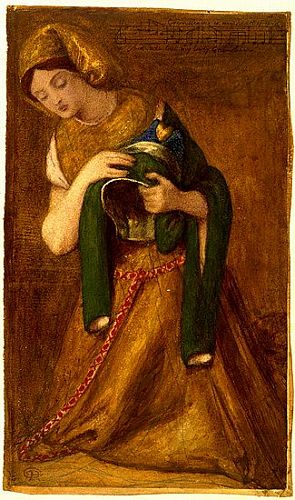
Image Credit: Rossetti Archive
Who was Lady Greensleeves
[W]hy would anyone be named for their green sleeves? Interpretations […] usually have a sexual connotation, most notably in the phrase “a green gown”, a reference to the grass stains on a woman’s dress from engaging in sexual intercourse outdoors. Was this lady a prostitute? [T]he song lyrics mention a “discourteous” rejection of the singer’s advances, suggesting to some that the lady in question was actually virtuous but, perhaps, was mistaken for a prostitute as a result of her green sleeves. [A]nother explanation is quite the opposite to promiscuity […]. [I]n heraldry, colour also had symbolisms and green indicated truth and fidelity […]. [A] knight may give a green armband to his true love to wear to show his devotion to her, giving rise to the familiar phrase “wearing your heart on your sleeve” meaning, to show your true feelings.
None of these theories, however, really seem to reflect the song’s true meaning, which clearly expresses an unrequited love by a rich man for a fair lady. All that we can confidently deduce, is that “Lady Greensleeves” is a nickname, not a title. Exactly who she was, remains a mystery.
Trivia Bits:
♦ In Shakespeare’s The Merry Wives of Windsor, the character Mistress Ford refers, twice, to “the tune of ‘Greensleeves'”.
♦ The tune was the basis for “Home in the Meadow,” a recurring song throughout the 1962 epic film How the West Was Won.
♦ A rendering of the tune, titled the “Lassie Theme”, was used extensively in the Lassie television show, especially the ending credits.
Everyone will remember this tune as What Child Is This? ~Vic
Sources & Additional Reading:
The Folk Song Greensleeves (Greensleeves Hubs)
Dante Gabriel Rossetti (Rossetti Archive)
Lyrics (Six Wives Website)
Greensleeves (Wikipedia)
Amy Nuttall
Movie Monday: Sleeping Beauty 1959

Sixty years ago, today, the most popular film at the box office was Sleeping Beauty.
Voice Cast:
☆ Mary Costa…….Princess Aurora
☆ Bill Shirley…….Prince Phillip
☆ Eleanor Audley…….Maleficent
☆ Verna Felton…….Flora/Queen Leah
☆ Barbara Luddy…….Merryweather
☆ Barbara Jo Allen…….Fauna
☆ Taylor Holmes…….King Stefan
☆ Bill Thompson…….King Hubert
After a beautiful princess, Aurora, is born in to royalty everyone gathers to exchange gifts. Everything is perfectly fine until an unwanted guest appears, Maleficent. Maleficent casts a spell on the young princess and announces that she will die by pricking her finger on the spindle of a spinning wheel on the evening of her 16th birthday. Fortunately, one of the good fairies, Merryweather, changes the spell so Aurora will fall asleep, and that the only way to wake her from her sleep is true love’s kiss. Finally the day comes.
The Sleeping Beauty story has many variations and has deep, medieval roots. Disney’s movie was based on French author Charles Perrault’s La Belle Au Bois Dormant (German: Dornröschen or Little Briar Rose) or, in English, The Sleeping Beauty in the Woods, written in the late 1600s.

Other Perrault works include Le Petit Chaperon Rouge (Little Red Riding Hood), Cendrillon (Cinderella), Le Chat Botté (Puss in Boots) and Barbe Bleue (Bluebeard). Perrault’s literary tales predate the Brothers Grimm material by 100+ years but, The Sleeping Beauty, in particular, was based on the Sun, Moon & Talia (Sole, Luna, e Talia) piece by Italian writer Giambattista Basile, published, posthumously, in the early 1600s. This would NOT be a good children’s fairy tale.
Perceforest, a collection of six French books from the middle 1300s, with ties to the Arthurian Legend, appears to be the earliest written form of the story.
Trivia Bits:
♦ Princess Aurora’s long, thin, willowy body shape was inspired by that of Audrey Hepburn.
♦ The prince is named after Prince Philip, the Duke of Edinburgh and husband of Queen Elizabeth II of Great Britain, as well as Prince Philip of Belgium (now King Philip).
♦ This is the only Disney movie with square trees.
♦ Famed Warner Bros. animation director Chuck Jones worked on the film, briefly, when Termite Terrace closed temporarily during the late 1950s. He found the atmosphere at Walt Disney Productions oppressive because everything anyone did there had to be approved by Walt Disney before, during and, after the process of production. He was more than happy when Warner’s animation department re-opened, where he stayed until it closed again in 1964.
 Cosmic-Observation