queen victoria
Throwback Thursday: The Sinking Of HMS Victoria 1893
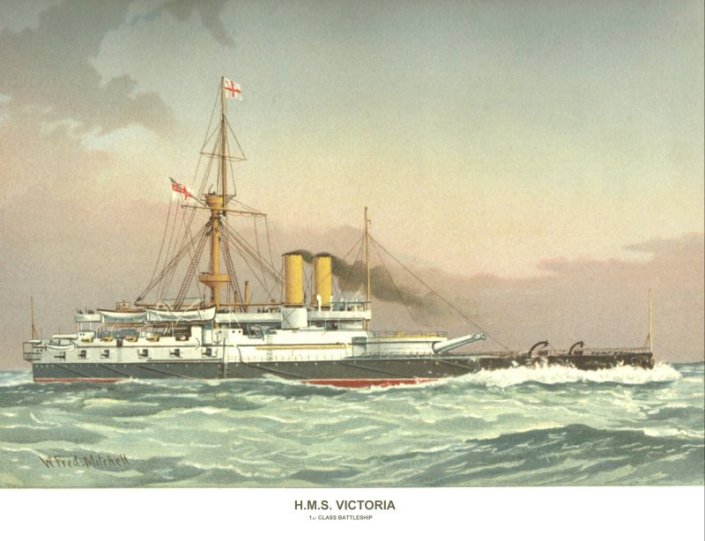
Author: William Frederick Mitchell
Wayback Machine Echo
Image Credit: Wikimedia
I certainly like her name! ~Vic
One-hundred, thirty years, ago, today…
[The] HMS Victoria was the lead ship in her class of two battleships of the Royal Navy. On June 22, 1893, she collided with [the] HMS Camperdown near Tripoli […] during maneuvers and quickly sank, killing 358 crew members, including the commander of the British Mediterranean Fleet, Vice-Admiral Sir George Tryon. One of the survivors was executive officer John Jellicoe, later commander-in-chief of the British Grand Fleet at the Battle of Jutland.
Victoria was constructed at a time of innovation and rapid development in ship design. Her name was originally to be Renown but, this was changed to Victoria while still under construction to celebrate Queen Victoria‘s Golden Jubilee, which took place the year the ship was launched. Her arrival was accompanied by considerable publicity. She was the largest, fastest and most powerful ironclad afloat, with the heaviest guns. Despite the ship’s many impressive features, compromises in the design meant that she proved less than successful in service.

Discovery Museum
Newcastle-Upon-Tyne
Image Credit: Hammersfan
May 18, 2015
A detailed model of the ship was exhibited at the Royal Navy exhibition in 1892 and another in silver was given to Queen Victoria by the officers of the Royal Navy and Royal Marines as a Jubilee gift.
The ship was nicknamed The Slipper (or when with her sister ship, [the] HMS Sans Pareil […] The Pair of Slippers) because of a tendency for her low fore-deck to disappear from view, in even slight seas, especially as a result of the low forward deck and raised aft superstructure…the two ships [had a] humorously perceived resemblance to the indoor footwear.
In clear, sunny weather, off the coast of Syria…
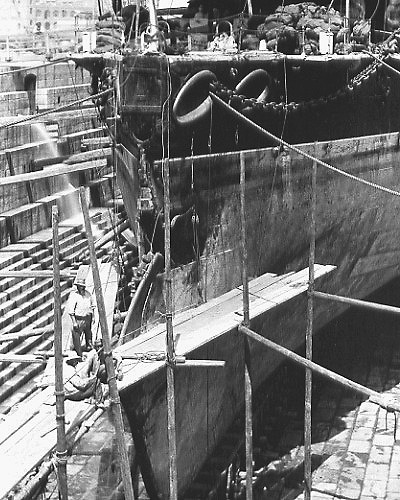
Source: Royal Navy
1893
Image Credit: Wikimedia
The officer in command, Vice Admiral Sir George Tryon, was a fearsome martinet with a reputation as a master of complicated ship handling. He had an elaborate plan for bringing his fleet to anchor, providing onlookers a spectacle of precision maneuvering. [Ten] battleships of the Mediterranean fleet were drawn up in two parallel columns, 1200 yards apart, heading directly away from port out to sea. Tryon then ordered a crash 180-degree turn in succession. The intention, apparently, was for each pair of ships…in order…to turn inwards and create a breathtaking view of the ships’ wakes fanning out, while the ships came about, only 400 yards from each other, [then proceeding] in the opposite direction from their original course, heading towards the land. Then, the ships were to turn 90 degrees to form one column and anchor in unison.
[The] Victoria capsized just 13 minutes after the collision, rotating to starboard with a terrible crash, as her boats and anything, free fell to the side and, as water, entering the funnels, caused explosions when it reached the boilers. With her keel uppermost, she slipped down into the water, bow first, propellers still rotating and threatening anyone near them. Most of the crew managed to abandon ship, although those in the engine room never received orders to leave their posts and were drowned. Those who escaped had to contend with the suction from the sinking ship. A circular wave spread out from it which repeatedly drew down those in the water. All manner of items broke loose from the ship as it sank and came shooting up among the men. Onlookers watched as the number of live men in the water steadily reduced.
[On August 22, 2004], the wreck of the Victoria was discovered by Lebanese-Austrian diver Christian Francis, aided by British diver Mark Ellyatt. She was found in [460 feet] of water off the coast near Tripoli […] and was located using sonar. The most amazing aspect of the wreck is that, unlike all others, she sits vertically with about two thirds of her above the sea bed. The upright position is assumed to have been caused by the huge weight of her fore guns, which would have dragged her down, bow first. The wreck has already been declared a war grave and an exclusion zone has been imposed around her, while the English and Lebanese authorities determine her legal status.
Additional:
♦ H.M.S. Victoria (City of Art/Web Archive/12-03-2014)
♦ Portsmouth City Centre/HMS Victoria (Memorials & Monuments In Portsmouth/Web Archive/08-24-2015)
Maritime Horrors
Christian Francis Finding HMS Victoria
Throwback Thursday: King James & The Virgin Queen 1603

1605
Collection: Museo del Prado
Photographer Source: Galaria Online
Four hundred, nineteen years ago, today, James Charles Stuart was crowned James I, King of England and Ireland, after the death of Elizabeth I. Though England and Scotland were sovereign, individual states, he ruled them in personal union.
He was the son of Mary, Queen of Scots and the great-great grandson of Henry VII. He was thirteen months old when his mother abdicated and he succeeded to the Scottish throne, though he had regents governing due to his minority status. He took full control of the government in 1583 and succeeded Elizabeth I, whom was childless, the last monarch from the House of Tudor, in 1603.
He ruled over all three kingdoms for 22 years during the Jacobean Era until his death in 1625 (also in March, on the 27th). During his reign, the Plantation of Ulster and the Colonisation of the Americas began.
He was the longest reigning Scottish monarch, ruling nearly 58 years, surpassed only by crazy King George III (59 years), Queen Victoria (nearly 64 years) and current Queen Elizabeth II at 70 years. He was on the throne during the Gunpowder Plot of 1605 (see my post on Guy Fawkes) and, during the Elizabethan literature Golden Age, with writers such as William Shakespeare and Sir Francis Bacon. He sponsored the English translation of the Bible, the most widely read version and was a poet, himself. He preferred peace to war, steering clear of the Thirty Years’ War that involved most of Europe. There are indications that he was bi-sexual.
He died young at the age of 58 and was succeeded by his second son, King Charles I, a poor ruler that was executed in 1649.
Who Was King James VI & I
King James I
 Cosmic-Observation