silent film
Movie Monday: A Butterfly’s Metamorphosis 1904
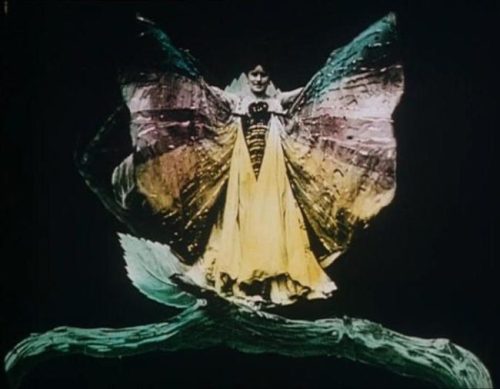
One hundred, fifteen years ago, in June, the short, French film La métamorphose du papillon or, A Butterfly’s Metamorphosis was released. The two-minute silent was directed by Gaston Velle, produced by Pathé Frères and, one of the distribution companies for the US was Edison Manufacturing Company.
From Wikipedia:
Gaston Velle was a French silent film director, and pioneer of special effects, who was prominent in early French and Italian cinema during the first two decades of the 20th century. Gaston began his career as a travelling magician before putting his illusionist skills to work in cinema and, ultimately, creating more than fifty films between 1903 and 1911. He worked under Auguste and Louis Lumière before serving as the head of production for the Italian film studio Cines. […] he is best remembered for his work at Pathé where he was hired to produce trick films that might rival those of his contemporary, Georges Méliès […]. Velle also created some of the first Féerie films […]. [He] mysteriously retired from film production in 1913 and little is known about the last several decades of his life.
[Disclaimer: Very little is known about this film and the above Wikipedia information is presented without any citations.]
Movie Monday: Eugen Sandow 1894

Specific dates are a little hard to come by but, one-hundred, twenty-five years ago in May, Edison Studios produced three silent actuality films of German bodybuilder Eugen Sandow (born Friedrich Wilhelm Müller). It was directed by Scottish mutoscope inventor, photographer and Edison employee William K. L. Dickson.
From Wikipedia:
Florenz Ziegfeld wanted to display Sandow at the 1893 World’s Columbian Exposition in Chicago. Ziegfeld found that the audience was more fascinated by Sandow’s bulging muscles than by the amount of weight he was lifting so, Ziegfeld had Sandow move in poses which he dubbed “muscle display performances”…and the legendary strongman added these displays in addition to performing his feats of strength with barbells. He added chain-around-the-chest breaking and other colorful displays to Sandow’s routine and Sandow quickly became Ziegfeld’s first star. The [Edison] film was of only part of his act and featured him flexing his muscles rather than performing any feats of physical strength.

From Film Threat:
Did you ever stop and say to yourself: “Hey, who was the very first movie star?” You never did? That’s funny, because I did. In researching the answer, I found myself going all the way back to the dawn of motion pictures, where a scantily clad muscleman flexing his biceps was the unlikely pioneer in the realm of celluloid stardom. The year was 1894 and the American motion picture industry consisted solely of Thomas Edison and his team of inventors. Edison had the technology in place but, he was missing one key element: the film contents. […] there was one man who had no problem filling that void. In between the expected presentations for feats of strength, there were posing sequences where Sandow arched and twisted his body in a manner that detailed the excesses of his musculature. Today, we call that bodybuilding, and no one thinks twice about it but, in the 1890s, it was a startling and exciting physical display. Reportedly, Sandow made a nice side business by accepting money from women who wanted to feel his mighty muscles! Sandow’s fame in the United States grew fairly quickly and he became a major headliner on the vaudeville circuit. Edison realized he could also cash in on Sandow’s fame and, in early 1894, he sent word to Ziegfeld about having Sandow appear in a kinetoscope film. Edison then handed Sandow over to William K.L. Dickson, who was in charge of the film production at Edison’s studio. Sandow stripped off his clothing, donned his tighty-whitey posing trunks and stood before the hand-cranked kinetoscope camera. And, to employ the ultimate cliché, history was made.
Movie Monday: The Ten Commandments 1923

Ninety-five years ago, today, The Ten Commandments, a Cecil B. DeMille silent film, was showing. Much like the Charlie Chaplin movie from last week, if this movie was a number one, there is no way to tell as the Academy Awards were still six years away. It was the 2nd highest-grossing film of 1923 so, it was very popular. It starred Theodore Roberts, Charles de Rochefort, Estelle Taylor, Julia Faye, Terrence Moore, James Neill, Lawson Butt and Clarence Burton. It was released on December 4 at Grauman’s Egyptian Theatre in Hollywood.
Plot from IMDB:
The first part tells the story of Moses leading the Jews from Egypt to the Promised Land, his receipt of the tablets and the worship of the golden calf. The second part shows the efficacy of the commandments in modern life through a story set in San Francisco. Two brothers, rivals for the love of Mary, also come into conflict when John discovers Dan used shoddy materials to construct a cathedral.
Trivia Bits:
♦ Most of the chariot crashes in the prologue were real and unplanned.
♦ After production, the enormous movie sets were bulldozed and buried in sand. It is now the legendary “Lost City of DeMille” and the site is recognized as an official archaeological site by the state of California.
♦ Midway through production, the film ran out of money and Cecil B. DeMille’s original backers pulled out. The production was saved when DeMille called in a personal favor from his friend Amadeo Giannini, one of the founders of Bank of America. Giannini’s $500,000 investment allowed the production to continue without stopping.
Movie Monday: Shoulder Arms 1918

Today, we are going waaaaaaay back…to 1918. On this date, Shoulder Arms, a Charlie Chaplin piece, was a very popular film. Was it a ‘number one’? Hard to tell. This film pre-dates the Academy Awards by 11 years. Starring Sir Charles Spencer Chaplin, Edna Purviance, Sydney Chaplin (Charlie’s elder, half-brother) and Tom Wilson, it is, primarily, a dream sequence set in France during World War I.
Plot from IMDB:
Charlie is in boot camp in the “awkward squad.” Once in France, he gets no letters from home. He finally gets a package containing limburger cheese, which requires a gas mask and which he throws over into the German trench. He goes “over the top” and captures thirteen Germans (“I surrounded them”) then, volunteers to wander through the German lines disguised as a tree trunk. With the help of a French girl, he captures the Kaiser and the Crown Prince and, is given a statue and victory parade in New York. Then…fellow soldiers wake him from his dream. [edited for grammar]
From an archived New York Times article:
“”The fool’s funny,” was the chuckling observation of one of those who saw Charlie Chaplin’s new film. “Shoulder Arms”, at the Strand, yesterday and, apparently, that’s the way everybody felt. There have been learned discussions as to whether Chaplin’s comedy is low or high, artistic or crude but, no one can deny that when he impersonates a screen fool, he is funny. Most of those who go to find fault with him remain to laugh. They may still find fault but, they will keep on laughing. In “Shoulder Arms”, Chaplin is as funny as ever.” [edited for grammar]
Trivia Bits:
♦ Many in Hollywood were nervous that one of their most famous peers was going to tackle the subject of WWI. It was released shortly before the Armistice so, it did not help boost national morale but, it did end up as one of Charles Chaplin’s most popular films and, it was particularly popular with returning doughboys.
♦ Released two weeks and one day before the end of World War I.
- ← Previous
- 1
- 2
 Cosmic-Observation