1928
Throwback Thursday: SN 1054

While my nation celebrates its Independence Day (and twenty-six other nations in the month of July), nine-hundred & sixty-five years ago, today, Supernova 1054 was discovered.
SN 1054 is a supernova that was first observed on 4 July 1054 and remained visible for around two years. The event was recorded in contemporary Chinese astronomy [..]. [There is] a pictograph associated with the Ancestral Puebloan (Anasazi) culture found near the Peñasco Blanco site in New Mexico. The remnant of SN 1054, which consists of debris ejected during the explosion, is known as the Crab Nebula (M1). It is located in the sky near the star Zeta Tauri (ζ Tauri) The core of the exploding star formed a pulsar called the Crab Pulsar. When the French astronomer Charles Messier watched for the return of Halley’s Comet in 1758, he confused the nebula for the comet as he was unaware of the former’s existence. Motivated by this error, he created his catalogue of non-cometary nebulous objects, the Messier Catalogue, to avoid such mistakes in the future. The nebula is catalogued as the first Messier object […].
[Source]

Chinese astronomers watching the sky on July 4, 1054, noted the appearance of a new or guest star just above the southern horn of Taurus. Other observations of the explosion were recorded by Japanese, Arabic and Native American stargazers. In 1731, British astronomer John Bevis observed a cloudy blob in the sky and added it to his star atlas. Although [Messier] credited himself with its discovery in his first publication of the Messier Catalog, he acknowledged Bevis’ original finding in subsequent versions after receiving a letter from the astronomer. Around 1844, [Irish] astronomer William Parsons, the third Earl of Rosse, sketched the nebula. The resemblance of the image to a crustacean led to M1’s other name, the Crab Nebula. In the early 20th century, astronomers (Carl Lampland/1921 & Edwin Hubble/1928, included) were able to take more detailed measurements of M1 and determined that it is expanding. Working backwards, they determined its origination date and matched the explosion up with observations from Chinese and Native American records.
[Source]

Alex Marentes
flickr.com
earthsky.org
It is likely that skywatchers of the Anasazi People in the American Southwest also viewed the bright new star in 1054. Historic research shows that a crescent moon was visible in the sky very near the new star on the morning of July 5, the day following the observations by the Chinese. The pictograph above, from Chaco Canyon in New Mexico, is believed to depict the event. The multi-spiked star to the left represents the supernova near the crescent moon. The handprint above may signify the importance of the event, or may be the artist’s “signature.”
[Source]
Happy 4th, everyone! ~Vic
Throwback Thursday: Losing King 1968

Fifty-one years ago, today, a powerful voice & soul was extinguished. I wasn’t even two years old when he was killed. He was only 39. He wasn’t a perfect person (who is?) but, his message was.
From The History Channel:
Just after 6:00p.m. on April 4, 1968, Martin Luther King, Jr. is fatally shot while standing on the balcony outside his second-story room at the Lorraine Motel in Memphis, Tennessee. The civil rights leader was in Memphis to support a sanitation workers’ strike and, was on his way to dinner when a bullet struck him in the jaw and severed his spinal cord. King was pronounced dead after his arrival at a Memphis hospital.
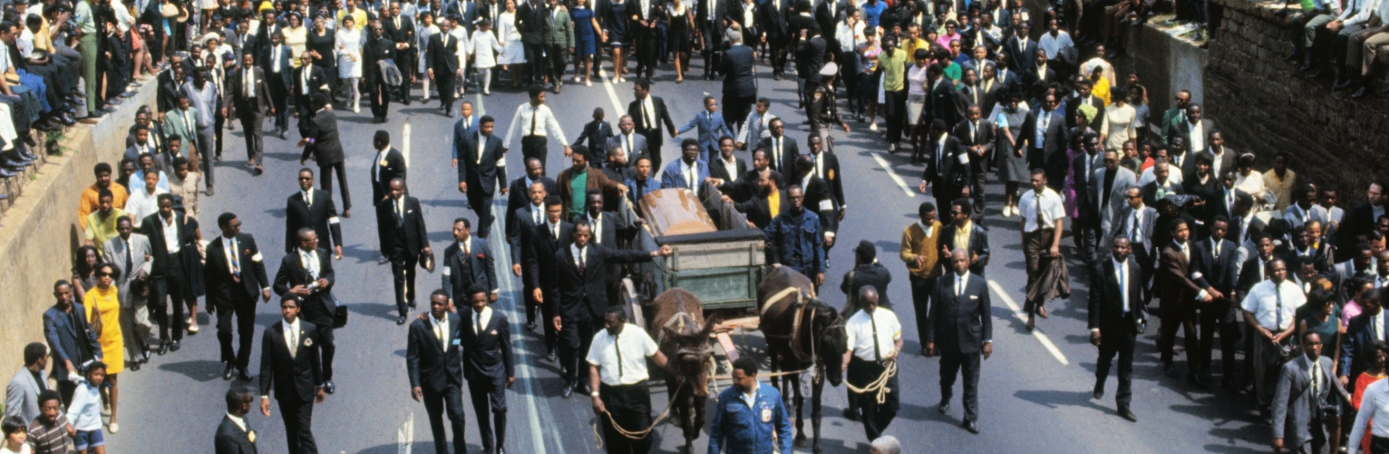
As word of the assassination spread, riots broke out in cities all across the United States and, National Guard troops were deployed in Memphis and Washington, D.C. On April 9, King was laid to rest in his hometown of Atlanta, Georgia. Tens of thousands of people lined the streets to pay tribute to King’s casket as it passed by in a wooden farm cart drawn by two mules.
From Wikipedia:
The King family and others believe the assassination was the result of a conspiracy involving the U.S. government, Mafia and Memphis police, as alleged by Loyd Jowers in 1993. They believe that Ray was a scapegoat. In 1999, the family filed a wrongful death lawsuit against Jowers for the sum of $10 million. During closing arguments, their attorney asked the jury to award damages of $100, to make the point that “it was not about the money.” During the trial, both sides presented evidence alleging a government conspiracy. The government agencies accused could not defend themselves or respond because they were not named as defendants. Based on the evidence, the jury concluded Jowers, and others, were “part of a conspiracy to kill King” and awarded the family $100. The allegations and the finding of the Memphis jury were later rejected by the United States Department of Justice in 2000 due to lack of evidence.

After the assassination of President Kennedy in 1963, King told his wife, Coretta Scott King, “This is what is going to happen to me also. I keep telling you, this is a sick society.”
Senator Robert F. Kennedy was the first to tell his audience in Indianapolis that King had died. He stated:
“For those of you who are black, and are tempted to be filled with hatred and mistrust of the injustice of such an act, against all white people, I would only say that I can also feel in my own heart the same kind of feeling. I had a member of my family killed but, he was killed by a white man.
His speech has been credited as preventing riots in Indianapolis when the rest of the country was not so lucky.
On March 10, 1969, James Earl Ray pleaded guilty (on his birthday) and was sentenced to 99 years in the Tennessee State Penitentiary. He died in prison at the age of 70 on April 23, 1998, twenty-nine years and 19 days after King’s assassination.
Many documents regarding an FBI investigation remain classified and will stay secret until 2027.
I’ve seen the Promised Land.
Tune Tuesday: Eddie Cantor 1929

Ninety years ago, today, the #1 song playing was Makin’ Whoopee, a jazzy-blues piece performed by Eddie Cantor from the Broadway musical comedy Whoopee! The musical was written by William Anthony McGuire, composed by Walter Donaldson (Carolina In The Morning & My Mammy), with lyrics by Gus Kahn (It Had To Be You & Dream A Little Dream Of Me). It was based on the 1923 play The Nervous Wreck by Owen Davis.
American Theatre critic Brooks Atkinson of The New York Times praised Cantor for:
“…a comedian of deftness and appealing humor. He is sad. He is preoccupied. He is apprehensive or insinuating with those floating eyes… In the past he has been funny, clever and ludicrous. But, he has never been so enjoyable.”
Of the music, he states:
“Walter Donaldson has composed an appropriate score worthy of better singing than it falls heir to.”
Apparently, Mr. Atkinson disliked Cantor’s singing ability.
The musical was made into a movie in 1930, also pre-code and Eddie Cantor reprised his role from the musical. There was also a 1979 Broadway revival that did very well.
Synopsis From Wikipedia:
In California, Sheriff Bob Wells and the daughter of a rancher, Sally Morgan, are getting married. She is in love with Wanenis, whose part-Indian heritage presents social difficulties for their romance. Sally abandons Sheriff Bob and their wedding, catching a ride with Henry Williams. As a hypochondriac, Henry has problems of his own but, Sally adds to his problems when she leaves a note saying they have eloped. A chase ensues with the jilted Bob, Mary, Henry’s nurse (who is in love with him) and a cast of others. Along the way, they arrive at the Indian Reservation where Wanenis lives. The movie star Leslie Daw enters the proceedings and sings the torchy, sentimental “Love Me, or Leave Me.”
Trivia Bits:
♦ Eddie Cantor invented the name The March of Dimes for the donation campaigns of the National Foundation for Infantile Paralysis (polio), a play on the “March of Time” newsreels. He began the first campaign on his own radio show in January 1938, asking people to mail a dime to the nation’s most famous polio victim, President Franklin D. Roosevelt. Other entertainers joined in the appeal via their own shows and the White House mail room was deluged with 2,680,000 dimes.
♦ At one time, when the rights to The Wizard of Oz (1939) were owned by Samuel Goldwyn, Cantor was considered for the role of the Scarecrow. Goldwyn eventually sold the rights to Metro-Goldwyn-Mayer.
♦ Quote: “Marriage is an attempt to solve problems together which you didn’t have when you were on your own.”
Wayback Wednesday: SS Central America 1857
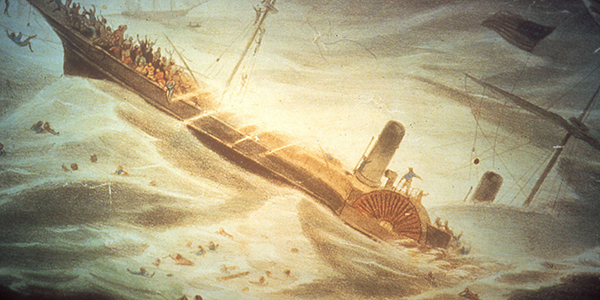
In 1857, caught in a Category 2 Hurricane, the SS Central America sank 160 miles off the coast of Cape Hatteras, North Carolina, drowning 420+, including Captain of the Ship Commander William Lewis Herndon. Nicknamed The Ship of Gold, 30,000 pounds of gold from the California Gold Rush went down with her, exacerbating The Panic of 1857.
It wasn’t until very recently that the lost gold was recovered and only two years ago that the salvage award of 100% was awarded.
In other September 12 trivia bits, as we wait for Hurricane Florence 2018 to show up, this appears to be a rather bad day for hurricanes. Did you know that there have been six Atlantic Hurricanes named Florence? She gets around. ~Vic
1910 Alice Stebbins Wells was hired as the first LAPD Policewoman.
1928 The Okeechobee Hurricane, a Category 4 storm, struck Guadeloupe, killing 1,200.
1979 Hurricane Frederic, a Category 4 storm, slammed into Dauphin Island, Alabama, destroying the bridge to the mainland and killing five.
1988 Hurricane Gilbert, the most intense Atlantic hurricane on record until 2005, devastated Jamaica, produced a 19 foot storm surge and killed 49.
 Cosmic-Observation