Pittsburgh pitcher Sam Leever injured his shoulder while trap-shooting, so his teammate Deacon Phillippe pitched five complete games. Phillippe won three of his games but, it was not enough to overcome the club from the new American League. Boston pitchers Bill Dinneen and Cy Young led Boston to victory. In Game #1, Phillippe struck out ten Boston batters. The next day, Dinneen bettered that mark, striking out 11 Pittsburgh batters in Game #2.
Honus Wagner [was] bothered by injuries […] and committed six errors. The shortstop was deeply distraught by his performance. The following spring, Wagner […] refused to send his portrait to a “Hall of Fame” for batting champion:
“I was too bum last year. I was a joke in that Boston-Pittsburgh Series. What does it profit a man to hammer along and make a few hits, when they are not needed, only to fall down when it comes to a pinch? I would be ashamed to have my picture up now.”
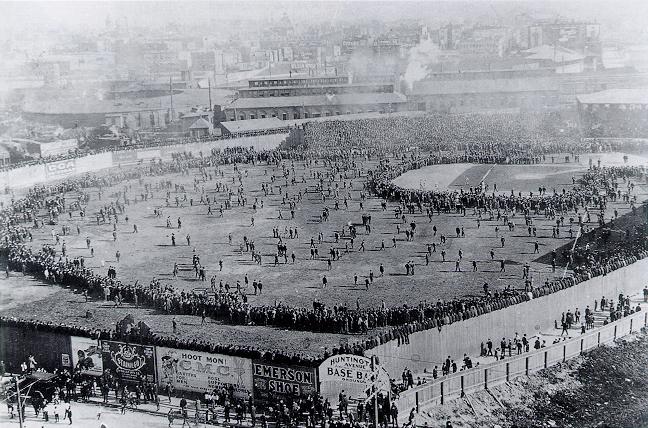
Due to overflow crowds at the Exposition Park games in Allegheny City, if a batted ball rolled under a rope in the outfield that held spectators back, a “ground-rule triple” would be scored. [Seventeen] ground-rule triples were hit in the four games played at the stadium.
In the series, Boston came back from a three-games-to-one deficit, winning the final four games (on October 13) to capture the title…(118 years ago). Such a large comeback would not happen again until the Pirates came back to defeat the Washington Senators in the 1925 World Series […]. […] Much was made of the influence of Boston’s Royal Rooters, who traveled to Exposition Park and sang their theme song Tessie to distract the opposing players […]. Boston wound up winning three out of four games in Allegheny City.
Pirates owner Barney Dreyfuss added his share of the gate receipts to the players’ share, so the losing team’s players actually finished with a larger individual share than the winning team’s.
The Series brought the new American League prestige and proved its best could beat the best of the National League, thus strengthening the demand for future World Series competitions.
“[The] lock of hair and telegram, which provides details of Lincoln’s assassination in 1865, are expected to fetch up to $75,000.”
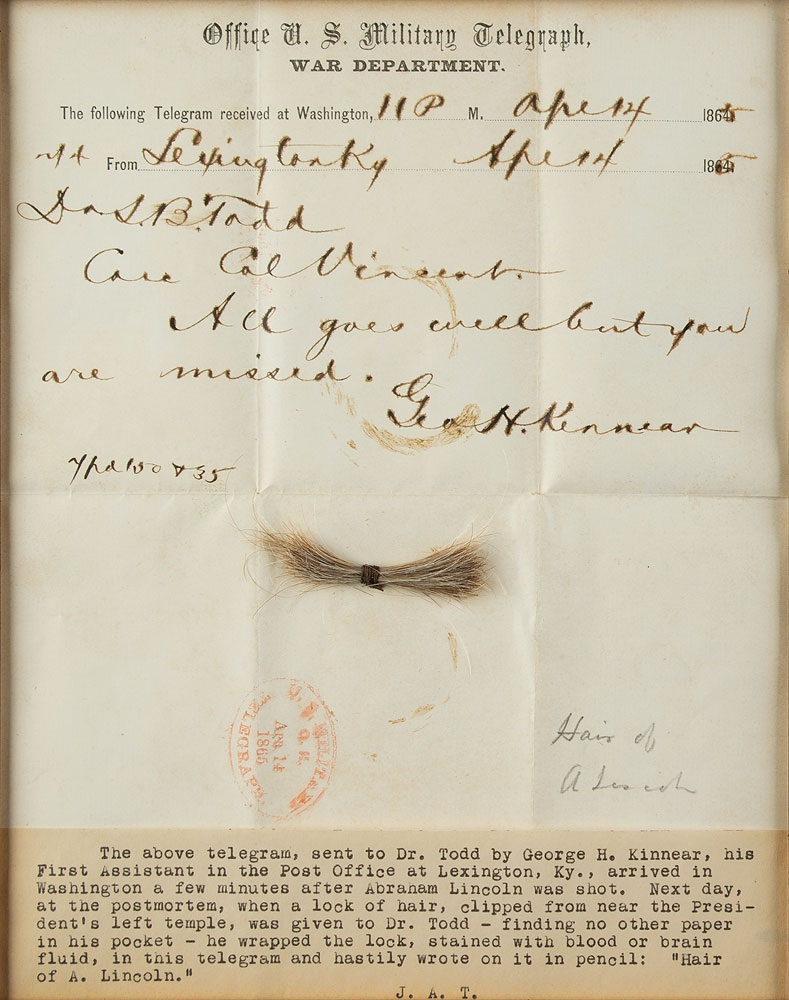
A lock of Abraham Lincoln’s hair wrapped in a telegram stained with the 16th president’s blood is up for auction online. [From RR Auction, based in Boston], [the two} inches of Lincoln’s hair was removed during his postmortem examination after the president was fatally shot by John Wilkes Booth.
The hair ended up in the custody of Dr. Lyman Beecher Todd, a cousin of Lincoln’s widow, Mary Todd Lincoln. The doctor was present at the postmortem examination and is believed to have wrapped the lock of hair in the telegram which had been sent to him the previous day by his assistant, George Kinnear. The telegram is stained with what is believed to be the slain president’s blood.
The hair is mounted to an official War Department manuscript telegram sent to Dr. Todd by George H. Kinnear, his assistant in the Post Office at Lexington, Kentucky, received in Washington at 11:00pm on April 14, 1865 […]. [A] typed caption prepared by Dr. Todd’s son reads, in part: “The above telegram […] arrived in Washington a few minutes after Abraham Lincoln was shot.
Image Credit: Kentucky Kindred Genealogy
Next day, at the postmortem, when a lock of hair, clipped from near the President’s left temple, was given to Dr. Todd. [Finding] no other paper in his pocket […] he wrapped the lock, stained with blood or brain fluid, in this telegram and hastily wrote on it in pencil […] ‘Hair of A. Lincoln.’”
Dr. Lyman Beecher Todd‘s own account of the autopsy, now preserved in an 1895 manuscript held in the Ida Tarbell collection of Lincoln papers at Allegheny College in Meadville, PA, differs slightly from his son’s, noting that he clipped the lock himself: “When all was over, General Hardin entered and handed me a pair of scissors, requesting me to cut a few locks of hair for Mrs. Lincoln. I carefully cut and delivered them to General Hardin and, then, secured one for myself which I have preserved as a sacred relic.”
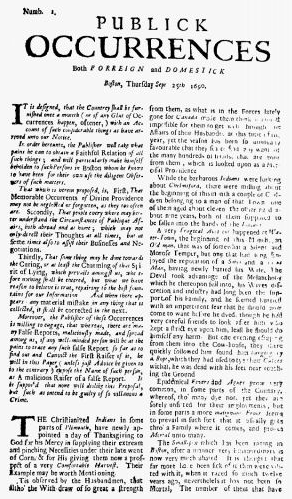
Three hundred, twenty-nine years ago, today, the multi-page newspaperPublick Occurrences Both Forreign and Domestick was published in the Americas. Edited by Benjamin Harris and printed by Richard Pierce, it was the first of its kind.
Before [the multi-page], single-page newspapers, called broadsides, were published in the English colonies and printed in Cambridge in 1689. The first edition was published September 25, 1690, in Boston, then a city in the Dominion of New England, and was intended to be published monthly, “or, if any Glut of Occurrences happen, oftener.”
No second edition was printed because the paper was shut down by the Colonial government on September 29, 1690, who issued an order as follows:
“Whereas some have lately presumed to Print and Disperse a Pamphlet, Entitled, Publick Occurrences, both Forreign and Domestick: Boston, Thursday, Septemb. 25th, 1690. Without the least Privity and Countenace of Authority. The Governour and Council having had the perusal of said Pamphlet, and finding that therein contained Reflections of a very high nature: As also sundry doubtful and uncertain Reports, do hereby manifest and declare their high Resentment and Disallowance of said Pamphlet, and Order that the same be Suppressed and called in; strickly forbidden any person or persons for the future to Set forth any thing in Print without License first obtained from those that are or shall be appointed by the Government to grant the same.”
Without a license, it was closed down after a single issue, Harris was jailed, and the next newspaper did not appear until 1704, when John Campbell’s Boston News-Letter was the first American newspaper to last beyond the first issue.
Benjamin Harris [was an] English bookseller and writer who was the first journalist in the British-American colonies. An ardent Anabaptist and Whig, Harris published argumentative pamphlets in London, especially ones attacking Roman Catholics and Quakers […]. His newspaper, Publick Occurrences, Both Foreign and Domestick (Sept. 25, 1690), the first newspaper printed in the colonies, was suppressed by Boston authorities after one issue. Harris returned to London and journalism in 1695. His London Post appeared regularly from 1699 to 1706.
I was struck by the spelling of the times when I stumbled across this. The fact that he was shut down by the government for daring to speak out (in London & in Boston) also caught my attention. The more things change, the more they stay the same. ~Vic

 Cosmic-Observation