cleavon little
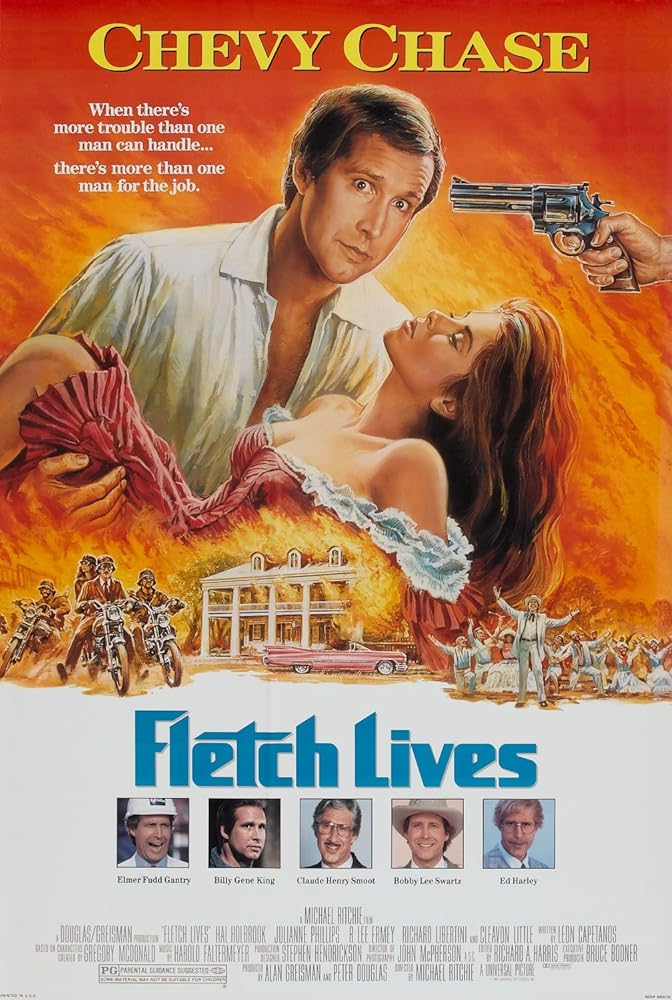
Movie Monday: Fletch Lives 1989

Chevy Chase
Julianne Phillips
R. Lee Ermey
Thirty years ago, today, the #1 film at the box office was Fletch Lives, starring Chevy Chase, Hal Holbrook, Julianne Phillips, R. Lee Ermey, Richard Libertini, Randall ‘Tex’ Cobb, Cleavon Little, George Wyner, Patricia Kalember, Geoffrey Lewis, Richard Belzer, Phil Hartman and Noelle Beck. Released March 17, it was a sequel to Fletch (1985), a movie about an investigative reporter named Irwin Maurice “Fletch” Fletcher, a character created in 1974 by mystery writer Gregory McDonald. It was directed by Michael Ritchie with music by Harold Faltermeyer.
Fletch fans rejoice! The reckless I.M. Fletcher, investigative reporter, returns to the screen. This time, the chameleon-like reporter ventures to Belle Isle, a sprawling 80-acre Louisiana plantation which Fletch inherits from his aunt. Trouble begins when a lovely attorney mysteriously turns up dead, a neighborly lawyer warns him to leave town and a ravishing real estate agent comes calling with a persistent offer he may not be able to refuse. Fletch must unravel the reasons for the mad land scramble with his trademark bag of hilarious disguises.
Quotes
From Chris Willman:
[…] a movie with a hero whose every other line of dialogue is a snide wisecrack directed at a fool. In this meager sequel, as in its popular predecessor, Chevy Chase demolishes every easy target in sight with a quip of the tongue. Some of the lines are funny but, after a while, you just want to smack him. […] Chevy, who isn’t playing a character (least of all the character first created by novelist Gregory McDonald) so much as reprising his nonplussed, punchline-spouting “Weekend Update” anchor role. […] Ritchie lets sophomoric scatology predominate over satire at every turn and, […] the gags are more crass than corrosive. […] moviegoers might think twice about signing on as the film makers’ partners in put-down when they’re clearly also its targets. Beware: [the movie] may assume that all Southerners are dim bulbs but, it doesn’t think you’re so bright yourself.
From Roger Ebert:
[The movie] is one more dispirited slog through the rummage sale of movie clichés […] If you were writing a screenplay, would you think a movie involving […] pathetic clichés had the slightest chance of interesting anyone? Chase’s assignment is to bring an angle, an edge, to plot materials that are otherwise completely without interest. And it’s theoretically possible for that to happen […] But, Chase is wrong for this material because of the pose of detachment and indifference that he brings to so many roles. He seems to be visiting the plot as a benevolent but, indifferent outsider. […] sometimes he seems to be covering himself, playing detached so that nobody can blame him if the comedy doesn’t work. In this film he seems to have no emotions at all […] Chase is at arm’s length from the plot, making little asides and whimsical commentaries while his hapless supporting cast does what it can with underwritten roles. A mystery is concealed somewhere in the folds of the movie’s plot but, one that will not surprise anyone who has seen half a dozen other mysteries. The identity of the bad guy can be deduced by applying the Law of Character Economy, which states that the mystery villain is always the only character in the plot who seems otherwise unnecessary. It admittedly takes a little more thought than usual to apply the law in this case, since so many of the characters seem unnecessary.
Trivia Bits
♦ The original character from the novel was a Marine veteran.
♦ Though there were eight sequels, and prequels, written by Gregory McDonald that could have been used as the basis for the second “Fletch” movie at the time, Universal decided to write a completely new story.
♦ The last name of televangelist Jimmy Lee Farnsworth is the same as that of the widely acknowledged inventor of television, Philo T. Farnsworth.
Wayback Wednesday: Lecherous Little Elf

Two days, ago, I posted my routine Movie Monday piece. For the date I chose, I highlighted Blazing Saddles, a #1 movie at that time and, when calculated in 1974, was the highest grossing movie of that year. The movie is laugh-out-loud funny and an absolute scream. That being said, in my comment section, it was dutifully pointed out that, in this day and age, the movie would never get made. I was provided with a link to a UK article from September 22, 2017. Here is the headline:
Our PC world is the death of comedy, says Mel Brooks: Veteran comedian claims society is ‘stupidly politically correct’ and that many of his films could not be made today
Quotes from the article:
‘We have become stupidly politically correct, which is the death of comedy,’ Brooks said.
‘It’s not good for comedy. Comedy has to walk a thin line, take risks.’
‘Comedy is the lecherous little elf whispering in the king’s ear, always telling the truth about human behaviour.’
He basically said the very same thing back in 2016.
This afternoon, while searching for a music video, I stumbled across The Dave Cullen Show. On Wednesday, August 16, 2017 he posted this:
On his other channel, he posted this back on September 15, 2015, which adds more films to the list:
Quote:
“If you take this film seriously, you missed the point.”
And, if you take my post seriously, you’re missing the point. ~Vic
Movie Monday: Blazing Saddles 1974

Forty-five years ago, today, the most popular film at the box office was Blazing Saddles, a satirical Mel Brooks-directed western starring Cleavon Little, Gene Wilder, Slim Pickens, Harvey Korman, Madeline Kahn, Mel Brooks (three on-screen characters), Alex Karras, David Huddleston, John Hillerman, Dom DeLuise, Count Basie (as himself), Rodney Allen Rippy (as a young Bart), with uncredited appearances by Anne Bancroft, Aneta Corsaut (Helen Crump) and Patrick Labyorteaux (JAG TV series). Released February 7, it was produced by Michael Hertzberg and based on a story by Andrew Bergman. Bergman collaborated with Brooks, Richard Pryor, Norman Steinberg and Al Uger to craft the screenplay and, John Morris (The Woman in Red & Dirty Dancing) was composer.
The Ultimate Western Spoof. A town where everyone seems to be named Johnson is in the way of the railroad. In order to grab their land, Hedley Lemar [sic] (Harvey Korman), a politically connected nasty person, sends in his henchmen to make the town unlivable. After the sheriff is killed, the town demands a new sheriff from the Governor (Mel Brooks). Hedley convinces him to send the town the first Black sheriff (Cleavon Little) in the west. Bart is a sophisticated urbanite who will have some difficulty winning over the townspeople.
Quotes:
From Vincent Canby (The New York Times):
“[…] comedies, like Mel Brooks’s “Blazing Saddles,” the best title of the year to date, are like Chinese food. A couple of hours later you wonder where it went. You wonder why you laughed as consistently as you did. [It] is every Western you’ve ever seen turned upside down and inside out, braced with a lot of low burlesque […]. The trouble is that [it] has no real center of gravity. Harvey Korman, a gifted comic actor who is so fine as Carol Burnett’s television co‐star, tries very hard to be funny as a crooked businessman and sometimes succeeds. But, it’s apparent that he’s hard put to keep up with the movie’s restless shifting from satire to parody to farce to blackout sketch. [It] has no dominant personality and, it looks as if it includes every gag thought up in every story conference. Whether good, bad or mild, nothing was thrown out.”

From Roger Ebert:
“It’s a crazed grab bag of a movie that does everything to keep us laughing except hit us over the head with a rubber chicken. At its best, his comedy operates in areas so far removed from taste that (to coin his own expression) it rises below vulgarity. One of the hallmarks of Brooks’ movie humor has been his willingness to embrace excess.”
From Mel Brooks (Interview at Creative Screen Writing):
“The writing process on Blazing Saddles was the complete opposite of the writing process on Young Frankenstein. Blazing Saddles was more or less written in the middle of a drunken fistfight. There were five of us all yelling loudly for our ideas to be put into the movie. Not only was I the loudest but, luckily, I also had the right as director to decide what was in or out.”
Trivia Bits:
♦ James Earl Jones was to be the original Sheriff. Richard Pryor was next in line but, the studio wouldn’t finance it due to Pryor’s background.
♦ Gig Young was originally cast as the “Waco Kid” but, collapsed on set and was replaced with Wilder.
♦ Warner Bros. almost didn’t release the film. The executives thought it too vulgar for the American public.
♦ Governor William J. Le Petomane (Brooks) was a take-off on the stage name of a French Flatulist.
Nominated for three Academy Awards and two BAFTAs. It won three awards. Recognized by the American Film Institute, it is listed as #6 of the 100 funniest American films.
 Cosmic-Observation