editor
I’m Done…For Now
I have been blogging since 2009, when I was living in Texas. WordPress used to be a great place blog. The format used to be really easy to use. That is not true, today. They have shoved the block editor down our throats. In order to keep the classic editor, you have to pay extra money. Even worse, if you want to tweak the settings on your (legacy) theme, you have to upgrade and pay more for that, to get the plug-in that returns your theme back to normal and not “blocks.” I’m tired of this crap. Don’t even get me started on what they have done to the Reader.
This isn’t fun, anymore. I have paid for another year, last month. My history will remain, until the money runs out. WordPress will, ultimately, delete a good portion of blog posts…unless you keep paying, in perpetuity. There is a graveyard of abandoned blogs all over WordPress. Besides my blog posts, I have a library of data from a, now, deceased psychic, Chris Thomas. I would encourage you to read his data, watch the videos and listen to the phone interviews. I also have a documentary on him. If you want to see it, I can provide a link but, it is copyrighted material and you can’t share it.
That’s about it. It’s so much easier to post pictures and talk to people on X (Twitter). WordPress has worn out its welcome with me. I have been hassled enough and I have paid enough. IF things change, I might return but…I doubt it.
I’m done. Goodbye.
~Vic
Of WordPress, Gallbladders & Twitter (X)
Hmmm…where to start… After a long absence, I am returning to my blog. WordPress Happiness Engineers have lost their freaking minds. I still operate in the “Classic” editor. I will NEVER use that nightmare of a “block” editor.

Suddenly, I have these strange, white squares and a “Plus New” symbol.

Here is a better link…
SnipBoard Image
I have also had to adjust my Admin Interface Style in General Settings. WP-Admin in the Classic style does not support the “Add New Post” drop-down I need to get to the Classic Editor. I can only get it in Default style. Can things get MORE confusing, here??? I SO miss the days when WordPress was EASY to use. Now, it is a giant PITA. I spent an hour trying to get a “Happiness Engineer” to explain to me WHY everything is so jacked-up. Has anyone noticed how screwed up the Reader is?
I have been gone so long that, I am having to re-learn how to blog. With all the changes, I am struggling to deal with this insane labyrinth. My absence has been due to my Significant Other needing assistance on a grand scale…and me, still battling my gallbladder. He is improving and I am…slowly.
In July of last year, I joined Twitter (X). Bastion of free speech, they said. Everyone has a voice, they said. Right. At the moment, I have been locked out of my account for six days. Want to know why? I apparently threatened YouTube with the word collapse. Musk stated in a post that he was building a YouTube alternative. It sounded good to me. I reposted his announcement and all I said was “@YouTube, you censor too much. I hope you collapse.” Bells went off, sirens started wailing in the distance and blood began to weep from the walls of my house. I was told that I had used violent speech. How in the AF could I possibly be a threat to YouTube??? *facepalm* I am supposed to be freed from my bird cage in a few hours. SMDH. I will continue to lurk, read & share my blog posts but, there won’t be any other engagement. It’s better than FakeBook, which I left years ago. I do still use Messenger.
Later…~Vic
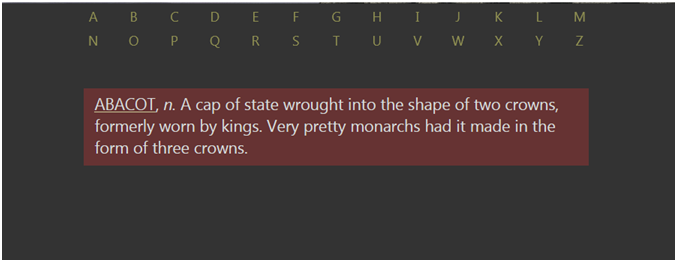
Word Wednesday: Abacot
Ambrose Bierce
The Devil’s Dictionary
Generations of reference books once included this term, including the first edition of the Encyclopaedia Britannica, dated 1771 […]
James Murray, the famous editor of the Oxford English Dictionary, found that the original word was bycoket, which was indeed a form of headgear, a cap or headdress with a peak both in front and behind, whose name he thought derived from an Old French term for a small castle crowning a hill. He declared abacot to be a ghost word and wrote in an article in [T]he Athenaeum in February 1882:
“There is not, never was, such a word.”
His entry for abacot in the first edition of the OED read in its entirity [sic] “a spurious word found in many dictionaries, originating in a misprint of bycoket.” In the bycoket entry, he told the story:
Through a remarkable series of blunders and ignorant reproductions of error, this word appears in modern dictionaries as abacot. In Hall’s Chronicles a bicocket appears to have been misprinted abococket, which was copied by Grafton, altered by Holinshed to abococke, and finally “improved” by Abraham Fleming to abacot (perhaps through an intermediate abacoc) […]
One may instead argue that since the word has — albeit rarely — been used, then it exists and ought to be treated as such. There is, after all, no shortage of words that have been grossly altered through popular error. The revision of its entry in the Oxford English Dictionary in December 2011 takes this view […]
Michael Quinion
Weird Words (Abacot)
World Wide Words
April 15, 2006 (Updated: June 23, 2012)
You want to know what an abacot/bycoket is? Think Robin Hood. ~Vic
Throwback Thursday: World Wide Web 1993

And, the world was never the same. ~Vic
On April 30, 1993, four years after publishing a proposal for “an idea of linked information systems,” computer scientist Tim Berners-Lee released the source code for the world’s first web browser and editor. Originally called Mesh, the browser that he dubbed WorldWideWeb became the first royalty-free, easy-to-use means of browsing the emerging information network that developed into the internet as we know it today.
Berners-Lee was a fellow at CERN, the research organization headquartered in Switzerland. Other research institutions like the Massachusetts Institute of Technology and Stanford University had developed complex systems for internally sharing information and Berners-Lee sought a means of connecting CERN’s system to others. He outlined a plan for such a network in 1989 and developed it over the following years. [He] wrote and published the first web page, a simplistic outline of the WorldWideWeb project, in 1991. Simple Web browsers like Mosaic appeared a short time later and, before long, the Web had become by far the most popular system of its kind.
The creation and globalization of the web is widely considered one of the most transformational events in human history.
Additional Reading & Sources:
The Birth of the Web (CERN)
World Wide Web Launches (The History Channel)
World Wide Web (Wikipedia)
Computer History Museum
 Cosmic-Observation