netherlands
Song Sunday: Radar Love

“I’ve been drivin’ all night, my hands wet on the wheel…There’s a voice in my head that drives my heel…
Submitted for your approval, returning to my Samsung playlist, I present Radar Love by Golden Earring, a Dutch hard-rock/progressive rock band. I can’t imagine that anyone out there hasn’t heard this song at least once. Founded in 1961 in The Hague, Netherlands, most of their extensive material didn’t even chart in the US. In the 60 years of their existence, they made 25 studio albums, eight live albums, two compilation albums and an impressive 74 singles. Originally named The Tornadoes…
Golden Earring was formed in 1961 in The Hague by 13-year-old George Kooymans and his 15-year-old neighbour, Rinus Gerritsen. Originally called The Tornados, the name was changed to Golden Earrings, when they discovered that The Tornados was already in use by another group.
They [achieved] their first success in 1965 with “Please Go,” as a pop rock band with Frans Krassenburg as lead singer. By 1969, the rest of the lineup had stabilized, with lead vocalist and multi-instrumentalist Barry Hay and drummer Cesar Zuiderwijk. By ’71, they [were] a regular presence on Dutch charts and [were] starting to climb up the ladder in Germany. They [signed] on to the Who’s Track label, which released a compilation of Dutch singles, Hearing Earring, helping the group break through in England.
Golden Earring
Prog Related/Netherlands
Prog Archives
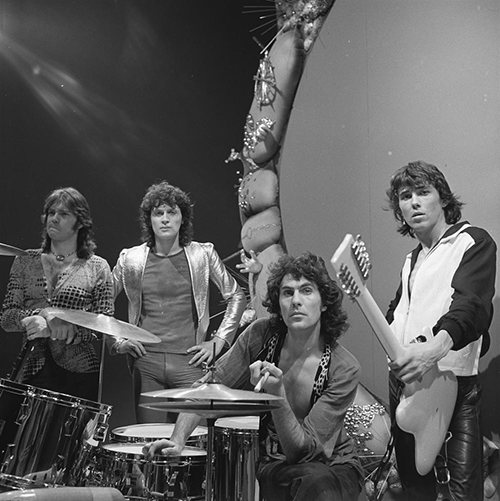
Date: April 19, 1974
Author: AVRO
Source: Netherlands Wiki
Image Credit: Wikipedia
The young group initially baptizes itself as The Tornadoes but, when that name turns out to have already been claimed by another band, they switch to The Golden Earrings – loosely based on a song by the British band The Hunters.
While most Dutch pop bands from the sixties stumble over the threshold to the seventies, the Golden Earring – as the band has come to call itself – emerges from the decade strong and confident.
In 1973, Golden Earring aspires to make an album that is of international allure both artistically and commercially. A lot of time is put into writing and recording what will eventually become Moontan. The mission succeeds brilliantly. Candy’s Going Bad, Radar Love, Just Like Vince Taylor and The Vanilla Queen are among the best the band has written to date.
Both Moontan’s first single Radar Love are a resounding success. First in the Netherlands, then in the rest of Europe and finally in America – where the album was released in 1974. Radar Love even becomes a big hit, with a 13th place as the highest listing. In the following years, however, the song will mainly grow into one of the ultimate car songs, which can still be heard daily on American radio stations. Radar Love has been covered by hundreds of international acts over the decades, including U2, White Lion, Ministry and Def Leppard. Both the single and the album are an undisputed milestone in Dutch pop history.
Golden Earring Biography Page (Google will have to translate.)

It’s not really normal for a band eight albums into their career to suddenly enjoy a worldwide breakout. And, for it to happen with a track over six minutes long with elongated instrumental passages and a somewhat mysterious narrative is even stranger. “…the song most likely to inspire a speeding ticket some 47 years after it was first released.” Barry Hay, the group’s lead singer and lyricist, explained in a recent interview with American Songwriter that a record company push gave then some hope.
“We signed up with Track records, the label of The Who,” Hay says. “And, they really put an effort into it, because they had a sort of monkey wrench. If they could put us together on tour in Europe, they could put us together in Madison Square Garden. So, [we’re] sort of the sons of the Who.”
“At first, the opening line was ‘I’m sitting in a bathtub.’ And, I thought, ‘That’s hardly masculine.’ Then, I came up with sitting in a car.”
“…Hay managed to come up with effortless couplets […] while tying them together in a resonant story of a mystical connection between two separated lovers. […] I remember, in those days, I was really interested in ESP. I read some shit about it. […] Like there’s an accident but, these people still have ESP, they still have contact in a way. Which is sort of a magical thing…
It also inspired a million interpretations but, Hay says that the tragic one is correct. “The guy actually dies,” he says of the song’s narrator. “That’s the gist of the whole thing. In a way, she still has contact with him. There is an afterlife.”
Behind The Song: Radar Love
American Songwriter
Jim Beviglia (Written three years ago)
Unfortunately, Golden Earring is no more:
Golden Earring Co-Founder George Kooymans Retires After ALS Diagnosis
The Band Calls It Quits ~Vic
Additional:
♦ The Virgin Encyclopedia of Heavy Rock (Colin Larkin/1999/Internet Archive/Pages 187-188/Sign-In Required)
♦ It’s Prog Jim, But Not As We Know It: Golden Earring (Louder Sound/Prog/Malcolm Dome/10-28-2014)
Flashback Friday: St. Elizabeth’s Flood 1421
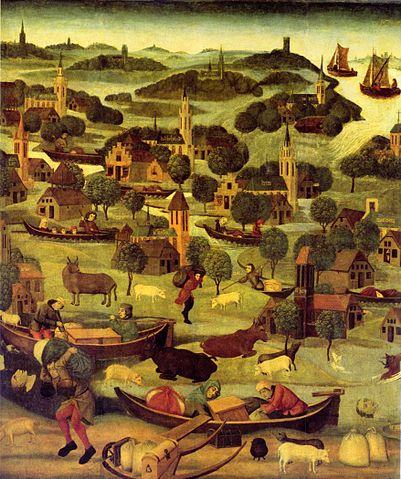
Circa 1490 to 1495
Collection: Amsterdam Museum
Source: Museum Site
Six hundred & one year, ago, today…
The St. Elizabeth’s flood of 1421 was a flooding of the Grote Hollandse Waard, an area in what is now the Netherlands. It takes its name from the feast day of Saint Elisabeth of Hungary which was formerly [November 19th]. It ranks 20th on the list of worst floods in history. During the night of [November 18th-19th] 1421, a heavy storm near the North Sea coast caused the dikes to break in a number of places and the lower-lying polder land was flooded. A number of villages were swallowed by the flood and were lost, causing between 2,000 and 10,000 casualties. The dike breaks and floods caused widespread devastation in Zeeland and Holland.
This flood separated the cities of Geertruidenberg and Dordrecht, which had previously fought against each other during the Hook and Cod (civil) wars. Most of the land remains flooded even since that day.
Most of the area remained flooded for several decades. Reclaimed parts are the island of Dordrecht, the Hoeksche Waard island and north-western North Brabant. Most of the Biesbosch area has been flooded since.
The cause of the flood was a powerful extratropical cyclone. Water from the storm in the North Sea surged up the rivers causing the dikes to overflow and break through. The flood reached a large sea arm between south Holland and Zeeland, destroying the Grote Hollandse Waard.
Wikipedia
I tried to find a video about this but, all I got was a creepy AI voice reading what I posted, above. As an interesting addendum, there was a St. Elizabeth’s flood of 1404, on or about November 19, also, affecting Holland, Zeeland and Flanders. History Calendar on Twitter posted about it, too. ~Vic
Additional:
♦ Zuiderzee Floods (Britannica/November 11, 2022)
♦ Elizabeth and the Flood (Codart/May 8, 2022)
♦ Katje the Windmill Cat (Atozmom’s BSF Blog/March 1, 2014)
Word Wednesday: Glowering
Origin
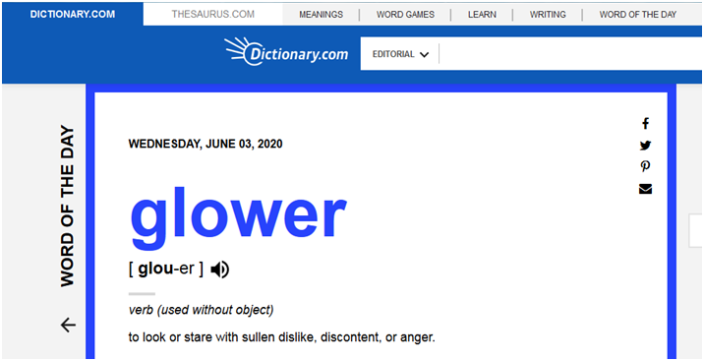
The verb glower, “to look or stare with sullen dislike” comes from Middle English gloren [or] glouren “to shine, gleam, glow, stare, stare at fixedly.” The Middle English forms are mostly from the north (Yorkshire) and Scotland. [T]he sense “to stare at fixedly” is Scottish. The source of gloren and glouren is obscure but, possibly, Scandinavian, e.g., Icelandic [as] glóra “to glow (like a cat’s eyes)” [or] Swedish and Norwegian dialect glora “to glow, stare.” The source of gloren [and] glouren may also be from Middle Low German glūren “to be overcast” or Dutch glueren “to leer, peep.” Glower entered English in the 15th century.
This is very similar to our “glaring at someone” which has its roots in Middle English, Middle Dutch and Middle Low German.
I’ve been doing a lot of glowering and glaring, lately. The whole world has gone insane-stupid. ~Vic
 Cosmic-Observation