In a combined operation with the ironclad ram CSS Albemarle, Confederate forces under Maj. Gen. Robert F. Hoke, attacked the Federal garrison at Plymouth, North Carolina, on April 17. On April 19, the ram appeared in the river, sinking the USS Southfield, damaging the USS Miami and driving off the other Union Navy ships (USS Ceres & USS Whitehead) supporting the Plymouth garrison. Confederate forces captured Fort Comfort, driving defenders into Fort Williams. On April 20, the garrison surrendered.
*************
Construction of the ironclad began in January 1863 and continued on during the next year. Word of the gunboat reached the Union naval officers stationed in the region, raising an alarm. They appealed to the War Department for an overland expedition to destroy the ship, to be christened Albemarle after the body of water into which the Roanoke emptied but, the Union Army never felt it could spare the troops needed to carry out such a mission. It was a decision that would prove to be very short-sighted.
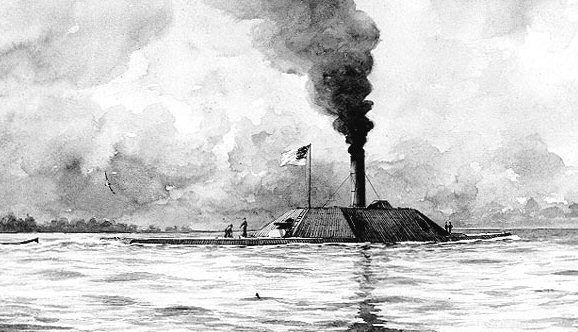
In April 1864, the newly commissioned Confederate States Steamer Albemarle, under the command of Captain James W. Cooke, got underway down-river toward Plymouth, North Carolina. Its mission was to clear the river of all Union vessels so that General Robert F. Hoke‘s troops could storm the forts located there.
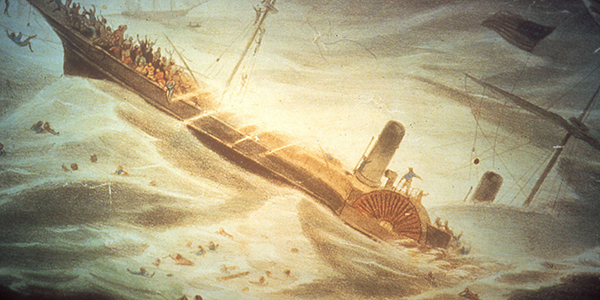
[…] two paddle steamers, USS Miami and USS Southfield, lashed together with spars and chains, approached from up-river, attempting to pass on either side of Albemarle in order to trap her between them.
Image Credit: sonofthesouth.net
The sinking of the USS Southfield.
Captain Cooke turned heavily to starboard, getting outboard of [the] Southfield but, running dangerously close to the southern shore. Turning back sharply into the river, he rammed the Union side-wheeler, driving her under. Albemarle’s ram became trapped in Southfield’s hull from the force of the blow and her bow was pulled under as well. As [the] Southfield sank, she rolled over before settling on the riverbed. This action released the death grip that held the new Confederate ram.
Miami fired a shell into Albemarle at point-blank range while she was trapped by the wreck of Southfield but, the shell rebounded off Albemarle’s sloping iron armor and exploded on [the] Miami, killing her commanding officer, Captain Charles W. Flusser. Miami’s crew attempted to board Albemarle to capture her but, were soon driven back by heavy musket fire. [The] Miami then steered clear of the ironclad and escaped into Albemarle Sound.
With the river now clear of Union ships, and with the assistance of Albemarle’s rifled cannon, General Hoke attacked and took Plymouth and, the nearby forts.
Image Credit: emergingcivilwar.com & Miller’s Photographic History
CSS Albemarle shortly after the battle.
Confederate forces attack Plymouth, North Carolina, in an attempt to recapture ports lost to the Union two years before. The four-day battle ended with the fall of Plymouth but, the Yankees kept the city bottled up with a flotilla on nearby Albemarle Sound.
In 1862, the Union captured Plymouth and several other points along the North Carolina coast. In doing so, they deprived the Confederacy of several ports for blockade-runners and the agricultural products from several fertile counties. In the spring of 1864, the Confederates mounted a campaign to reverse these defeats. General George Pickett led a division to the area and launched a failed attack on New Bern in February. Now, General Robert Hoke assumed command and moved his army against Plymouth, fifty miles north of New Bern. He planned an attack using the C.S.S. Albemarle, an ironclad that was still being built on the Roanoke River inland from Plymouth.
With 7,000 men, Hoke attacked the 2,800-man Union garrison at Plymouth on April 17. His troops began to capture some of the outer defenses but, he needed the Albemarle to bomb the city from the river. The ironclad moved from its makeshift shipyard on April 17 but, it was still under construction. With workers aboard, Captain James Cooke moved down the Roanoke. The Albemarle‘s rudder broke and the engine stalled, so it took two days to reach Plymouth. When it arrived, the Rebel ship took on two Yankee ships, sinking one and forcing the other to retreat. With the ironclad on the scene, Hoke’s men captured Plymouth on April 20.
The Rebel victory was limited by the fact that the Albemarle was still pinned in the Roanoke River.
The Battle of New Bern (also known as the Battle of New Berne) was fought on 14 March 1862, near the city of New Bern, North Carolina, as part of the Burnside Expedition of the American Civil War. The US Army’s Coast Division, led by Brigadier General Ambrose Burnside and accompanied by armed vessels from the North Atlantic Blockading Squadron, were opposed by an undermanned and badly trained Confederate force of North Carolina soldiers and militia led by Brigadier General Lawrence O’B. Branch. Although the defenders fought behind breastworks that had been set up before the battle, their line had a weak spot in its center that was exploited by the attacking Federal soldiers. When the center of the line was penetrated, many of the militia broke, forcing a general retreat of the entire Confederate force. General Branch was unable to regain control of his troops until they had retreated to Kinston, more than 30 miles (about 50 km) away. New Bern came under Federal control, and remained so for the rest of the war.
Hatteras Island, on the outer shore of North Carolina, fell to Union forces in August, 1861. Roanoke Island, just to the north, was captured on February 8, 1862. Elizabeth City on the mainland followed days later. With the freedom to navigate unmolested through Albemarle and Pamlico Sounds, Brig. Gen. Ambrose E. Burnside’s command looked for other strategic targets of opportunity. The city of New Bern was a significant target, as the Atlantic and North Carolina Railroad that connected the coast with the interior passed through there. On March 11, 1862, Burnside’s force embarked from Roanoke Island to rendezvous with Union gunboats at Hatteras Inlet for a joint expedition against New Bern. On March 13th, the fleet sailed up the Neuse River and disembarked infantry south of the Confederate defenses, about 4,000 men behind breastworks at Fort Thompson. The defenders, a mix of North Carolina infantry, cavalry and artillery, were commanded by Brig. Gen. Lawrence Branch. On March 14th, the brigades of Brig. Gens. John G. Foster, Jesse Reno, and John G. Parke attacked along the railroad and after four [sic] hours of fighting, drove the Confederates out of their fortifications. The Federals captured several nearby gun positions and occupied a base that they would hold to the end of the war, in spite of several Confederate attempts to recapture it.
On March 13th 1862, 11,000 Union troops led by General Ambrose Burnside, along with 13 heavily-armed gunboats led by Commodore Stephen Rowan, landed at Slocum’s Creek, now part of the Cherry Point Marine Corps Air Station. Their objective was [the] capture of the town of New Bern because of its strategic position and the fact that the Atlantic and North Carolina railroad was also located here. Union strategists hoped to use New Bern as a stepping off point to cutting off the main Confederate north-south railroad supply line at Goldsboro.
Awaiting the Union forces were about 4,500 inexperienced and ill-equipped Confederate troops commanded by General Laurence [sic] O’Bryan Branch, a politician with virtually no military experience. Branch positioned his infantry regiments, one cavalry regiment, local militia and three gun batteries to defend a line extending from Fort Thompson on the Neuse River and running approximately one mile west to the Weatherby Road at the eastern edge of Brice’s Creek. Extending Branch’s right wing to the railroad tracks was the 26th North Carolina Regiment commanded by Colonel Zebulon Vance, later governor of North Carolina.
Despite support from Commodore Rowan’s gunboats, this attack stalled. However, a regiment of General Parke’s brigade flanked the position of a militia battalion in the vicinity of Wood’s brickyard adjoining the railroad. Parke’s infantry drove these poorly armed, fresh militiamen from their position leaving the right flank of the 35th North Carolina Regiment exposed. The Confederate line was broken between the 26th and the 35th regiments, and the Union forces pushed through forcing the retreat of the Confederate troops.
The Battle of New Bern was the baptism of fire for the 26th North Carolina. Later, in July 1863, the 26th lost 588 of 800 men at the Battle of Gettysburg, sustaining the largest numerical losses of any unit, North or South, during the entire course of the war.
Estimated casualties for the battle: 1080 total. The fierce battle in the swamps and along the railroad five miles south of New Bern, proved to be a major victory for the Union and led to the ensuing occupation of New Bern for the remainder of the Civil War. Although Union forces never seized and held the rail line at Goldsboro, their presence in New Bern required the Confederacy to divert troops to the railroad’s defense that might have been used in the critical battles in Virginia. For General Ambrose Burnside, the New Bern victory was a factor in his subsequently being given command of the Army of the Potomac and leadership in the Union disaster at Fredericksburg.
One-hundred and fifty-seven years ago, today… ~Vic
The Nineteenth Amendent to the U.S. Constitution was ratified on August 18, 1920, with Tennessee being the last state to vote in favor of, achieving the 3/4 majority needed to amend. One would think that this event would have been the end of any argument against a woman’s right to vote but, one more hurdle had to be cleared.
Ninety-seven years ago, today, the U.S. Supreme Court made a ruling on the constitutionality of the amendment.
On October 12, 1920, Cecilia Streett Waters and Mary D. Randolph, citizens of Maryland, applied for and were granted registration as qualified voters in Baltimore City. To have their names stricken from the list Oscar Leser and others brought this suit in the court of common pleas. The only ground of disqualification alleged was that the applicants for registration were women, whereas the Constitution of Maryland limits the suffrage to men. Ratification of the proposed amendment to the federal Constitution, now known as the Nineteenth, 41 Stat. 362, had been proclaimed on August 26, 1920, 41 Stat. 1823, pursuant to Revised Statutes, § 205 (Comp. St. § 303). The Legislature of Maryland had refused to ratify it. The petitioners contended, on several grounds, that the amendment had not become part of the federal Constitution. […] the case comes here on writ of error. That writ must be dismissed but, the petition for a writ of certiorari, also duly filed, is granted. The laws of Maryland authorize such a suit by a qualified voter against the board of registry. Whether the Nineteenth Amendment has become part of the federal Constitution is the question presented for decision.
Photo Credit: law.edu
There were three claims: [1] The power to amend the Constitution did not cover this amendment due to its character.
“[…] the amendment “destroyed State autonomy” because it increased Maryland’s electorate without the state’s consent.”
[2] Several states that had ratified the amendment had constitutions that prohibited women from voting, rendering them unable to ratify an amendment to the contrary.
[3] The ratifications of Tennessee and West Virginia were invalid, because they were adopted without following the rules of legislative procedure in place in those states.
Justice Brandeis delivered the opinion of the Court:
[1] This amendment is in character and phraseology precisely similar to the Fifteenth. For each, the same method of adoption was pursued. One cannot be valid and the other invalid. That the Fifteenth is valid, although rejected by six states, including Maryland, has been recognized and acted on for half a century.
[2] […] But the function of a state Legislature in ratifying a proposed amendment to the federal Constitution, like the function of Congress in proposing the amendment, is a federal function derived from the federal Constitution and, it transcends any limitations sought to be imposed by the people of a state.
[3] The question raised may have been rendered immaterial by the fact that since the proclamation the Legislatures of two other states—Connecticut and Vermont—have adopted resolutions of ratification. But, a broader answer should be given to the contention. The proclamation by the Secretary certified that, from official documents on file in the Department of State, it appeared that the proposed amendment was ratified by the Legislatures of 36 states and, that it ‘has become valid to all intents and purposes as a part of the Constitution of the United States.’ As the Legislatures of Tennessee and of West Virginia had power to adopt the resolutions of ratification, official notice to the Secretary, duly authenticated, that they had done so, was conclusive upon him, and, being certified to by his proclamation, is conclusive upon the courts.
“So, while the 19th Amendment granted women the right to vote, Leser made sure that the right could actually be used, even where the state constitution said otherwise. It’s not one of the more famous Supreme Court decisions in American history but, without it, the electorate would be, well, lesser.”
As an addendum to the above, Maryland finally ratified the amendment on March 29, 1941 but, didn’t certify that until February 25, 1958, two days shy of an exact 36 year delay. And, I am sad to say that my home state of North Carolina didn’t ratify until May 6, 1971, making it third to last behind South Carolina (ratified July 1, 1969 but, not certified until August 22, 1973) and Mississippi (ratified March 22, 1984).
Little video snippet regarding this case:
And, I grew up watching Schoolhouse Rock, I just had to put this up:
It wasn’t until very recently that the lost gold was recovered and only two years ago that the salvage award of 100% was awarded.
In other September 12 trivia bits, as we wait for Hurricane Florence 2018 to show up, this appears to be a rather bad day for hurricanes. Did you know that there have been six Atlantic Hurricanes named Florence? She gets around. ~Vic
Twenty-five years ago, today, the number one movie was The Fugitive, a suspense film that was based on the TV Show that ran from 1963 to 1967 on ABC starring David Janssen.
The television show started before I was born and I was just an infant when it ceased production. I have picked up a re-run or two over the years. Harrison Ford managed to capture the intensity that David Janssen displayed nearly 30 years earlier. ~Vic
Update:
Some of the links, below, became broken and I’ve had to re-gather some information as Mr. Barrett has done his best to wipe out his history. If links become broken again, I have provided PDF screen captures of the data.
[Note: This is a re-post from an old blog, originally posted on February 27, 2010. I think it’s worth sharing because I find this man to be dangerous. He’s a liar and a bully and, I’m shining the light on him.]
This guy, Stephen Barrett…he’d have you believe that he is the foremost expert in all things quackery. To him, anything other than mainstream-AMA-backed medicine is useless.
Photo Credit: Anaximperator Blog
Although he is free to present his opinion, much like the rest of us out here blogging (me, included), do not be fooled by the ‘M.D.’ at the end of his name. I think he even wrote his own biography on Wikipedia. However, that being expressed, he has gotten himself into quite a bit of trouble in the courts for repeatedly suing people and claiming he was a ‘retired psychiatrist’. Carlos F. Negrete of Negrete Law and Health Freedom Law, attorney for Tedd Koren, D.C., got the awful truth out of Mr. Barrett…
At trial, under a heated cross-examination by Negrete, Barrett conceded that he was not a Medical Board Certified psychiatrist because he had failed the certification exam. This was a major revelation since Barrett had provided supposed “expert testimony” as a psychiatrist and had testified in numerous court cases. Barrett also had said that he was a “legal expert” even though he had no formal legal training.
That cross-examination (screen capture PDF) took place in 2005 in Allentown, PA…Mr. Barrett’s longtime residence (he was born in New York City in 1933). In 2007, a higher court in Pennsylvania backed up the lower court’s decision to dismiss his frivolous lawsuit (original screen capture PDF) (updated screen capture PDF). It was at that point he decided to relocate to Chapel Hill, NC. Perhaps Allentown folks got tired of his crap? I find it amusing that he decided to move to an area that is a hotbed of the very alternative medicine he rails against. The Triangle of North Carolina (Raleigh-Durham-Chapel Hill) contains a plethora of natural, homeopathic and holistic practitioners. I’m pretty sure he didn’t move to the area to get warm fuzzies from the locals. I think he saw an opportunity to make money harassing and ambulance-chasing gifted healers. He does have legal bills he needs cover.
A Patrick Pontillo operated a now-defunct website (screen capture PDF) on chemical sensitivities (a subject that I know something about). He maintains an additional, similar website, Blue Marble Album. He has an extensive history on Mr. Barrett.
Tim Bolen has his own history of Barrett (screen capture PDF & Web Archived Page) from his website and wrote an article on the Doctor’s Data vs Barrett case. Judging by this posted 2016 legal decision, the case was nearly a stalemate but, Barrett’s National Council Against Health Fraud (NCAHF) dissolved after the lawsuit began and Quackwatch dissolved before the case came to trial…even though the website is still active and full of hysterical mainstream medical nonsense. “Googling” this case (I really, really dislike that term but, it is, now, part of our language…for better or worse…) will return links stating that the case was “settled, amicably, out of court”. Translation: Both parties were tired of fighting after six years. A lawsuit of this size and scope costs money…and time. And, Stephen Barrett is in his 80s. The briefing notes clearly state that both parties were free to re-file and start new court proceedings. That means…more money and more time.
Be very careful when you read this man’s so-called “facts”. He is no expert. He merely has an opinion and he has tried to beat people over the head with it. Believing that this man is a seasoned doctor with many, many practicing years of experience would be as ridiculous as believing that I am an experienced journalist. I am not and would never claim to be.




 Cosmic-Observation