According to Herodotus, the appearance of the eclipse was interpreted as an omen and, interrupted a battle in a long-standing war between the Medes and the Lydians. The fighting immediately stopped and they agreed to a truce. Because astronomers can calculate the dates of historical eclipses, Isaac Asimov described this battle as the earliest historical event whose date is known with precision to the day and described the prediction as the birth of science.
Photo Credit: Ancient Origins
The Mechanics of a Monumentally Difficult Prediction
The reason this astronomical event is thought of as being so important is that predicting a solar eclipse, compared with a lunar eclipse, is exceptionally difficult. The astronomer must not only calculate when it will occur but, where on Earth’s surface it will be visible […]. [In] a lunar eclipse, the moon passes through the Earth’s sun shadow and the phenomena is visible on the whole side of the Earth that is in night-time […]. [They] often last longer than an hour. In solar eclipses, however, the moon’s shadow falls across the Earth in a comparatively narrow path, with a maximum duration, at any given location, of about 7 1/2 minutes.
[What] makes Thales’ prediction [an] historical mystery is that historians know early Greeks, at large, didn’t have this essential lunar data and there are no other records of Greek astronomers in this period accurately predicting any other eclipses. Thus, it is thought by historians that the only place Thales’ advanced astronomical knowledge could have come from was Egypt. [It’s] known [that] Thales studied Egyptian techniques for measuring sections of land with rope […].
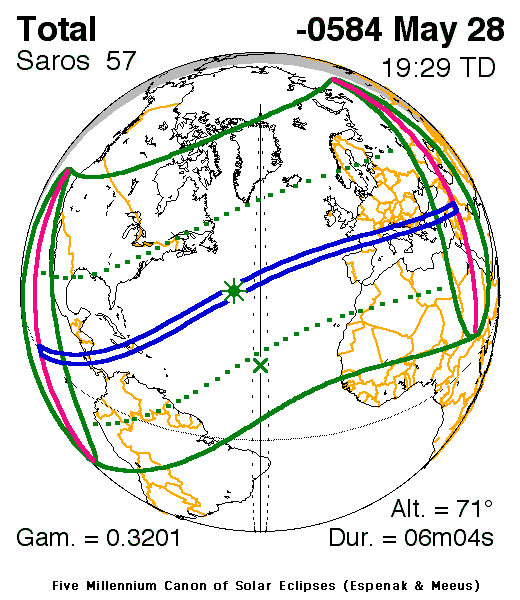
Returning [to] the war (mentioned above), after 15 years of fighting, on May 28, 585 BC, the armies of King Aylattes of Lydia were in battle with the forces of King Cyaxares of Medes (or, possibly, Astyages, his son), near the River Halys in what is, today, central Turkey. Chroniclers noted the heavens darkening and soldiers on both sides laying down their weapons in awe of the spectacle […]. [The] event ended both the battle and the war.
[A] Wired article says this famous astronomical event has been debated by hundreds of scholars for nearly two millennia and that some authorities believe Thales’ eclipse may have occurred 25 years earlier in 610 BC. But, the reason most agree with the 585 BC date is the record of the famous battle in Asia Minor ending when the day was suddenly turned to night.
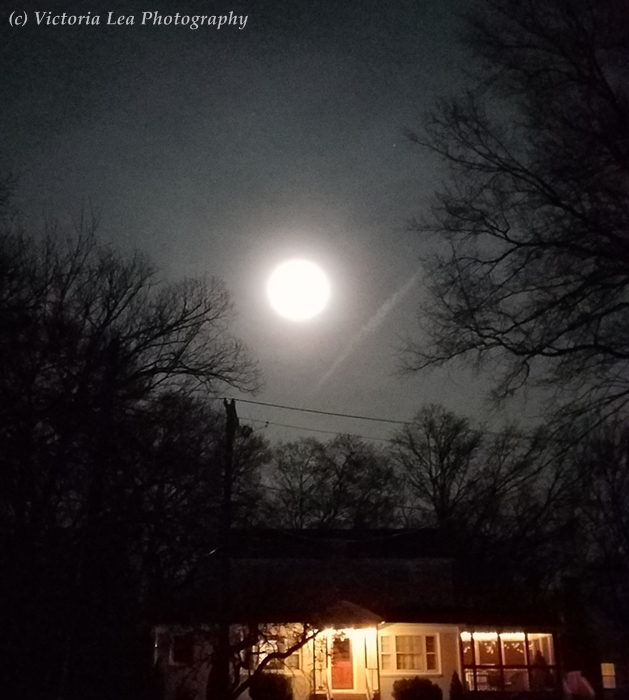
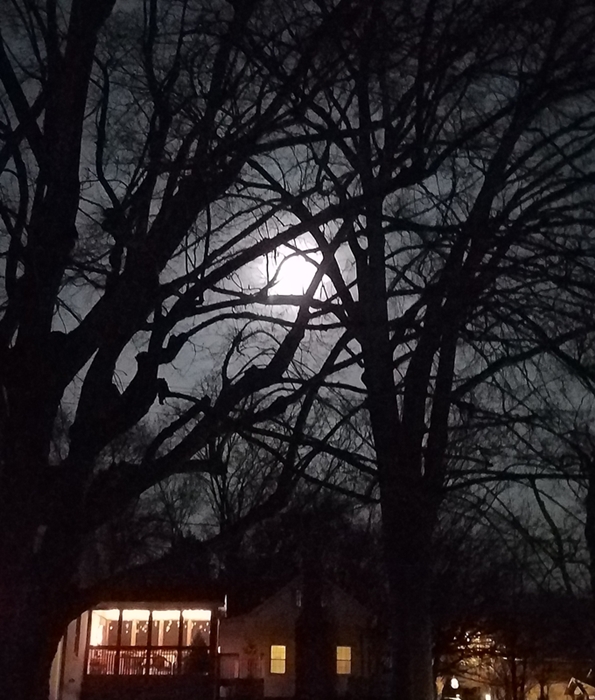
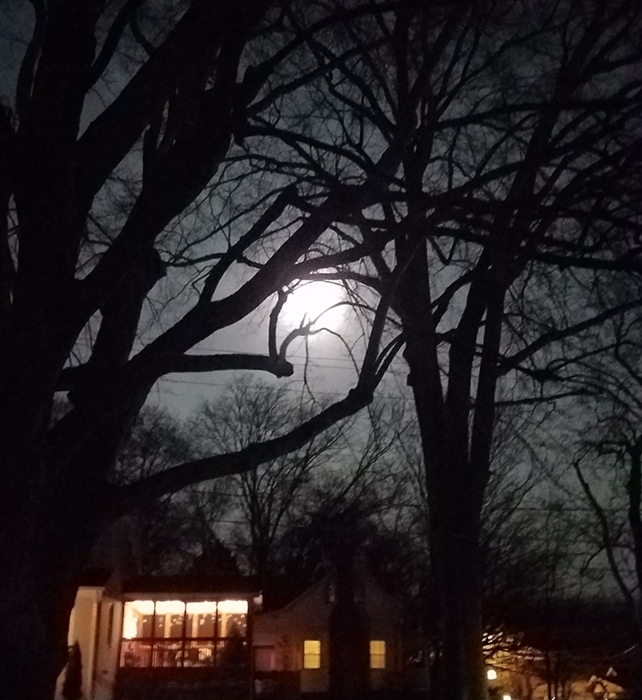
Last year, the Full Worm Moon coincided with the Vernal Equinox. This year, the Worm Moon will be at full illumination at 1:47pm, today. I got some shots of it, earlier (actually, wee hours of the morning).
I did a complete write-up on the Worm Moon on my 2019 post with all of the interesting and varied Native American names. This year, our Worm Moon is a Supermoon, though that isn’t really a true and official ‘astronomical’ term. It’s more of an astrological description and, apparently, was coined by astrologer Richard Nolle. The technical term is perigeesyzygy, with perigee referring to the closeness of the Moon to the Earth and syzygy referring to a straight-line astronomical configuration of three celestial bodies. Depending upon that configuration, there might be a solar eclipse or a lunar eclipse. Supermoons also bring higher tides. This Moon is the last full moon of Winter. Howl for me! ~Vic
Big & bright.
From my driveway.Peaking thru the trees.Reaching out to touch it.I see you.


 Cosmic-Observation