tsort charts
Music Monday: Bedelia 1904
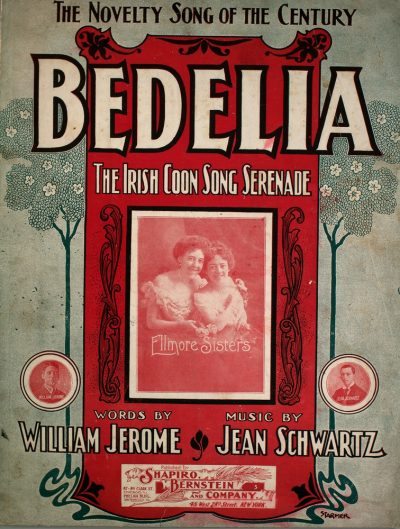
One hundred, twenty years ago, the Irish coon song serenade Bedelia was a number one song for the Haydn Quartet. According to TSort, this version of the song topped Billboard for eleven weeks. Written in 1903 by Jean Schwartz and William Jerome (Flannery), the song has been recorded many times by many singers.
Building songs around girls’ names has always been popular and this one may have been the most popular of this era. The sheet music bills the song as The Novelty Song of the Century and An Irish Coon Song Serenade. Coon songs were popular at the time but, steeped in racial stereotypes about African Americans. The song has more Irish influence than African American, so one assumes the publisher was trying to capitalize on the coon craze with the latter billing. The song was introduced by Blanche Ring playing the character of Liliandra in The Jersey Lily, which opened in September 1903. It was her first starring role on Broadway.
It is unclear who first recorded the song. Billy Murray [did a version that] went to #1. Considering his parents were Irish immigrants, it was fitting that Murray tackled the song, affecting a thick Irish accent to emphasize the song’s comedic nature. Murray’s was among four versions to chart in January 1904. It was quickly followed by a recording by the Haydn Quartet, which spent seven weeks at #1.
Music Monday: T’ain’t Nobody’s Business If I Do 1923
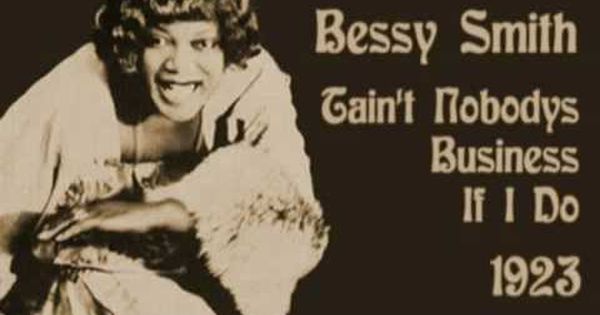
Digging around in Tsort, I was looking for something in 1923 in October. I was not disappointed. T’ain’t Nobody’s Business If I Do was published, originally, in 1922 by Porter Grainger and Everett Robbins, according to the Encyclopedia of the Blues. It was first recorded by an Anna Myers with the Original Memphis Five.
Other recordings were done by Alberta Hunter, Sara Martin and Billie Holiday but, Bessie Smith did her own take.
The most popular of the classic blues singers was Tennessee-born Bessie Smith, who first recorded in 1923. Known as the Empress of the Blues, she possessed a large voice. Smith had toured on the T.O.B.A. circuit since 1912, originally as a chorus girl. By 1918, she was appearing in her own revue in Atlantic City, New Jersey. She struggled, initially, to be recorded. Three companies turned her down before she was signed by Columbia. She eventually became the highest-paid black artist of the 1920s and recorded over 160 songs. Inducted into the Rock and Roll Hall of Fame in 1989, she is often regarded as one of the greatest singers of her era and was a major influence on fellow blues singers, as well as jazz vocalists.
Wikipedia Summaries
With a theme of freedom of choice, some of the lyrics are pretty tough. Per Tsort, this was the top song for a week per US Billboard 9, October 1923. In 1928, guitarist Frank Stokes recorded a country blues version. In 1947, jump blues singer Jimmy Witherspoon did a version titled Ain’t Nobody’s Business, reviving the song and it was the best selling record of 1949. Hank Williams, Jr. recorded his own version of the song for his 1990 album Lone Wolf, peaking at #15 on Billboard’s Hot Country Singles & Tracks chart. In 1996, a version by H2O, featuring Billie Piper got to #19 on the UK Singles chart. ~Vic
The B.B. King Reader: Six Decades of Commentary
Ain’t Nobody’s Business (The Blues Foundation)
Music Monday: Hello Central! Give Me No Man’s Land 1918

One hundred, five years, ago…
Hello Central! Give Me No Man’s Land is a World War I era song released in 1918. Lyrics were written by Sam M. Lewis and Joe Young. Jean Schwartz composed the music. The song was published by Waterson Berlin & Snyder, Co. of New York City. Artist Albert Wilfred Barbelle designed the sheet music cover, which features a photo of Al Jolson next to a shadow of a child on the phone. Explosions in No Man’s Land take up the rest of the red background. The song was written for both voice and piano. It was first introduced in the 1918 musical Sinbad.
The song tells the story of a child attempting to call her father in No Man’s Land. She is unable to reach him over the telephone because her father has been killed fighting on the Western Front.
Wikipedia Summary
There is very little else written about this song. When I have gone to the Tsort charts, with these older pieces, I have usually chosen whatever was at the top of the particular chart, for the particular year. This time, I looked, specifically, for this month in 1918. According to (old) US Billboard 1, this song was on the chart for eight weeks. ~Vic
♦ The New York Public Library Digital Collections
♦ Library of Congress
♦ Smithsonian: National Museum Of American History
♦ WorldCat
♦ First World War: Multimedia History (Web Archive)
 Cosmic-Observation