One-hundred, ninety-nine years ago, today, the realDaniel Boone passed away. Two days prior, I posted about the television show Daniel Boone that was hardly accurate in its portrayal or his frame of life despite being a popular show.
On September 26, 1820 the great pioneering frontiersman Daniel Boone dies quietly in his sleep at his son’s home near present-day Defiance, Missouri.
The indefatigable voyager was 86. Boone was born in 1734 (he has two different dates of birth due to the 1752 Gregorian calendar switch) to Quaker parents living in Berks County, Pennsylvania. Following a squabble with the Pennsylvania Quakers, Boone’s family decided to head south and west for less crowded regions and they eventually settled in the Yadkin Valley of North Carolina. There the young Daniel Boone began his life-long love for wilderness, spending long days exploring the still relatively unspoiled forests and mountains of the region. An indifferent student who never learned to write more than a crude sentence or two, Boone’s passion was for the outdoors, and he quickly became a superb marksman, hunter and woodsman. (It should be noted here that historian John Mack Faragher stated that Boone “acquired a level of literacy that was the equal of most men of his times. He was often the only literate person in groups of frontiersmen.”)
In May of 1769, Boone and five companions crossed over the Cumberland Gap and explored along the south fork of the Kentucky River. Boone returned in 1773 with his family, hoping to establish a permanent settlement. An Indian attack prevented that first attempt from succeeding (Boone’s eldest son James and, William Russell‘s son Henry were captured and tortured to death, a prelude to Dunmore’s War.) but, Boone returned two years later to open the route that became known as Boone’s Trace (or the Wilderness Road) between the Cumberland Gap and a new settlement along the Kentucky River called Fortress Boonesboro. Boonesboro eventually became one of the most important gateways for the early American settlement of the Trans-Appalachian West.
After the French and Indian War (1754–1763) broke out between the French and British, and their respective Indian allies, North Carolina Governor Matthew Rowan called up a militia, for which Boone volunteered. He served under Captain Hugh Waddell on the North Carolina frontier. Waddell’s unit was assigned to serve in the command of General Edward Braddock […].
Boone served in the North Carolina militia during [the] “Cherokee Uprising“. His militia expeditions went deep into Cherokee territory beyond the Blue Ridge Mountains and he was separated from his wife for about two years.
On December 22, 1769, Boone and a fellow hunter, Benjamin Cutbirth, were captured by a party of Shawnees, who confiscated all of their skins and told them to leave and never return.
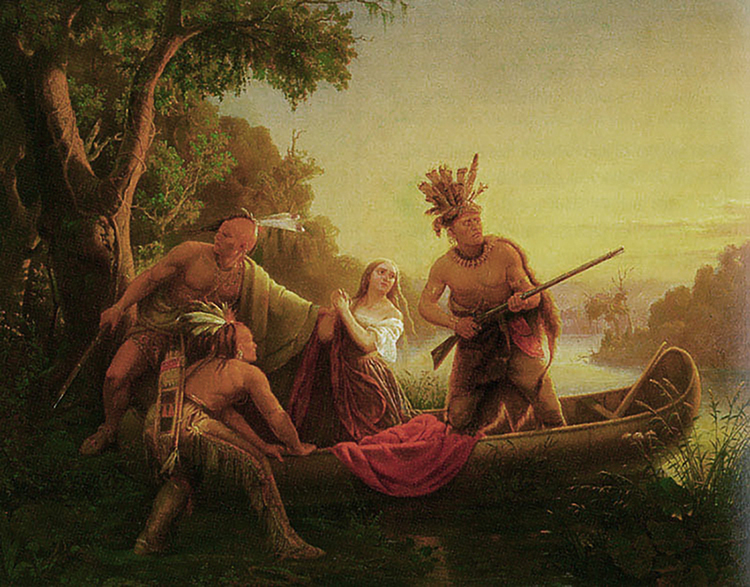
Image Credit: wikipedia.org & wikimedia.org Charles Wimar 1853
[During the Revolutionary War], Boone’s daughter Jemima and two other teenaged girls were captured outside Boonesborough by an Indian war party on July 5, 1776. The incident became the most celebrated event of Boone’s life. James Fenimore Cooper created a fictionalized version of the episode in his classic novel The Last of the Mohicans (1826).
He lived quite an eventful life.
♦ In February 1778, Boone was adopted into the Shawnee tribe as a prisoner to replace a fallen warrior (a Shawnee custom) and was named Sheltowee (Big Turtle), eventually escaping.
♦ In September 1778, he was court-martialed due to misunderstandings during the Siege of Boonesborough.
♦ There is some indication that Boone crossed paths with Abraham Lincoln’s grandfather.
♦ In 1780, Boone was [a] Lieutenant Colonel in the Fayette County militia. In October, his brother Ned was killed by Shawnees and beheaded for a trophy, as the they thought they had killed Boone.
♦ In 1781, he was elected as a representative to the Virginia General Assembly.
♦ [Traveling] to Richmond to take his seat in the legislature, […] British dragoons under Banastre Tarleton captured Boone and several other legislators near Charlottesville. The British released Boone on parole several days later.
♦ In 1782, he was elected sheriff of Fayette County.
♦ By 1787, he owned seven slaves.
♦ In 1798, a warrant was issued for Boone’s arrest after he ignored a summons to testify in a court case, although the sheriff never found him.
♦ Also in 1798, the Kentucky assembly named Boone County in his honor.
♦ From 1799 to 1804, he served as syndic and commandant, appointed by the Spanish governor of Spanish Louisiana (now St. Charles County, Missouri).
♦ American painter John James Audubon claimed to have gone hunting with Boone in the woods of Kentucky around 1810 (some historians believe Boone visited his brother Squire near Kentucky in 1810).
♦ Boone died of natural causes at his son Nathan’s home. He was 85.
Daniel Boone was one of two significant historical figures played by Fess Parker. He previously appeared as Davy Crockett in a series of episodes of the Walt Disney anthology television series […]. Efforts had been made to secure the rights to Crockett from Walt Disney but, Disney refused to sell, so, the series wound up being about Boone instead. In contrast, Parker’s Boone was less of an explorer and more a family man than Parker’s Crockett. Parker as Crockett also generally wore a light beard, whereas his Boone was predominantly clean-shaven.
The series is set in the 1770s and 1780s, just before, during and after the American Revolution and, mostly centered on adventures in, and about, Boonesborough, Kentucky. Some aspects of the show were less than historically faithful, which, at one point, led the Kentucky legislature to condemn the inaccuracies. The series’ story line does not follow historical events. Instead, story lines run back and forth concerning historical events.
Photo Credit: imdb.com
[Ed Ames] role as Mingo led to a famous tomahawk-throwing demonstration on The Tonight Show, that was rerun on anniversary clip shows for decades afterward, in which Ames threw a tomahawk at a target of a man and the hatchet landed between the cutout’s legs, much to host Johnny Carson‘s amusement.
Trivia Bits:
♦ According to an interview with Veronica Cartwright, she left the series because the producers wanted to have her character of Jemima Boone involved in more mature situations, such as budding romantic relationships. Patricia Blair did not like this because it made her feel too old, so she threatened to leave the series if Cartwright was not let go from the series.
♦ Israel Boone was one of seventy-two killed at the Battle of Blue Licks, one of the last battles of the Revolutionary War, on August 19, 1782. He was twenty-three. His father Daniel was there and saw his son killed. Coincidentally, Darby Hinton, who played Israel, was born on the 175th Anniversary of Israel’s death, August 19, 1957.
♦ [The] Boones [actually] had ten children […].
♦ Unlike Fess Parker [6’5″ 1/2], the real Daniel Boone was only about 5’8″.
During the Civil War, two of the oldest families in Kentucky, the Dillons and the Goodwins, begin a long and bitter feud that has lasted into 1938. When Jack Dillon refuses to enter his father’s banking business he, under an assumed name, gets a job as a trainer in Sally Goodwin’s stables. A romance develops between them. When Sally’s father dies, the entire estate, including the horses, has to be sold at auction to pay his debts. A note turns up left by Sally’s father that, according to a wager made between him and the elder Dillon, any one horse in the Dillon stable can be claimed by the Goodwins. Complications arise when Sally finds out that Jack is a Dillon.
Trivia Bits:
♦ A number of famous Kentucky-bred champion racehorses are presented including Gallant Fox, Omaha, Hard Tack, Chance Play and Man of War, who is called the greatest racehorse.
♦ Two Kentucky Derby winners, Willie “Smokey” Saunders and Charlie Burrell, were employed for the film.
♦ Don Ameche was originally cast for the male lead but, was replaced by Richard Greene after undergoing a tonsillectomy.
♦ Arleen Whelan was originally scheduled for the female lead.




 Cosmic-Observation