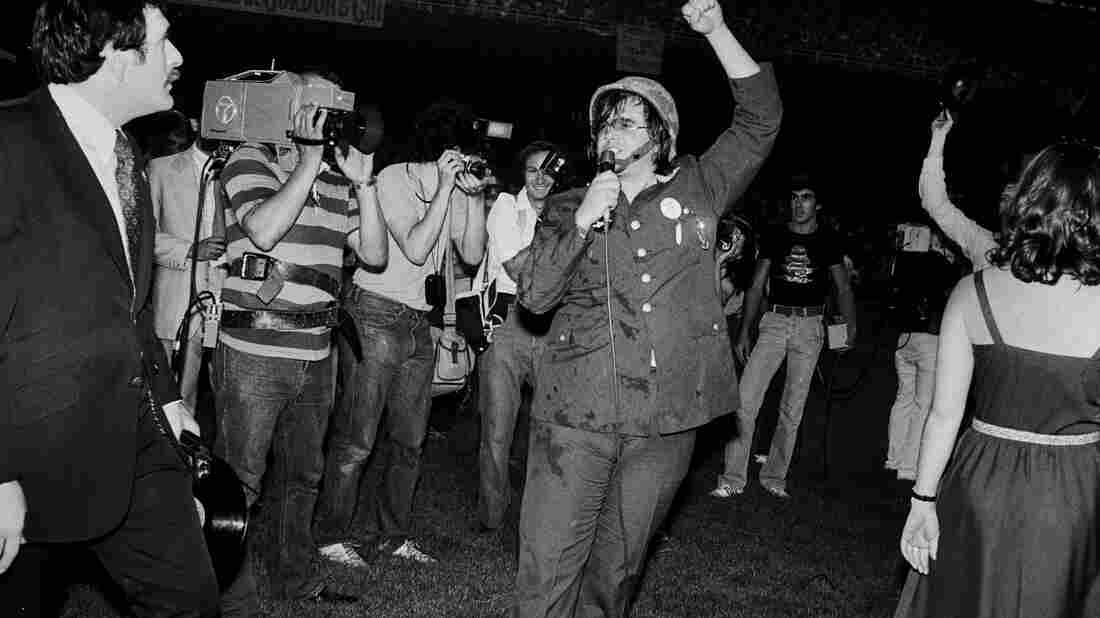
Forty years ago, today, the Disco Demolition took place at Chicago’s Comiskey Park. What started out as a baseball promotion turned into a mêlée that damaged the field.
[..] disco didn’t quite die a natural death by collapsing under its own weight. Instead, it was killed by a public backlash that reached its peak on this day in 1979 […]. That incident, which led to at least nine injuries, 39 arrests and, the cancellation and forfeit of a Major League Baseball game, is widely credited […] or, blamed for […] dealing disco its death blow.
The event was the brainchild of Steve Dahl and Garry Meier, popular disk jockeys on Chicago’s WLUP “The Loop” FM. […] many […] rock DJs were displaced by disco [but], only Dahl was inspired to launch a semi-comic vendetta aimed at “the eradication and elimination of the dreaded musical disease.”
On May 2, the rainout of a game between the Chicago White Sox and the Detroit Tigers led to the scheduling of a doubleheader on July 12. Dahl and Meier approached the White Sox with a rather unorthodox idea for an attendance-boosting promotion […]. […] allow Dahl to blow up a dumpster full of disco records between games of the doubleheader. White Sox executive Mike Veeck embraced the idea […].
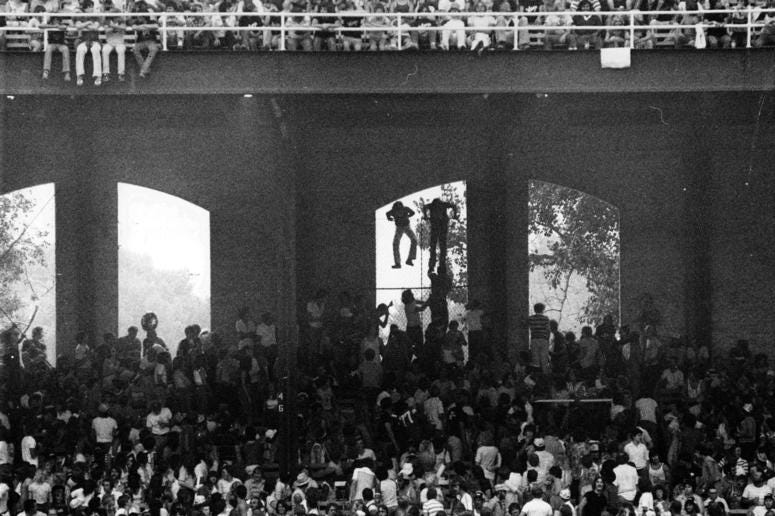
[…] organizers […] grossly [underestimated] the appeal of the 98-cent discount tickets offered to anyone who brought a disco record to the park to add to the explosive-rigged dumpster. WLUP and the White Sox expected perhaps 5,000 more fans than the average draw of 15,000 or so […]. What they got, instead, was a raucous sellout crowd of 40,000+ and an even more raucous overflow crowd of as many as 40,000 more outside on Shields Avenue.
What followed was utter chaos, as fans by the thousands stormed the field, […] began to wreak havoc, shimmying up the foul poles, tearing up the grass and lighting vinyl bonfires on the diamond while the stadium scoreboard implored them to return to their seats. Conditions were judged too dangerous for the scheduled game to begin and the Detroit Tigers were awarded a win by forfeit.
In the weeks before the event, Dahl invited his listeners to bring records they wanted to see destroyed to Comiskey Park. Owner Bill Veeck was concerned the promotion might become a disaster […]. His fears were substantiated when he saw the people walking towards the ballpark that afternoon. […] many carried signs that described disco in profane terms.
Some leapt turnstiles, climbed fences and entered through open windows. Attendees were supposed to deposit their records into a large box [but], once the box was overflowing, many people brought their discs to their seats. Many of the records were not collected by staff and were thrown like flying discs from the stands. Tigers designated hitter Rusty Staub remembered that the records would slice through the air and land sticking out of the ground. He urged teammates to wear batting helmets when playing their positions. “It wasn’t just one, it was many. Oh, God almighty, I’ve never seen anything so dangerous in my life.” Attendees also threw firecrackers, empty liquor bottles and lighters onto the field. The game was stopped several times because of the rain of foreign objects.
Dozens of hand-painted banners with such slogans as “Disco Sucks” were hung from the ballpark’s seating decks. Dahl set off the explosives, destroying the records and tearing a large hole in the outfield grass. […] the first of 5,000 to 7,000 attendees rushed onto the field […]. The batting cage was destroyed and, the bases were pulled up and stolen. Among those taking to the field was 21-year-old aspiring actor Michael Clarke Duncan […]. Duncan slid into third base, had a silver belt buckle stolen and went home with a bat from the dugout. Some attendees danced in circles around the burning vinyl shards.
Chicago police in full riot gear arrived (9:08pm) to the applause of the baseball fans remaining in the stands. Those on the field hastily dispersed upon seeing the police. Tigers manager Sparky Anderson refused to allow his players to take the field […] due to safety concerns. Anderson […] demanded that the game be forfeited to the Tigers. He argued that, under baseball’s rules, a game can only be postponed due to an Act of God, and that, as the home team, the White Sox were responsible for field conditions.
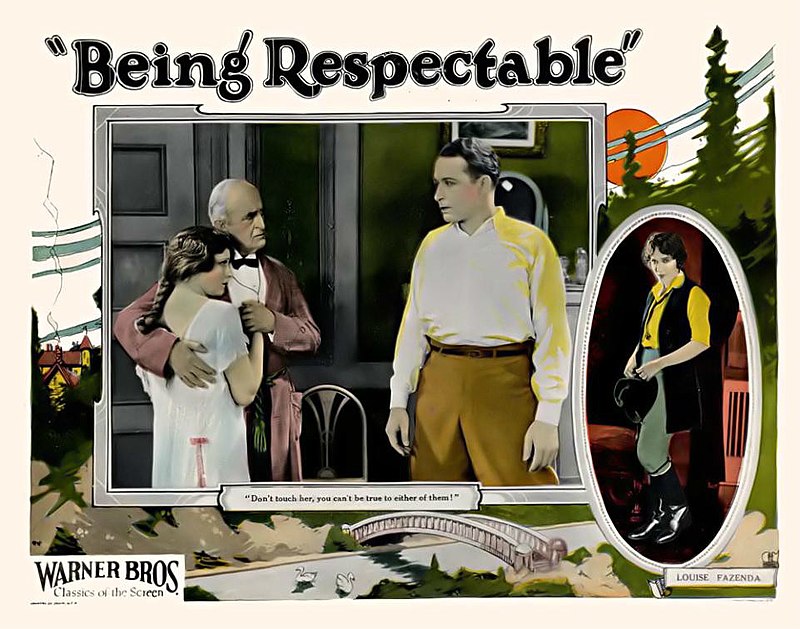
Wealthy young Charles Carpenter is pressured by his family to marry Suzanne, even though he is really in love with young “flapper” Valerie. He gives in to his family’s pressure, however and marries Suzanne, after which Valerie leaves town. Years later, after Charles and Suzanne have had a child, Valerie comes back to town and, Charles realizes he is still in love with her…and she with him. Complications ensue. [Source]
Through the scheming of his respectable, and wealthy family, Charles Carpenter is obliged to marry Suzanne, although he is in love with young flapper Valerie Winship. Years later, when Valerie is back in town, they renew the affair and, Carpenter plans to leave his wife and child for her. […] in the end, he yields to family duty and respectability. [Source]
The Ultimate Western Spoof. A town where everyone seems to be named Johnson is in the way of the railroad. In order to grab their land, Hedley Lemar [sic] (Harvey Korman), a politically connected nasty person, sends in his henchmen to make the town unlivable. After the sheriff is killed, the town demands a new sheriff from the Governor (Mel Brooks). Hedley convinces him to send the town the first Black sheriff (Cleavon Little) in the west. Bart is a sophisticated urbanite who will have some difficulty winning over the townspeople.
“[…] comedies, like Mel Brooks’s “Blazing Saddles,” the best title of the year to date, are like Chinese food. A couple of hours later you wonder where it went. You wonder why you laughed as consistently as you did. [It] is every Western you’ve ever seen turned upside down and inside out, braced with a lot of low burlesque […]. The trouble is that [it] has no real center of gravity. Harvey Korman, a gifted comic actor who is so fine as Carol Burnett’s television co‐star, tries very hard to be funny as a crooked businessman and sometimes succeeds. But, it’s apparent that he’s hard put to keep up with the movie’s restless shifting from satire to parody to farce to blackout sketch. [It] has no dominant personality and, it looks as if it includes every gag thought up in every story conference. Whether good, bad or mild, nothing was thrown out.”
“It’s a crazed grab bag of a movie that does everything to keep us laughing except hit us over the head with a rubber chicken. At its best, his comedy operates in areas so far removed from taste that (to coin his own expression) it rises below vulgarity. One of the hallmarks of Brooks’ movie humor has been his willingness to embrace excess.”
“The writing process on Blazing Saddles was the complete opposite of the writing process on Young Frankenstein. Blazing Saddles was more or less written in the middle of a drunken fistfight. There were five of us all yelling loudly for our ideas to be put into the movie. Not only was I the loudest but, luckily, I also had the right as director to decide what was in or out.”
[…] it was the first Beatles record to be made using four-track equipment. It was also the group’s first American number one, entering the Billboard Hot 100 chart on 18 January 1964 at number forty-five and starting the British Invasion of the American music industry.
“A telegram came through to Brian from Capitol Records of America. He came running in to the room saying, ‘Hey, look. You are number one in America!’ I Want To Hold Your Hand had gone to number one. Well, I can’t describe our response. We all tried to climb onto Big Mal’s back to go round the hotel suite: ‘Wey-hey!’ And that was it, we didn’t come down for a week.”
“It was such a buzz to find that it had gone to number one. We went out to dinner that evening with Brian and George Martin. George took us to a place which was a vault, with huge barrels of wine around. It was a restaurant and its theme was… well, the bread rolls were shaped like penises, the soup was served out of chamber pots and the chocolate ice cream was like a big turd. And, the waiter came ’round and tied garters on all the girls’ legs. I’ve seen some pictures of us. There is a photograph around of Brian with the pot on his head. It was a great feeling because we were booked to go to America directly after the Paris trip, so it was handy to have a number one. We’d already been hired by Ed Sullivan so, if it had been a number two or number ten we’d have gone anyway but, it was nice to have a number one. We did have three records out in America before this one. The others were on two different labels. It was only after all the publicity and the Beatlemania in Europe that Capitol Records decided, ‘Oh, we will have them.’ They put out I Want To Hold Your Hand as our first single but, in fact, it was our fourth.”
Will We All Become Beatle Nuts?
Here’s What the Reviewers Say…
“Anyone who is not a teenage girl obviously is unqualified to comment on the sight of The Beatles in action. Heaven knows we’ve heard them enough. It has been impossible to get a radio weather bulletin or time signal without running into “I Want To Hold Your Hand.” And now, having seen the four performers on Ed Sullivan’s show Sunday night, Beatlemania is even more of a mystery to an elderly viewer.”
~Cynthia Lowry (Associated Press)
“It is now clear why President de Gaulle has been giving England such a hard time about the Common Market. He undoubtedly saw The Beatles and decided nothing doing. As you certainly know, America saw the four-member rock’n’roll British group live on television last night. Pandemonium reigned. Vive La France.”
~Rick DuBrow (United Press International)
“”You can tell right away its The Beatles and not anyone else,” is the opinion of a 15-year-old specialist on the topic who saw them on the Ed Sullivan show. The age of 15 (or 16, or 14 or 13) is essential in Beatle experts. And, so, taking the above axiom as gospel, an attempt was made to find out just what is musically unique about the English group that is now visiting our shores.”
~Theodore Strongin (The New York Times)
“It seems The Beatles came, sang and conquered…all that is but, the TV reviewers. Most of the time, these reviewers have real troubles finding something to write about. Ask them… When Elvis Presley first appeared on the popular musical scene and made his TV début, did they praise him? No. In fact, most beat singers who come under the TV reviewer’s eagle eye rarely receive a word of praise. It seems obvious the reviewers came to bury the teenage favorites and not to praise them. Again, the teenage taste has been mocked. As long as this superior feeling is put across, the younger generation will continue to make their idols…and won’t give a darn who likes them.”
[…] it was the first Beatles record to be made using four-track equipment. It was also the group’s first American number one, entering the Billboard Hot 100 chart on 18 January 1964 at number forty-five and starting the British Invasion of the American music industry.
“A telegram came through to Brian from Capitol Records of America. He came running in to the room saying, ‘Hey, look. You are number one in America!’ I Want To Hold Your Hand had gone to number one. Well, I can’t describe our response. We all tried to climb onto Big Mal’s back to go round the hotel suite: ‘Wey-hey!’ And that was it, we didn’t come down for a week.”
“It was such a buzz to find that it had gone to number one. We went out to dinner that evening with Brian and George Martin. George took us to a place which was a vault, with huge barrels of wine around. It was a restaurant and its theme was… well, the bread rolls were shaped like penises, the soup was served out of chamber pots and the chocolate ice cream was like a big turd. And, the waiter came ’round and tied garters on all the girls’ legs. I’ve seen some pictures of us. There is a photograph around of Brian with the pot on his head. It was a great feeling because we were booked to go to America directly after the Paris trip, so it was handy to have a number one. We’d already been hired by Ed Sullivan so, if it had been a number two or number ten we’d have gone anyway but, it was nice to have a number one. We did have three records out in America before this one. The others were on two different labels. It was only after all the publicity and the Beatlemania in Europe that Capitol Records decided, ‘Oh, we will have them.’ They put out I Want To Hold Your Hand as our first single but, in fact, it was our fourth.
Will We All Become Beatle Nuts?
Here’s What the Reviewers Say…
“Anyone who is not a teenage girl obviously is unqualified to comment on the sight of The Beatles in action. Heaven knows we’ve heard them enough. It has been impossible to get a radio weather bulletin or time signal without running into “I Want To Hold Your Hand.” And now, having seen the four performers on Ed Sullivan’s show Sunday night, Beatlemania is even more of a mystery to an elderly viewer.”
~Cynthia Lowry (Associated Press)
“It is now clear why President de Gaulle has been giving England such a hard time about the Common Market. He undoubtedly saw The Beatles and decided nothing doing. As you certainly know, America saw the four-member rock’n’roll British group live on television last night. Pandemonium reigned. Vive La France.”
~Rick DuBrow (United Press International)
“”You can tell right away its The Beatles and not anyone else,” is the opinion of a 15-year-old specialist on the topic who saw them on the Ed Sullivan show. The age of 15 (or 16, or 14 or 13) is essential in Beatle experts. And, so, taking the above axiom as gospel, an attempt was made to find out just what is musically unique about the English group that is now visiting our shores.”
~Theodore Strongin (The New York Times)
“It seems The Beatles came, sang and conquered…all that is but, the TV reviewers. Most of the time, these reviewers have real troubles finding something to write about. Ask them… When Elvis Presley first appeared on the popular musical scene and made his TV début, did they praise him? No. In fact, most beat singers who come under the TV reviewer’s eagle eye rarely receive a word of praise. It seems obvious the reviewers came to bury the teenage favorites and not to praise them. Again, the teenage taste has been mocked. As long as this superior feeling is put across, the younger generation will continue to make their idols…and won’t give a darn who likes them.”
Lyrics: Oh yeah, I’ll tell you something,
I think you’ll understand,
Then I’ll say that something,
I wanna hold your hand,
I wanna hold your hand,
I wanna hold your hand.
Oh please say to me
You’ll let me be your man,
And please say to me,
You’ll let me hold your hand,
Now let me hold your hand,
I wanna hold your hand.
And when I touch you
I feel happy inside,
It’s such a feeling
That my love I can’t hide,
I can’t hide, I can’t hide.
Yeah, you got that something,
I think you’ll understand,
When I feel that something,
I wanna hold your hand,
I wanna hold your hand,
I wanna hold your hand.
And when I touch you
I feel happy inside,
It’s such a feeling
That my love I can’t hide,
I can’t hide, I can’t hide.
Yeah, you got that something,
I think you’ll understand,
When I feel that something,
I wanna hold your hand,
I wanna hold your hand,
I wanna hold your hand.
“…a comedian of deftness and appealing humor. He is sad. He is preoccupied. He is apprehensive or insinuating with those floating eyes… In the past he has been funny, clever and ludicrous. But, he has never been so enjoyable.”
Of the music, he states:
“Walter Donaldson has composed an appropriate score worthy of better singing than it falls heir to.”
Apparently, Mr. Atkinson disliked Cantor’s singing ability.
The musical was made into a movie in 1930, also pre-code and Eddie Cantor reprised his role from the musical. There was also a 1979 Broadway revival that did very well.
In California, Sheriff Bob Wells and the daughter of a rancher, Sally Morgan, are getting married. She is in love with Wanenis, whose part-Indian heritage presents social difficulties for their romance. Sally abandons Sheriff Bob and their wedding, catching a ride with Henry Williams. As a hypochondriac, Henry has problems of his own but, Sally adds to his problems when she leaves a note saying they have eloped. A chase ensues with the jilted Bob, Mary, Henry’s nurse (who is in love with him) and a cast of others. Along the way, they arrive at the Indian Reservation where Wanenis lives. The movie star Leslie Daw enters the proceedings and sings the torchy, sentimental “Love Me, or Leave Me.”
Trivia Bits:
♦ Eddie Cantor invented the name The March of Dimes for the donation campaigns of the National Foundation for Infantile Paralysis (polio), a play on the “March of Time” newsreels. He began the first campaign on his own radio show in January 1938, asking people to mail a dime to the nation’s most famous polio victim, President Franklin D. Roosevelt. Other entertainers joined in the appeal via their own shows and the White House mail room was deluged with 2,680,000 dimes.
♦ At one time, when the rights to The Wizard of Oz (1939) were owned by Samuel Goldwyn, Cantor was considered for the role of the Scarecrow. Goldwyn eventually sold the rights to Metro-Goldwyn-Mayer.
♦ Quote: “Marriage is an attempt to solve problems together which you didn’t have when you were on your own.”



 Cosmic-Observation