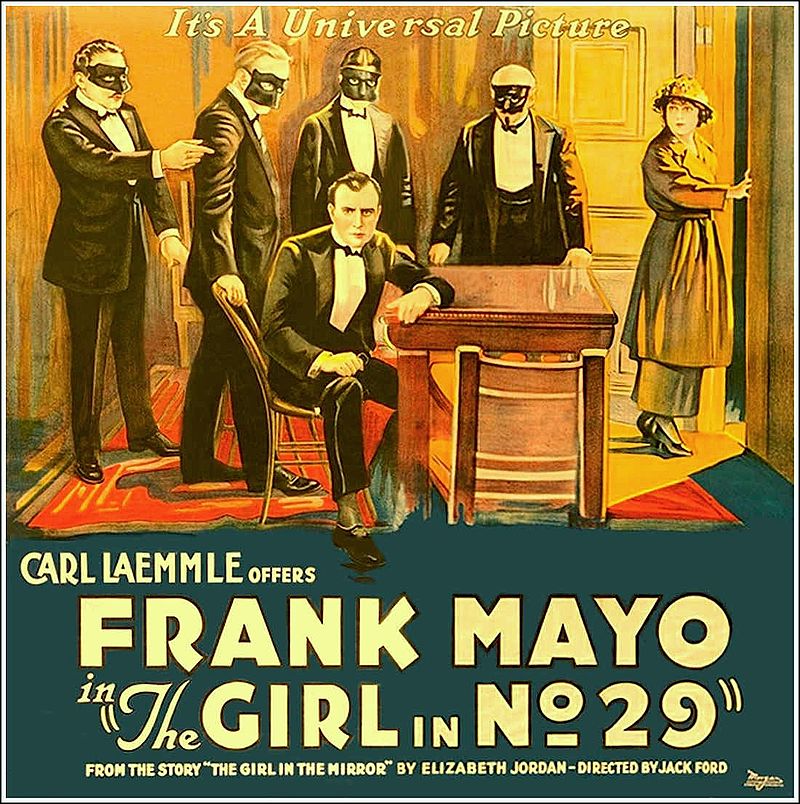
After turning out a successful drama, young playwright Laurie Devon settles down to a life of idleness. Alarmed and disgusted, his friends make every effort to get him to work again but, he refuses. One evening, while glancing into his mirror, Laurie sees a beautiful girl in the apartment across the way, holding a revolver to her head. Dashing out of his apartment house, he prevents her from pulling the trigger. He learns that her name is Doris Williams and discovers that her plight is caused by a man named Shaw. Soon after, Shaw and his thugs abduct her, and Laurie comes to her rescue, shooting her tormentor. Returning home, he confesses his crime to his sister and friends, and learns that the whole incident was a trick to restore his interest in life. The plot succeeds and Laurie writes another hit play in which his new wife Doris is the star.
Laurie Devon (Mayo) is a New York playwright who, having had one success, refuses to work on another play. One night he sees a woman (Anderson) in an apartment across the street take out a gun and place it to her forehead. He reaches her in time to save her and she tells him that she is under some terrible evil influence, which she will not disclose. Devon attempts to untangle the mystery and is led on an adventure. The woman is taken to a house on Long Island, where Devon, after a fight, rescues her. He takes out the revolver and shoots one of the pursuers, who falls to the ground. On returning home, he is heartbroken and tells his sister Barbara (Fair) and his friends that he is a murderer. His sister, and two of his friends, then confess that the whole thing was a frame-up. [T]hey had hired some actors to stage everything and that it was an attempt to get the ambitionless [sic] author to write again. The revolver used in the suicide attempt by the woman, and in the later shooting, had blanks. Devon and the woman from the apartment melt into each other’s arms at the final fade-out.
One of four Admiral-class battlecruisers ordered in mid-1916, [she was] commissioned in 1920 [and] named after 18th-century Admiral Samuel Hood. Despite the appearance of new and, more modern ship designs over time, Hood remained the largest and most powerful warship in the world for 20 years after her commissioning. […] her prestige was reflected in her nickname, “The Mighty Hood”. She was scheduled to undergo a major rebuild in 1941 to correct [some] issues but, the outbreak of World War II in September 1939 forced the ship into service without the upgrades.
In May, [she and] the battleshipPrince of Wales were ordered to intercept the German battleship Bismarck and, the heavy cruiserPrinz Eugen, which were en route to the Atlantic where they were to attack convoys. When Bismarck sailed for the Atlantic […], Hood, together with […] Prince of Wales, was sent out in pursuit along with several other groups of British capital ships to intercept the German ships before they could break into the Atlantic […]. Hood was commanded by Captain Ralph Kerr and was flying the flag of Vice-Admiral Lancelot Holland. The German ships were spotted by two British heavy cruisers (Norfolk & Suffolk) on 23 May and Holland‘s ships intercepted Bismarck, and her consort, Prinz Eugen, in the Denmark Strait between Greenland and Iceland.
Bismarck
Image Credit: pinterest.com
On 24 May 1941, early in the Battle of the Denmark Strait, less than 10 minutes after the British opened fire, a shell from Bismarck struck Hood near her aft ammunition magazines. Soon afterwards, Hood exploded and sank within three minutes, with the loss of all but three of her crew. Prince of Wales continued to exchange fire with Bismarck but, suffered serious malfunctions in her main armament. The British battleship had only just been completed in late March 1941 and used new quadruple gun turrets that were unreliable. [She] soon broke off the engagement.
Due to [the] perceived invincibility of the Hood, the loss affected British morale.
On this day in 1941, Germany’s largest battleship, the Bismarck, sinks the pride of the British fleet, HMS Hood.
The Bismarck was the most modern of Germany’s battleships, a prize coveted by other nation’s navies, even while still in the blueprint stage (Hitler handed over a copy of its blueprints to Joseph Stalin as a concession during the days of the Hitler-Stalin Neutrality Pact). The HMS Hood, originally launched in 1918, was Britain’s largest battlecruiser (41,200 tons) but, also capable of achieving the relatively fast speed of 31 knots. The two met in the North Atlantic, northeast of Iceland, where two British cruisers had tracked down the Bismarck. Commanded by Admiral Gunther Lutjens, Commander-in-Chief of the German Fleet, the Bismarck sunk the Hood, resulting in the death of 1,500 of its crew. Only three Brits survived. Captain Kerr was one of the casualties.
During the engagement, the Bismarck‘s fuel tank was damaged. Lutjens tried to make for the French coast but, was sighted, again, only three days later. Torpedoed to the point of incapacity, the Bismarck was finally sunk by a ring of British war ships. Admiral Lutjens was one of the 2,300 German casualties.
Having grown up listening to Johnny Horton, one of my favorite songs of his is, of course, Sink the Bismarck, released in 1960 (a #1 single in Canada). ~Vic
Lyrics In May of 1941 the war had just begun
The Germans had the biggest ship that had the biggest guns
The Bismarck was the fastest ship that ever sailed the sea
On her decks were guns as big as steers and shells as big as trees
Out of the cold and foggy night came the British ship the Hood
And every British seaman he knew and understood
They had to sink the Bismarck the terror of the sea
Stop those guns as big as steers and those shells as big as trees
We’ll find the German battleship that’s makin’ such a fuss
We gotta sink the Bismarck ’cause the world depends on us
Yeah hit the decks a runnin’ boys and spin those guns around
When we find the Bismarck we gotta cut her down
The Hood found the Bismarck and on that fatal day
The Bismarck started firing fifteen miles away
We gotta sink the Bismarck was the battle sound
But when the smoke had cleared away the mighty Hood went down
For six long days and weary nights they tried to find her trail
Churchill told the people put every ship asail
Cause somewhere on that ocean I know she’s gotta be
We gotta sink the Bismarck to the bottom of the sea
We’ll find the German battleship that’s makin’ such a fuss
We gotta sink the Bismarck ’cause the world depends on us
Yeah hit the decks a runnin’ boys and spin those guns around
When we find the Bismarck we gotta cut her down
The fog was gone the seventh day and they saw the morning sun
Ten hours away from homeland the Bismarck made its run
The Admiral of the British fleet said turn those bows around
We found that German battleship and we’re gonna cut her down
The British guns were aimed and the shells were coming fast
The first shell hit the Bismarck they knew she couldn’t last
That mighty German battleship is just a memory
Sink the Bismarck was the battle cry that shook the seven seas
We found the German battleship ’twas makin’ such a fuss
We had to sink the Bismarck cause the world depends on us
We hit the deck a runnin’ and we and spun those guns around
Yeah we found the mighty Bismarck and then we cut her down
We found the German battleship ’twas makin’ such a fuss
We had to sink the Bismarck cause the world depends on us
We hit the deck a runnin’ and we and spun those guns around
We found the mighty Bismarck and then we cut her down
The Nineteenth Amendent to the U.S. Constitution was ratified on August 18, 1920, with Tennessee being the last state to vote in favor of, achieving the 3/4 majority needed to amend. One would think that this event would have been the end of any argument against a woman’s right to vote but, one more hurdle had to be cleared.
Ninety-seven years ago, today, the U.S. Supreme Court made a ruling on the constitutionality of the amendment.
On October 12, 1920, Cecilia Streett Waters and Mary D. Randolph, citizens of Maryland, applied for and were granted registration as qualified voters in Baltimore City. To have their names stricken from the list Oscar Leser and others brought this suit in the court of common pleas. The only ground of disqualification alleged was that the applicants for registration were women, whereas the Constitution of Maryland limits the suffrage to men. Ratification of the proposed amendment to the federal Constitution, now known as the Nineteenth, 41 Stat. 362, had been proclaimed on August 26, 1920, 41 Stat. 1823, pursuant to Revised Statutes, § 205 (Comp. St. § 303). The Legislature of Maryland had refused to ratify it. The petitioners contended, on several grounds, that the amendment had not become part of the federal Constitution. […] the case comes here on writ of error. That writ must be dismissed but, the petition for a writ of certiorari, also duly filed, is granted. The laws of Maryland authorize such a suit by a qualified voter against the board of registry. Whether the Nineteenth Amendment has become part of the federal Constitution is the question presented for decision.
Photo Credit: law.edu
There were three claims: [1] The power to amend the Constitution did not cover this amendment due to its character.
“[…] the amendment “destroyed State autonomy” because it increased Maryland’s electorate without the state’s consent.”
[2] Several states that had ratified the amendment had constitutions that prohibited women from voting, rendering them unable to ratify an amendment to the contrary.
[3] The ratifications of Tennessee and West Virginia were invalid, because they were adopted without following the rules of legislative procedure in place in those states.
Justice Brandeis delivered the opinion of the Court:
[1] This amendment is in character and phraseology precisely similar to the Fifteenth. For each, the same method of adoption was pursued. One cannot be valid and the other invalid. That the Fifteenth is valid, although rejected by six states, including Maryland, has been recognized and acted on for half a century.
[2] […] But the function of a state Legislature in ratifying a proposed amendment to the federal Constitution, like the function of Congress in proposing the amendment, is a federal function derived from the federal Constitution and, it transcends any limitations sought to be imposed by the people of a state.
[3] The question raised may have been rendered immaterial by the fact that since the proclamation the Legislatures of two other states—Connecticut and Vermont—have adopted resolutions of ratification. But, a broader answer should be given to the contention. The proclamation by the Secretary certified that, from official documents on file in the Department of State, it appeared that the proposed amendment was ratified by the Legislatures of 36 states and, that it ‘has become valid to all intents and purposes as a part of the Constitution of the United States.’ As the Legislatures of Tennessee and of West Virginia had power to adopt the resolutions of ratification, official notice to the Secretary, duly authenticated, that they had done so, was conclusive upon him, and, being certified to by his proclamation, is conclusive upon the courts.
“So, while the 19th Amendment granted women the right to vote, Leser made sure that the right could actually be used, even where the state constitution said otherwise. It’s not one of the more famous Supreme Court decisions in American history but, without it, the electorate would be, well, lesser.”
As an addendum to the above, Maryland finally ratified the amendment on March 29, 1941 but, didn’t certify that until February 25, 1958, two days shy of an exact 36 year delay. And, I am sad to say that my home state of North Carolina didn’t ratify until May 6, 1971, making it third to last behind South Carolina (ratified July 1, 1969 but, not certified until August 22, 1973) and Mississippi (ratified March 22, 1984).
Little video snippet regarding this case:
And, I grew up watching Schoolhouse Rock, I just had to put this up:
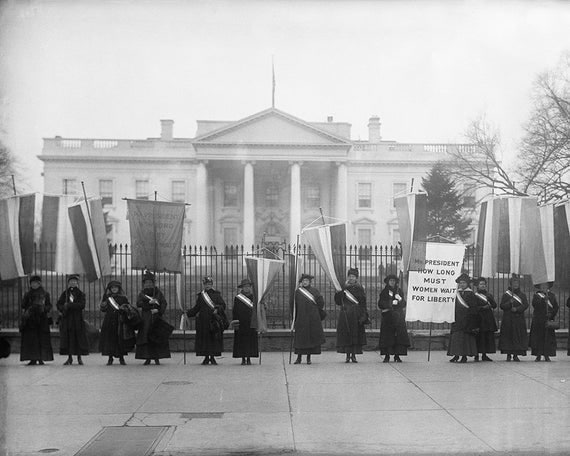
One hundred and two years ago, today, a group of women, organized by Women’s Rights Activist Alice Paul and the National Woman’s Party (NWP), began a picketing and protest campaign in front of the White House during the Wilson Presidency. Known as the Silent Sentinels, the protest began after a meeting with the President regarding suffrage proved fruitless with Wilson stating to the women to “…concert public opinion on behalf of women’s suffrage.” The silent protest was a new strategy for the National Suffrage Movement and served as a constant reminder of Wilson’s lack of support.
Photo Credit: equalmeansequal.org
Originally founded as the Congressional Union for Woman Suffrage (CUWS) after the 1913 woman suffrage parade, they broke away from the National American Woman Suffrage Association (NAWSA), a more moderate group. CUWS only lasted three years and morphed into the NWP. The Suffragist was their weekly newsletter, containing essays, progress reports and notes on the President’s continuing indifference.
There were differing public reactions. Some approved, assisting with holding banners, bringing beverages and donating money. Some opposed their actions, including the leader of the NAWSA, Carrie Chapman Catt, whom preferred political tactics via individual states instead of a national amendment. She feared a male voter backlash.
Photo Credit: pinterest.com
Anti-suffragist mobs could be violent (worsening after the US entered World War I) spurred by the more insulting banners that compared Wilson to Kaiser Wilhelm. The New York Times called the protests “…silly, silent and offensive.” Massachusetts Representative Joseph Walsh referred to them as “…bewildered, deluded creatures with short skirts and short hair…” and “…nagging, iron-jawed angels.”
They were harassed, arrested, tortured and abused. Hunger strikes were met with forced feeding. On the night of November 14, 1917, known as the “Night of Terror“, the superintendent of the Occoquan Workhouse (prison), W.H. Whittaker, ordered the nearly forty guards to brutalize the suffragists. The treatment stories angered many Americans, creating more support. The protesters were finally released November 27 & 28, 1917, Alice Paul having spent five weeks there.
President Wilson finally announced his amendment support on January 8, 1918. The House barely passed the amendment the next day but, the Senate waited until October to vote. It failed by two votes. Protester arrests resumed August 6, 1918 and, by December, protestors were starting fires and burning Wilson effigies in front of the White House. Alice Paul encouraged people to vote against anti-suffrage Senators during the 1918 elections. The House, again, passed the amendment on May 21, 1919 and the Senate followed June 4 ending the six-day-a-week protest. The Nineteenth Amendment was adopted August 18, 1920.




 Cosmic-Observation