biography
Wayback Wednesday: Jolliet-Marquette Upper Mississippi Exploration 1673

Date: 1681
Based on the 1673 Expedition
Source: Library of Congress
Author: Melchisédech Thévenot
Image Credit: Wikimedia Commons
Three hundred, fifty years ago, today…
On May 17, 1673, Louis Jolliet and Jacques Marquette departed from St. Ignace, Michigan, with two canoes and five other voyageurs of French-Indian ancestry. The group sailed to Green Bay. They paddled upstream (southward) on the Fox River to the site now known as Portage, Wisconsin. There, they portaged a distance of slightly less than two miles through marsh and oak forest to the Wisconsin River. Europeans eventually built a trading post at that shortest convenient portage between the Great Lakes and Mississippi River basins. On June 17, the canoeists ventured onto the Mississippi River near present-day Prairie du Chien, Wisconsin.
The Jolliet-Marquette expedition paddled along the west bank of the Mississippi until mid-July. When they passed the mouth of the Arkansas River, they became satisfied that they had established that the Mississippi flowed into the Gulf of Mexico.
The voyageurs then followed the Mississippi back to the mouth of the Illinois River, which friendly natives told them was a shorter route back to the Great Lakes. Following the Illinois river upstream, they turned up its tributary, the Des Plaines River near modern-day Joliet, Illinois. They continued up the Des Plaines River and portaged their canoes, and gear, at the Chicago Portage. They followed the Chicago River downstream until they reached Lake Michigan near the location of modern-day Chicago. Father Marquette stayed at the mission of St. Francis Xavier at the southern end of Green Bay, which they reached in August. Jolliet returned to Quebec to relate the news of their discoveries. On his way through the Lachine Rapids, Jolliet’s canoe overturned and his records were lost. His brief narrative, written from memory, is in essential agreement with Marquette’s, the chief account of the journey.
While Hernando de Soto was the first European to make official note of the Mississippi River by discovering its southern entrance in 1541, Jolliet and Marquette were the first to locate its upper reaches and, travel most of its length, about 130 years later. De Soto had named the river Rio del Espiritu Santo but, tribes along its length called it “Mississippi”, meaning “Great River” in the Algonquian languages.
Wikipedia Summary
Additional:
♦ Louis Jolliet (Britannica)
♦ Louis Jolliet (Dictionary of Canadian Biography)
♦ Jacques Marquette (Britannica)
♦ Jacques Marquette (Biography)
♦ The Explorers (Canadian Museum of History)
♦ Archdiocese of Chicago (New Advent Catholic Encyclopedia/James Marquette)
Louis Jolliet & Jacques Marquette: PBS World Explorers
Marquette and Jolliet: The Beginning of the Voyage to the Mississippi
Song Sunday: Radar Love

“I’ve been drivin’ all night, my hands wet on the wheel…There’s a voice in my head that drives my heel…
Submitted for your approval, returning to my Samsung playlist, I present Radar Love by Golden Earring, a Dutch hard-rock/progressive rock band. I can’t imagine that anyone out there hasn’t heard this song at least once. Founded in 1961 in The Hague, Netherlands, most of their extensive material didn’t even chart in the US. In the 60 years of their existence, they made 25 studio albums, eight live albums, two compilation albums and an impressive 74 singles. Originally named The Tornadoes…
Golden Earring was formed in 1961 in The Hague by 13-year-old George Kooymans and his 15-year-old neighbour, Rinus Gerritsen. Originally called The Tornados, the name was changed to Golden Earrings, when they discovered that The Tornados was already in use by another group.
They [achieved] their first success in 1965 with “Please Go,” as a pop rock band with Frans Krassenburg as lead singer. By 1969, the rest of the lineup had stabilized, with lead vocalist and multi-instrumentalist Barry Hay and drummer Cesar Zuiderwijk. By ’71, they [were] a regular presence on Dutch charts and [were] starting to climb up the ladder in Germany. They [signed] on to the Who’s Track label, which released a compilation of Dutch singles, Hearing Earring, helping the group break through in England.
Golden Earring
Prog Related/Netherlands
Prog Archives
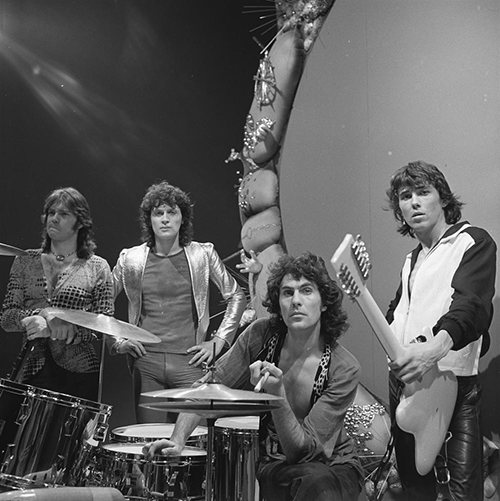
Date: April 19, 1974
Author: AVRO
Source: Netherlands Wiki
Image Credit: Wikipedia
The young group initially baptizes itself as The Tornadoes but, when that name turns out to have already been claimed by another band, they switch to The Golden Earrings – loosely based on a song by the British band The Hunters.
While most Dutch pop bands from the sixties stumble over the threshold to the seventies, the Golden Earring – as the band has come to call itself – emerges from the decade strong and confident.
In 1973, Golden Earring aspires to make an album that is of international allure both artistically and commercially. A lot of time is put into writing and recording what will eventually become Moontan. The mission succeeds brilliantly. Candy’s Going Bad, Radar Love, Just Like Vince Taylor and The Vanilla Queen are among the best the band has written to date.
Both Moontan’s first single Radar Love are a resounding success. First in the Netherlands, then in the rest of Europe and finally in America – where the album was released in 1974. Radar Love even becomes a big hit, with a 13th place as the highest listing. In the following years, however, the song will mainly grow into one of the ultimate car songs, which can still be heard daily on American radio stations. Radar Love has been covered by hundreds of international acts over the decades, including U2, White Lion, Ministry and Def Leppard. Both the single and the album are an undisputed milestone in Dutch pop history.
Golden Earring Biography Page (Google will have to translate.)

It’s not really normal for a band eight albums into their career to suddenly enjoy a worldwide breakout. And, for it to happen with a track over six minutes long with elongated instrumental passages and a somewhat mysterious narrative is even stranger. “…the song most likely to inspire a speeding ticket some 47 years after it was first released.” Barry Hay, the group’s lead singer and lyricist, explained in a recent interview with American Songwriter that a record company push gave then some hope.
“We signed up with Track records, the label of The Who,” Hay says. “And, they really put an effort into it, because they had a sort of monkey wrench. If they could put us together on tour in Europe, they could put us together in Madison Square Garden. So, [we’re] sort of the sons of the Who.”
“At first, the opening line was ‘I’m sitting in a bathtub.’ And, I thought, ‘That’s hardly masculine.’ Then, I came up with sitting in a car.”
“…Hay managed to come up with effortless couplets […] while tying them together in a resonant story of a mystical connection between two separated lovers. […] I remember, in those days, I was really interested in ESP. I read some shit about it. […] Like there’s an accident but, these people still have ESP, they still have contact in a way. Which is sort of a magical thing…
It also inspired a million interpretations but, Hay says that the tragic one is correct. “The guy actually dies,” he says of the song’s narrator. “That’s the gist of the whole thing. In a way, she still has contact with him. There is an afterlife.”
Behind The Song: Radar Love
American Songwriter
Jim Beviglia (Written three years ago)
Unfortunately, Golden Earring is no more:
Golden Earring Co-Founder George Kooymans Retires After ALS Diagnosis
The Band Calls It Quits ~Vic
Additional:
♦ The Virgin Encyclopedia of Heavy Rock (Colin Larkin/1999/Internet Archive/Pages 187-188/Sign-In Required)
♦ It’s Prog Jim, But Not As We Know It: Golden Earring (Louder Sound/Prog/Malcolm Dome/10-28-2014)
Wayback Wednesday: Attilla Attacks Italy 452
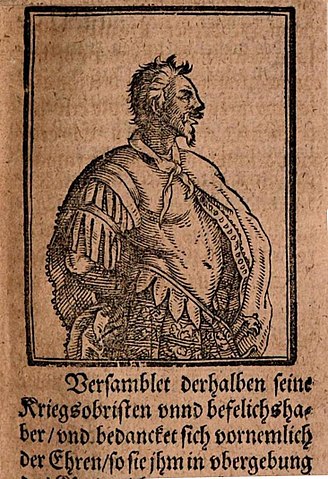
Author: Willhelm Dilich
Source: Ungarische Chronica
Image Credit: Wikipedia
Attila was the ruler of the Huns from 434 until his death in March 453. He was also the leader of a tribal empire consisting of Ostrogoths, Alans and Bulgars, among others, in Central and Eastern Europe. He is also considered one of the most powerful rulers in world history.
Attila [invaded] and [ravaged] Italy on June 8, 452, one-thousand, five hundred and seventy years, ago, today. Communities became established in what would later become Venice as a result of these attacks when the residents fled to small islands in the Venetian Lagoon. His army sacked numerous cities and razed Aquileia so completely that it was afterwards hard to recognize its original site. Aëtius lacked the strength to offer battle, but managed to harass and slow Attila’s advance with only a shadow force. Attila finally halted at the River Po. By this point, disease and starvation may have taken hold in Attila’s camp, thus hindering his war efforts and potentially contributing to the cessation of invasion.
Wiki Summary
Attila, by-name Flagellum Dei (Latin: “Scourge of God”) [ruled] jointly with his elder brother Bleda until 445. In legend, he appears under the name Etzel in the Nibelungenlied and under the name Atli in Icelandic sagas. The empire that Attila and his elder brother Bleda inherited seems to have stretched from the Alps and the Baltic in the west to somewhere near the Caspian Sea in the east.
In 452, the Huns invaded Italy and sacked several cities, including Aquileia, Patavium (Padua), Verona, Brixia (Brescia), Bergomum (Bergamo), and Mediolanum (Milan). Aetius could do nothing to halt them but, the famine and pestilence raging in Italy in that year compelled the Huns to leave without crossing the Apennines.
Attila, King of the Huns
Britannica Summary
Attila invaded northern Italy in 452 but, spared the city of Rome due to the diplomacy of Pope Leo I and the rough shape of his own troops. Legend has it that St. Peter and St. Paul appeared to Attila, threatening to strike him dead if he did not settle with Pope Leo I. Attila died the following year, in 453, before he could try once again to take Italy.
Attlia the Hun
Biography
Sir Thomas Sean Connery

Bond. James Bond.
Photo Credit: Far Out Magazine UK
I just found out about the passing of actor Sean Connery. There are certain actors I have a thing for and he is one of them. Our birthdays are five days apart and we both have Scottish (and Irish) ancestry. He enlisted in the Royal Navy at the age of 16, was assigned to the HMS Formidable as an Able Seaman and was medically discharged at 19 for ulcers.
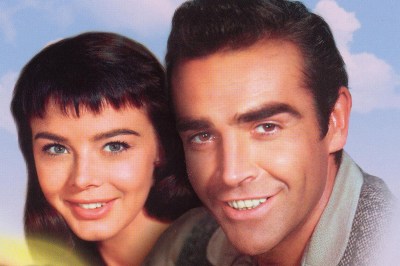
Image Credit: Time
One of his early endeavors was as an artist’s model. He was into bodybuilding and was in a Mr. Universe contest, though the actual year is disputed. He was a footballer, playing for Bonnyrigg Rose and was once offered a contract to play professionally:
“[I] realised that a top-class footballer could be over the hill by the age of 30 and I was already 23. I decided to become an actor and it turned out to be one of my more intelligent moves.”
He was a member of the Scottish National Party and campaigned for Scottish Independence, financially supporting the party until the UK passed legislation to prohibit overseas funding. One of his two tattoos was “Scotland Forever.”
He managed to make it all the way to 90 but, according to his son Jason, he had been unwell for some time. He passed peacefully in his sleep at his home in the Bahamas. I think it altogether fitting and proper that Sir Sean left on Halloween during a full Blue Moon. Godspeed. ~Vic

Image Credit: Reddit
Career Highlights:
His acting debut (uncredited) was in the UK film Lilacs in the Spring (titled Let’s Make Up in the US) in 1954, a British musical starring Errol Flynn. On UK TV, he played MacBeth, Alexander the Great and Count Vronsky. His first appearance on US TV was on The Jack Benny Program in 1957. His first credited film roll in the US was a UK/US collaboration in the movie Action of the Tiger, also in 1957. He was the first James Bond (and some say the only one), he played a savage in the distant future, became Robin Hood, was a Marshal in outer space, was King Agamemnon, was a sword-wielding immortal, did a turn as a Franciscan friar, was an Untouchable, a Provost Marshall in San Francisco, was the father of Indiana Jones, a Russian submarine Captain, appeared as King Richard, became a doctor, was a detective, a professor, played King Arthur, played an ex-con & an art thief, was a reclusive author and, was the voice of The Last Dragon. He was only in one Western in 1968. His last time on the big screen was in 2003 playing Allan Quatermain in The League of Extraordinary Gentlemen and his last time on TV was playing character John Muir in an episode of the documentary Freedom: A History of US, also in 2003. He did voice work up to 2012.
Awards:
♥ 1987 Academy Award (Best Supporting Actor/The Untouchables)
♥ 1987 BAFTA (Best Actor/The Name of the Rose)
♥ 1998 BAFTA Fellowship
♥ 1972 Golden Globe (Henrietta Award/World Film Favorite-Male)
♥ 1987 Golden Globe (Best Supporting Actor/The Untouchables)
♥ 1995 Golden Globe (Cecil B. DeMille Award)

Photo Credit: Pinterest
Nominations:
♦ 1987 BAFTA (Best Supporting Actor/The Untouchables)
♦ 1989 BAFTA (Best Supporting Actor/Indiana Jones and the Last Crusade)
♦ 1990 BAFTA (Best Actor/The Hunt for Red October)
♦ 1965 Golden Globe (Henrietta Award/World Film Favorite-Male)
♦ 1968 Golden Globe (Henrietta Award/World Film Favorite-Male)
♦ 1989 Golden Globe (Best Supporting Actor/Indiana Jones and the Last Crusade)
www.seanconnery.com (Web Archive)
Additional Reading & Sources:
BBC News
Belly Buzz (Web Archive of Connery’s Military Service)
List of Work (IMDb)
List of Work (Wikipedia)
Muscle Memory (As Tom Connery)
Scottish Junior Football Association (Web Archive)
Scottish Roots
Talk-Talk UK (Archive Today Copy of Connery’s Biography)
 Cosmic-Observation