For the New Year, I will be doing some blog-housekeeping. I have a tendency to stretch myself thin with headings and posts. I will be doing some consolidating. Song Sunday, News of the Day (NOTD) & Word of the Day (WOTD) are gone. I jettisoned some other headings about a year, ago. On to the show…~Vic
Returning to my Samsung playlist, submitted for your approval…
“Tell me your secrets, I’ll tell you mine…”
The second track, on side two, from the album Hotel California, Victim of Love was never released as a single. It was the B-Side to New Kid in Town, releasedDecember 7, 1976 and did get some airplay as an album track over the years.
By the time the Eagles reached the mid-1970s, they were on top of the world. They had been sorting their way through every rock trope they could think of and the album One of These Nights spawned three different singles. With success also comes pressure, though and the band had their backs against the wall when it came time to make Hotel California. When talking about making the concept for the album, Don Henley mentioned wanting to say something about the state of Hollywood, saying, “There’s a fine line between the American dream and the American nightmare.” The rest of the band were more than willing to comply, with Joe Walsh coming up with the original lick for Life in the Fast Lane on a whim.
Walsh had claimed to use the lick as a warm-up exercise but, it turned into its own piece once Glenn Frey got the title for the song. While guitarist Don Felder came up with the main chord progression for the title track, he had his sights on another song that he wrote for the album. Midway through recording, Felder said that he wanted to sing the track Victim of Love, which he claimed to have written by himself. As Henley remembers, what Felder presented the band with was just a collection of riffs, which was then turned into a song by Frey and J.D. Souther.
After one butchered take after the next, the band told Felder that it would be better if he didn’t sing the song, only for Felder to put his foot down. The band acquiesced and let Felder do his own take on the song but, they were also keeping a close eye on their manager as well. As the sessions were winding down, the band gave manager Irving Azoff a job…take Felder out to dinner while they re-recorded the entire track. When Felder found out that he was being erased from the song, he mentioned feeling betrayed…”It was like Don was taking that song from me. I had been promised a song on the next record.”
While Henley, to this day, disputes that there were no promises made to Felder, this started the dividing line between the band. As the touring got bigger and bigger, Felder started to get more resentful towards Frey and Henley for getting all of the songwriting royalties. By the time the band pulled into Long Beach for a benefit concert, Felder took it one step too far after making an off-handed remark to Senator Alan Cranston about the free show. Compared to the petty squabbling behind the scenes, there was audio taken of the infamous gig, which led to Frey and Felder threatening to kill each other onstage. When the house lights went out that night, Felder took his guitar, smashed it and drove off, never to be heard from again.
Once bassist Timothy B. Schmidt called Frey about the next rehearsals, he confirmed the worst. The band was history. The Eagles’ music may have reeked of California sunshine but, their final days ended with plotting, resentment and some of the worst drama a band could ask for.
Also known as the Second Treaty of Indian Springs or Treaty with the Creeks, one-hundred, ninety-five years ago, today, it was signed by the Muscogee and the U.S. government at the Indian Springs Hotel (now a museum).
The U.S. and the Muscogee had, previously, signed the Treaty of Indian Springs of 1821. On January 8, the Muscogee agreed to cede their land holdings east of the Flint River to the state of Georgia in exchange for $200,000, paid in installments.
[…] Duncan Campbell and James Meriwether, U.S. Commissioners, [wrote] to Georgia Governor George M. Troup regarding obstacles the commissioners [faced] in treating with the Creeks. They [related] that proceedings [were] being conducted orally since the written method [had] failed. Also, the publication of negotiations held at Tucabatchee (Tuckabatchee or Tuckabatchie) and Pole Cat Springs [had] spread alarm throughout the nation as [had] the persistent “interference” of the Cherokees. Campbell and Meriwether negotiated the Treaty of Indian Springs [of] 1825 that was unauthorized by a majority of Creeks and, later, abrogated by the United States.
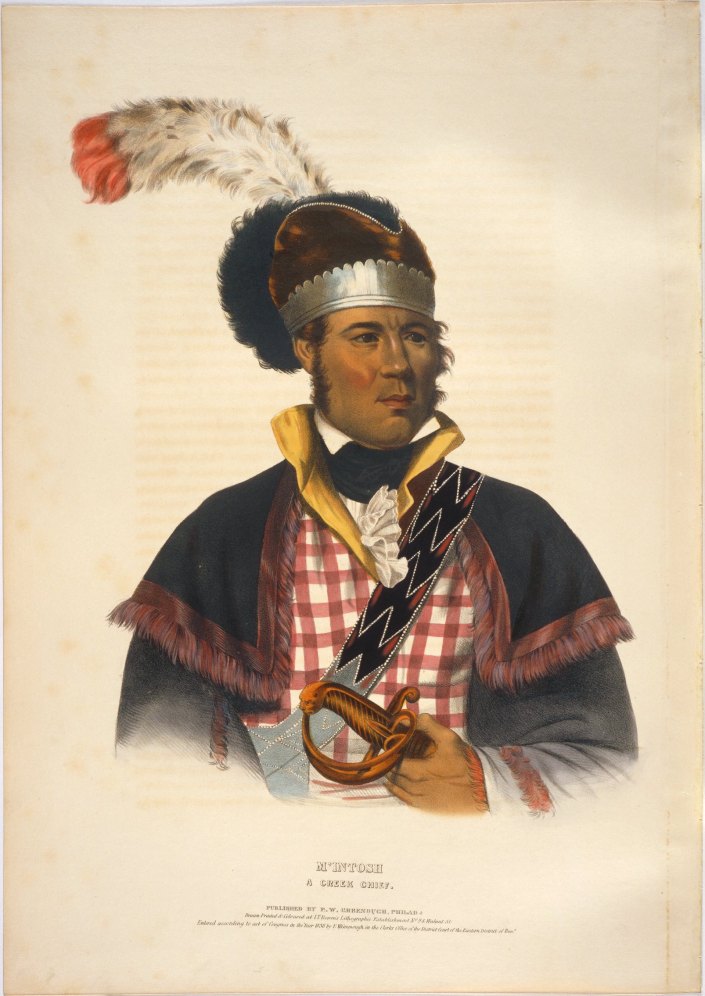
Image Credit: Georgia Encyclopedia William McIntosh
Tustunnuggee Hutke (White Warrior)
The treaty that was agreed [to] was negotiated with six chiefs of the Lower Creek, led by William McIntosh. McIntosh agreed to cede all Muscogee lands east of the Chattahoochee River, including the sacred Ocmulgee National Monument (Historic Park), to Georgia and Alabama and, accepted relocation west of the Mississippi River to an equivalent parcel of land along the Arkansas River. In compensation for the move to unimproved land, and to aid in obtaining supplies, the Muscogee nation would receive $200,000 (again), paid in decreasing installments over a period of years. An additional $200,000 was paid directly to McIntosh.
Outcome:
Governor Troup, and most Georgians, were in favor of the treaty and his inside man was his first cousin…William McIntosh. McIntosh paid the highest price. According to a Creek law, that McIntosh, himself, had supported, a sentence of execution awaited any Creek leader who ceded land to the United States without the full assent of the entire Creek Nation. Just before dawn on April 30, 1825, Upper Creek chief Menawa, accompanied by 200 Creek warriors (The Law Menders), attacked McIntosh at Lockchau Talofau (Acorn Bluff/McIntosh Reserve) to carry out the sentence. They set fire to his home, shot and stabbed him to death and, [killed] the elderly Coweta chief Etomme Tustunnuggee. Chillie McIntosh, the chief’s oldest son, had also been sentenced to die but, he escaped by diving through a window. Later that day, the Law Menders found [Samuel and Benjamin Hawkins, Jr.] (McIntosh’s sons-in-law), who were also signatories. They hanged Samuel and shot Benjamin but, he escaped.
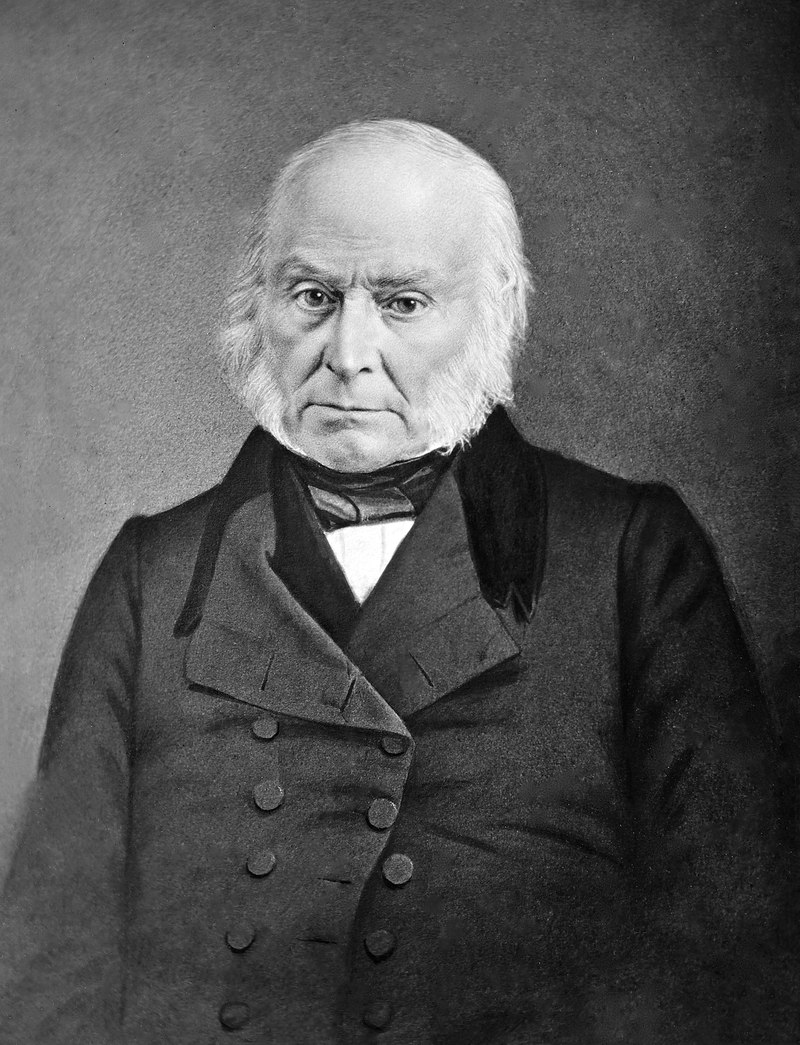
A large majority of chiefs and warriors objected that McIntosh did not have sufficient authority to sign treaties or cede territory. [The] Creek Nation sent a delegation, led by Opothleyahola and [included] Menawa, to lodge an official complaint. Federal investigators (appointed by President John Quincy Adams) agreed and the U.S. government negotiated a new land cession in the 1826 Treaty of Washington. The Creeks did not, however, have their territory restored in the new treaty.
Though the Creek did retain a small tract of land on the Georgia-Alabama border and the Ocmulgee National Monument, Governor Troup refused to recognize the new treaty. [He] authorized all Georgian citizens to evict the Muscogee and ordered the land surveyed for a lottery, including the piece that was to remain in Creek hands. He threatened an attack on Federal troops if they interfered with the [previous] treaty and challenged [the President]. The president intervened with Federal troops but, Troup called out the state militia, and Adams, fearful of a civil war, conceded.
Sixty-five years ago, today, the #1 song on Billboard (pre-hot 100 era) was Oh! My Pa-Pa (O Mein Papa) performed by Eddie Fisher. A lamentation, sung by a young woman grieving the loss of her clown-father, the song was written by Swiss composer Paul Burkhard in 1939 for the musical Der schwarze Hecht (The Black Pike). Reproduced and re-issued in 1950 as Das Feuerwerk (The Firework), the musical was made into a German film, Fireworks, in 1954 starring Lilli Palmer.
Trumpeter Eddie Calvert had a #1 with an instrumental version of the song in the UK at the very same time Fisher’s version was the #1 in the US.
On March 8, 1967, television audiences were treated to a version of the song by Jim Nabors, in character as Gomer Pyle, in the Season 3 episode (#85) “Sing a Song of Papa”. On October 24, 1991, Krusty the Clown sang the song as O mein Papa on The Simpsons in the Season 3 episode Like Father, Like Clown, a twist on the young woman’s sorrow over her father.




 Cosmic-Observation