wikipedia summary
Throwback Thursday: Edward III 1327

Author: William Bruges (1375-1450)
Date: 1430 to 1440
Description: Illuminated Manuscript Miniature
Six hundred, ninety-seven years ago, today…
Edward III, also known as Edward of Windsor before his accession, was King of England from January 25, 1327, until his death in 1377. He is noted for his military success and for restoring royal authority after the disastrous and unorthodox reign of his father, Edward II. Edward III transformed the Kingdom of England into one of the most formidable military powers in Europe. His fifty-year reign was one of the longest in English history and saw vital developments in legislation & government, in particular, the evolution of the English Parliament, as well as the ravages of the Black Death. He outlived his eldest son, Edward the Black Prince and the throne passed to his grandson Richard II.
Edward was crowned at age fourteen after his father was deposed by his mother, Isabella of France and her lover Roger Mortimer. At the age of seventeen, he led a successful coup d’état against Mortimer, the de facto ruler of the country and began his personal reign. After a successful campaign in Scotland, he declared himself rightful heir to the French throne, starting the Hundred Years’ War. The first phase of the war […] would become known as the Edwardian War. Victories at Crécy and Poitiers led to the highly favorable Treaty of Brétigny […] and Edward renounced his claim to the French throne. Edward’s later years were marked by international failure and domestic strife, largely as a result of his inactivity and poor health.
Edward was born at Windsor Castle on November 13, 1312 and was described in a contemporary prophecy as “the boar that would come out of Windsor“.Wiki Summary
Wayback Wednesday: Invasion Of Grenada 1983

Getty Image
Phil Kukielski
IINSTP
Forty years ago, today…this happened during my senior year of high school. I remember it well. I also enjoyed Heartbreak Ridge in 1986, even though the scene with the pay telephone and the credit card call for fire support, that actually happened, was the 82nd Airborne Division, not the Marines. ~Vic
The United States Invasion of Grenada began at dawn on October 25, 1983. The United States and a coalition of six Caribbean nations invaded the island nation of Grenada, 100 miles north of Venezuela. Code-named Operation Urgent Fury by the U.S. military, it resulted in military occupation within a few days. It was triggered by the strife within the People’s Revolutionary Government, which resulted in the house arrest and execution of the previous leader, [the] second Prime Minister of Grenada, Maurice Bishop, [leading to] the establishment of the Revolutionary Military Council, with Hudson Austin as chairman. The invasion resulted in the appointment of an interim government, followed by elections in 1984.
Wikipedia Summary
Grenada gained independence in 1974. Maurice Bishop became [Prime Minister] as a result of a coup in 1979 and, he had pursued left-wing policies with Soviet and Cuban aid since then. In Washington, D.C., he was seen as a communist collaborator and a new airport under construction in Grenada was deemed a transfer point for weapons destined for Latin American revolutionaries. Bishop’s assassination, by a more hard-line Military Revolutionary Council on October 19, 1983, was taken as the signal to act. Publicly justified by the need to protect U.S. students in Grenada, Operation Urgent Fury was hastily thrown together. The only resistance was likely to come from a contingent of Cubans, claimed to be construction workers by Havana.
♦ The Invasion of Grenada (The History Guy/April 20, 2019)
♦ Operation Urgent Fury: The 1983 US Invasion of Grenada (War History Online/Nikola Budanovic/December 2, 2017)
♦ How Grenada Reshaped The US Military (Informal Institute For National Security Thinkers & Practitioners/Phil Kukielski/September 8, 2013)
US Invades Grenada AP Archive
Heartbreak Ridge Trailer
Music Monday: T’ain’t Nobody’s Business If I Do 1923
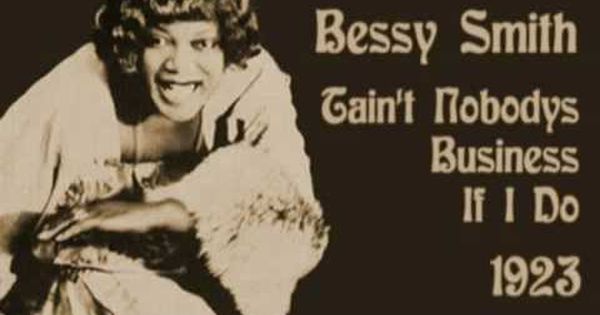
Digging around in Tsort, I was looking for something in 1923 in October. I was not disappointed. T’ain’t Nobody’s Business If I Do was published, originally, in 1922 by Porter Grainger and Everett Robbins, according to the Encyclopedia of the Blues. It was first recorded by an Anna Myers with the Original Memphis Five.
Other recordings were done by Alberta Hunter, Sara Martin and Billie Holiday but, Bessie Smith did her own take.
The most popular of the classic blues singers was Tennessee-born Bessie Smith, who first recorded in 1923. Known as the Empress of the Blues, she possessed a large voice. Smith had toured on the T.O.B.A. circuit since 1912, originally as a chorus girl. By 1918, she was appearing in her own revue in Atlantic City, New Jersey. She struggled, initially, to be recorded. Three companies turned her down before she was signed by Columbia. She eventually became the highest-paid black artist of the 1920s and recorded over 160 songs. Inducted into the Rock and Roll Hall of Fame in 1989, she is often regarded as one of the greatest singers of her era and was a major influence on fellow blues singers, as well as jazz vocalists.
Wikipedia Summaries
With a theme of freedom of choice, some of the lyrics are pretty tough. Per Tsort, this was the top song for a week per US Billboard 9, October 1923. In 1928, guitarist Frank Stokes recorded a country blues version. In 1947, jump blues singer Jimmy Witherspoon did a version titled Ain’t Nobody’s Business, reviving the song and it was the best selling record of 1949. Hank Williams, Jr. recorded his own version of the song for his 1990 album Lone Wolf, peaking at #15 on Billboard’s Hot Country Singles & Tracks chart. In 1996, a version by H2O, featuring Billie Piper got to #19 on the UK Singles chart. ~Vic
The B.B. King Reader: Six Decades of Commentary
Ain’t Nobody’s Business (The Blues Foundation)
Throwback Thursday: Japan Airlines Flight 404 1973

Date: August 19, 1983
Source: Air Britain Photo Library
Similar plane to the hijacked one.
Acquired: Wikimedia Commons
Fifty years ago, today…
Japan Air Lines Flight 404 was a passenger flight which was hijacked by Palestinian and Japanese terrorists on July 20, 1973. The flight departed Amsterdam-Schiphol International Airport, Netherlands, […], en route to Tokyo International Airport […], Japan, via Anchorage International Airport, Alaska. The aircraft was a Boeing 747-246B, with 123 passengers and 22 crew members on board. The passenger complement included five terrorists, led by Osamu Maruoka, a member of the Japanese Red Army and the other four were members of the Popular Front for the Liberation of Palestine.
The flight was hijacked shortly after takeoff from Schiphol. In the course of the hijacking, a grenade carried by one of the skyjackers detonated, killing her and injuring the flight’s chief purser. The lead hijacker […] immediately announced himself to air traffic control as El Kassar, hijacking the aircraft in the name of the Palestinian Liberation movement. After several Middle Eastern governments refused to permit Flight 404 to land, the plane eventually touched down in Dubai, in the United Arab Emirates. After several days on the ground, the terrorists demanded the release of Kozo Okamoto, survivor of the JRA’s attack on Tel Aviv’s Lod Airport.
After the Israeli government refused to release Okamoto, the hijackers flew the aircraft first to Damascus, Syria, and then to Benghazi, in Libya. On July 23, 89 hours after the hijacking began, the passengers and crew were released. [The] hijackers then blew up the aircraft, making the incident the second hull loss of a Boeing 747. The first hull-loss was also the result of hijackers. Maruoka escaped and in 1977, led the hijacking of Japan Air Lines Flight 472. He remained a fugitive, until 1987, when he was arrested in Tokyo after entering Japan on a forged passport. Given a life sentence, he died in prison on May 29, 2011.
Wikipedia Summary
The Skyjackers Strike Again (Time Magazine/07-30-1973/Wayback Machine)
Skyjackers: Part II (Time Magazine/07-30-1973/Wayback Machine)
Chronology Of Aviation Terrorism: 1968-2004 (Skyjack Chronology/Dr. Hillel Avihai/Wayback Machine)
Aviation Safety Network Database (JL404/Aviation Letter 184/07-23-1973)
Ex-Red Army Member Maruoka Dies (The Japan Times/05-30-2011)
July 22
July 25
July 26
TV Tuesday: Wisden Trophy 1963
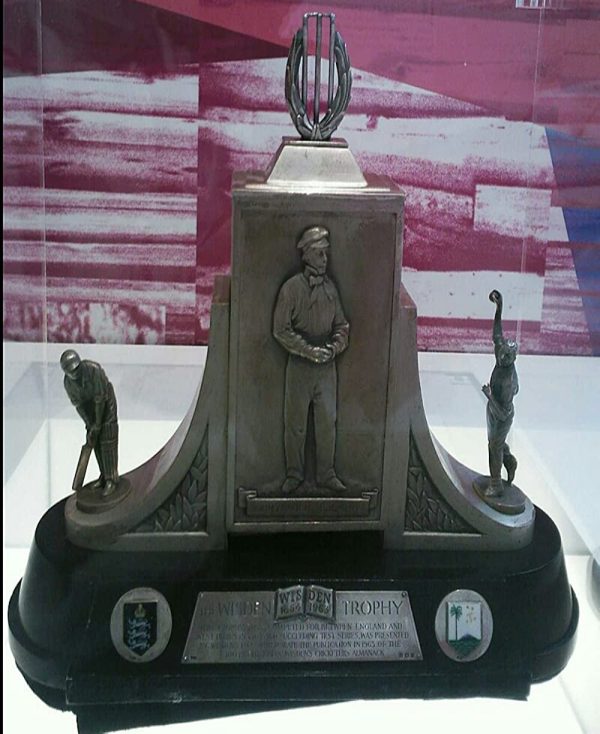
Sixty years, ago, today, the British TV Series Wisden Trophy debuted.
The trophy is named after the famous cricketing publisher Wisden and was presented by John Wisden & Co. after gaining the approval of the Marylebone Cricket Club (MCC) and the West Indies Cricket Board (WICB). The [trophy] was presented to the victorious team as a symbol of its victory but, then, returned to the MCC Museum at Lord’s.
The [trophy was] awarded to the winner of the Test cricket series, played between England and the West Indies. It was first awarded in 1963 to commemorate the hundredth edition of Wisden Cricketers’ Almanack. Series were played in accordance with the future tours programme, with varying lengths of time between tours. If a series was drawn, then, the country holding the [trophy] retained it. In 2020, it was announced that the trophy would be replaced by the Richards–Botham Trophy, named after Sir Vivian Richards and Sir Ian Botham.
Wikipedia Summary
The list of “cast members” consisted of various cricketers hosting the show. Brian Lara had the most appearances (34), with Garry Sobers, Rohan Kanhai and Micky Stewart hosting the first episode.
I have to confess that I know squat about cricketing. ~Vic
 Cosmic-Observation