I have not done a National or Celebration Day since July 2020. I routinely do well-known Holidays but, I am putting these back in rotation. Enjoy! ~Vic
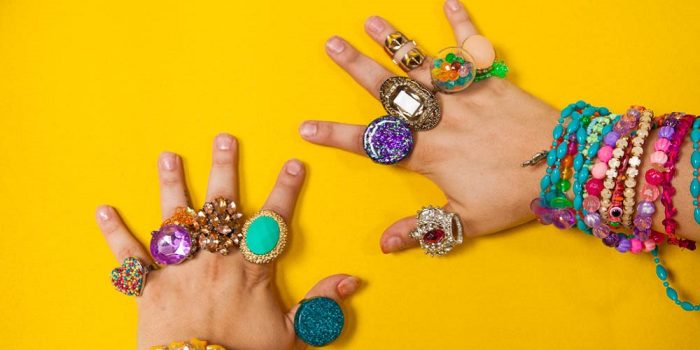
Ever wish there was more than one day a year where you could take all the conventions of proper dress and throw them out the window? Wish no more! Wear Something Gaudy allows you to let all your best examples of excruciatingly bad taste hang out for the world to see. Obviously, the best way is to choose something that is utterly without taste or fashion to wear but, that isn’t the only way. You can find your way to thrift stores to locate out of date fashions that are rarely seen out and about today and, put together an ensemble designed to shock and appall. Even throwing on a eye-searing boa can be a simple way to celebrate or you can just wear colors that clash. Everyone has pieces in their wardrobe that just don’t go, so, get in there and make peoples eyes waggle!
Wear Something Gaudy Day first came into existence through the 1970s sitcom Three’s Company, which was based on a British TV show called Man About the House. In the show, Larry Dallas, played by Richard Kline, is a used car salesman and flashy womanizer who frequently lies about his identity. True to his character, he proposed Wear Something Gaudy Day as a way to celebrate outlandish fashion. The holiday didn’t catch on immediately but, over time, California natives began celebrating it in their tackiest outfits.
[Contrary] to popular belief, the term gaudy does not come from the Spanish architect Antoni Gaudi. Etymologists have traced the usage of the word to the 16th century, well before Gaudi’s time. At that time, the word was used to refer trickery.
Have you ever wondered why dress shirts or jackets have sleeves on their cuffs? It’s actually because of Napoleon. He got tired of watching his soldiers wipe their noses on their sleeves, so he had their jackets equipped with buttons.
**Edward Lodewijk Van Halen (January 26, 1955 – October 6, 2020)**
“She saw the look in his eyes, and she knew better…”
This Sunday’s playlist submission is Jamie’s Cryin’ by American rock band Van Halen, formed in 1972 in Pasadena, California. The sixth track from their debut album Van Halen, it was released as a single on May 16, 1978 but, it never charted. Credit for songwriting is the whole band and the album peaked at #19 on the Billboard 200 on May 20, 1978 after its February 10 release. It was certified RIAA Diamond (10x Platinum) in sales on August 7, 1996.
American rapper Tone Lōc used the opening tom-tom and bass riff from this song on his 1989 hit Wild Thing and wound up settling out of court with Van Halen. He and Eddie Van Halen crossed paths some time afterwards and it wasn’t friendly.
I was in sixth grade when this song came out and I had no clue. I was all into disco back then. I didn’t know who they were until Dance the Night Away came out the following year. I didn’t buy an album of theirs until Diver Down. I have never been to a concert. ~Vic
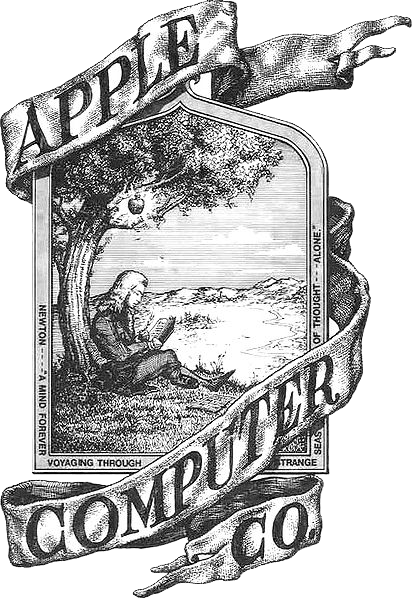
Designed by Ronald Wayne Isaac Newton under an apple tree.
Image Credit: wikimedia.org & wikipedia.org
Forty-four years ago, today, the Apple Computer Company was founded by Steve Jobs, Steve Wozniak and Ronald Wayne, though Wayne sold his share back within 12 days. Headquartered in Cupertino, California, it grew from the “two Steves” into a multinational company. Jobs and Wozniak met in 1971 via mutual friend Bill Fernandez. Their partnership began with autodidact Wozniak’s blue boxes build and Jobs salesmanship. Jobs split the blue box profits with Wozniak.
Wozniak designed a video terminal and, new microcomputers, such as the Altair 8800 and the IMSAI, inspired [him] to build a microprocessor into his video terminal and have a complete computer. [He] designed computers on paper, waiting for the day he could afford a CPU. When MOS Technology released its 6502 chip in 1976, Wozniak wrote a version of BASIC for it, then began to design a computer for it to run on. When Jobs saw Wozniak’s computer, which would later become known as the Apple I, he was immediately interested in its commercial potential.
Initially, Wozniak intended to share schematics of the machine for free but, Jobs insisted that they should, instead, build and sell bare printed circuit boards for the computer. Jobs eventually convinced Wozniak to go into business together and start a new company of their own. According to Wozniak, Jobs proposed the name “Apple Computer” when he had just come back from Robert Friedland’s All-One Farm in Oregon. Jobs told Walter Isaacson that he was “…on one of my fruitarian diets…” when he conceived of the name and thought “…it sounded fun, spirited and not intimidating…plus, it would get us ahead of Atari in the phone book.”
The information on Apple, Jobs & Wozniak is extensive. This post is a mere highlight of its beginnings. I won’t be reinventing the wheel, here. I will say, though, that the very first computer I ever programmed on in 1983, using BASIC, was an Apple II. ~Vic
[Note: I originally posted this, yesterday, just before midnight. In researching the data, I stumbled across Bill Owens, a photographer that was at Altamont. He was hired by the Associated Press to cover the concert. I emailed him, reference the two photos of his I posted. I hit ‘publish’ before I found his contact page and statement about photos for sale. In my haste to get this up while it was still Friday, I jumped the gun and quickly made the post private. I asked Bill what the price would be to use two of his pictures. As a photographer myself, I understand copyright issues but, I also recognize the gray area that many a blogger operate in, in the blogosphere….Fair Use (link on that, below). Anyway, this very kind gentleman has allowed my one-time use for this 50th anniversary post. He also provided me with a copy of an interview, conducted by Tony D’Souza in April 2019, covering his Altamont experience and other questions regarding his career. I will post an excerpt and attach the full interview, below. ~Vic]
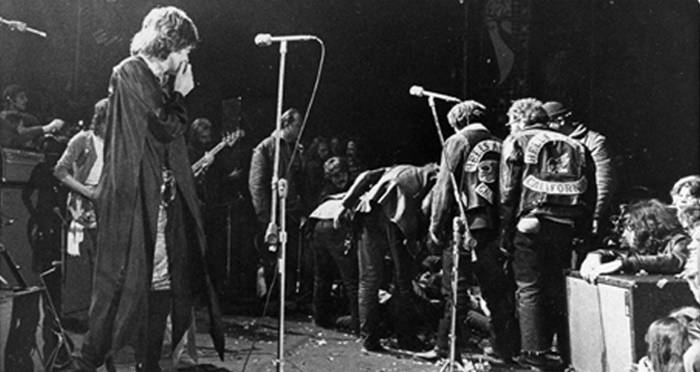
[It’s] not every day that a rock and roll band’s performance, let alone the Rolling Stones’, is accompanied by a knifing, stomping murder within a scream of the stage.
“The violence,” Keith Richard told the London Evening Standard, “just in front of the stage was incredible. Looking back, I don’t think it was a good idea to have [Hells] Angels there. But, we had them at the suggestion of the Grateful Dead. The trouble is, it’s a problem for us either way. If you don’t have them to work for you as stewards, they come, anyway and cause trouble. But, to be fair, out of the whole 300 Angels working as stewards, the vast majority did what they were supposed to do, which was to regulate the crowds as much as possible without causing any trouble. But, there were about ten or twenty who were completely out of their minds…trying to drive their motorcycles through the middle of the crowds.”
The Maysles Brothers, the film company which had shot the whole Stones’ tour, complete with its violent climax at Altamont, had gotten some remarkable footage of Hunter’s killing.
Robert Hiatt, a medical resident at the Public Health Hospital in San Francisco, was the first doctor to reach 18-year-old Meredith Hunter after the fatal wounds. He was behind the stage and responded to Jagger’s call from the stage for a doctor. When Hiatt got to the scene, people were trying to get Hunter up on the stage, apparently in the hope that the Stones would stop playing and help could get through quicker.
Stones on stage with Hells Angels.
Photo Credit: allthatsinteresting.com
Three others […] died (two in a hit-and-run accident, another by drowning) and, countless more were injured and wounded during the course of this daylong “free” concert. It was such a bad trip that it was almost perfect. All it lacked was mass rioting and the murder of one or more musicians.
All these things happened, and worse. Altamont was the product of diabolical egotism, hype, ineptitude, money manipulation and, at base, a fundamental lack of concern for humanity.
Bill Owens took iconic photos of the Hells Angels beating concertgoers with pool cue sticks at the Rolling Stones’ performance during the Altamont Speedway Free Festival four months after Woodstock on December 6, 1969. Altamont, which included violence almost all day and one stabbing death, is considered by historians as the end of the Summer of Love and the overall 1960’s youth ethos. This series of photos include panoramas of the massive, unruly crowd, Grace Slick and Carlos Santana on stage with the press of humanity so close in, they’re clearly performing under duress.
Of that day, Owens has written: “I got a call from a friend, she said the Associated Press wanted to hire me for a day to cover a rock and roll concert. I road my motorcycle to the event. I had two Nikons, three lenses, thirteen rolls of film, a sandwich, and a jar of water.”
Owens was so fearful of retribution by the Hells Angels that he published the photos under pseudonyms. Some of the negatives were later stolen…Owens believes by the Angels. He continues to have conflicted feelings about Altamont. He had no interest in violence and took no pride in photographing it.
In 1972, Owens released a book of black and white photography called Suburbia, also, now, an American icon. Irascible, stubborn, funny, grouchy, ornery and deeply rooted in small town life, Owens is built like a middleweight puncher and wears his hair as though he was a Marine. Indeed, Owens was never a hippie but, a clean-cut newspaper photographer, husband and father, who joined the Peace Corps to serve his country and “do good.” Turning 80 this September, Owens has also had noted careers as a craft beer brewer and pub owner, a magazine publisher many times over and, is now a distiller. His books include Suburbia, Working, Leisure and many others. He is the recipient of a Guggenheim and two NEAs. His work is collected in leading museums the world over, including the Smithsonian. Recent coverage of Owens includes an April retrospective in the New York Times (link above) of his Altamont photos for the event’s impending 50th anniversary. The photos are available for viewing at Owens’ website (link above and below).
I first met Owens at the defunct Rostel Gallery in remote and far northern Dunsmuir, CA, in late August or early September of 2008 (I remember because my daughter had just been born and the event was the first outing of her life), where they were showing images from Suburbia. These are images of people embarking on a new, modern way of life that they look excited by, but also confused, as though technology and the modish styles of the time were costumes they were still getting comfortable in. Owens’ photograph of a young suburban boy wearing cowboy boots, carrying a toy rifle and riding a Big Wheel, “Ritchie,” has always haunted me, though I couldn’t say precisely why.
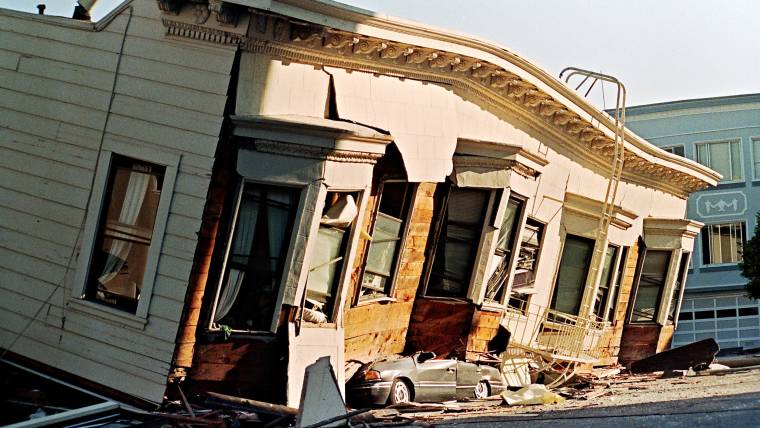
San Francisco Bay Bridge
Photo Credit: huffingtonpost.comPhoto Credit: nbcnews.com
Other October 17 history:
1814…..The London Beer Flood kills eight people. (Yes, this actually happened.)
1931…..Al Capone goes to prison for tax evasion. (Addendum: There seems to be confusion on the specific date of his conviction. Time Magazine, The NYTimes and the History Channel say the 17th. The FBI says the 18th. Pick one…)
1973…..OPEC imposes the oil embargo as punishment for assisting Israel during the Yom Kippur War. (Remember those gas lines, anyone?)






 Cosmic-Observation