flick
Flick Friday: To Hell With The Kaiser! 1918
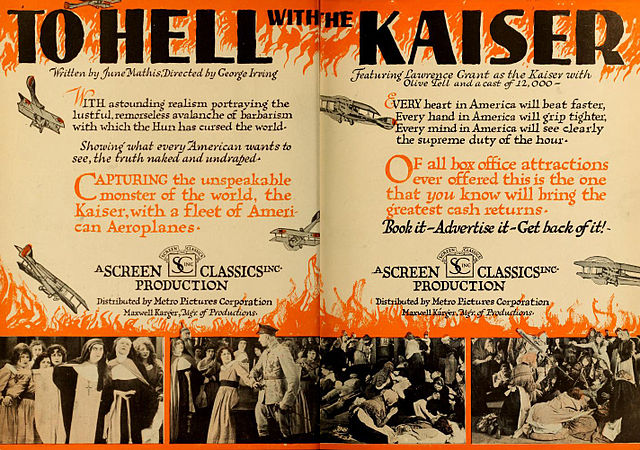
Source: Archive Image
Author: Metro Pictures/Screen Classics, Inc.
One-hundred, five years, ago, today…the silent black & white, comedy-drama To Hell With The Kaiser! was released. Written by June Mathis and directed by George Irving, it starred Lawrence Grant (as The Kaiser/actor Robert Graubel), Olive Tell, Betty Howe, John Sunderland, Earl Schenck (as the Crown Prince), Mabel Wright, Frank Currier, Karl Dane and Walter P. Lewis as Satan.
Following the death of his father, Frederick III of Germany, Wilhelm Hohenzollern becomes the German Kaiser and forms a pact with the devil that, he will conquer the globe in exchange for his soul. During the Kaiser’s invasion of Belgium, the Crown Prince enters a church and rapes Ruth Monroe, the daughter of an American inventor who has perfected a noiseless communications device. When the professor denounces the Crown Prince, he immediately is shot, whereupon his other daughter Alice vows to obtain revenge. While Alice’s sweetheart, Winslow Dodge, fights with the Americans as an aviator, she arranges to meet the Crown Prince through her friend Robert Graubel, an actor who impersonates the Kaiser at public functions. With her father’s wireless [device], Alice informs Winslow of the Kaiser’s whereabouts and, as he captures the German emperor, she kills the Crown Prince. Now a prisoner, the Kaiser drowns himself and wakes up in Hell, where Satan abdicates in his favor, saying that the Kaiser’s tortures are more fiendish than any he ever devised.
IMDb Storyline

Lobby Poster
IMDb & Amazon
Lawrence Grant, who spent his lengthy career playing odious villains, appeared in the dual role of Kaiser Wilhelm II and his look-alike, German actor Robert Graubel. Terrified of being assassinated, the Kaiser hires Graubel to impersonate him at various political functions. In the film, the Kaiser achieves military success through an infernal pact with Satan. Once this is established, the film concentrates on the seemingly endless tally of misdeeds perpetrated by the Kaiser during his quarter-century reign over Germany. His “partner in crime” is the Crown Prince […], who thinks nothing of casually raping convent girls and gunning down protesting nuns. The Crown Prince’s latest conquest is Ruth Monroe […], the daughter of an American inventor. When Ruth’s father protests this outrage, he is brutally murdered, whereupon Ruth’s sister Alice […] vows revenge. Using her father’s newest invention, a wireless machine whose coded messages cannot be intercepted, Alice directs a battalion of planes to bomb the small German village where the Kaiser is hiding. Captured by the Allies, the Kaiser is ignominiously dumped in a POW camp but, not before enduring a well-aimed sock on the jaw from a pugnacious dough-boy. In despair, the Kaiser commits suicide and sends his soul to hell. In hell, the devil […] gives up his throne, confessing that the Kaiser is far more sinister than he could ever hope to be.
[On June 8, 1918], Motography ran a Screen Classics press release explaining that To Hell With The Kaiser “reveals the machinations of Europe’s military monster before and during the war, his contempt for Americans […], his elaborate plans to crush France, […] destroy Russia, […] partition the world, […] his [order] to employ deadly gases in the war, the true circumstances under which he ordered the sinking of the Lusitania, the raiding of hospitals […].” Years before the war, Mr. Grant’s physical likeness to the German ruler was noted by a high official of the Kaiser’s court and a proposition was made for Grant to play the Kaiser in a dramatization […]. The war broke out before discussions went any further.
Actor John Sunderland, playing American pilot Winslow Dodge, was himself “an aviator who has seen service in Belgium.”
[It] had been released in the press that Kaiser Wilhelm II had half a dozen doubles who were employed to pose for him in various parts of the country, where there might be danger of assassination, while the real Kaiser, himself, remained safe behind this cloak.
To Hell With The Kaiser opened in New York City at the Broadway Theatre on June 30, 1918, immediately after it had emerged from the cutting and editing rooms […].
The film turned out to be an effective propaganda tool […]. Not only has the picture been shown in munitions plants and training camps […] but, this power has now been demonstrated in a new way…to convert conscientious objectors.
The National Film Preservation Board (NFPB) included this film on its list of Lost U.S. Silent Feature Films as of February 2021.
I found the building of this post fascinating. What started out as a simple movie post, turned into a history lesson. It’s a shame that it is lost. There are photographs of still pictures on IMDb. ~Vic
Movie Monday: Holly 2006

“Out of thousands, he tried to save one.”
Fifteen years ago, today, the drama film Holly debuted at the Edinburgh International Film Festival. Directed by Guy Moshe and, written by Moshe and Guy Jacobson, it starred Ron Livingston, Chris Penn, Virginie Ledoyen, Udo Kier and Jacquie “Thuy” Nguyen as Holly.
Shot on location in Cambodia, including many scenes in actual brothels in the notorious red light district of Phnom Penh, “Holly” is a captivating, touching and emotional experience. Patrick, an American card shark and dealer of stolen artifacts, has been ‘comfortably numb’ in Cambodia for years when he encounters Holly, a 12-year-old Vietnamese girl in the K-11 red light village. The girl has been sold by her impoverished family and smuggled across the border to work as a prostitute. Holly’s virginity makes her a lucrative prize and, when she is sold to a child trafficker, Patrick embarks on a frantic search, through both the beautiful and sordid faces of the country, in an attempt to bring her to safety. Harsh, yet poetic, this feature forms part of the ‘K-11’ Project, dedicated to raising awareness of the epidemic of child trafficking and the sex slavery trade through several film projects. The film’s producers endured substantial hardships in order to be able to shoot in Cambodia and have also founded the Redlight Children Campaign, […] a worldwide grassroots initiative generating conscious concern and, inspiring immediate action against child sex-ploitation.
IMDb Summary from Anonymous
Trivia Bits:
♦ Tom Sizemore was originally slated to play Freddie but, after being arrested for failing several drug tests, he was dropped from the production and replaced by Chris Penn.
♦ This was one of Chris Penn’s last films.
Flick Friday: Cars 2 2011

Finn McMissile: “Finn McMissile, British Intelligence.”
Tow Mater: “Tow Mater, average intelligence.”
Ten years ago, today, the #1 movie at the box office was Cars 2. Directed by John Lasseter and Brad Lewis, it was produced by Denise Ream. The original story was penned by Lasseter, Lewis and Dan Fogelman with Ben Queen crafting the screenplay. Voices were Owen Wilson (Lightning McQueen), Larry the Cable Guy (Sir Tow Mater), Michael Caine (Finn McMissile), Emily Mortimer (Holley Shiftwell), John Turturro (Francesco Bernoulli), Eddie Izzard (Sir Miles Axlerod), Thomas Kretschmann (Professor Zündapp), Joe Mantegna (Grem), Peter Jacobson (Acer), Bonnie Hunt (Sally Carrera, Bruce Campbell (Rod Redline), Tony Shalhoub (Luigi), Darrell Waltrip (Darrell Cartrip), Brent Musburger (Brent Mustangburger), Colin Cowherd (Colin Cowling Blimp), Jason Isaacs (Siddeley Gulfstream V/Leland Turbo), Lloyd Sherr (Fillmore/Tony Trihull Combat Ship), Paul Dooley (Sarge), Cheech Marin (Ramone), Katherine Helmond (Lizzie), John Ratzenberger (Mack), Jeff Gordon (Jeff Gorvette) and John Lasseter as Crew Chief John Lassetire.
The famous race car Lightning McQueen and his team are invited to compete in the World Grand Prix race. There, McQueen’s best friend Mater finds himself involved in international espionage and, alongside two professional British spies, attempts to uncover a secret plan led by a mysterious mastermind and his criminal gang, which threatens the lives of all competitors in the tournament.
MadMovieManiac
Tagline: Going where no car has gone before.
Flick Friday: Just Plane Beep 1965

Amazon
Fifty-five years ago, today, the short, animated film Just Plane Beep was released. Produced by David DePatie & Friz Freleng and, directed by Rudy Larriva, Paul Julian was the uncredited voice of the Road Runner.
Synopsis from the Looney Tunes Fan Site (possible future broken link as Fandom is in the middle of a migration):
Wile E. Coyote chases Road Runner on foot but, Road Runner produces dust and runs off the side, smacking the coyote against a wall. While lying down on the ground, a paper for Acme War Surplus is blown towards the coyote and he sends a coupon in the mail. He receives a World War I bi-plane kit and plans to catch the Road Runner using it.
Needless to say, things don’t go well. ~Vic
Additional Reading & Sources:
Big Cartoon Database
IMDb
IMDb Movie Connections List
Internet Animation Database
SuperCartoons
Looney Tunes & Merrie Melodies Filmography 1965 (Wikipedia)
Wile E. Coyote & the Road Runner (Wikipedia)
Movie Monday: To Hell and Back 1955

Sixty-five years ago, today, the war film To Hell and Back was released, originally in San Antonio. Directed by Jesse Hibbs and based on the book of the same name, it starred Audie Murphy, Marshall Thompson, Charles Drake, Jack Kelly, Gregg Palmer, Paul Picerni, David Janssen, Denver Pyle, Brett Halsey (Admiral’s great-nephew) and Gordon Gebert as a young Audie.
Biopic of the wartime exploits of Audie Murphy (played by himself), the most decorated US soldier in World War II. Starting with his boyhood in Texas, where he became the head of his family at a young age, the story follows his enrollment in [the] Army where he was assigned to the 3rd Division. He fought in North Africa, Sicily and Italy, before landing in southern France and, eventually, fighting in Germany. A Medal of Honor recipient, he also received battle honors from the French and Belgian government.
The highly variable Audie Murphy delivers his best screen performance as “himself” in Universal‘s To Hell and Back. Based on the star’s autobiography, this is the story of how Murphy became America’s most-decorated soldier during WW II. After dwelling a bit on Murphy’s hard-scrabble Texas upbringing, the story moves ahead to 1942, when, as a teenager, Audie joined the army. Within a year, he was a member of the 7th Army, serving in North Africa, Italy, France and, ultimately, Germany and Austria. One by one, the members of Murphy’s Company B are killed in the war, until only three men from the original company are left. [The] others appear at the finale as ghostly images […]. The bulk of the film is given over to Murphy’s conspicuous acts of combat bravery and his killing of 240 enemy soldiers. Highlighted by excellent battle sequences, To Hell and Back is a serviceable tribute to a most complex individual.

Photo Author: Fort Detrick
Wikipedia & Wikimedia
Trivia Bits:
♦ Filmed at Fort Lewis, WA, Yakima River, WA, Oak Creek Wildlife Area, WA and Universal Studios.
♦ Audie Murphy originally declined the opportunity to portray himself in the movie, not wanting people to think that he was attempting to cash in on his role as a war hero. Murphy initially suggested his friend Tony Curtis to play him.
♦ Audie Murphy’s war buddy Onclo Airheart was slated to play himself, but he declined due to the fact that the movie was to be shot during planting season.
♦ [Author] David Morell [sic] cites Audie Murphy as the inspiration for the character of John Rambo.
♦ In the movie, […] Murphy does his one-man standoff on top of a medium M-4 Sherman tank. [In] real life it happened on top of an M10 Wolverine tank destroyer.
♦ Audie Murphy’s feats of heroism and his much decorated status have been compared to those of his counterpart during World War I, Sgt. Alvin C. York […].
Murphy […] wrote poetry and songs, and, himself a sufferer, was among the first advocates for Post-Traumatic Stress Disorder. He died on May 28, 1971, when the private airplane in which he was riding crashed.
Additional Reading:
To Hell and Back (American Film Institute)
To Hell and Back (Turner Classic Movies)
Alvin York (Wikipedia)
Audie Murphy (Wikipedia)
Flick Friday: Vigilante Hideout 1950

Technically, today is also a bust for Flick Friday, just like my July 24 post. There were no movie releases, today, in 1950, either, so I will grab the August 6 release. Seventy years ago, yesterday, the western film Vigilante Hideout was released. Directed by Fred C. Bannon and written by Richard Wormser, it starred Allan Lane, Black Jack (Allan Lane’s horse), Eddie Waller, Roy Barcroft and Virginia Herrick.
Rocky (Lane), a Range Detective, arrives to help Nugget (Waller) with rustlers. When he learns Nugget owns only three cows, he stays on, anyway and, soon, becomes involved in Benson’s attempt to blow open the bank’s safe. When Rocky upsets his plans, Benson (Don Haggerty), supposedly, gets rid of him by having him declared an outlaw, wanted dead or alive. Then, Benson takes a load of explosives into an old mine located directly under the bank vault.
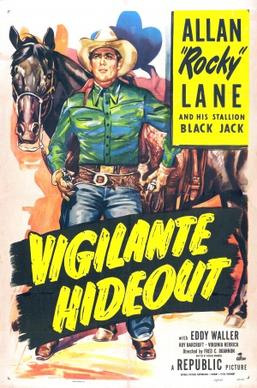
Double-barreled justice catches up with a cold-blooded killer when “Rocky” takes up the chase! Cattle detective, Rocky Lane, arrives in town to investigate cattle disappearances only to realize just three cows, owned by eccentric inventor Nugget Clark, are involved. However, the disappearances lead to a deeper mystery involving dynamite explosions, rampaging cowboys and a water shortage.
Lane and his trusty black stallion are on hand to help old-timer Waller find water for a town which is threatening to fold up due to drought. Some crooked townsfolk don’t want the water to be found because they want to collect on the $25,000 being stashed away for an aqueduct. Lane’s job is to make sure these people don’t pose too much of a problem, while Waller goes about finding the water. The characterization of Waller as a crazed inventor of gadgets is an added attraction to this oater with a realistic bent.
Full Synopsis (Turner Classic Movies)
Additional Reading:
American Film Institute
The Complete Movie
 Cosmic-Observation