renaissance
Music Monday: Now Is The Month of Maying 1595
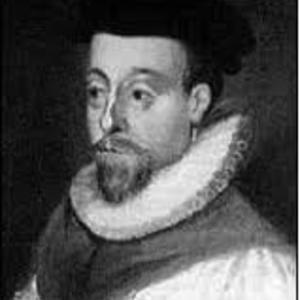
Stepping backwards a bit, I stumbled across something prior to 1600…
Thomas Morley was an English composer, theorist, singer and organist of the Renaissance. He was one of the foremost members of the English Madrigal School. Living in London at the same time as Shakespeare, Morley was the most famous composer of secular music in Elizabethan England. [He] was active in church music as a singer, composer and organist at St Paul’s Cathedral [and] was involved in music publishing. [He] lived for a time in the same parish as Shakespeare and, a connection between the two has been long speculated but, never proven. In addition to his madrigals, [he] wrote instrumental music, including keyboard music […].
Now Is The Month of Maying is one of the most famous of the English ballets […]. It is based on the canzonet So Ben Mi Chi Ha Bon Tempo used by Orazio Vecchi […]. It was printed in […] Morley’s First Book of Ballets to Five Voyces [in] 1595. The song delights in bawdy double-entendre. It is, apparently, about spring dancing but, this is a metaphor for making love/sex. For example, a barley-break would have suggested outdoor sexual activity (rather like […] a roll in the hay). The use of such imagery and puns increased during the Renaissance.
It was also heard in 1964 on The Andy Griffith Show episode The Song Festers.

Lyrics:
Now is the month of maying,
When merry lads are playing,
Fa la la la la la la la la,
Fa la la, etc…
Each with his bonny lass
Upon the greeny grass.
Fa la la, etc…
The Spring, clad all in gladness,
Doth laugh at Winter’s sadness,
Fa la la, etc…
And to the bagpipe’s sound
The nymphs tread out their ground.
Fa la la, etc…
Fie then! Why sit we musing,
Youth’s sweet delight refusing?
Fa la la, etc…
Say, dainty nymphs, and speak,
Shall we play barley break?
Fa la la, etc…
Additional Reading & Sources:
Thomas Morley (Britannica)
Thomas Morley (Elizabethan-Era Site)
The Song Festers (IMDB)
Now Is The Month of Maying (Wikipedia)
Thomas Morley (Wikipedia)
Barney’s Voice Lessons
Tune Tuesday: Flow, My Tears 1600
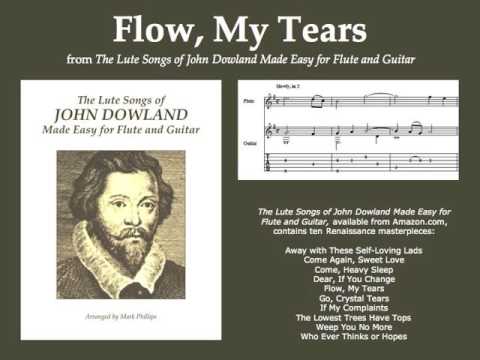
Four hundred, twenty years ago, Renaissance composer, lutenist and singer John Dowland (a contemporary of William Shakespeare) publishes his Second Book of Songs in London. There were 22 song titles in the book and the most well known of these is Flow, My Tears. Written as an aria and for a lute, its style and form is based on a pavane, a slow, couple-dance common in the 16th century. It’s original 1596 title was Lachrimae Pavane (literally “tears dance”) and Dowland added lyrics later.
This is Dowland’s most famous aria and he would, occasionally, sign his name as Jo. Dolandi de Lachrimae (literally, “John of the Tears“)
Lines 8 thru 10 are quoted in Philip K. Dick‘s book Flow, My Tears, the Policeman Said, a science fiction novel set in a dystopian future. The book’s title is a direct reference to Dowland’s piece.
Additional Reading & Sources:
John Dowland (Edition HH Music Publishers)
John Dowland Part I (Millenium of Music)
John Dowland Biography (Study Website)
Lachrimae: Continental Context (University of London Goldsmiths)
Flow, My Tears (Wikipedia)
Flow My Tears, the Policeman Said (Wikipedia)

Philip K. Dick 1974
First Edition Hardcover
wikipedia.org & wikimedia.org
Lyrics:
Flow, my tears, fall from your springs!
Exiled for ever, let me mourn;
Where night’s black bird her sad infamy sings,
There let me live forlorn.
Down vain lights, shine you no more!
No nights are dark enough for those
That in despair their last fortunes deplore.
Light doth but shame disclose.
Never may my woes be relieved,
Since pity is fled;
And tears and sighs and groans my weary days, my weary days
Of all joys have deprived.
From the highest spire of contentment
My fortune is thrown;
And fear and grief and pain for my deserts, for my deserts
Are my hopes, since hope is gone.
Hark! you shadows that in darkness dwell,
Learn to contemn light
Happy, happy they that in hell
Feel not the world’s despite.
Music Monday: Spem In Alium 1570
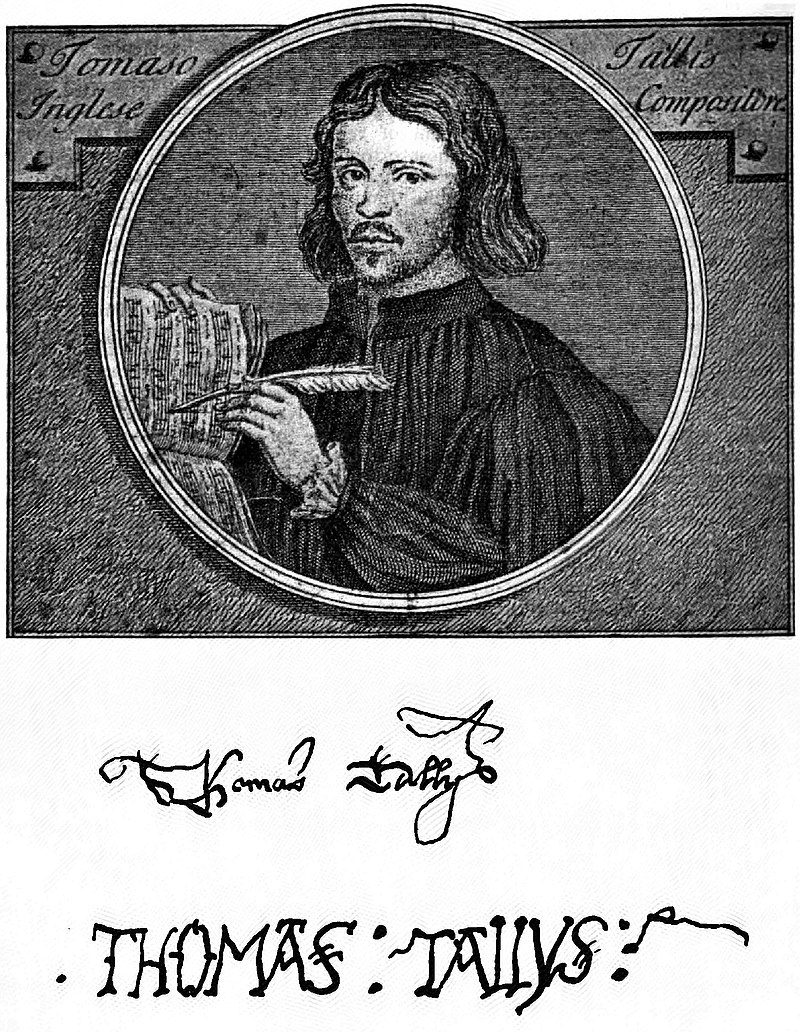
Portrait by Gerard van der Gucht
Engraving by Niccolò Haym
Image Credit: wikipedia.org & wikimedia.org
Now, we are in the 1570s…
Spem in Alium is Latin for “hope in any other” or “hope in another”. A 40-part Renaissance Motet, it was composed in 1570 (thereabouts) by Thomas Tallis (Tallys). Written for eight choirs of five voices each, meaning there are 40 separate voices singing individual lines of music, it is considered to be Tallis’s greatest achievement and, possibly, one of the finest compositions of all time.
Information on where it was first performed is scarce. There appears to be some confusion regarding where it took place, as two locations…Nonsuch Palace, a royal Tudor palace in Surrey built by Henry VIII (not to be confused with Nonsuch Mansion) and Arundel House, a London townhouse originally for the Bishops of Bath & Wells…were both owned by Henry Fitzalan, the 12th/19th Earl of Arundel at one time. Most of what I have read leans towards Arundel House but, truly, I don’t think anyone really knows. It’s all a big guess. And, it is pure speculation as to why he wrote it. Some suggestions include a challenge due to an Italian composer doing same, Elizabeth’s 40th birthday or, perhaps for Mary as he was Catholic. Again, no one really knows.
The music, below, is soul stirring. ~Vic

Arundel House
Image Credit: wikipedia.org & wikimedia.org
The text of the motet:
Spem in alium nunquam habui
Praeter in te, Deus Israel
Qui irasceris et propitius eris
et omnia peccata hominum
in tribulatione dimittis
Domine Deus
Creator caeli et terrae
respice humilitatem nostram

Watercolour of the south frontage of Nonsuch Palace
Image Credit: wikipedia.org & wikimedia.org
English Translation:
I have never put my hope in any other
but in Thee, God of Israel
who canst show both wrath and graciousness,
and who absolves all the sins
of man in suffering
Lord God,
Creator of Heaven and Earth
Regard our humility
Additional Reading & Sources:
The Belle Jar (Blog Post)
Oxford Music Online
Spem in Alium History (PDF on Super Flumina Website)
How To Buy Spem In Alium (Classic FM Website)
Tallis and His Song of Forty Parts (Zenodo Website)
Music Monday: My Lady Carey’s Dompe 1520s
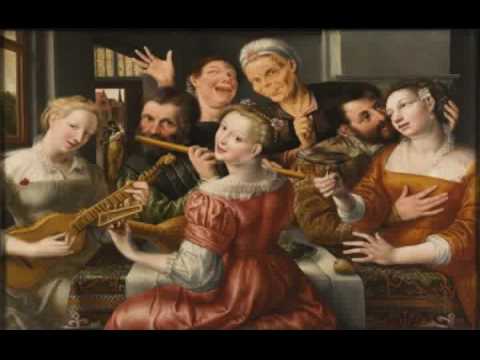
Coming forward in time, I was reading around in the 1400s & 1500s (noticing some of the composers that died in the plague) and discovered another interesting little piece: My Lady Carey’s Dompe (a lament or dirge), a traditional English dance tune. Written for a harpsichord and, possibly, a lute, the composer remains unknown, though suggested attribution is Hugh Aston and, the specific date is questionable. It could be 1525 or, 1528 if the song was, indeed, composed for the death of William Carey, a courtier in the service of Henry VIII. Lady Carey could refer to his wife Mary Boleyn, a mistress to Henry and sister to Anne Boleyn but, could also refer to his mother, sisters or his sister-in-law.
In any case, the song is lovely and, catchy. Enjoy.
Sources
My Lady Carey’s Dompe
1520s in Music
Allmusic Write-Up
The Anne Boleyn Files
Sheet Music
British Library (Record of the Composition)
Internet Archive (History of Keyboard Composition)
“One of the earliest surviving keyboard pieces we have…”
 Cosmic-Observation