An Iowa man, who received a postcard from his sister, said he was surprised to note the card had been mailed in 1987. Paul Willis, a hog farmer in Thornton, said a postcard appeared in his mailbox, recently, from his sister, Annie Lovell […]. [H]e soon noticed the card bore a picture of Lovell on a Grand Canyon hike in 1987 and a San Francisco postmark from December of that same year.
Willis said the postcard bore a second postmark from April 29 of this year in Des Moines so, he called the post office to see if they had any explanation for the postcard’s tardiness. [An] employee said the postcard may have been discovered while furniture and machines were being moved for cleaning. “She said, ‘Well, the post offices are all going through deep cleaning because of COVID-19…'” Willis [recounted to] the Santa Rosa Press-Democrat.
An Illinois woman experienced a similar incident in July 2019, when a postcard showed up at her home that had been mailed 26 years earlier. Kim Draper said the card was addressed to the previous residents of her Springfield home and, [it] recounted the residents’ father’s travels in Hong Kong.
It’s funny how every news article out there these days just has to make a tie in with the virus. And, that image doesn’t look like a mask to me. It looks like something else. Just sayin’… ~Vic
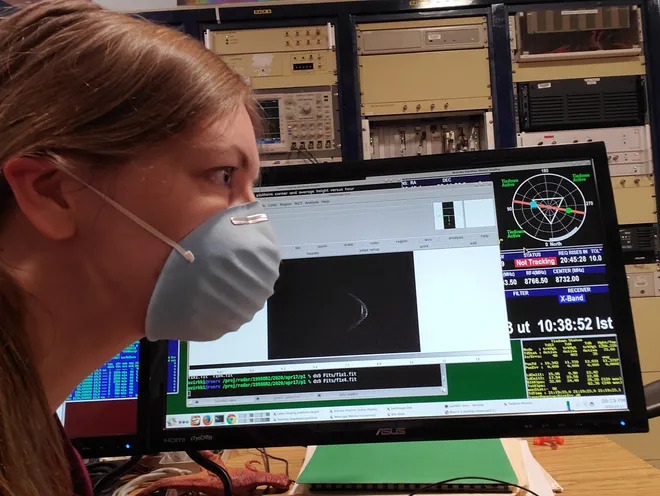
An asteroid is hurtling close to the Earth, and with it, a startling reminder of the coronavirus pandemic. The space rock, known as 1998 OR2, will be nearly 4 million miles away from Earth on Wednesday at 5:59am EDT, classifying it as a “potentially hazardous” asteroid, despite the impossibility of it posing a threat to Earth anytime soon.
A newly captured image by [the] Arecibo Observatory in Puerto Rico brings its own surprise. As the asteroid approaches our planet, it looks as if it’s wearing its own mask and may very well be conducting its own social distancing practices. “The small-scale topographic features, such as hills and ridges on one end of asteroid 1998 OR2, are fascinating, scientifically,” Anne Virkki, head of planetary radar at Arecibo Observatory, said in a statement. “But, since we are all thinking about COVID-19, these features make it look like 1998 OR2 remembered to wear a mask.”
Image Credit: Arecibo Observatory & USA Today
It’s classified as a potentially hazardous asteroid because it is more than 500 feet in diameter and closer than 4,650,000 miles to Earth. “Although this asteroid is not projected to impact Earth, it is important to understand the characteristics of these types of objects to improve impact-risk mitigation technologies,” she said.
The asteroid, which is about one mile in diameter, has been traveling at nearly 20,000 mph since its discovery in 1998. Though it may not come anywhere near Earth in the coming weeks, Flaviane Venditti, a researcher at the observatory, said in a statement that, in 2079, it “will pass Earth about 3.5 times closer than it will this year.”
A man wearing the US Navy uniform went to the oceanfront in Emerald Isle, North Carolina, on Thursday, in an apparent protest against the town’s restrictions amid the coronavirus pandemic. The man, who was identified by a witness as a retired US Navy [Master Chief], was seen photographed standing in front of a sign that read “LAND OF THE FREE.” Mike Conner, a longtime resident of Emerald Isle, and a surfer, told Insider the retired sailor stood in the waters for about 10 minutes before he was approached by law enforcement officers. Conner said the man was asked to remove himself from the area but, refused the request. “The sailor eventually left the water on his own accord, without incident”, Conner added.
Hours after the incident, the town announced it would lift the ban on access on Saturday. Surfers, and other residents, previously expressed their disapproval by staging protests throughout the area and were “fired up by the closures”, Conner said. “We’re very happy that Emerald Isle allowed access, not just to us swimmers but, to everybody that uses it as a medium for their exercise,” Connor said. “We don’t want our rights stomped all over.”
The man in the uniform and the Emerald Isle Police Department did not respond to a request for comment.
Photo Credit: Palm Beach County
Water Utilities Department
Facebook Post
I haven’t done one of these since 2013. I read a lot and sometimes I come across some strange things. This is an article from United Press International:
Wet Wipes Clog All Four Pumps At Florida Wastewater Facility
April 15, 2020 (UPI) Utility officials in a Florida county are reminding residents not to flush wet wipes down the toilet after all four of the wastewater facility’s pumps clogged at the same time.
The Palm Beach County Water Utilities Department said in a Facebook post that all four pumps at the organization’s wastewater pumping facility in Boca Raton ended up clogged at the same time “for the first time ever.” The post blamed the clogs on increased use of wet wipes.
“It took a team of three utility mechanics to dissemble and reassemble the pumps in order to remove the compacted wipes,” the post said. The department said residents who find themselves “low on toilet paper” amid shortages from the COVID-19 pandemic should remember that all wet wipes, including those labeled “flushable,” should be thrown in the trash and not disposed of in the toilet.
Wait a minute. Are these folks insinuating that “residents who find themselves low on toilet paper” are using Clorox and/or Lysol wet wipes in lieu of TP? Or, are we talking baby wipes here? The article isn’t all that clear. Either way…just…DAMN. ~Vic
Two days, ago, I posted my routine Movie Monday piece. For the date I chose, I highlighted Blazing Saddles, a #1 movie at that time and, when calculated in 1974, was the highest grossing movie of that year. The movie is laugh-out-loud funny and an absolute scream. That being said, in my comment section, it was dutifully pointed out that, in this day and age, the movie would never get made. I was provided with a link to a UK article from September 22, 2017. Here is the headline:
Our PC world is the death of comedy, says Mel Brooks: Veteran comedian claims society is ‘stupidly politically correct’ and that many of his films could not be made today
Quotes from the article:
‘We have become stupidly politically correct, which is the death of comedy,’ Brooks said.
‘It’s not good for comedy. Comedy has to walk a thin line, take risks.’
‘Comedy is the lecherous little elf whispering in the king’s ear, always telling the truth about human behaviour.’
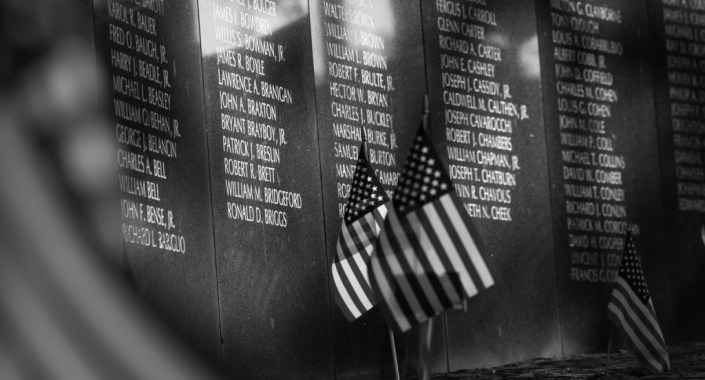
On this day in 1964, Congress approved the Gulf of Tonkin Resolution, effectively entering the U.S. into a conflict that still affects us to this day. This resolution, brought about by the questionable Gulf of Tonkin Incident (also referred to as the USS Maddox incident), gave President Johnson the legal justification for sending U.S. troops to Vietnam, under the guise of assisting a country under the treat of communist aggression.
“The resolution marked the beginning of an expanded military role for the United States in the Cold War battlefields of Vietnam, Laos and Cambodia. By 1964, America’s ally, South Vietnam, was in serious danger of falling to a communist insurgency. The insurgents, aided by communist North Vietnam, controlled large areas of South Vietnam and no amount of U.S. military aid and training seemed able to save the southern regime. During the presidencies of Dwight D. Eisenhower and John F. Kennedy, hundreds-and then thousands-of U.S. military advisers had been sent to South Vietnam to train that nation’s military forces. In addition, hundreds of millions of dollars in military and economic assistance had been given to South Vietnam. The administration of President Lyndon B. Johnson made the decision that only direct U.S. military intervention in the conflict could turn the tide. However, Johnson was campaigning in the presidential election of 1964 as the “responsible” candidate who would not send American troops to fight and die in Asia. In early August, a series of events occurred that allowed Johnson to appear statesmanlike while simultaneously expanding the U.S. role in Vietnam. On August 2, North Vietnamese torpedo boats attacked an American destroyer in the Gulf of Tonkin. Johnson responded by sending in another destroyer. On August 4, the two destroyers reported that they were under attack. This time, Johnson authorized retaliatory air attacks against North Vietnam. He also asked Congress to pass the Gulf of Tonkin Resolution. This resolution declared, “The United States regards as vital to its national interest and to world peace the maintenance of international peace and security in Southeast Asia.” It also gave Johnson the right to “take all necessary measures to repel any armed attack against the forces of the United States and to prevent further aggression.” The House passed the resolution by a unanimous vote. The vote in the Senate was 88 to 2. Johnson’s popularity soared in response to his “restrained” handling of the crisis. The Johnson administration went on to use the resolution as a pretext to begin heavy bombing of North Vietnam in early 1965 and to introduce U.S. combat troops in March 1965. Thus began a nearly eight-year war in which over 58,000 U.S. troops died. In a wider sense, the Gulf of Tonkin Resolution can be considered America’s Cold War policy toward all of Southeast Asia at the time. The resolution was also another example of the American government’s less than candid discussion of “national security” matters during the Cold War. Unspoken during the Congressional debate over the resolution was the fact that the commanders of the U.S. destroyers could not state with absolute accuracy that their ships had actually been attacked on the night of August 4, nor was any mention made of the fact that the U.S. destroyers had been assisting South Vietnamese commandos in their attacks on North Vietnamese military installations. By the late 1960s, the tangle of government deceptions and lies began to unravel as public confidence in both Johnson and the American military effort in Vietnam began to erode.”
[My father was in college from 1963 to 1967 and was in the ROTC. I was born at the beginning of his senior year. He came very, very close to going to Vietnam as a 2LT. He became more and more disturbed by reports and stories of what was actually happening over there. The young men that had graduated before him and entered combat…weren’t coming home. Many of the officers that he had started out with during his early years with the ROTC…weren’t coming back. The ones that did manage to return spoke of a “war without direction or purpose” and horrible “death traps”. My father had a crisis of faith, in a way. As a 2LT in the Army, he would have been an officer that could, potentially, send other young men under him to their deaths. If friends were telling him that the purpose of the war was not completely understood, how could he, in good conscience, participate. He took his concerns to his ROTC CO. That conversation devolved into a shouting match, complete with threats. My father resigned his ‘impending’ commission, despite the protestation of an older officer, stating that “Men like you, we need. We need the common sense approach and conscience you display. You would be a voice of reason and strength that could steady the others.” He would hear none of it. He turned in his uniforms, graduated…and never looked back. My father is still alive, today, because of his decision not to participate. He was never sent a draft card. ~Vic
Addendum: My father passed away on August 25, 2022]
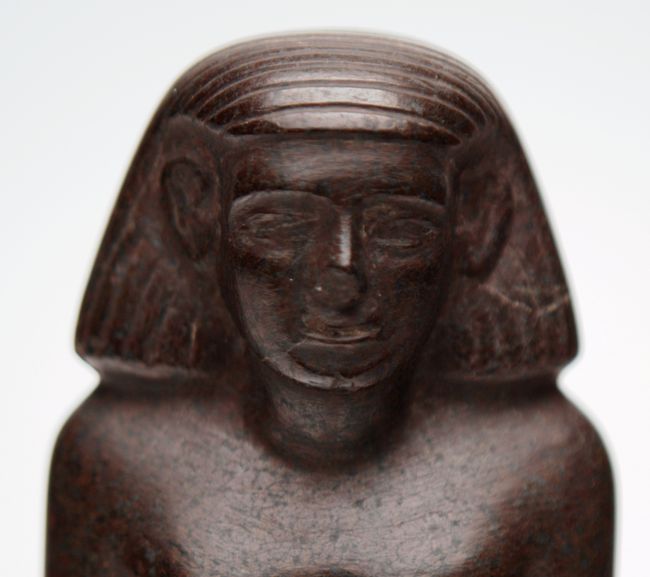
An ancient Egyptian statue appears to have started moving on its own, much to the amazement of scientists and museum curators. The statue of Neb-Senu, believed to date to 1800 B.C., is housed in the Manchester Museum in England, at least for now. But, if the statue keeps moving, there’s no telling where it will end up. “I noticed one day that it had turned around,” museum curator Campbell Price told the Manchester Evening News. “I thought it was strange because it is in a case and I am the only one who has a key. I put it back but, then, the next day, it had moved again […]. We set up a time-lapse video and, although the naked eye can’t see it, you can clearly see it rotate.”
The [10in. (25cm)] statue was acquired by the museum in 1933, according to the New York Daily News. The video clearly shows the artifact slowly turning counterclockwise during the day but, remaining stationary at night. This daytime movement led British physicist Brian Cox to believe the statue’s movement is due to the vibration created by museum visitors’ footsteps. “Brian thinks it’s differential friction, where two surfaces, the stone of the statuette and glass shelf it is on, cause a subtle vibration, which is making the statuette turn […]. But, it has been on those surfaces since we have had it and it has never moved before […]. And, why would it go around in a perfect circle?” said Price.
On his blog, Price […] speculates that the statue “was carved of steatite and, then, fired [which] may imply that it is now vulnerable to magnetic forces.” Steatite, also known as soapstone, is a soft stone often used for carving. Oddly, the statue turns 180 degrees to face [backwards], then turns no more. This led some observers to wonder if the statue moves to show visitors the inscription on its back which asks for sacrificial offerings consisting of bread, beer, oxen and fowl.
None of the proposed explanations satisfies Price. “It would be great if someone could solve the mystery,” he said. But, Paul Doherty (d. 2017), senior scientist at the Exploratorium in San Francisco, believes the statue’s movement isn’t caused by any supernatural force but, by something quite ordinary…vibrational, stick-slip friction, sometimes called stick-slip vibration. As Doherty told LiveScience, “[If] the glass shelf, on which the statue rests, vibrates even slightly, […] the vibrating glass moves the statue in the same direction, […] causing it to turn around.” An everyday example can occur when someone uses an electric blender on a kitchen countertop […]. The vibration of the blender can cause a nearby coffee cup to walk across the countertop.
But, why would the statue stop moving after turning 180 degrees? Doherty believes the statue stops turning because it’s asymmetrically weighted […]. “One side of the statue has more weight than the other side,” [Doherty said]. After turning around on the shelf, the statue’s uneven bottom reaches a more stable position and stops turning. Besides the footsteps of passing museum visitors, the source of the stick-slip vibration “…could be some trolley that goes by during the day or a train that passes during the day,” Doherty said.








 Cosmic-Observation