In my last post on March 2, I was talking about sitting under my Hackberry tree and getting pelted with debris from a little woodpecker above me. I tried to get some shots of him but, they weren’t clear enough. My S7 just doesn’t do well with distance. That’s OK. I have other stuff.
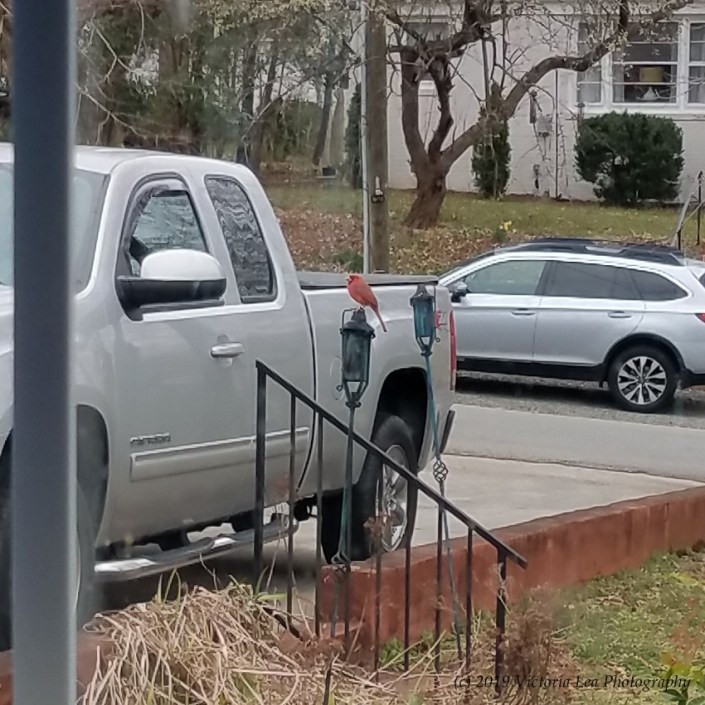
From the Den window.
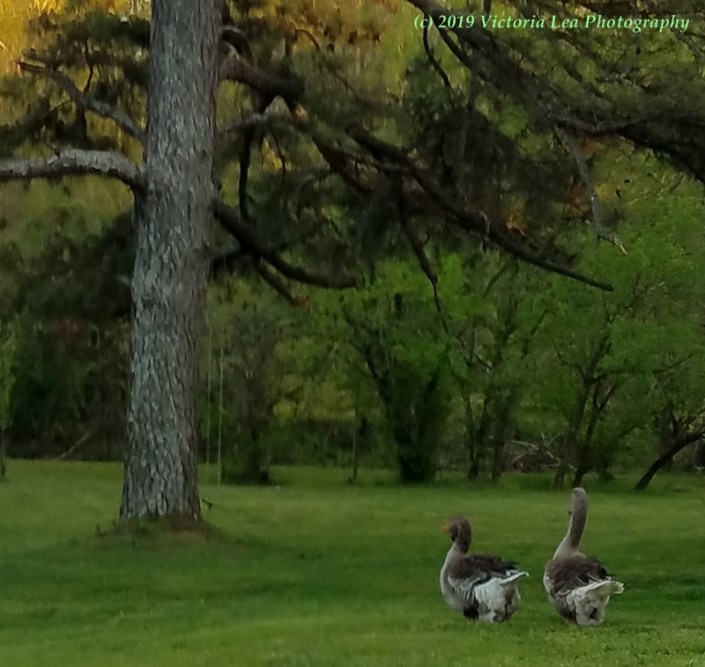
02-19-2019And, he looked at the camera.Geese coming up from the river.
04-16-2019And, headed to a neighbor’s backyard.They are such a cute pair.I haven’t seen any activity…yet. 05-06-2019
I did a post last year, celebrating the Summer Solstice of 2018. I got some really cool pictures that day. I got a few this year with some visitations from nature.
If anyone can identify my caterpillar, let me know. ~Vic
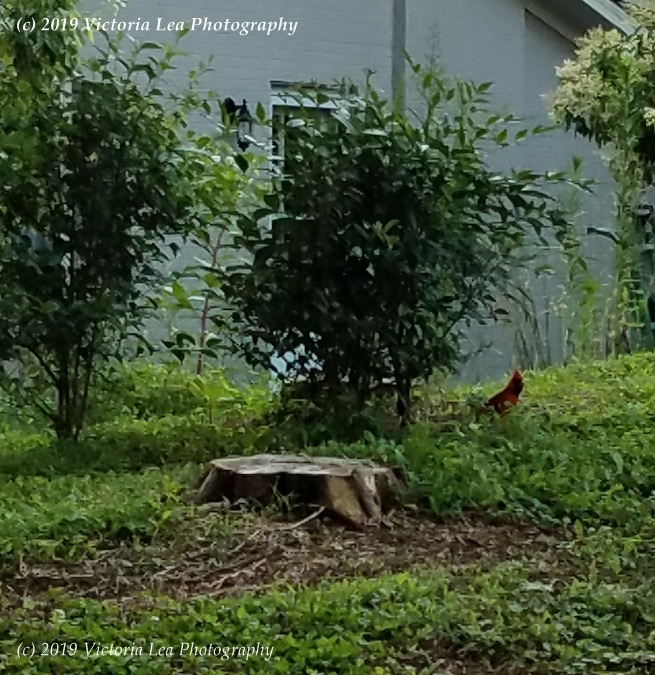
From my Adirondack chair in the side yard.Young Cardinal checking things out.Fuzzy, green caterpillar that I can’t identify.
I tried.
Crawled up on my chair.National Day Calendar & Pinterest
The Summer Solstice for our area of the planet was at 11:45am EDT.
The word “solstice” comes from Latin solstitium — from sol (Sun) and stitium (still or stopped), reflecting the fact that on the solstice, the Sun appears to stop “moving” in the sky as it reaches its northern or, southernmost point (declination) for the year, as seen from Earth. After the solstice, the Sun appears to reverse course and head back in the opposite direction. The motion referred to here is the apparent path of the Sun when one views its position in the sky at the same time each day, for example at local noon. Over the year, its path forms a sort of flattened figure eight, called an analemma. Of course, the Sun, itself, is not moving (unless you consider its own orbit around the Milky Way Galaxy). Tnstead, this change in position in the sky that we on Earth notice is caused by the tilt of Earth’s axis as it orbits the Sun, as well as Earth’s elliptical, rather than circular, orbit. The timing of the June solstice is not based on a specific calendar date or time. It all depends on when the Sun reaches its northernmost point from the equator.
Did you know that the Sun actually sets more slowly around the time of a solstice, in that it takes longer to set below the horizon? This is related to the angle of the setting Sun. The farther the Sun sets from due west along the horizon, the shallower the angle of the setting Sun. (Conversely, it’s faster at or near the equinoxes.) Bottom-line, enjoy those long romantic summertime sunsets at or near the solstice!
Many cultures, both ancient and modern, celebrate the sunlight with rituals and holidays. Every year on the summer solstice, thousands of people travel to Wiltshire, England, to Stonehenge […]. There are many Midsummer celebrations all over the planet.
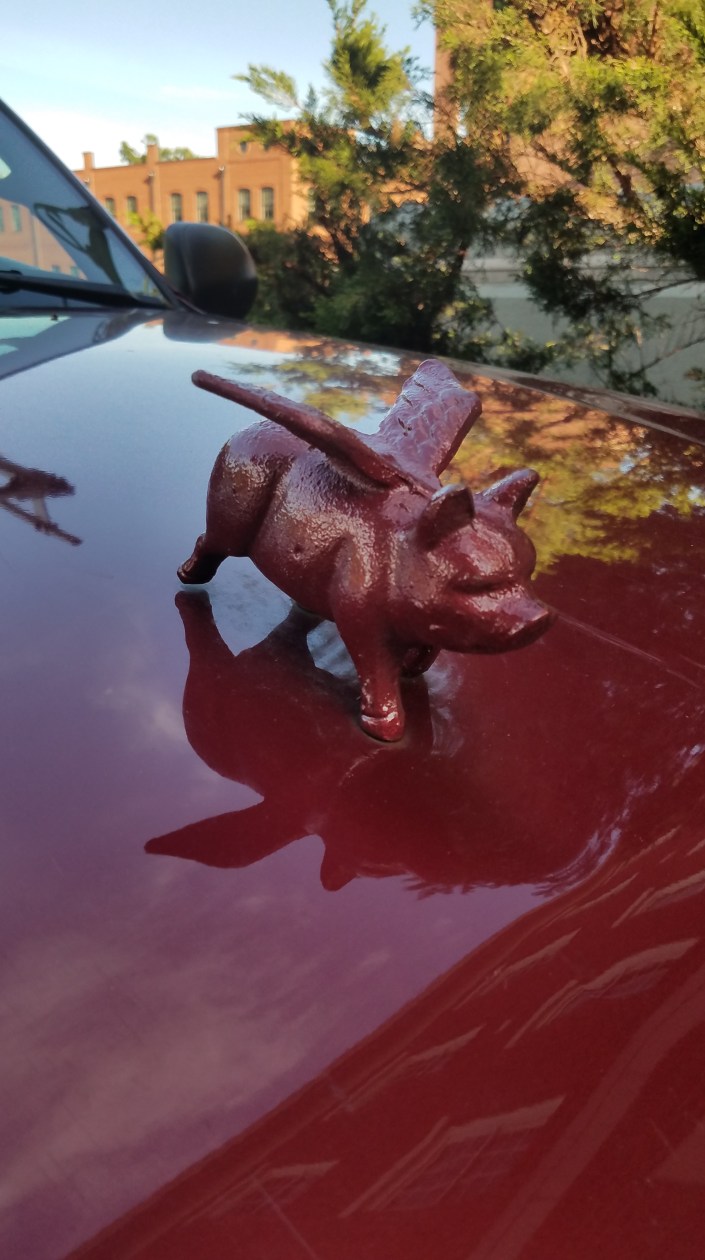
This definitely comes under the heading of “things you don’t see everyday.” I was walking home from our local market when I caught sight of this on a pick-up truck, parked in the library parking lot. ~Vic
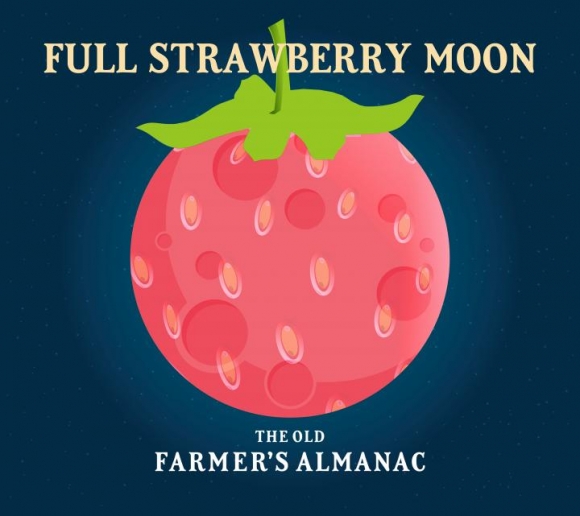
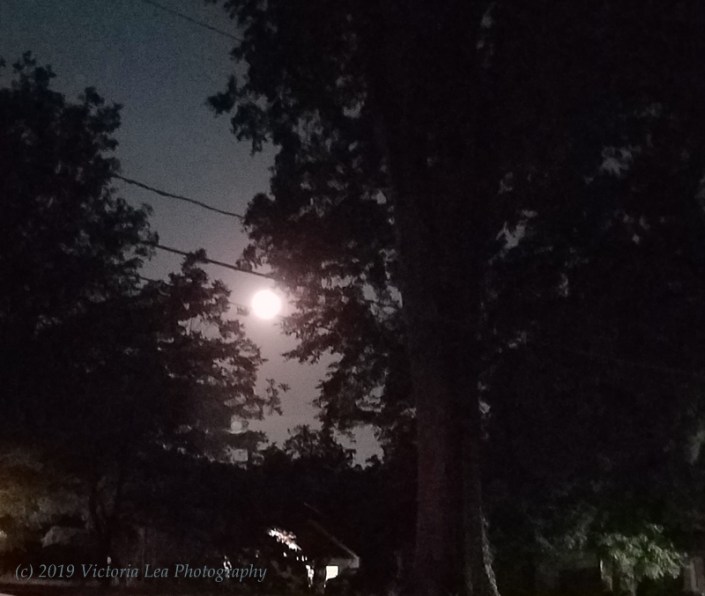
I did a post nearly a year ago for 2018. Last year, the Strawberry Moon appeared after the Summer Solstice. It’s also referred to as the Flower Moon and this year, it is also a Fathers’ Day Moon (I just made that up). Full illumination occurred at 4:30am EDT. Howl for me! ~Vic
Standing in my driveway.
I supposed my photos could be impressionist like Monet.
The colorful name is closely linked with the spread of warmer weather across the Northern Hemisphere and many Native American and, First Nations peoples, have special names for this full moon. The Algonquin tribes of what is now New England coined the nickname Full Strawberry Moon because the phase marked the best time of year to harvest the wild fruit. Similarly, the Cherokee of the southeastern woodlands knew the moon as the Green Corn Moon, the time of year when fresh corn ears grow best.
The sweetest full moon of the year is June’s full moon […]. While the full moon itself is inedible, despite how round and delicious it may seem, the Full Strawberry Moon marks strawberry harvesting season in North America. Most Algonquin tribes understood that it was a sign that wild strawberries were starting to ripen and ready for the harvest. Delicious though ripe strawberries may be, June’s full moon has another name that’s even sweeter. What could possibly be sweeter than strawberries? Try honey. In Europe, June’s full moon was actually known as the Honey Moon. Other European names for it included the Hot Moon, signifiying the beginning of hot summer days, or Hay Moon, because of the first hay harvest. Those names aside, European names for the Full Strawberry Moon overall tend to have sweet, romantic connotations, a good example [being] the name Full Rose Moon. June’s full moon is also called Mead Moon, which could refer to the mowing of meadows during summer but, there’s another more romantic interpretation as well.
Power lines always get in the way.
In Europe, it’s traditional to gift mead or honey to a newlywed couple during their first moon of marriage. The name Honey Moon, itself, has now become a common word in the English language, used to refer to the honeymoon holiday that couples go on right after they’re married. It used to be that newlyweds in ancient Europe would go on a sweet romantic holiday around the time of June’s full moon because the moon phases were seen as a symbol for the phases of a marriage with the full moon signifying the fullest and happiest part, the wedding itself. The Full Strawberry Moon is tied to romance and marital bliss all around the world. In India, for example, June’s full moon is celebrated as Vat Purnima where married women perform a ceremonial ritual to show their love for their husbands. Vat Purnima is based off a legend from the Mahabharata about a beautiful woman, Savitri, who is determined to save her husband, Satyavan, who is doomed to die an early death. Savitri fasts for three days before Satyavan dies, upon which she successfully negotiates with the King of Hell for the resurrection of her husband. Similarly, married women nowadays dress up in beautiful saris, fast and tie a thread around a banyan tree seven times to wish that their husbands will lead long, happy lives.
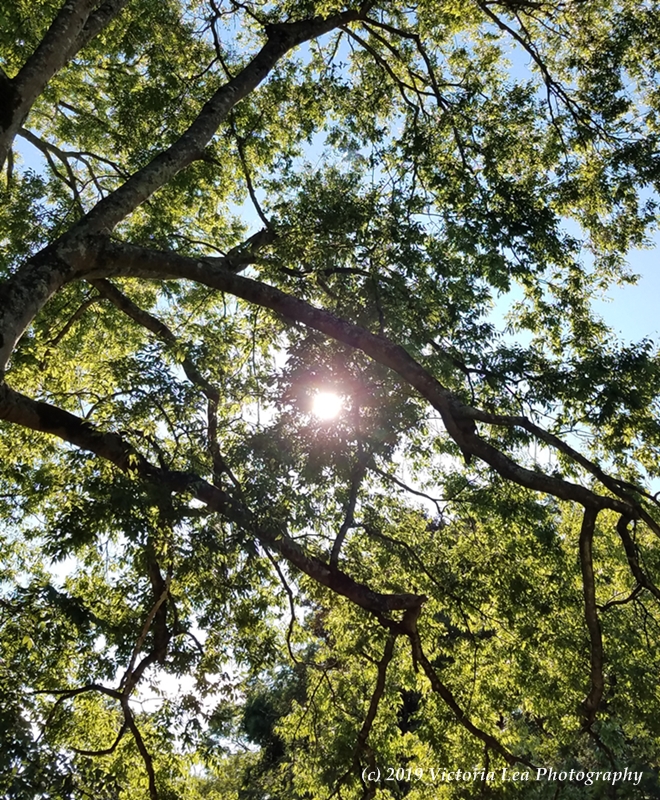
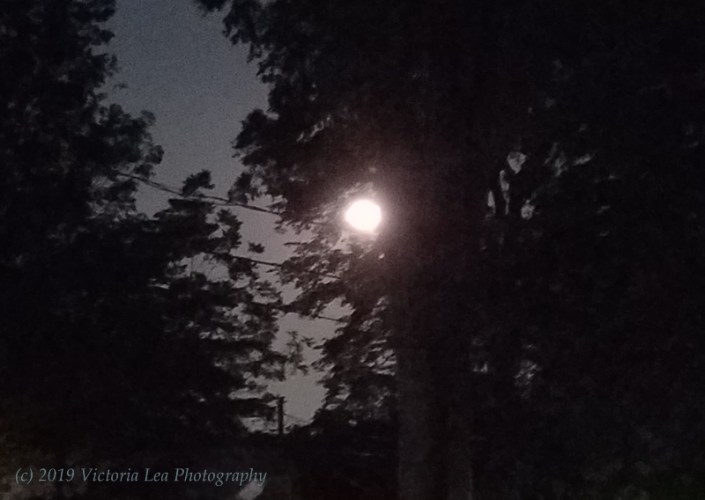
Peaking through the Willow Oak.
It is no wonder, then, that the Pagans also call June’s full moon the Lovers’ Moon. This is an excellent time to work on the connections in your life, romantic or otherwise, by showing affection to your loved ones and allowing yourself to be vulnerable to encourage intimacy in your relationships. During this Honey Moon, some Hoodoo practitioners will even use honey in magic rituals to sweeten other people’s feelings towards the practitioner. An example of a sweetening ritual is to pour honey into a saucer containing the target’s name before lighting a candle on top of it. Another example of a honey ritual is to tie two poppets together with honey between them in order to heal a broken relationship between two people. Honey rituals aside, true magic may happen when you invest your time and effort during this month to work on your relationships and, appreciate the love you have in your life.
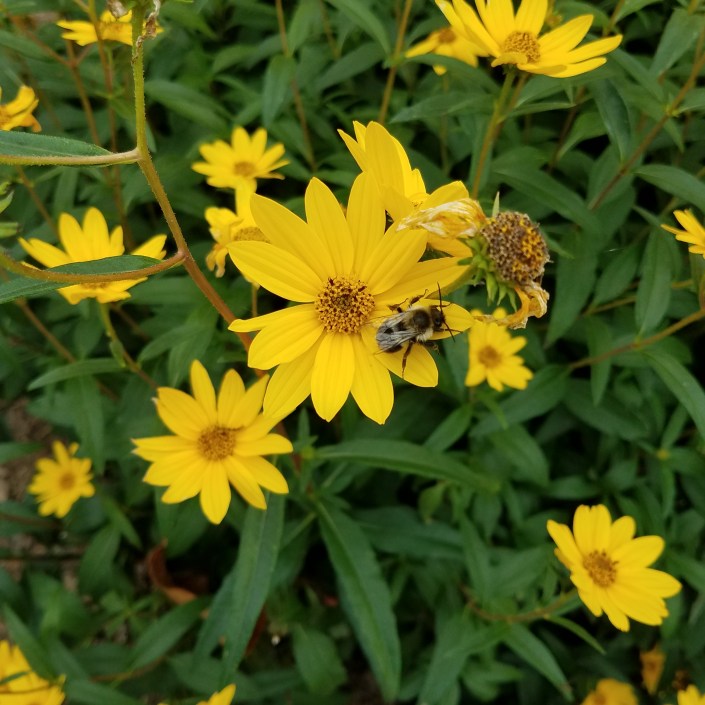
Coreopsis Bee
Coreopsis blooming in November.
11-04-2017McKinley with lunch.
I think it is a grasshopper.
09-06-2018Daisy Bee
At least, I think it is a daisy.
10-13-2018Sidewalk Slug
He had places to go.
03-21-2019Window Worm
This thing showed up during the rain storms.
It looks like a tape worm.
04-13-2019Blue Tail
I see these lizards all over the place.
They are quick.
05-06-2019Lacy Wings
Cute green thing in the kitchen window.
05-10-2019Pale Blue
Tiny little moth.
05-11-2019
Sharing a fantastic shot and an equally incredible time-lapse clip from Michael Andrew Just.
Watch the stars move through the night sky and the sun rising at Zion National Park, Utah. Lots of UFOs traveling through the sky also. Watch in HiDef at Full Screen.
Going back fifteen years, this is a shot of Buddy, interrupting an exercise routine. This was during my Texas years. He was such a sweet baby and I still miss him. ~Vic
This is really hard to see but, it says “Seek Love”.
Riverwalk path.
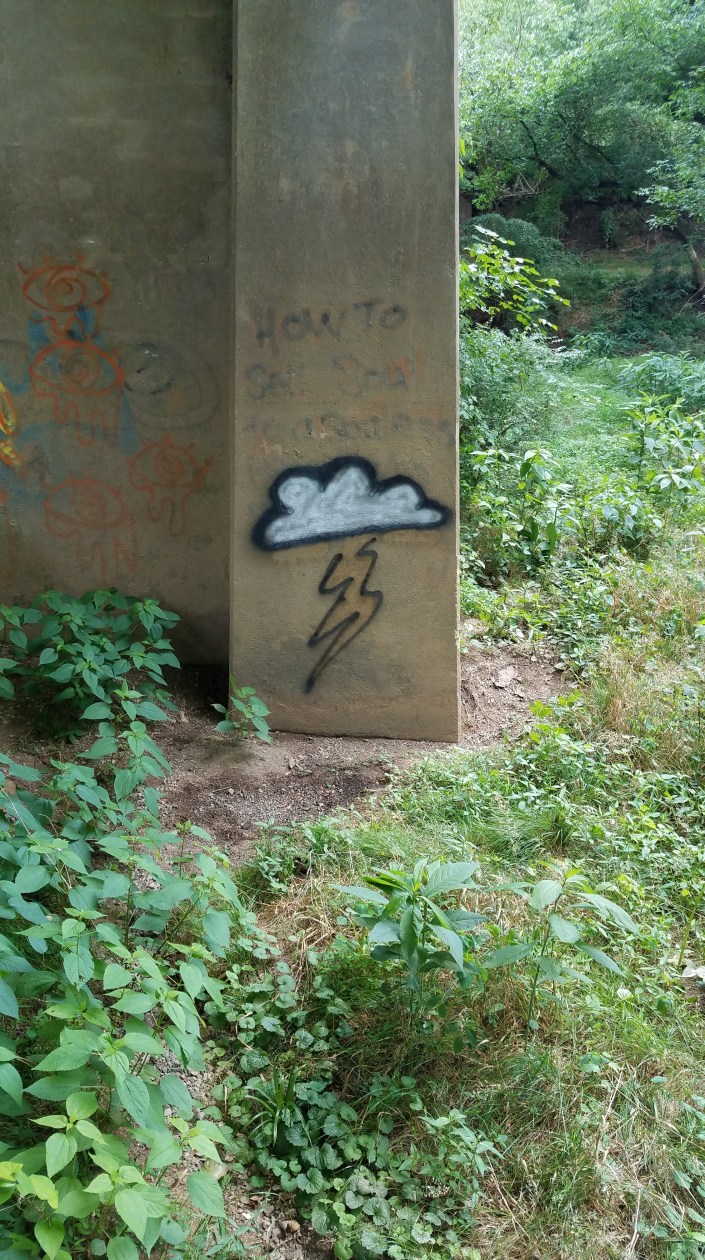
05-26-2019How to sell soul to a soulless people who sold their souls?
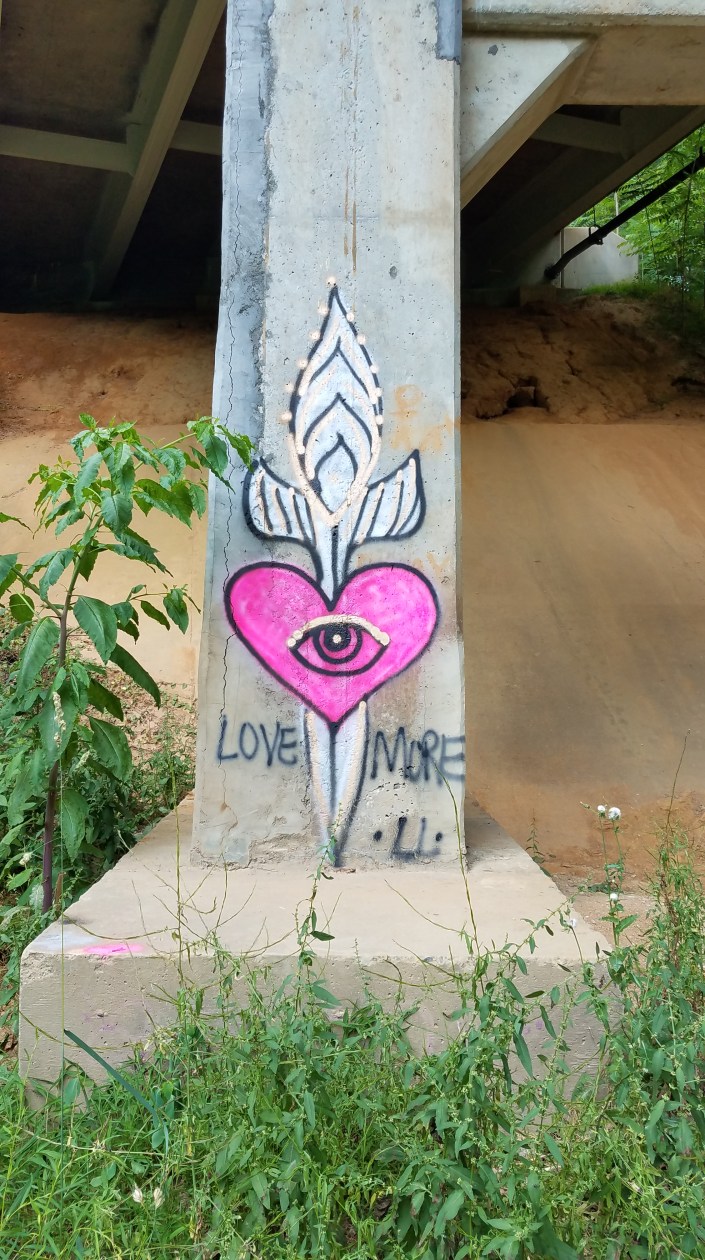
06-09-2017Love More
06-01-2019Nothing is easy, especially high voltage.
06-09-2017One-eyed smile?
06-01-2019Storm cloud over the soulless people.
How apropos…
06-01-2019Smiley scribbled in the window.
This is the shed next to the house from the first post.
05-19-2019Remember the winter tree with the red heart, love, pain and voodoo?
It’s gone. New canvas for new art.
05-17-2019
A McKinley by the lamp post at the First Baptist Church.
The web was enormous.
09-02-2017An Orb Weaver off the corner of the front porch.
09-22-2017I guess she was enjoying the flowers.
10-02-2017She posed for me.
What a ham.Slug on the front porch.
10-18-2017It took me a while to find this one.
Google “black bug, yellow dots” and you will get tons of pix.
This is an Asian lady beetle larva.
10-28-2017Larger slug on the side of the house.
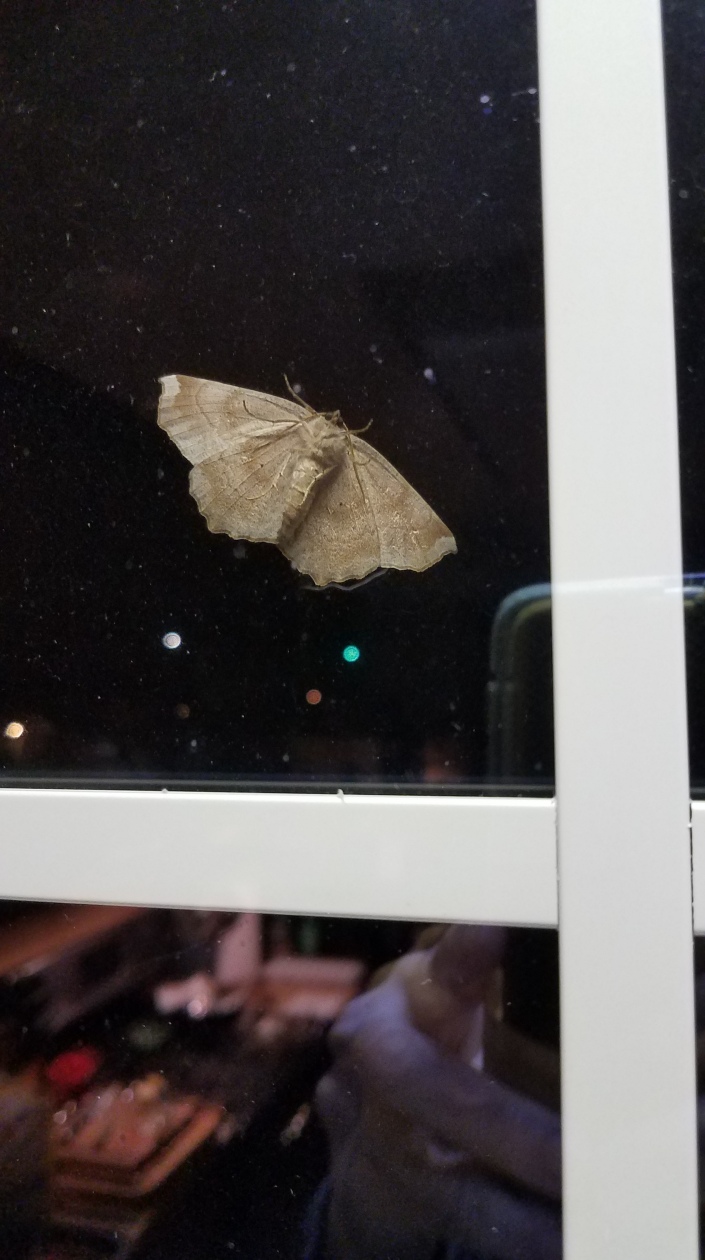
06-16-2018Moth on the kitchen window.
04-03-2019























 Cosmic-Observation