lost
Flick Friday: George Washington, Jr. 1924
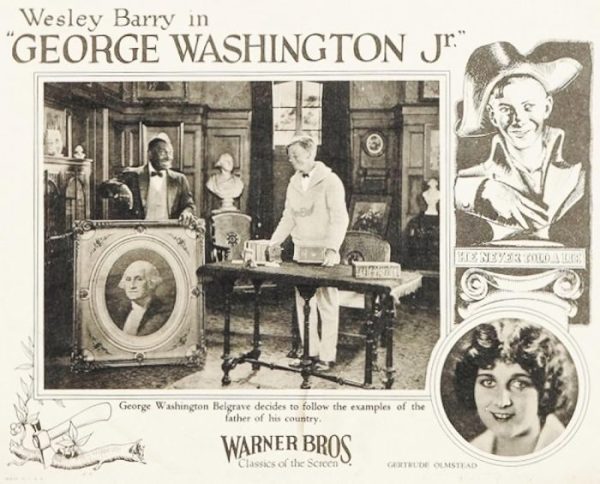
One hundred years, ago, today, the movie George Washington, Jr., was released. A black & white silent comedy film, it starred Wesley Barry, Gertrude Olmstead, Léon Bary, Heinie Conklin, Otis Harlan, William Courtright and Eddie Phillips. Based on the 1906 play by George M. Cohan, it was directed by Malcolm St. Clair, with the screenplay & story by Rex Taylor.
As described in a film magazine review, Count Gorfa, anarchist leader, steals the private records of a Senate Investigative Committee, the loss of which threatens the political fortunes of Senator Belgrave, whose daughter the Count wishes to wed. The Senator’s son, the young George Washington Belgrave and his friend Robert Lee Hopkins trail the anarchists. After many adventures and burlesques of historical fables, the documents are recovered and the Senator is saved.
A senator is trying to get his niece to marry a foreign count. The senator’s teenage son finds out that the count is not only a phony but, an international criminal. The boy sets out to break up the impending marriage, save his father from ruin and, his cousin from marrying a man she doesn’t love.
IMDb Storyline
George Belgrave is guided by George Washington’s principles of integrity and honesty. He exposes his cousin Dolly’s fiancé, Count Tyrola, to be a bogus count and an internationally sought criminal. [As] the leader of the Vassalini gang, [he] steals a secret treaty from George’s father, a United States senator. It is Tyrola’s intention to use the treaty to cause political strife in Bessarabia. George, his friend Bob, and Ham, the negro butler, subdue the Vassalini gang and, after recovering the treaty, lock them up. Tyrola’s treachery is revealed seconds before the wedding ceremony. George, to save his father embarrassment, tells his only lie in giving him credit for the whole “plan” to capture Tyrola. Cousin Dolly marries friend Bob.
This is a lost film. ~Vic
Trivia Bits:
♦ The original Broadway production of George Washington, Jr. opened at the Herald Square Theatre on February 12, 1906 and ran for 81 performances.
♦ The role of the servant Eton Ham was played by Conklin in blackface.
TCM: George Washington, Jr.
AFI: George Washington, Jr.
Exibitors Trade Review (Internet Archive)
TV Tuesday: The Queen Street Gang 1968

Fifty-five years, ago, today, the British, Thames Television TV show The Queen Street Gang was released. There were nine episodes from Aug. 1 to Sep. 26. Directors were Nicholas Ferguson and Adrian Cooper. Writers were Roy Russell and Desmond Skirrow. The main cast was Sebastian Abineri (Big Bill), Liz Crowther (Phillipa), Len Jones (Sniffer), Anthony Peplow (Speedy), Michael Feldman (Mini Morris), Michael Gwynn (Professor Morris) and Maureen O’Reilly (Mrs. Morris).
Comedy drama series. A group of kids manage to get involved in adventures with spies and the like.
IMDb Storyline
Well trained, highly organised and working from a secret H.Q., The Queen Street Gang were, undoubtedly, an attempt by Thames television to create a modern day Famous Five. There were even comparisons to be drawn with the Enid Blyton created characters, including one of the children being the daughter of a top secret researcher. The series was based on a 1966 children’s adventure book called The Case of the Silver Egg by Desmond Skirrow and adapted for TV by Roy Russell. The first of the two stories made involved a silver egg that was able to hold all the electricity in the world, which was then stolen by a group of criminals […]. It was up to the gang to recover it, rescue the kidnapped professor and make the world a safer place for us all.
Television Heaven UK
Noel Onely
January 24, 2019
This series is believed lost. ~Vic
The Queen Street Gang (Nostalgia Central)
Flick Friday: [The] Forbidden Lover 1923

One hundred years, ago, today, the black & white silent film [The] Forbidden Lover was released. Brackets around “THE” is a product of the differences of the title from data sources. This film is an edited version of The Power of Love, the very first 3-D movie, released on September 27, 1922 at the Ambassador Hotel Theater in Los Angeles. Both films are believed lost.
Directed by Nat G. Deverich and, written by Kate Corbaley & Caroline Crawford, it starred Elliot Sparling, Barbara Bedford, Noah Beery, Aileen Manning, Albert Prisco and John Herdman.
Yankee sea captain lands on the coast during the old Spanish days to trade with the ranch owners. He meets a girl who is betrothed to a man she loathes. After a series of adventures and narrow escapes, he shows up the unscrupulous ranch owner and wins the girl.
IMDb [The] Forbidden Lover Storyline
Motion Picture News Booking Guide
October 1923
Production Company: Sierra Productions
Tagline: A Romance Of Early California
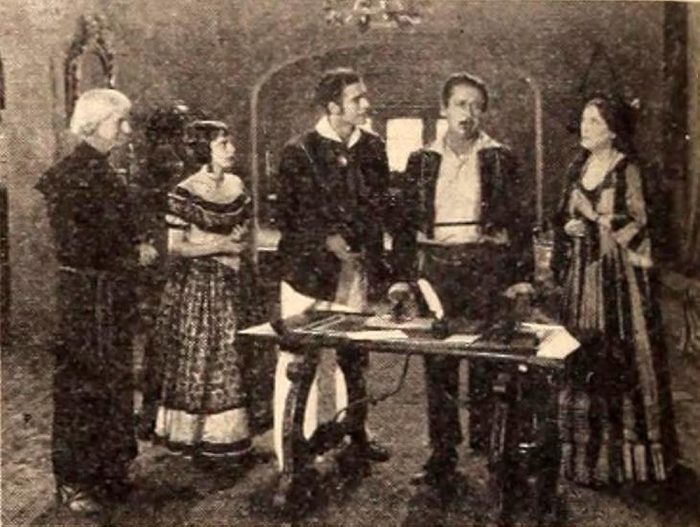
The Power Of Love
Image Credit: IMDb & Amazon
Because of his financial trouble, Don Almeda promises his daughter, Maria, to Don Alvarez but, Maria does not love [him]. In fact, she falls in love with Terry O’Neil, a stranger who has been wounded by robbers associated with Alvarez. O’Neil takes Alvarez’s place at a masked ball. Alvarez, in turn, robs the old Padre of some pearls and stabs him to death with O’Neil’s knife. He then accuses O’Neil of the murder and tries to shoot him but, wounds Maria instead, having thrown herself in front of him. Maria recovers and, after proving that Alvarez is a thief and a killer, weds O’Neil.
IMDb The Power of Love Storyline
Moving Picture World
October 1922
Production Company: Perfect Pictures
Tagline: A pair of spectacles will be handed to you as you enter the theatre, through which you will view the new sterescopic pictures.
The Power of Love was screened in front of a live audience at the Ambassador Hotel Theater […]. It was projected dual-strip in the red/green anaglyph format, making it both the earliest known film that utilized dual strip projection and the earliest known film in which anaglyph glasses were used. The camera rig used to shoot the film was made by the producers themselves and as you can imagine, it was far from perfect. Simply put, the film was not a success. It was screened, again, for exhibitors, and press, in New York City and, then, almost immediately fell out of sight. It was not booked again by other exhibitors. Unfortunately, we may never see what this movie looked like.
3-D TV & Movies
The first stereoscopic image dates to 1844, which makes 3-D images as old as the art of photography. [No] less a personage than Queen Victoria was photographed in 1854 in stereoscopic 3-D. 3-D stereoscopic moving images date to the 1850s with what was called the Kinetamatoscope [sic]. The first public display of a 3-D movie came in 1922 with The Power of Love […]. The film received a decent review in Moving Pictures World, then promptly disappeared from history by changing its title to Forbidden Lover and touring the country in a 2-D version. It was too complex and costly at the time to take 3-D on the road.
Randome
Looking Up/My Daily Plant Blogspot (Blogger)
Cirque de 3-D
March 6, 2009
What Was The First 3D Movie? (3D TV & Movies/Web Archive/06-02-2011)
A Tour Through The History Of 3-D Movies (Reelz/Jeff Otto/01-22-2009/Web Archive/07-20-2012)
Forbidden Lover (Silent Era/06-08-2013)
The Power of Love (Silent Era/10-16-2011)
Forbidden Lover (TCM)
The Forbidden Lover (AFI Catalog)
The Power of Love (AFI Catalog)
The Shot Of The Year (The Dissolve/Calum Marsh/12-19-2014)
Flick Friday: To Hell With The Kaiser! 1918
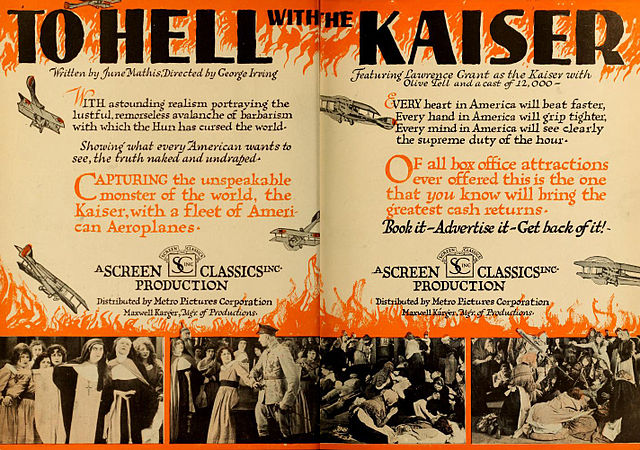
Source: Archive Image
Author: Metro Pictures/Screen Classics, Inc.
One-hundred, five years, ago, today…the silent black & white, comedy-drama To Hell With The Kaiser! was released. Written by June Mathis and directed by George Irving, it starred Lawrence Grant (as The Kaiser/actor Robert Graubel), Olive Tell, Betty Howe, John Sunderland, Earl Schenck (as the Crown Prince), Mabel Wright, Frank Currier, Karl Dane and Walter P. Lewis as Satan.
Following the death of his father, Frederick III of Germany, Wilhelm Hohenzollern becomes the German Kaiser and forms a pact with the devil that, he will conquer the globe in exchange for his soul. During the Kaiser’s invasion of Belgium, the Crown Prince enters a church and rapes Ruth Monroe, the daughter of an American inventor who has perfected a noiseless communications device. When the professor denounces the Crown Prince, he immediately is shot, whereupon his other daughter Alice vows to obtain revenge. While Alice’s sweetheart, Winslow Dodge, fights with the Americans as an aviator, she arranges to meet the Crown Prince through her friend Robert Graubel, an actor who impersonates the Kaiser at public functions. With her father’s wireless [device], Alice informs Winslow of the Kaiser’s whereabouts and, as he captures the German emperor, she kills the Crown Prince. Now a prisoner, the Kaiser drowns himself and wakes up in Hell, where Satan abdicates in his favor, saying that the Kaiser’s tortures are more fiendish than any he ever devised.
IMDb Storyline

Lobby Poster
IMDb & Amazon
Lawrence Grant, who spent his lengthy career playing odious villains, appeared in the dual role of Kaiser Wilhelm II and his look-alike, German actor Robert Graubel. Terrified of being assassinated, the Kaiser hires Graubel to impersonate him at various political functions. In the film, the Kaiser achieves military success through an infernal pact with Satan. Once this is established, the film concentrates on the seemingly endless tally of misdeeds perpetrated by the Kaiser during his quarter-century reign over Germany. His “partner in crime” is the Crown Prince […], who thinks nothing of casually raping convent girls and gunning down protesting nuns. The Crown Prince’s latest conquest is Ruth Monroe […], the daughter of an American inventor. When Ruth’s father protests this outrage, he is brutally murdered, whereupon Ruth’s sister Alice […] vows revenge. Using her father’s newest invention, a wireless machine whose coded messages cannot be intercepted, Alice directs a battalion of planes to bomb the small German village where the Kaiser is hiding. Captured by the Allies, the Kaiser is ignominiously dumped in a POW camp but, not before enduring a well-aimed sock on the jaw from a pugnacious dough-boy. In despair, the Kaiser commits suicide and sends his soul to hell. In hell, the devil […] gives up his throne, confessing that the Kaiser is far more sinister than he could ever hope to be.
[On June 8, 1918], Motography ran a Screen Classics press release explaining that To Hell With The Kaiser “reveals the machinations of Europe’s military monster before and during the war, his contempt for Americans […], his elaborate plans to crush France, […] destroy Russia, […] partition the world, […] his [order] to employ deadly gases in the war, the true circumstances under which he ordered the sinking of the Lusitania, the raiding of hospitals […].” Years before the war, Mr. Grant’s physical likeness to the German ruler was noted by a high official of the Kaiser’s court and a proposition was made for Grant to play the Kaiser in a dramatization […]. The war broke out before discussions went any further.
Actor John Sunderland, playing American pilot Winslow Dodge, was himself “an aviator who has seen service in Belgium.”
[It] had been released in the press that Kaiser Wilhelm II had half a dozen doubles who were employed to pose for him in various parts of the country, where there might be danger of assassination, while the real Kaiser, himself, remained safe behind this cloak.
To Hell With The Kaiser opened in New York City at the Broadway Theatre on June 30, 1918, immediately after it had emerged from the cutting and editing rooms […].
The film turned out to be an effective propaganda tool […]. Not only has the picture been shown in munitions plants and training camps […] but, this power has now been demonstrated in a new way…to convert conscientious objectors.
The National Film Preservation Board (NFPB) included this film on its list of Lost U.S. Silent Feature Films as of February 2021.
I found the building of this post fascinating. What started out as a simple movie post, turned into a history lesson. It’s a shame that it is lost. There are photographs of still pictures on IMDb. ~Vic
NOTD: Odd Headstones

Image Credit: Mac Armstrong
Kaushik Patowary
Amusing Planet
09-19-2017When Canadian doctor Samuel Bean lost his first two wives, Henrietta and Susanna, within 20 months of each other, he decided that the best way to honor them would be to create a tombstone dedicated to a hobby they both enjoyed…solving puzzles. The doctor had them buried side by side in Rushes Cemetery near Crosshill, Wellesley Township, Ontario and a single gravestone was placed over their graves. The gravestone bore a puzzle, one that kept historians stumped and amateur cryptologists busy for the next eighty years.
A replica of the gravestone can still be seen in Rushes Cemetery. The original stone was badly weathered and was replaced with this durable granite replica in 1982. The stone is about three feet high and features a finger pointed skyward with the words “Gone Home” above the two women’s names. Underneath the names is a grid carved with 225 seemingly random numbers and letters.
Without doubt, Dr. Samuel Bean must have received many requests to reveal the meaning of the cryptic message but, he would have none. Then, in 1904, while [on holiday] in Cuba, Dr. Bean fell overboard from a sailboat and drowned. The secret of the coded gravestone was forever lost.
News of the Day
 Cosmic-Observation