song
Music Monday: When Irish Eyes Are Smiling 1913

Image Credit: Knick Of Time Blog
One-hundred, ten years ago…
When Irish Eyes Are Smiling is a lighthearted song in tribute to Ireland and was very popular in June 1913. Its lyrics were written by Chauncey Olcott and George Graff, Jr., set to music composed by Ernest Ball, for Olcott’s production of The Isle O’ Dreams and, Olcott sang the song in the show. It was first published in 1912, at a time when songs in tribute to a romanticised Ireland were very numerous […], both in Britain and the United States. During the First World War, the famous tenor John McCormack recorded the song.
The song continued to be a familiar standard for generations. Decades later, it was used as the opening song on the radio show Duffy’s Tavern. The song has been recorded on over 200 singles and albums, by many famous singers, including Bing Crosby, Connie Francis and Roger Whittaker.
Wikipedia Summary
As I have stated in previous posts, Billboard’s charting abilities, in the early 20th Century, is difficult to navigate. My first stop, for these early pieces, is the Tsort site. Playback FM is very helpful, too. Digging around in the Wayback Machine can be a complete rat maze. The data is there but, how much time do you devote to searching for it.
There was a Shamrock Summit in March 1985, apparently, in Canada (which I don’t remember). Starting on St. Patrick’s Day, Prime Minister Brian Mulroney and President Ronald Reagan met & talked for two days. Remember the Acid Rain Scare back then? It was seen as a Turning Point in U.S.-Canada Relations (both Trudeaus don’t play well with others?) and the closing ceremonies were televised, with the men & their wives singing the song (Mulroney & Reagan are Irish surnames). I find the meeting in Quebec City and the singing of an Irish song, ironic and amusing. ~ Vic
Additional:
♦ Irish Eyes Are Smiling (The Account of Composer Ernest R. Ball’s Life/IMDb/1944)
♦ Still Something To Smile About (Pocono Record/Marta Gouger/Wayback Machine/03-06-2007)
♦ When Irish Eyes Are Smiling (Irish Music Daily/Pat/No Date Given)
♦ List Of Movies Using The Song
Music Monday: Shine On, Harvest Moon 1908

One hundred, fifteen years ago in May (not necessarily today), the song Shine On, Harvest Moon was at the top of the Billboard chart, such as it was back then, for eleven weeks. Sung by Ada Jones & Billy Murray, the song is credited to the married vaudeville team of Nora Bayes & Jack Norworth.
It was one of a series of moon-related Tin Pan Alley songs of the era. The song was debuted by Bayes and Norworth in the Ziegfeld Follies of 1908 to great acclaim. It became a pop standard and, continues to be performed and recorded in the 21st Century. During the vaudeville era, songs were often sold outright and the purchaser would be credited as the songwriter. John Kenrick credits the song’s writers as Edward Madden and Gus Edwards. However, David Ewen credits Dave Stamper, who contributed songs to 21 editions of the Ziegfeld Follies and was Bayes’ pianist from 1903 to 1908. Vaudeville comic Eddie Cantor also credited Stamper.
The song has had a long history with Hollywood movies. In 1932, animation great Dave Fleischer directed a short titled Shine On Harvest Moon. A 1938 Roy Rogers western was named after the song, as was a 1944 biographical film about Bayes and Norworth. The song has been featured in dozens of movies from 1933 to 1978. There was also a popular British 1980s comedy drama called Shine on Harvey Moon.
Wikipedia Summary Excerpts
I am not entirely sure why this Jones & Murray piece is listed as 1909, as Tsort lists it as 1908. There must be some lost data, somewhere. ~Vic
Film & Television
Other Recordings
Duo’s Long List Of Songs Performed
Tune Tuesday: In The Good Old Summer Time 1903

1896 Publicity Photo
National Phonograph Co.
One hundred, twenty years ago, today, the #1 song in 1903 was In The Good Old Summer Time by the Haydn Quartet. In a previous post, I stated that Tsort has very few charts prior to 1920. Music popularity just wasn’t tracked as closely as it is, today. For music this old, I plug in a date on Playback FM and run with it.
Written by Ren Shields and composed by George “Honey Boy” Evans, it is a Tin Pan Alley song, originally published in 1902. Blanche Ring assisted in having the number added to the 1902 comedy musical The Defender. There is also a John Philip Sousa band version.
The Haydn Quartet was originally formed in 1896 as the Edison Quartet. They eventually changed their name to Haydn, an homage to Joseph Haydn and as a way to record for other companies besides Edison Records.
In The Good Old Summer Time was a very popular song for its time and John Scantlebury MacDonald, a replacement member of the Edison Quartet, went on to record the song, solo. It was the Haydn Quartet’s biggest commercial success while contracted with the Victor Talking Machine Company.
Song Sunday: Fade Into You

“I think it’s strange you never knew…”
Sunday evening’s playlist submission is Fade Into You by alternative band Mazzy Star. Released April 12, 1994, it is the first track on the album So Tonight That I Might See. Written by Hope Sandoval and David Roback, it was a surprise hit, peaking at #44 on Billboard’s Hot 100, #19 on the Mainstream Top 40 chart, #3 on the Modern Rock Tracks (Alternative Songs, now) chart and #48 on the UK Singles chart. It was Mazzy Star‘s only single to make to make the Billboard Hot 100. It has been used, frequently, in movies, most notably Starship Troopers, Lord of War, Burlesque and Thank You For Your Service plus several TV shows.
I’d never heard of Mazzy Star or heard this song when it originally came out. I am late to the party finding this, just discovering them a few years ago. Sadly, David Roback passed away February 24, 2020, from cancer.
Mazzy Star Official (Facebook Page)
MTV Version
Monochrome Version
Music Monday: Greensleeves 1580

Artist: Dante Gabriel Rossetti
Harvard Art Musems
Model: Mrs. W. J. Knewstub
Photographer: Maris Stella
Reverse Image
Image Credit: Wikipedia & Wikimedia
Moving forward to 1580…
Henry VIII
A widespread belief exists that the song Greensleeves was composed by none other than King Henry VIII following an early rejection of his love by his future wife Anne Boleyn. The lyrics of this song of unrequited love have been seen to relate to his courtship of Anne in the 1520s. Many of the verses of Greensleeves imply a rich and extravagant courtship […]. Henry VIII was a composer and musician of some merit […]. [C]ourt officials […] attribute to Henry many compositions which were not his and the consensus of expert opinion, today, is that Greensleeves was composed rather later in the Tudor era, during the reign of Anne Boleyn’s daughter, Queen Elizabeth I. [T]he piece is based on an Italian style of composition that did not reach England until after Henry’s death […].
Origins
A broadside ballad […] was registered at the London Stationer’s Company in September [of] 1580, by [a] Richard Jones, as A Newe Northern Dittye of ye Ladye Greene Sleves. Six more ballads followed in less than a year, one on the same day […]. Needless to say the rights to the song were in very hot dispute. It was in 1584 that Jones printed his final version of the melody and this is the one we know today. It was titled A New Courtly Sonnet of the Lady Green Sleeves […].
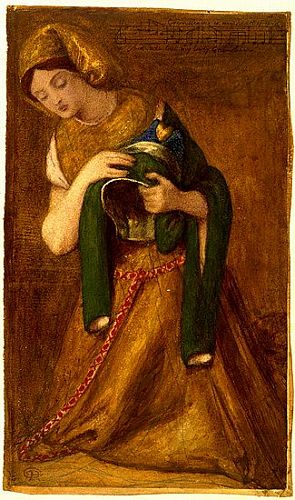
Image Credit: Rossetti Archive
Who was Lady Greensleeves
[W]hy would anyone be named for their green sleeves? Interpretations […] usually have a sexual connotation, most notably in the phrase “a green gown”, a reference to the grass stains on a woman’s dress from engaging in sexual intercourse outdoors. Was this lady a prostitute? [T]he song lyrics mention a “discourteous” rejection of the singer’s advances, suggesting to some that the lady in question was actually virtuous but, perhaps, was mistaken for a prostitute as a result of her green sleeves. [A]nother explanation is quite the opposite to promiscuity […]. [I]n heraldry, colour also had symbolisms and green indicated truth and fidelity […]. [A] knight may give a green armband to his true love to wear to show his devotion to her, giving rise to the familiar phrase “wearing your heart on your sleeve” meaning, to show your true feelings.
None of these theories, however, really seem to reflect the song’s true meaning, which clearly expresses an unrequited love by a rich man for a fair lady. All that we can confidently deduce, is that “Lady Greensleeves” is a nickname, not a title. Exactly who she was, remains a mystery.
Trivia Bits:
♦ In Shakespeare’s The Merry Wives of Windsor, the character Mistress Ford refers, twice, to “the tune of ‘Greensleeves'”.
♦ The tune was the basis for “Home in the Meadow,” a recurring song throughout the 1962 epic film How the West Was Won.
♦ A rendering of the tune, titled the “Lassie Theme”, was used extensively in the Lassie television show, especially the ending credits.
Everyone will remember this tune as What Child Is This? ~Vic
Sources & Additional Reading:
The Folk Song Greensleeves (Greensleeves Hubs)
Dante Gabriel Rossetti (Rossetti Archive)
Lyrics (Six Wives Website)
Greensleeves (Wikipedia)
Amy Nuttall
Tune Tuesday: Roll With It 1988

It’s Tune Tuesday! And…I just made that up. But, hey, I’m having fun. I hope you have fun, too. ~Vic
Thirty years ago, today, the number one song was:
Roll With It by Steve Winwood.
 Cosmic-Observation