Of all the songs we released as singles, that was my favorite. The song, first of all, had a classical base and the middle had a gospel section, which I loved.
We were doing an album at the time and, usually, we try and be collaborative when we write the songs because, we had made an agreement that we would share the publishing on all of our songs so that specific writers don’t get the credit. But, that was a song that I came up with. We put it on a bummer album like Oops! Wrong Planet thinking, maybe, we need to put something a little hopeful on it.
The song still has meaning to me. I perform it every night with Ringo. Ringo has his “three hit rule” and I’m taking advantage of a technicality in that Love Is The Answer was a hit but, it wasn’t a hit for me or Utopia. It was a hit for England Dan & John Ford Coley.
Originally, Ringo wanted me to do Hello It’s Me and I just felt that the song, in the context of what the rest of the band was playing, didn’t represent the message I wanted to convey because, “Hello It’s Me” is a kind of a selfish song. It’s me, me, me…it’s all about me. I’m in charge and, all this other stuff. I thought a better song, especially for Mr. Peace & Love, Ringo himself, would be “Love Is The Answer” and, people would know the song because it was a hit. […] they, maybe even, would just gloss over the fact that it wasn’t a hit for me and think, ‘Oh Yeah! Now, I remember him singing this song.’ So, for me, it’s a high point of the evening and, hopefully, the audience is getting the message.
[The movie] depicts a dystopian future in which humanity is unknowingly trapped inside a simulated reality called the Matrix, created by thought-capable machines (artificial beings) to control humans while using their bodies as an energy source. Hacker and computer programmer, Neo, learns this truth and “is drawn into a rebellion against the machines”, which involves other people who have been freed from the Matrix.
The film is an example of the cyberpunk subgenre. The Wachowskis’ approach to action scenes drew upon their admiration for Japanese animation and martial arts films and, the film’s use of fight choreographers and wire fu techniques from Hong Kong action cinema, influenced subsequent Hollywood action film productions. The Matrix is known for popularizing a visual effect known as “bullet time“, in which the heightened perception of certain characters is represented by allowing the action within a shot to progress in slow-motion while the camera’s viewpoint appears to move through the scene at normal speed. The film contains numerous allusions to philosophical and religious ideas, including existentialism, Marxism, feminism, Buddhism, nihilism and postmodernism.
“The Matrix” is a visually dazzling cyberadventure, full of kinetic excitement but, it retreats to formula just when it’s getting interesting. It’s kind of a letdown when a movie begins by redefining the nature of reality and ends with a shoot-out. We want a leap of the imagination, not one of those obligatory climaxes with automatic weapons fire.
I’ve seen dozens if not hundreds of these exercises in violence, which recycle the same tired ideas: Bad guys fire thousands of rounds but, are unable to hit the good guy. Then, it’s down to the final showdown between good and evil…a martial arts battle in which the good guy gets pounded until he’s almost dead, before he finds the inner will to fight back. Been there, seen that (although rarely done this well).
“The Matrix” did not bore me. It interested me so much, indeed, that I wanted to be challenged even more. I wanted it to follow its material to audacious conclusions, to arrive not simply at victory but, at revelation.
“I walked out of The Matrix with Jared and I was thinking, ‘What kind of science fiction movie can people make now?'” Aronofsky says. “The Wachowskis basically took all the great sci-fi ideas of the 20th century and rolled them into a delicious pop culture sandwich that everyone on the planet devoured. Suddenly Philip K. Dick‘s ideas no longer seemed that fresh. Cyberpunk? Done.”
[…] Mr. Shyamalan is not much of a cinema historian. Among the directors he admires are Peter Weir, Cameron Crowe, Alfred Hitchcock and the Wachowski Brothers. “Whatever you think of ‘The Matrix,’ every shot is there because of the passion they have! You can see they argued it out!”
Trivia Bits:
♦ For the cell phone conversation scene between Neo and Morpheus in the MetaCortex office, Keanu Reeves actually climbed up the window without a stuntman, which was 34 floors up.
♦ Will Smith was approached to play Neo but, turned down the offer in order to star in Wild Wild West (1999). He later admitted that, at the time, he was “not mature enough as an actor” and that, if given the role, he “would have messed it up”. He had no regrets, saying that “Keanu was brilliant as Neo.”
♦ In an online interview when the film was first released, the Wachowskis revealed that they’d both take the Blue Pill when given Neo’s choice.
The untimely deaths of famous musicians at age 27 may be coincidence but, it is [a] tragic coincidence. The mythology of the 27 Club gained prominence with the death of Kurt Cobain in 1994 since he died at the same age as iconic rock musicians, including Jimi Hendrix, Janis Joplin and Jim Morrison, when they died in the 1970s. The premature death of Amy Winehouse at age 27 in 2011, again, renewed interest in the age’s apparent curse. This is a list of some of the artists and musicians who died at the far too young age of 27.
Robert Johnson…Blues singer-songwriter-musician (May 8, 1911 – August 16, 1938) Brian Jones…The Rolling Stones founder (February 28, 1942 – July 3, 1969) Alan “Blind Owl” Wilson…Canned Heat co-founder (July 4, 1943 – September 3, 1970) Jimi Hendrix…Rock singer-songwriter-guitarist (November 27, 1942 – September 18, 1970) Janis Joplin…Rock-soul-blues singer-songwriter (January 19, 1943 – October 4, 1970) Jim Morrison…The Doors co-founder (December 8, 1943 – July 3, 1971) Ron “Pigpen” McKernan…Grateful Dead founding member (September 8, 1945 – March 8, 1973) Kurt Cobain (February 20, 1967 – April 5, 1994) Amy Winehouse…Singer-songwriter (September 14, 1983 – July 23, 2011)
Fifty-one years ago, today, a powerful voice & soul was extinguished. I wasn’t even two years old when he was killed. He was only 39. He wasn’t a perfect person (who is?) but, his message was.
Just after 6:00p.m. on April 4, 1968, Martin Luther King, Jr. is fatally shot while standing on the balcony outside his second-story room at the Lorraine Motel in Memphis, Tennessee. The civil rights leader was in Memphis to support a sanitation workers’ strike and, was on his way to dinner when a bullet struck him in the jaw and severed his spinal cord. King was pronounced dead after his arrival at a Memphis hospital.
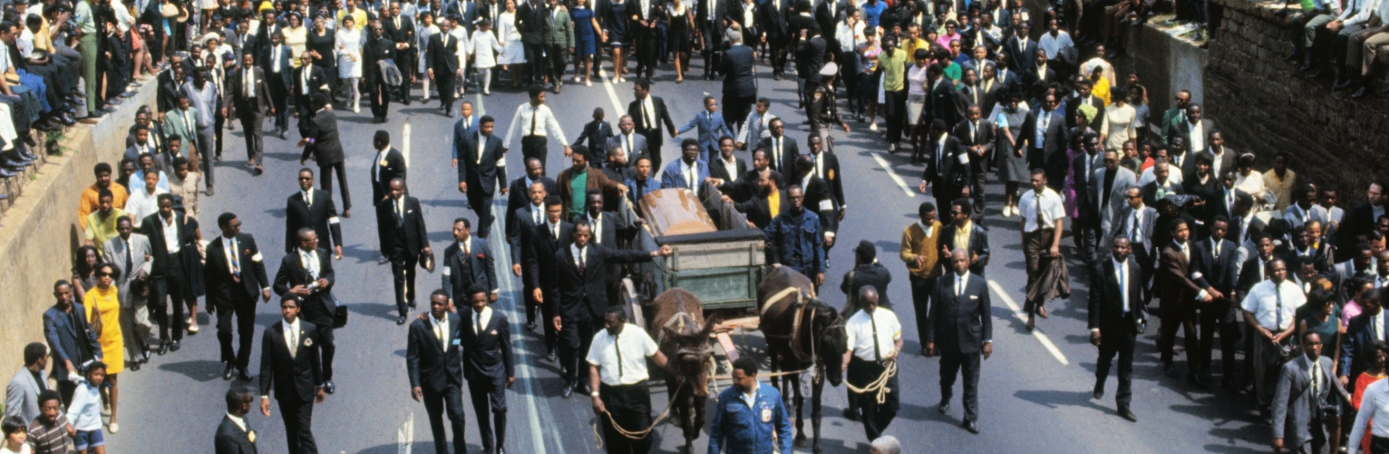
As word of the assassination spread, riots broke out in cities all across the United States and, National Guard troops were deployed in Memphis and Washington, D.C. On April 9, King was laid to rest in his hometown of Atlanta, Georgia. Tens of thousands of people lined the streets to pay tribute to King’s casket as it passed by in a wooden farm cart drawn by two mules.
The King family and others believe the assassination was the result of a conspiracy involving the U.S. government, Mafia and Memphis police, as alleged by Loyd Jowers in 1993. They believe that Ray was a scapegoat. In 1999, the family filed a wrongful death lawsuit against Jowers for the sum of $10 million. During closing arguments, their attorney asked the jury to award damages of $100, to make the point that “it was not about the money.” During the trial, both sides presented evidence alleging a government conspiracy. The government agencies accused could not defend themselves or respond because they were not named as defendants. Based on the evidence, the jury concluded Jowers, and others, were “part of a conspiracy to kill King” and awarded the family $100. The allegations and the finding of the Memphis jury were later rejected by the United States Department of Justice in 2000 due to lack of evidence.
“For those of you who are black, and are tempted to be filled with hatred and mistrust of the injustice of such an act, against all white people, I would only say that I can also feel in my own heart the same kind of feeling. I had a member of my family killed but, he was killed by a white man.
On March 10, 1969, James Earl Ray pleaded guilty (on his birthday) and was sentenced to 99 years in the Tennessee State Penitentiary. He died in prison at the age of 70 on April 23, 1998, twenty-nine years and 19 days after King’s assassination.
The Battle of New Bern (also known as the Battle of New Berne) was fought on 14 March 1862, near the city of New Bern, North Carolina, as part of the Burnside Expedition of the American Civil War. The US Army’s Coast Division, led by Brigadier General Ambrose Burnside and accompanied by armed vessels from the North Atlantic Blockading Squadron, were opposed by an undermanned and badly trained Confederate force of North Carolina soldiers and militia led by Brigadier General Lawrence O’B. Branch. Although the defenders fought behind breastworks that had been set up before the battle, their line had a weak spot in its center that was exploited by the attacking Federal soldiers. When the center of the line was penetrated, many of the militia broke, forcing a general retreat of the entire Confederate force. General Branch was unable to regain control of his troops until they had retreated to Kinston, more than 30 miles (about 50 km) away. New Bern came under Federal control, and remained so for the rest of the war.
Hatteras Island, on the outer shore of North Carolina, fell to Union forces in August, 1861. Roanoke Island, just to the north, was captured on February 8, 1862. Elizabeth City on the mainland followed days later. With the freedom to navigate unmolested through Albemarle and Pamlico Sounds, Brig. Gen. Ambrose E. Burnside’s command looked for other strategic targets of opportunity. The city of New Bern was a significant target, as the Atlantic and North Carolina Railroad that connected the coast with the interior passed through there. On March 11, 1862, Burnside’s force embarked from Roanoke Island to rendezvous with Union gunboats at Hatteras Inlet for a joint expedition against New Bern. On March 13th, the fleet sailed up the Neuse River and disembarked infantry south of the Confederate defenses, about 4,000 men behind breastworks at Fort Thompson. The defenders, a mix of North Carolina infantry, cavalry and artillery, were commanded by Brig. Gen. Lawrence Branch. On March 14th, the brigades of Brig. Gens. John G. Foster, Jesse Reno, and John G. Parke attacked along the railroad and after four [sic] hours of fighting, drove the Confederates out of their fortifications. The Federals captured several nearby gun positions and occupied a base that they would hold to the end of the war, in spite of several Confederate attempts to recapture it.
On March 13th 1862, 11,000 Union troops led by General Ambrose Burnside, along with 13 heavily-armed gunboats led by Commodore Stephen Rowan, landed at Slocum’s Creek, now part of the Cherry Point Marine Corps Air Station. Their objective was [the] capture of the town of New Bern because of its strategic position and the fact that the Atlantic and North Carolina railroad was also located here. Union strategists hoped to use New Bern as a stepping off point to cutting off the main Confederate north-south railroad supply line at Goldsboro.
Awaiting the Union forces were about 4,500 inexperienced and ill-equipped Confederate troops commanded by General Laurence [sic] O’Bryan Branch, a politician with virtually no military experience. Branch positioned his infantry regiments, one cavalry regiment, local militia and three gun batteries to defend a line extending from Fort Thompson on the Neuse River and running approximately one mile west to the Weatherby Road at the eastern edge of Brice’s Creek. Extending Branch’s right wing to the railroad tracks was the 26th North Carolina Regiment commanded by Colonel Zebulon Vance, later governor of North Carolina.
Despite support from Commodore Rowan’s gunboats, this attack stalled. However, a regiment of General Parke’s brigade flanked the position of a militia battalion in the vicinity of Wood’s brickyard adjoining the railroad. Parke’s infantry drove these poorly armed, fresh militiamen from their position leaving the right flank of the 35th North Carolina Regiment exposed. The Confederate line was broken between the 26th and the 35th regiments, and the Union forces pushed through forcing the retreat of the Confederate troops.
The Battle of New Bern was the baptism of fire for the 26th North Carolina. Later, in July 1863, the 26th lost 588 of 800 men at the Battle of Gettysburg, sustaining the largest numerical losses of any unit, North or South, during the entire course of the war.
Estimated casualties for the battle: 1080 total. The fierce battle in the swamps and along the railroad five miles south of New Bern, proved to be a major victory for the Union and led to the ensuing occupation of New Bern for the remainder of the Civil War. Although Union forces never seized and held the rail line at Goldsboro, their presence in New Bern required the Confederacy to divert troops to the railroad’s defense that might have been used in the critical battles in Virginia. For General Ambrose Burnside, the New Bern victory was a factor in his subsequently being given command of the Army of the Potomac and leadership in the Union disaster at Fredericksburg.
One-hundred and fifty-seven years ago, today… ~Vic
Sly and the Family Stone took the Sixties ideal of a generation coming together and, turned it into deeply groove-driven music. Rock’s first integrated, multi-gender band became funky Pied Pipers to the Woodstock Generation, synthesizing rock, soul, R&B, funk and psychedelia into danceable, message-laden, high-energy music. In promoting their gospel of tolerance and celebration of differences, Sly and the Family Stone brought disparate audiences together during the latter half of the Sixties. The group connected with the rising counterculture by means of songs that addressed issues of personal pride and liberation in the context of driving, insistent and sunny-tempered music that fused rock and soul, creating a template for Seventies funk.
Lyrics: Sometimes I’m right and I can be wrong
My own beliefs are in my song
The butcher, the banker, the drummer and then
Makes no difference what group I’m in
I am everyday people, yeah, yeah
There is a blue one
Who can’t accept the green one
For living with a fat one
Trying to be a skinny one
Different strokes
For different folks
And so on and so on
And scooby dooby dooby
Oh sha sha
We got to live together
I am no better and neither are you
We are the same, whatever we do
You love me, you hate me, you know me and then
You can’t figure out the bag I’m in
I am everyday people, yeah yeah
There is a long hair
That doesn’t like the short hair
For being such a rich one
That will not help the poor one
Different strokes
For different folks
And so on and so on
And scooby dooby dooby
Oh sha sha
We got to live together
There is a yellow one
That won’t accept the black one
That won’t accept the red one
That won’t accept the white one
Different strokes
For different folks
And so on and so on
And scooby dooby dooby
Oh sha sha
I am everyday people
Addendum:
In 1961, Billboard added a new category called Adult Contemporary. Prior to that, from 1958 to 1960, everything fit into either Hot 100, R & B or Country. In 1963, Billboard 200 was added and in 1964, Top Country Albums. As of 2018, Billboard now has 87 individual categories. Choosing a number #1 song in any of these categories could fill up a blog, if a blogger was so inclined. Previously, I tried to showcase Hot 100s and added Alternative Rock, Mainstream Rock, Country and, R&B. It is a lot of work and if I tried to cover all the new categories, well…they would find my dead body, slumped over the keyboard.
Under normal circumstances, I go backwards each week by five years. I love music so, I’m going to have to shift gears, soon, to cover #1 songs in some categories other than the coveted Hot 100. I may end up going backwards five years every month instead of every week. We shall see… ~Vic
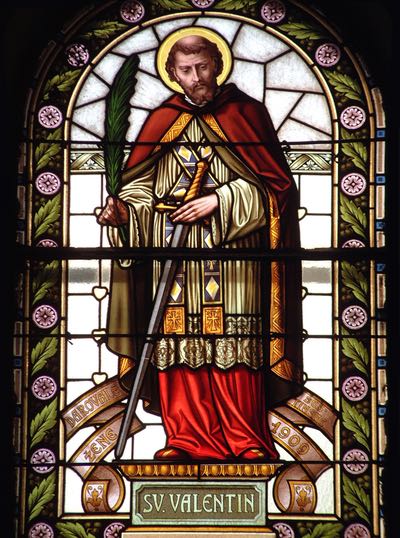
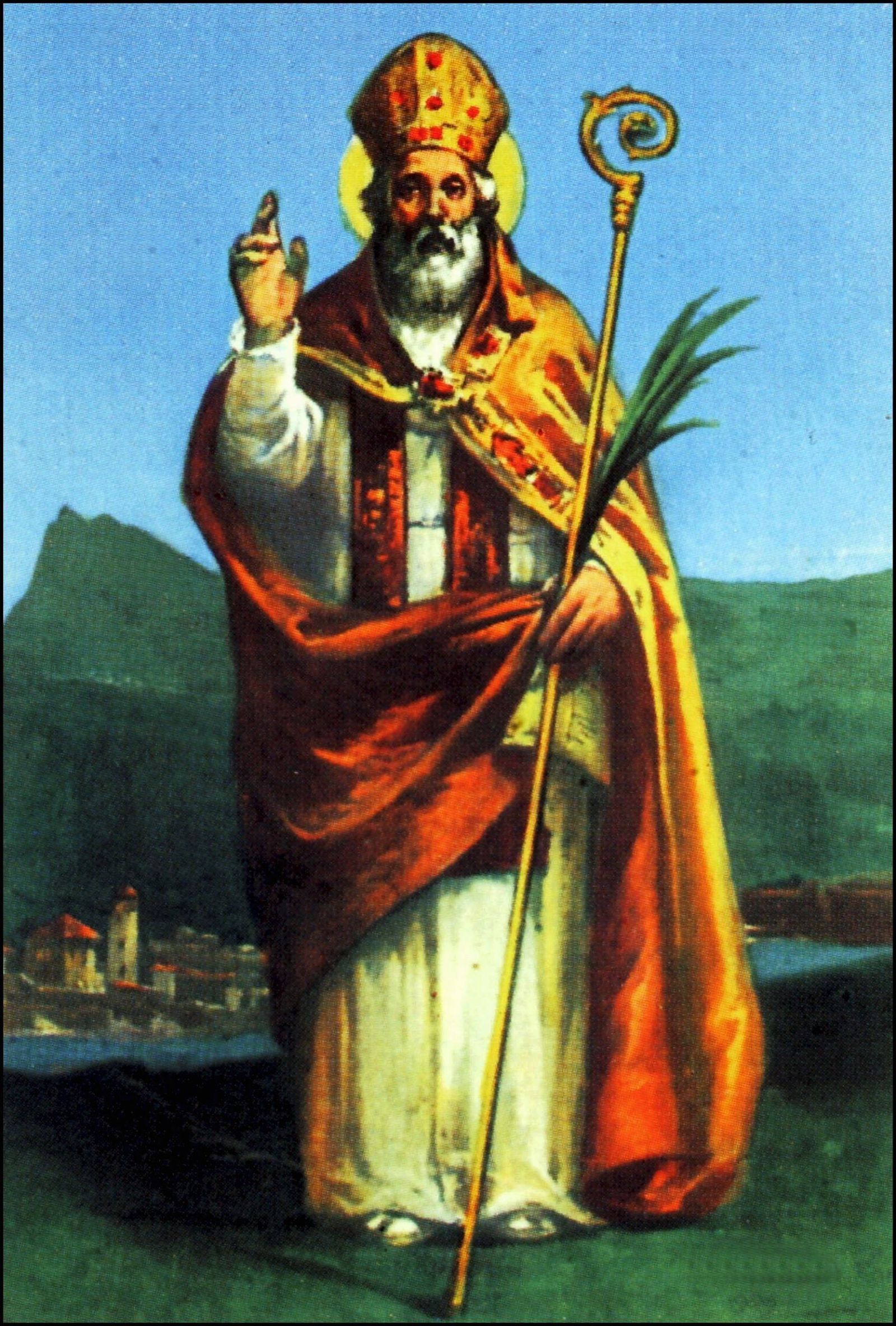
There are SO many stories regarding the origins of the Valentine’s Day we celebrate. The most common story about this elusive man was that he was a priest and bishop in Rome in the 3rd century. The Roman Emperor of the time was Claudius Gothicus (Claudius II), the first of the tough, soldier emperors, that ruled with an iron fist and was known for his cruelty. From The History Channel:
Under the rule of Claudius the Cruel, Rome was involved in many unpopular and bloody campaigns. The emperor had to maintain a strong army but, was having a difficult time getting soldiers to join his military leagues. Claudius believed that Roman men were unwilling to join the army because of their strong attachment to their wives and families. To get rid of the problem, Claudius banned all marriages and engagements in Rome. Valentine, realizing the injustice of the decree, defied Claudius and continued to perform marriages for young lovers in secret. When Valentine’s actions were discovered, Claudius ordered that he be put to death. Valentine was arrested and dragged before the Prefect of Rome who condemned him to be beaten to death with clubs and, to have his head cut off. The sentence was carried out on February 14, on or about the year 270. Legend also has it that while in jail, Valentine left a farewell note for the jailer’s daughter, who had become his friend, and signed it “From Your Valentine.”
[…] he was arrested and thrown in prison by Emperor Claudius II. He was put under vigilance of prefect Asterius, director of the confine who had challenged Valentine, before, regarding his alleged healing powers. Asterius, a ruthless man, requested Valentine to restore the gift of sight to his daughter, Julia, who was born a blind girl. Valentine placed his hands over her eyes, prayed to God and Julia was able to see. Asterius, in awe of Valentine’s power converted to Christianity, along with 46 members of his family. He, then, also freed all Christians who were confined in his prison. The emperor, aware of what had happened, ordered Valentine and Asterius to be beheaded. The penalty was probably executed, on February 14, 271 AD. Sometime before his execution, Valentine wrote a letter, signed “from your Valentine”, saying goodbye to Julia, the daughter of Asterius with whom he had fallen in love. This would become the first record in history of a “Valentine’s Day letter”.
According to the popular hagiographical identity, and what is believed to be the first representation of St. Valentine, the Nuremberg Chronicle, St. Valentine was a Roman priest martyred during Claudius’ reign. […] A relationship between the saint and emperor began to grow, until Valentine attempted to convince Claudius of Christianity. Claudius became (en)raged and sentenced Valentine to death, commanding him to renounce his faith or be beaten with clubs and beheaded. St. Valentine refused to renounce his faith and, Christianity, and was executed outside the Flaminian Gate on February 14, 269. However, other tales of St. Valentine’s life claim he was executed either in the year 269, 270, 273 or 280. Another variation of the legend of St. Valentine says he refused to sacrifice to pagan gods, was imprisoned and, while imprisoned, he healed the jailer’s blind daughter. Whoever he was, Valentine did really exist, because archaeologists have unearthed a Roman catacomb and an ancient church dedicated to St. Valentine. In 496AD, Pope Gelasius marked February 14th as a celebration in honor of his martyrdom.
The Catholic Church’s official list of recognized saints, the Roman Martyrology, lists seven Valentines: a martyr (a possible Roman priest or Terni bishop) buried on the Via Flaminia (February 14); a priest from Viterbo (November 3); a bishop from Raetia who died in about 450 (January 7); a fifth-century priest and hermit (July 4); a Spanish hermit who died in about 715 (October 25); Valentine Berrio Ochoa, martyred in 1861 (November 24); and Valentine Jaunzarás Gómez, martyred in 1936 (September 18). Valentine did not appear in the official Church calendar for centuries, however “Martyr Valentinus the Presbyter and those with him at Rome” remains on the list of saints proposed for veneration by Catholics. In the Eastern Orthodox Church, Saint Valentine the Presbyter is celebrated on July 6, and Hieromartyr Saint Valentine (Bishop of Interamna, Terni in Italy) is celebrated on July 30. Clearly they are viewed as two separate people. Notwithstanding that, conventionally, members of the Greek Orthodox Church named Valentinos (male) or Valentina (female) celebrate their name on February 14th.
The Modern
So, how did we get the day of celebration we have now? That is nearly as obscure as the saint that the day is based on.
English 18th-century antiquarians Alban Butler and Francis Douce, noting the obscurity of Saint Valentine’s identity, suggested that Saint Valentine’s Day was created as an attempt to supersede the pagan holiday of Lupercalia (mid-February in Rome). This idea has lately been dismissed by other researchers, such as Professor Jack B. Oruch of the University of Kansas, Henry Ansgar Kelly of the University of California, Los Angeles and Associate Professor Michael Matthew Kaylor of the Masaryk University. Many of the current legends that characterize Saint Valentine were invented in the 14th century in England, notably by Geoffrey Chaucer and his circle, when the feast day of February 14 first became associated with romantic love.
[…] University of Kansas English professor, the late Jack B. Oruch, had a different theory […] Through research, he determined that the poet Geoffrey Chaucer linked love with St. Valentine for the first time in his 14th-century works “Parlement of Foules” and “The Complaint of Mars.” Therefore, Oruch claimed that Chaucer invented Valentine’s Day as we know it today. At the time, February 14 also happened to be considered the first day of spring since it was the beginning of birds’ mating season—perfectly appropriate for a celebration of affection.
Addendum
According to Catholic Online and Catholic Saints, Saint Valentine is the Patron Saint of epilepsy, fainting, (a non-specific) plague, bee keepers, affianced couples, betrothed couples, engaged couples, love, lovers, happy marriages, young people and travelers. Whew! That is quite a lot to keep up with.
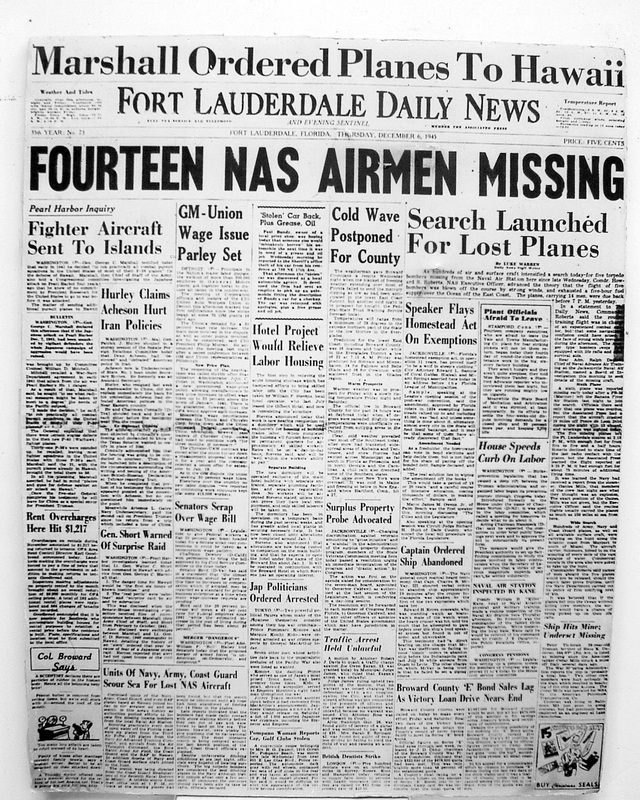
Seventy-three years ago, today, the infamous Flight 19 disappeared over the Bermuda Triangle in what was supposed to be a routine, three-hour exercise of combat training and navigation. Four TBM-1Cs and one TBM-3 Grumman Avenger torpedo bombers took off from NAS Fort Lauderdale at 14:10pm. Twenty-seven year old Navy Lieutenant Charles Carroll Taylor was the flight leader and pilot of FT-28, the TBM-3.
“Two hours after the flight began, the leader of the squadron, who had been flying in the area for more than six months, reported that his compass and back-up compass had failed and, that his position was unknown. The other planes experienced similar instrument malfunctions. Radio facilities on land were contacted to find the location of the lost squadron but, none were successful. After two more hours of confused messages from the fliers, a distorted radio transmission from the squadron leader was heard at 18:20pm, apparently calling for his men to prepare to ditch their aircraft simultaneously because of lack of fuel.”
“Radio conversations between the pilots were overheard by base and other aircraft in the area. The practice bombing operation is known to have been carried out because at about 15:00pm, a pilot requested and was given permission to drop his last bomb. Forty minutes later, another flight instructor, Lieutenant Robert F. Cox in FT-74, forming up with his group of students for the same mission, received an unidentified transmission.
Photo Credit: nasflmuseum.com
An unidentified crew member asked Powers (Marine Corps Captain Edward Joseph Powers, Jr., pilot of FT-36), for his compass reading. Powers replied: “I don’t know where we are. We must have got lost after that last turn.” Cox then transmitted: “This is FT-74, plane or boat calling ‘Powers’ please identify yourself so someone can help you.” The response after a few moments was a request from the others in the flight for suggestions. FT-74 tried again and a man identified as FT-28 (Lt. Taylor) came on. “FT-28, this is FT-74, what is your trouble?” “Both of my compasses are out”, Taylor replied, “and I am trying to find Fort Lauderdale, Florida. I am over land but it’s broken. I am sure I’m in the Keys but, I don’t know how far down and, I don’t know how to get to Fort Lauderdale.”
FT-74 informed the NAS that aircraft were lost, then advised Taylor to put the sun on his port wing and fly north up the coast to Fort Lauderdale. […] no bearings could be made on the flight and the IFF (transmitter) could not be picked up. Taylor was told to broadcast on 4805 kHz. This order was not acknowledged so he was asked to switch to 3000 kHz, the search and rescue frequency. Taylor replied: “I cannot switch frequencies. I must keep my planes intact.”
As the weather deteriorated, radio contact became intermittent and it was believed that the five aircraft were actually, by that time, more than 200 nmi (230 mi; 370 km) out to sea east of the Florida peninsula. Taylor radioed “We’ll fly 270 degrees west until landfall or running out of gas” and requested a weather check at 17:24pm. By 17:50pm, several land-based radio stations had triangulated Flight 19’s position as […] north of the Bahamas and well off the coast of central Florida.”
There is some question as to the exact time of Taylor’s last transmission (18:20pm or 19:04pm) but, he was heard saying “All planes close up tight…we’ll have to ditch unless landfall…when the first plane drops below 10 gallons, we all go down together.” By that time, the sun had set and the weather was much worse.
“Two PBM Mariner flying boats were dispatched from NAS Banana River in Melbourne, Florida (now Patrick Air Force Base), carrying rescue equipment. Less than a half hour after take-off (at approximately 19:27), one of the PBM’s (Trainer 49/BuNo 59225) radioed the tower that they were nearing Flight 19’s last assumed position. The rescue plane with a crew of 13 men was never heard from again.”
“At 21:15pm, the tanker SS Gaines Mills reported it had observed flames from an apparent explosion leaping 100 ft (30 m) high and burning for 10 minutes. Captain Shonna Stanley reported unsuccessfully searching for survivors through a pool of oil and aviation gasoline. The escort carrier USS Solomons also reported losing radar contact with an aircraft at the same position and time.”
A 500 page Navy investigation was published a few months later. Initially, blame was placed upon Lt. Taylor for mistaking the Bahamas for the Florida Keys and not listening to his subordinate officers. The report was amended to ’cause unknown’ when Taylor’s mother stated that the Navy had no evidence for their conclusions…no planes and no bodies. Lt. Taylor was listed as ‘not at fault’ as his compasses were not working. The disappearance of PBM-5 Trainer 49 was attributed to a mid-air explosion.
Seventy-one years ago, today, something happened in Roswell, New Mexico. The Roswell Daily Record printed the story of the crash of a flying saucer on a ranch roughly 30 miles outside of Roswell proper. The Sacramento Bee picked up the story and printed statements from the Roswell Army Air Field.
Over the years, I’ve seen documentaries and read accounts of the initial debris field pieces that were retrieved from the owner of the land. I’ve seen the interviewees on camera and read their statements. I also know that there was a concerted effort by our military to keep what they found out of any more newspapers and, to quickly change the narrative to the weather balloon story.
I’ve actually been to Roswell, NM, spending the night in a local motel just for the complete experience in September of 2002. It’s cattle ranch territory and it smells that way especially in the morning. I’ve been to the Roswell UFO Museum. It is really quite fascinating to walk through it. Some of it is tongue-in-cheek but, there is a lot of information despite the government’s desire to make it “a joke”. A local waitress in a diner, where my *then* husband and I went for breakfast, said that the whole thing was a blessing and a curse. It brought in tourism dollars but, it was also a sore point for some of the older residents whom, at that time, still remembered the events when they happened. As she poured our coffee, she leaned over and told us that there were many locals that swore it was a craft…information passed quietly from neighbor to neighbor, family descendant to family descendant, much like Native American verbal history, handed down through time. Frankly, I never believed the official story. There were too many questions left unanswered and too many things that didn’t add up. Plus, our government lies to us all the time. Why should this be any different.
[…] these were a race we have come to call The Greys. The Greys originate on a star system many galaxies distant from us. […] their own name for themselves does not translate into anything pronounceable by the human voice box. These beings have been observing Earth for many centuries […] The Greys behave a little like human teenagers in that they have a certain level of knowledge but, cannot quite put it into context. The first real contact we had with these beings was with the Roswell crash in New Mexico in 1948 [sic]. This was an event where a Grey ship malfunctioned and crashed into the desert near the town of Roswell. As with just about anything that happens in America, the military took control. The crash provided them with an alien ship and three survivors. The Greys were reluctant to become involved in human affairs but, the American military had three of their beings. So began a relationship […] The American military looking for ‘advanced’ technology to give them global military advantage and, in return, the Greys received free access to the genetic material available on Earth.
[Note: Chris Thomas is many things but, not the best typist. His books have a few typos.]
Their home galaxy is too far distant for us to have a name for it. This race is responsible for some of the human and animal abductions that have taken place on Earth in the past 40 years. As they were causing some disruption to human plans, they have, effectively, been banned from our solar system since 2000. This race has been working with the American miliary since the Roswell crash in 1947 and has given over a great deal of its technology in exchange for permission to carry out some animal experimentation and medical examinations of people.
During the Second World War, a great many ‘unidentified’ flying craft were observed as the skies were watched with far more zeal than was previously necessary. Several of these craft were shot down but, because it was war time and it was known that Hitler was developing many innovative weapons, it was assumed that crashed UFOs were Nazi in origin. During the war, the American military began to experiment with many forms of weapons and energy devices and, in particular, energy devices that would help shield ships or aircraft from the newly developed enemy radar. […] the technology was kept for later experiments which the American military began in the late 1940s. In 1948 [sic], the experiments began in a region of New Mexico, although this time, the machinery was land based […] They ran experiments for three days and each day at least one UFO fell out of the sky, the most famous one being the crash at Roswell. There is so much disinformation spread about this race that the only way of finding out any form of truth is to look to the Akashic. In exchange for new ‘alien’ technology, the American military ‘granted’ the Greys permission to abduct and study human physiology. Since 2000, the Greys have been asked not to travel to our solar system, a request with which they have generally been happy to comply.
Their first real contact with Earth was the Roswell crash […] The military have mainly been interested in Grey technology which the military mainly use for psychic attack purposes. The Greys are very interested in human physiology and are responsible for some human and animal abductions. Please note: the vast majority of human and animal abductions, and mutilations, have been carried out by the military.
Still believe our government? Still believe our military? If you are unsure of what the Akashic is, that will be for another post. ~Vic









 Cosmic-Observation