WWI
Flick Friday: The Heart Of Wetona 1919

One hundred, five years ago, today, the silent, adventure film The Heart Of Wetona was released. Directed by Sidney Franklin, it was written by Mary Murillo, basing it on a theatrical work by George Scarborough. Produced by Joseph M. Schenck, it starred Norma Talmadge (as Wetona), Fred Huntley, Thomas Meighan, Gladden James, F. A. Turner and Charles Edler.
“After the half-breed daughter of a Comanche Chief falls for a young engineer who deserts her, she turns to a white Indian agent who marries her.”
IMDb Short
“Wetona, the daughter of Indian Chief Quannah and a white mother, returns to her tribe after an education in a white school in the East, [only] to find herself torn between the two cultures of her heritage.”
IMDb Storyline
“The film tells the story of some Comanche Indians and their preparations for a Corn Dance. The father of Wetona finds out she loves a white man.
Wikipedia Plot
♦ Heart Of Wetona (World War One era song, sung by Wetona’s soldier)
Complete Movie
Music Monday: Hello Central! Give Me No Man’s Land 1918

One hundred, five years, ago…
Hello Central! Give Me No Man’s Land is a World War I era song released in 1918. Lyrics were written by Sam M. Lewis and Joe Young. Jean Schwartz composed the music. The song was published by Waterson Berlin & Snyder, Co. of New York City. Artist Albert Wilfred Barbelle designed the sheet music cover, which features a photo of Al Jolson next to a shadow of a child on the phone. Explosions in No Man’s Land take up the rest of the red background. The song was written for both voice and piano. It was first introduced in the 1918 musical Sinbad.
The song tells the story of a child attempting to call her father in No Man’s Land. She is unable to reach him over the telephone because her father has been killed fighting on the Western Front.
Wikipedia Summary
There is very little else written about this song. When I have gone to the Tsort charts, with these older pieces, I have usually chosen whatever was at the top of the particular chart, for the particular year. This time, I looked, specifically, for this month in 1918. According to (old) US Billboard 1, this song was on the chart for eight weeks. ~Vic
♦ The New York Public Library Digital Collections
♦ Library of Congress
♦ Smithsonian: National Museum Of American History
♦ WorldCat
♦ First World War: Multimedia History (Web Archive)
Music Monday: When Irish Eyes Are Smiling 1913

Image Credit: Knick Of Time Blog
One-hundred, ten years ago…
When Irish Eyes Are Smiling is a lighthearted song in tribute to Ireland and was very popular in June 1913. Its lyrics were written by Chauncey Olcott and George Graff, Jr., set to music composed by Ernest Ball, for Olcott’s production of The Isle O’ Dreams and, Olcott sang the song in the show. It was first published in 1912, at a time when songs in tribute to a romanticised Ireland were very numerous […], both in Britain and the United States. During the First World War, the famous tenor John McCormack recorded the song.
The song continued to be a familiar standard for generations. Decades later, it was used as the opening song on the radio show Duffy’s Tavern. The song has been recorded on over 200 singles and albums, by many famous singers, including Bing Crosby, Connie Francis and Roger Whittaker.
Wikipedia Summary
As I have stated in previous posts, Billboard’s charting abilities, in the early 20th Century, is difficult to navigate. My first stop, for these early pieces, is the Tsort site. Playback FM is very helpful, too. Digging around in the Wayback Machine can be a complete rat maze. The data is there but, how much time do you devote to searching for it.
There was a Shamrock Summit in March 1985, apparently, in Canada (which I don’t remember). Starting on St. Patrick’s Day, Prime Minister Brian Mulroney and President Ronald Reagan met & talked for two days. Remember the Acid Rain Scare back then? It was seen as a Turning Point in U.S.-Canada Relations (both Trudeaus don’t play well with others?) and the closing ceremonies were televised, with the men & their wives singing the song (Mulroney & Reagan are Irish surnames). I find the meeting in Quebec City and the singing of an Irish song, ironic and amusing. ~ Vic
Additional:
♦ Irish Eyes Are Smiling (The Account of Composer Ernest R. Ball’s Life/IMDb/1944)
♦ Still Something To Smile About (Pocono Record/Marta Gouger/Wayback Machine/03-06-2007)
♦ When Irish Eyes Are Smiling (Irish Music Daily/Pat/No Date Given)
♦ List Of Movies Using The Song
Movie Monday: To Hell and Back 1955

Sixty-five years ago, today, the war film To Hell and Back was released, originally in San Antonio. Directed by Jesse Hibbs and based on the book of the same name, it starred Audie Murphy, Marshall Thompson, Charles Drake, Jack Kelly, Gregg Palmer, Paul Picerni, David Janssen, Denver Pyle, Brett Halsey (Admiral’s great-nephew) and Gordon Gebert as a young Audie.
Biopic of the wartime exploits of Audie Murphy (played by himself), the most decorated US soldier in World War II. Starting with his boyhood in Texas, where he became the head of his family at a young age, the story follows his enrollment in [the] Army where he was assigned to the 3rd Division. He fought in North Africa, Sicily and Italy, before landing in southern France and, eventually, fighting in Germany. A Medal of Honor recipient, he also received battle honors from the French and Belgian government.
The highly variable Audie Murphy delivers his best screen performance as “himself” in Universal‘s To Hell and Back. Based on the star’s autobiography, this is the story of how Murphy became America’s most-decorated soldier during WW II. After dwelling a bit on Murphy’s hard-scrabble Texas upbringing, the story moves ahead to 1942, when, as a teenager, Audie joined the army. Within a year, he was a member of the 7th Army, serving in North Africa, Italy, France and, ultimately, Germany and Austria. One by one, the members of Murphy’s Company B are killed in the war, until only three men from the original company are left. [The] others appear at the finale as ghostly images […]. The bulk of the film is given over to Murphy’s conspicuous acts of combat bravery and his killing of 240 enemy soldiers. Highlighted by excellent battle sequences, To Hell and Back is a serviceable tribute to a most complex individual.

Photo Author: Fort Detrick
Wikipedia & Wikimedia
Trivia Bits:
♦ Filmed at Fort Lewis, WA, Yakima River, WA, Oak Creek Wildlife Area, WA and Universal Studios.
♦ Audie Murphy originally declined the opportunity to portray himself in the movie, not wanting people to think that he was attempting to cash in on his role as a war hero. Murphy initially suggested his friend Tony Curtis to play him.
♦ Audie Murphy’s war buddy Onclo Airheart was slated to play himself, but he declined due to the fact that the movie was to be shot during planting season.
♦ [Author] David Morell [sic] cites Audie Murphy as the inspiration for the character of John Rambo.
♦ In the movie, […] Murphy does his one-man standoff on top of a medium M-4 Sherman tank. [In] real life it happened on top of an M10 Wolverine tank destroyer.
♦ Audie Murphy’s feats of heroism and his much decorated status have been compared to those of his counterpart during World War I, Sgt. Alvin C. York […].
Murphy […] wrote poetry and songs, and, himself a sufferer, was among the first advocates for Post-Traumatic Stress Disorder. He died on May 28, 1971, when the private airplane in which he was riding crashed.
Additional Reading:
To Hell and Back (American Film Institute)
To Hell and Back (Turner Classic Movies)
Alvin York (Wikipedia)
Audie Murphy (Wikipedia)
Throwback Thursday: Silent Sentinels 1917
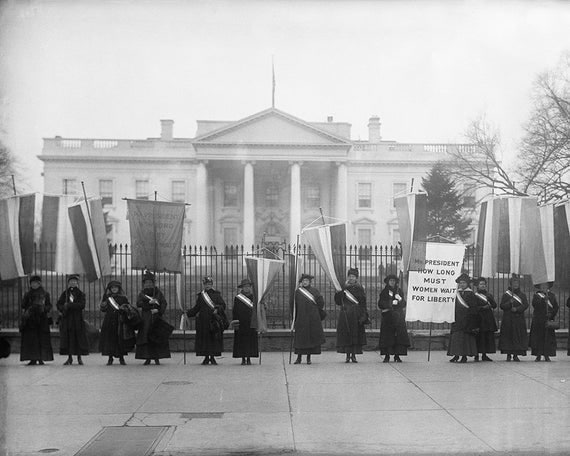
One hundred and two years ago, today, a group of women, organized by Women’s Rights Activist Alice Paul and the National Woman’s Party (NWP), began a picketing and protest campaign in front of the White House during the Wilson Presidency. Known as the Silent Sentinels, the protest began after a meeting with the President regarding suffrage proved fruitless with Wilson stating to the women to “…concert public opinion on behalf of women’s suffrage.” The silent protest was a new strategy for the National Suffrage Movement and served as a constant reminder of Wilson’s lack of support.

Originally founded as the Congressional Union for Woman Suffrage (CUWS) after the 1913 woman suffrage parade, they broke away from the National American Woman Suffrage Association (NAWSA), a more moderate group. CUWS only lasted three years and morphed into the NWP. The Suffragist was their weekly newsletter, containing essays, progress reports and notes on the President’s continuing indifference.
There were differing public reactions. Some approved, assisting with holding banners, bringing beverages and donating money. Some opposed their actions, including the leader of the NAWSA, Carrie Chapman Catt, whom preferred political tactics via individual states instead of a national amendment. She feared a male voter backlash.

Anti-suffragist mobs could be violent (worsening after the US entered World War I) spurred by the more insulting banners that compared Wilson to Kaiser Wilhelm. The New York Times called the protests “…silly, silent and offensive.” Massachusetts Representative Joseph Walsh referred to them as “…bewildered, deluded creatures with short skirts and short hair…” and “…nagging, iron-jawed angels.”
They were harassed, arrested, tortured and abused. Hunger strikes were met with forced feeding. On the night of November 14, 1917, known as the “Night of Terror“, the superintendent of the Occoquan Workhouse (prison), W.H. Whittaker, ordered the nearly forty guards to brutalize the suffragists. The treatment stories angered many Americans, creating more support. The protesters were finally released November 27 & 28, 1917, Alice Paul having spent five weeks there.
President Wilson finally announced his amendment support on January 8, 1918. The House barely passed the amendment the next day but, the Senate waited until October to vote. It failed by two votes. Protester arrests resumed August 6, 1918 and, by December, protestors were starting fires and burning Wilson effigies in front of the White House. Alice Paul encouraged people to vote against anti-suffrage Senators during the 1918 elections. The House, again, passed the amendment on May 21, 1919 and the Senate followed June 4 ending the six-day-a-week protest. The Nineteenth Amendment was adopted August 18, 1920.
See Iron Jawed Angels film.

Movie Monday: Shoulder Arms 1918

Today, we are going waaaaaaay back…to 1918. On this date, Shoulder Arms, a Charlie Chaplin piece, was a very popular film. Was it a ‘number one’? Hard to tell. This film pre-dates the Academy Awards by 11 years. Starring Sir Charles Spencer Chaplin, Edna Purviance, Sydney Chaplin (Charlie’s elder, half-brother) and Tom Wilson, it is, primarily, a dream sequence set in France during World War I.
Plot from IMDB:
Charlie is in boot camp in the “awkward squad.” Once in France, he gets no letters from home. He finally gets a package containing limburger cheese, which requires a gas mask and which he throws over into the German trench. He goes “over the top” and captures thirteen Germans (“I surrounded them”) then, volunteers to wander through the German lines disguised as a tree trunk. With the help of a French girl, he captures the Kaiser and the Crown Prince and, is given a statue and victory parade in New York. Then…fellow soldiers wake him from his dream. [edited for grammar]
From an archived New York Times article:
“”The fool’s funny,” was the chuckling observation of one of those who saw Charlie Chaplin’s new film. “Shoulder Arms”, at the Strand, yesterday and, apparently, that’s the way everybody felt. There have been learned discussions as to whether Chaplin’s comedy is low or high, artistic or crude but, no one can deny that when he impersonates a screen fool, he is funny. Most of those who go to find fault with him remain to laugh. They may still find fault but, they will keep on laughing. In “Shoulder Arms”, Chaplin is as funny as ever.” [edited for grammar]
Trivia Bits:
♦ Many in Hollywood were nervous that one of their most famous peers was going to tackle the subject of WWI. It was released shortly before the Armistice so, it did not help boost national morale but, it did end up as one of Charles Chaplin’s most popular films and, it was particularly popular with returning doughboys.
♦ Released two weeks and one day before the end of World War I.
Military Monday: First Woman Marine

One hundred years ago, today, August 13, 1918, Opha May (Jacob) Johnson, born May 4, 1879, enlisted in the Marine Corps Reserve during World War I. She just happened to be the first one in line with 300+ other women behind her.
From the U.S. World War One Centennial Commission:
At the onset and throughout the First World War, women in the United States were still denied the same basic rights and privileges as male citizens, including the right to vote. Suffragists would continue to battle on through this time, but their efforts would not culminate into a constitutional revision until 1920. Not only was the political arena considered off-limits for women, but military service was also denied to them. Though legends of women dressing as males to fight for the United States had been spoken of since the Revolution, women were not allowed to legally enlist in the armed services, the Marine Corps being no exception. By the summer of 1918 however, the Corps was in need of more soldiers, many of whom occupied vital administrative and clerical positions throughout the war department at the time. The idea was circulated and eventually approved to allow women into the marines to fill these non-combat positions, relieving this men to head for the front. From Kokomo, Indiana, Opha May Johnson was first in line when the recruiting station in Washington D.C. opened its doors to women and would become a legend as the first woman Marine.
She passed away August 11, 1955 but, her funeral services were held on August 13, 1955…37 years to the day that she first stood in line.
 Cosmic-Observation