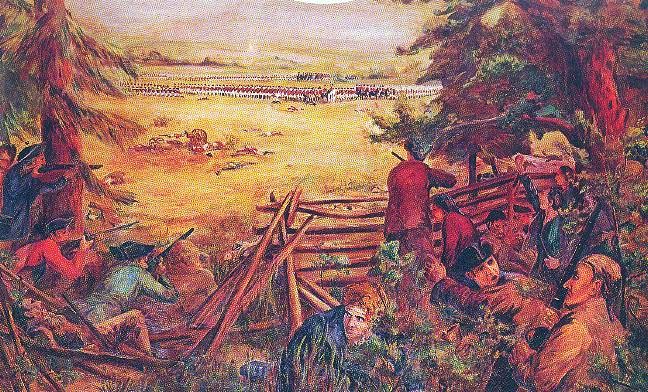
On a field in [the] Piedmont [of] North Carolina, Regulators clashed with North Carolina militia on May 16, 1771. Many probably had predicted the day when public disagreements, political protests and riots would one day escalate into an armed conflict. For a couple decades, tensions had been mounting. Piedmont farmers believed that they were being overtaxed and had been paying excessive fees to local sheriffs, and the colonial government. Piedmont farmers started demanding changes to the law and, publicly humiliating, intimidating and sometimes, flogging officials whom they deemed to be corrupt…Judge Richard Henderson and Sheriff Edmund Fanning are two examples.
After the Johnston [Riot] Act was passed, Rowan Regulators deemed it “riotous,” writes historian William Powell and, “swore that they would pay no more taxes.” Similar sentiment spread throughout the backcountry, so, in 1771, Governor Tryon flexed his executive muscle and ordered a special court in Hillsborough. Predicting that disgruntled Regulators would protest this action, Tryon sent out militia to the courthouse to quell any rebellious activity or interference with court sessions.
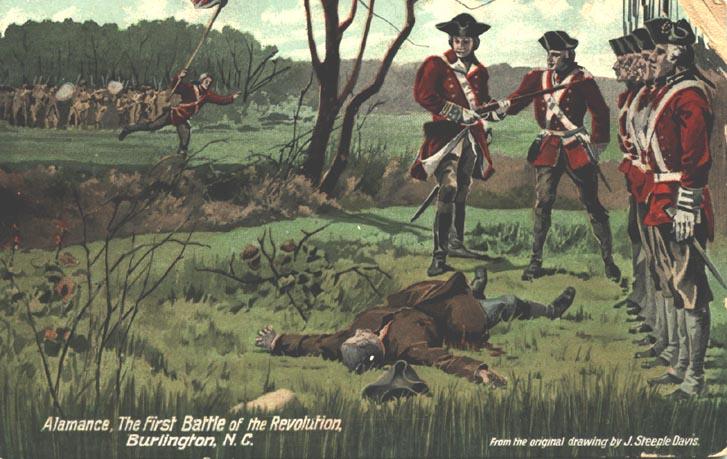
Image Credit: wikipedia.org & J. Steeple Davis
As the militia marched westward, approximately 2,000 Regulators assembled and, converged and met the militiamen camping beside Great Alamance Creek. On May 16, the Regulators relayed to Governor Tryon that they wanted to discuss their differences with government officials. Tryon scoffed at the suggestion and returned a message stating that a prerequisite for such an audience necessitated that the Regulators disarm. The royal governor gave the Regulators one hour to surrender. Their reply: “Fire and be damned.” No doubt believing the other side to be condemned to eternal fire, Tryon and the militia answered with cannon fire.
The Battle of Alamance lasted for two hours. The Regulators fired weapons behind trees and large rocks [but] their effort lacked organization. Sometimes when a Regulator would run out of ammunition, he left the field of battle. As to be expected, the militia was more organized in its attack, and maneuvers, and Tryon defeated the Regulators.
The War of the Regulation which culminated in the Battle of Alamance is one of the most controversial events in the history of North Carolina.
A great many of the people of North Carolina in the years just before the American Revolution were restless and dissatisfied with the state of affairs in their province. Their grievances were serious and affected their daily lives. Royal governors sent from outside the province were not able to maintain peace and quiet but, instead, frequently gave the people further cause for discontent. The outstanding group opposing the ruling class represented by the governor and his friends were known as Regulators.
It was a movement based upon the social and economic differences between the tidewater section and the back country of North Carolina. In the East, the people were almost entirely of English descent. It was here that an aristocratic form of society prevailed, based upon large plantations and slave labor. This area had taken on many of the forms and luxuries of older societies. The people looked to Virginia, and the mother country, for its social, intellectual and political standards. In the West, Scotch-Irish and German ancestries were predominant. Here, plantations were small and slaves were few in number. For the most part, the West was still in the pioneer stage. The forms and ideals of society were democratic. Philadelphia was the principal center for the interchange of ideas, as well as of produce. With slight intercourse between them, the two sections felt but little sympathetic interest in each other.
[…] North Carolina’s Governor Tryon built himself a mansion of grandiose proportions from those unfair taxes levied on struggling farmers. At this point emerged the Regulators. A group formed to protest these abuses, initially to print petitions, distribute pamphlets, advertise their demands for fair hearing and tax.
What started as a war of words swiftly moved to confrontation in the North Carolina courthouse of Hillsborough when a mob took over the building and removed the judge. Governor Tryon immediately passed a law making membership in the Regulators an act of treason.
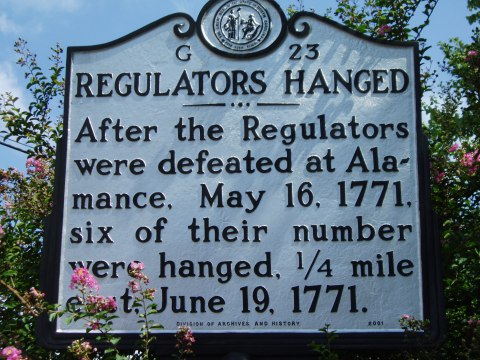
One man from the Regulators, attempting to negotiate peace, crossed to Tryon who took a gun from one of his militiamen and shot the man dead. An order to ‘Fire and be damned’ was given and the Battle of Alamance ensued. The Regulators, though not outnumbered, were without sufficient arms and ammunition and, the outcome was swift. Governor Tryon took 13 prisoners and six were later executed in nearby Hillsborough.
[Historical records of the casualties are disputed. The numbers of dead range from nine to 27 and the wounded range from 61 to 300. Historians of the time claim that this was, indeed, the beginning of the American Revolution. Modern historians disagree with this.
[…] shot by inventor and film pioneer William Friese-Greene on celluloid film using his ‘machine’ camera, the 20 feet of film […] was shot […] at Apsley Gate, Hyde Park, London. [It] was claimed to be the first motion picture [but] Louis Le Prince successfully shot on glass plate before 18 August 1887 and on paper negative in October 1888. It may, nonetheless, be the first moving picture film on celluloid and the first shot in London.
It is now considered a lost film with no known surviving prints and only one possible still image extant.
Image Credit: wikipedia.org
An article in This Is Bristol UK from December 17, 2009, (via The Wayback Machine) has an interview with David Friese-Greene, the great-grandson. From the article:
My great-grandfather was an idealist and a brilliant inventor, with 71 patents to his name but, he was a dreadful businessman. He died without ever having made a penny out of his inventions. He married his first wife Helena Friese when he was just 19 and incorporated her surname with his, because he felt it sounded more impressive. Tragically, Helena died at the age of 21 […].
It was during the late 1880s, shortly after Helena’s death, that Friese-Greene first began to experiment with the idea of creating moving pictures. […] in 1890, he patented [a] new device, which he dubbed the chronophotographic camera. Unfortunately, he was so pleased with his creation that, he wrote to the great American inventor, Thomas Edison, telling him what he had come up with and, even, included plans and designs […]. William never heard back from the inventor of the electric light bulb, though, the following year, Edison patented his own version of a movie camera and went down in many history books as the inventor of cinema.
In fact, William died a pauper but, [was] still passionate about his most famous creation. He was at a cinema industry meeting in London, which had been called to discuss the poor state of the British film industry in 1921. He had got to his feet to speak about his vision of how film could be used to create educational documentaries when he fell down dead. It is said he had just 21 pence in his pockets when he died.
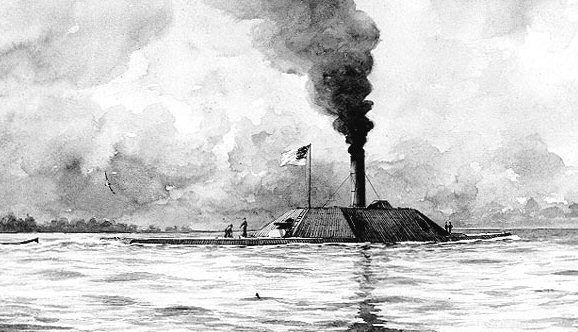
In a combined operation with the ironclad ram CSS Albemarle, Confederate forces under Maj. Gen. Robert F. Hoke, attacked the Federal garrison at Plymouth, North Carolina, on April 17. On April 19, the ram appeared in the river, sinking the USS Southfield, damaging the USS Miami and driving off the other Union Navy ships (USS Ceres & USS Whitehead) supporting the Plymouth garrison. Confederate forces captured Fort Comfort, driving defenders into Fort Williams. On April 20, the garrison surrendered.
*************
Construction of the ironclad began in January 1863 and continued on during the next year. Word of the gunboat reached the Union naval officers stationed in the region, raising an alarm. They appealed to the War Department for an overland expedition to destroy the ship, to be christened Albemarle after the body of water into which the Roanoke emptied but, the Union Army never felt it could spare the troops needed to carry out such a mission. It was a decision that would prove to be very short-sighted.
In April 1864, the newly commissioned Confederate States Steamer Albemarle, under the command of Captain James W. Cooke, got underway down-river toward Plymouth, North Carolina. Its mission was to clear the river of all Union vessels so that General Robert F. Hoke‘s troops could storm the forts located there.
[…] two paddle steamers, USS Miami and USS Southfield, lashed together with spars and chains, approached from up-river, attempting to pass on either side of Albemarle in order to trap her between them.
Image Credit: sonofthesouth.net
The sinking of the USS Southfield.
Captain Cooke turned heavily to starboard, getting outboard of [the] Southfield but, running dangerously close to the southern shore. Turning back sharply into the river, he rammed the Union side-wheeler, driving her under. Albemarle’s ram became trapped in Southfield’s hull from the force of the blow and her bow was pulled under as well. As [the] Southfield sank, she rolled over before settling on the riverbed. This action released the death grip that held the new Confederate ram.
Miami fired a shell into Albemarle at point-blank range while she was trapped by the wreck of Southfield but, the shell rebounded off Albemarle’s sloping iron armor and exploded on [the] Miami, killing her commanding officer, Captain Charles W. Flusser. Miami’s crew attempted to board Albemarle to capture her but, were soon driven back by heavy musket fire. [The] Miami then steered clear of the ironclad and escaped into Albemarle Sound.
With the river now clear of Union ships, and with the assistance of Albemarle’s rifled cannon, General Hoke attacked and took Plymouth and, the nearby forts.
Image Credit: emergingcivilwar.com & Miller’s Photographic History
CSS Albemarle shortly after the battle.
Confederate forces attack Plymouth, North Carolina, in an attempt to recapture ports lost to the Union two years before. The four-day battle ended with the fall of Plymouth but, the Yankees kept the city bottled up with a flotilla on nearby Albemarle Sound.
In 1862, the Union captured Plymouth and several other points along the North Carolina coast. In doing so, they deprived the Confederacy of several ports for blockade-runners and the agricultural products from several fertile counties. In the spring of 1864, the Confederates mounted a campaign to reverse these defeats. General George Pickett led a division to the area and launched a failed attack on New Bern in February. Now, General Robert Hoke assumed command and moved his army against Plymouth, fifty miles north of New Bern. He planned an attack using the C.S.S. Albemarle, an ironclad that was still being built on the Roanoke River inland from Plymouth.
With 7,000 men, Hoke attacked the 2,800-man Union garrison at Plymouth on April 17. His troops began to capture some of the outer defenses but, he needed the Albemarle to bomb the city from the river. The ironclad moved from its makeshift shipyard on April 17 but, it was still under construction. With workers aboard, Captain James Cooke moved down the Roanoke. The Albemarle‘s rudder broke and the engine stalled, so it took two days to reach Plymouth. When it arrived, the Rebel ship took on two Yankee ships, sinking one and forcing the other to retreat. With the ironclad on the scene, Hoke’s men captured Plymouth on April 20.
The Rebel victory was limited by the fact that the Albemarle was still pinned in the Roanoke River.
Image Credit: sonofthesouth.net
Original Harper’s Weekly leaflet.
Confederate batteries firing on Fort Sumter.
The illustration above captures the first significant battle of the Civil War.
S. C. Major Anderson had long urged his government, but in vain, to strengthen the military works in Charleston Harbor. The burden of the few replies was: “Be prudent; be kind; do nothing to excite the South Carolinians. It will not do to send you reinforcements, for that might bring on hostilities.” At length he was satisfied that the people were about to attempt to seize Fort Sumter.
[..] he resolved to take position in Sumter before it should be too late. He was commander of all the defenses of the harbor, and, in the absence of orders to the contrary, he might occupy any one he chose.
Governor Pickens sent a message to Anderson demanding his immediate withdrawal from [the fort]. The demand was politely refused and, the Major was denounced in the State convention, in the legislature, in public and private assemblies, as a “traitor to the South,” […]. The Confederates in Charleston and Washington were filled with rage.
[Secretary of War] Floyd declared the “solemn pledges of the government” had been violated by Anderson and he demanded of the President [Buchanan] permission to withdraw the garrison from Charleston Harbor. The President refused; a disruption of the cabinet followed. Floyd fled; and Anderson received (Dec. 31) from Secretary of War [Joseph] Holt —a Kentuckian like himself— an assurance of his approval of what he had done.
Governor Pickens, nettled by Anderson’s refusal to give up Sumter, treated him as a public enemy within the domain of South Carolina. Armed South Carolinians had been sent to take possession of Fort Moultrie, where they found the works dismantled.
On February 7, […] seven states adopted a provisional constitution for the Confederate States of America and established their temporary capital at Montgomery, Alabama. A February peace conference met in Washington, D.C. but, failed to resolve the crisis. The remaining eight slave states declined pleas to join the Confederacy.
The seceding states seized numerous Federal properties within their boundaries, including buildings, arsenals and fortifications. President James Buchanan protested but, took no military action in response. Buchanan was concerned that an overt action could cause the remaining slave states to leave the Union and, while he acknowledged there was no constitutional authority for a state to secede, he could find no constitutional authority for him to act to prevent it.
South Carolina authorities considered Anderson’s move to be a breach of faith. Governor [Francis W.] Pickens believed that President Buchanan had made implicit promises to him to keep Sumter unoccupied and suffered political embarrassment as a result of his trust in those promises. Buchanan, a former U.S. Secretary of State and diplomat, had used carefully crafted ambiguous language to Pickens, promising that he would not “immediately” occupy it. From Major Anderson’s standpoint, he was merely moving his existing garrison troops from one of the locations under his command to another.
Governor Pickens […] ordered that all remaining Federal positions except Fort Sumter were to be seized.
President Buchanan was surprised and dismayed at Anderson’s move to Sumter, unaware of the authorization Anderson had received. Nevertheless, he refused Pickens’s demand to evacuate Charleston harbor. Since the garrison’s supplies were limited, Buchanan authorized a relief expedition of supplies, small arms, and 200 soldiers. […] an unarmed civilian merchant ship, Star of the West [was sent], which might be perceived as less provocative to the Confederates. As Star of the West approached the harbor entrance on January 9, 1861, it was fired upon by a battery on Morris Island, […] staffed by cadets from The Citadel […].
In a letter delivered January 31, 1861, Governor Pickens demanded of President Buchanan that he surrender Fort Sumter because, “I regard that possession is not consistent with the dignity or safety of the State of South Carolina.”
On March 4, 1861, Abraham Lincoln was inaugurated as president. He was almost immediately confronted with the surprise information that Major Anderson was reporting that only six weeks of rations remained at Fort Sumter. A crisis similar to the one at Fort Sumter had emerged at Pensacola, Florida, where Confederates threatened another U.S. fortification — Fort Pickens. Lincoln and his new cabinet struggled with the decisions of whether to reinforce the forts, and how. They were also concerned about whether to take actions that might start open hostilities and which side would be perceived as the aggressor as a result. Similar discussions and concerns were occurring in the Confederacy.
After the formation of the Confederate States of America in early February, there was some debate among the secessionists whether the capture of the fort was rightly a matter for South Carolina or for the newly declared national government in Montgomery, Alabama. South Carolina Governor Pickens was among the states’ rights advocates who thought that all property in Charleston Harbor had reverted to South Carolina upon that state’s secession as an independent commonwealth.
The South sent delegations to Washington, D.C. and, offered to pay for the Federal properties and enter into a peace treaty with the United States. Lincoln rejected any negotiations with the Confederate agents because he did not consider the Confederacy a legitimate nation and making any treaty with it would be tantamount to recognition of it as a sovereign government.
On April 6, Lincoln notified Governor Pickens that “an attempt will be made to supply Fort Sumter with provisions only and, that, if such attempt be not resisted, no effort to throw in men, arms or ammunition will be made without further notice, [except] in case of an attack on the fort.”
Lincoln’s notification had been made to the Governor of South Carolina, not the new Confederate Government, which Lincoln did not recognize. Pickens consulted with [P. G. T.] Beauregard, the local Confederate commander. Soon, President Davis ordered Beauregard to repeat the demand for Sumter’s surrender and, if it did not, to reduce the fort before the relief expedition arrived.
Beauregard dispatched aides […] to Fort Sumter on April 11 to issue the ultimatum. Anderson refused, although he reportedly commented, “I shall await the first shot and, if you do not batter us to pieces, we shall be starved out in a few days.”
At 1 a.m. on April 12, the aides brought Anderson a message from Beauregard: “If you will state the time which you will evacuate Fort Sumter, and agree in the meantime that you will not use your guns against us unless ours shall be employed against Fort Sumter, we will abstain from opening fire upon you.”
Maj. Anderson replied that he would evacuate Sumter by noon, April 15, unless he received new orders from his government or additional supplies.
Aide Col. Chesnut considered this reply to be too conditional and [replied] to Anderson: Sir, by authority of Brigadier General Beauregard, commanding the Provisional Forces of the Confederate States, we have the honor to notify you that he will open fire of his batteries on Fort Sumter in one hour from this time.”
Anderson escorted the officers back to their boat, shook hands with each one, and said “If we never meet in this world again, God grant that we may meet in the next.”
Although the Union garrison returned fire, they were significantly outgunned and, after 34 hours, Major Anderson agreed to evacuate. There were no deaths on either side as a direct result of this engagement, although a gun explosion during the surrender ceremonies on April 14 caused two Union deaths.
From Son of the South:
The fort had been evacuated, not surrendered. Anderson bore away the flag of Sumter, which was used as his winding-sheet, and was buried with him.
The untimely deaths of famous musicians at age 27 may be coincidence but, it is [a] tragic coincidence. The mythology of the 27 Club gained prominence with the death of Kurt Cobain in 1994 since he died at the same age as iconic rock musicians, including Jimi Hendrix, Janis Joplin and Jim Morrison, when they died in the 1970s. The premature death of Amy Winehouse at age 27 in 2011, again, renewed interest in the age’s apparent curse. This is a list of some of the artists and musicians who died at the far too young age of 27.
Robert Johnson…Blues singer-songwriter-musician (May 8, 1911 – August 16, 1938) Brian Jones…The Rolling Stones founder (February 28, 1942 – July 3, 1969) Alan “Blind Owl” Wilson…Canned Heat co-founder (July 4, 1943 – September 3, 1970) Jimi Hendrix…Rock singer-songwriter-guitarist (November 27, 1942 – September 18, 1970) Janis Joplin…Rock-soul-blues singer-songwriter (January 19, 1943 – October 4, 1970) Jim Morrison…The Doors co-founder (December 8, 1943 – July 3, 1971) Ron “Pigpen” McKernan…Grateful Dead founding member (September 8, 1945 – March 8, 1973) Kurt Cobain (February 20, 1967 – April 5, 1994) Amy Winehouse…Singer-songwriter (September 14, 1983 – July 23, 2011)
Fifty-one years ago, today, a powerful voice & soul was extinguished. I wasn’t even two years old when he was killed. He was only 39. He wasn’t a perfect person (who is?) but, his message was.
Just after 6:00p.m. on April 4, 1968, Martin Luther King, Jr. is fatally shot while standing on the balcony outside his second-story room at the Lorraine Motel in Memphis, Tennessee. The civil rights leader was in Memphis to support a sanitation workers’ strike and, was on his way to dinner when a bullet struck him in the jaw and severed his spinal cord. King was pronounced dead after his arrival at a Memphis hospital.
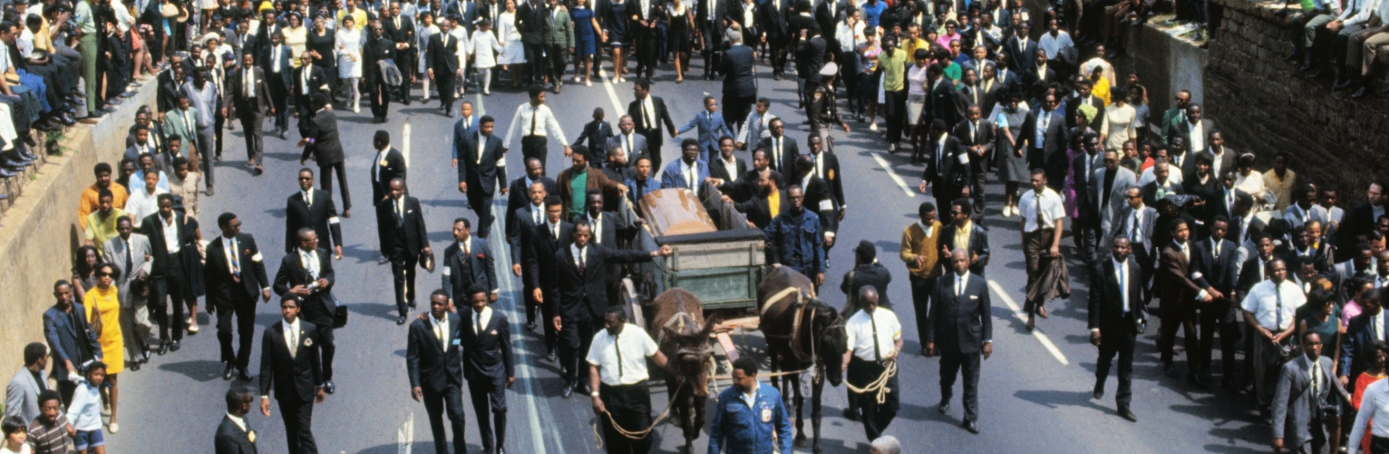
As word of the assassination spread, riots broke out in cities all across the United States and, National Guard troops were deployed in Memphis and Washington, D.C. On April 9, King was laid to rest in his hometown of Atlanta, Georgia. Tens of thousands of people lined the streets to pay tribute to King’s casket as it passed by in a wooden farm cart drawn by two mules.
The King family and others believe the assassination was the result of a conspiracy involving the U.S. government, Mafia and Memphis police, as alleged by Loyd Jowers in 1993. They believe that Ray was a scapegoat. In 1999, the family filed a wrongful death lawsuit against Jowers for the sum of $10 million. During closing arguments, their attorney asked the jury to award damages of $100, to make the point that “it was not about the money.” During the trial, both sides presented evidence alleging a government conspiracy. The government agencies accused could not defend themselves or respond because they were not named as defendants. Based on the evidence, the jury concluded Jowers, and others, were “part of a conspiracy to kill King” and awarded the family $100. The allegations and the finding of the Memphis jury were later rejected by the United States Department of Justice in 2000 due to lack of evidence.
“For those of you who are black, and are tempted to be filled with hatred and mistrust of the injustice of such an act, against all white people, I would only say that I can also feel in my own heart the same kind of feeling. I had a member of my family killed but, he was killed by a white man.
On March 10, 1969, James Earl Ray pleaded guilty (on his birthday) and was sentenced to 99 years in the Tennessee State Penitentiary. He died in prison at the age of 70 on April 23, 1998, twenty-nine years and 19 days after King’s assassination.
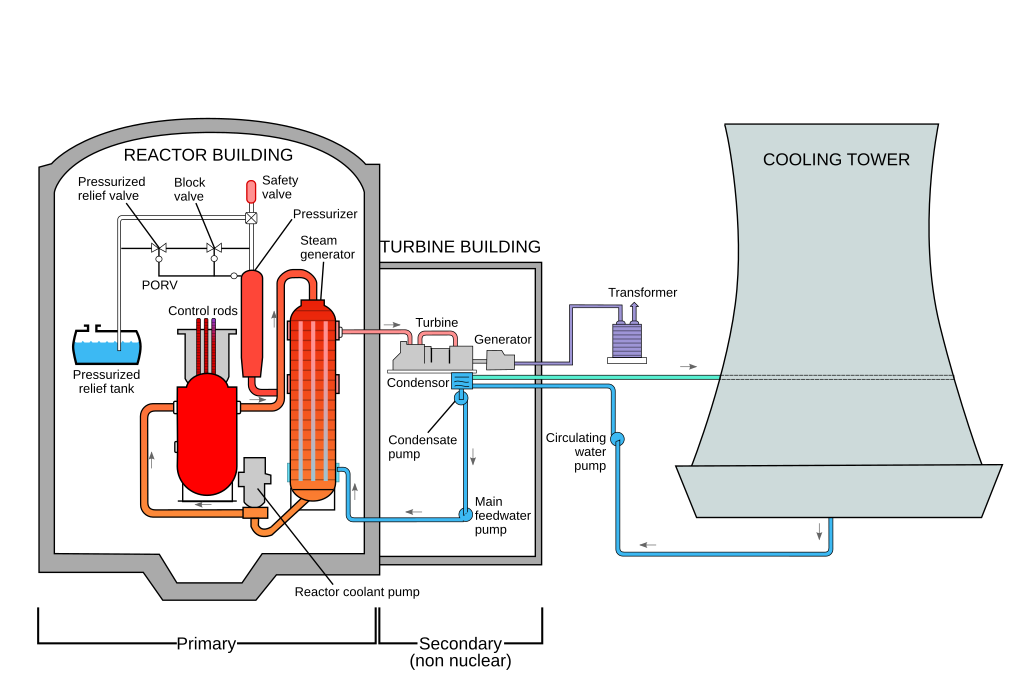
At 4:00am EST on March 28, 1979, the worst accident in the history of the U.S. nuclear power industry begins when a pressure valve in the Unit-2 reactor at Three Mile Island fails to close. Cooling water, contaminated with radiation, drained from the open valve into adjoining buildings and the core began to dangerously overheat.
After the cooling water began to drain out of the broken pressure valve […] emergency cooling pumps automatically went into operation. Left alone, these safety devices would have prevented the development of a larger crisis. However, human operators in the control room misread confusing, and contradictory readings, and shut off the emergency water system. The reactor was also shut down but, residual heat from the fission process was still being released. By early morning, the core had heated to over 4,000 degrees, just 1,000 degrees short of meltdown. In the meltdown scenario, the core melts and deadly radiation drifts across the countryside, fatally sickening a potentially great number of people.
As the plant operators struggled to understand what had happened, the contaminated water was releasing radioactive gases throughout the plant. The radiation levels, though not immediately life-threatening, were dangerous and, the core cooked further as the contaminated water was contained and precautions were taken to protect the operators. Shortly after 8:00am EST, word of the accident leaked to the outside world. The plant’s parent company, Metropolitan Edison, downplayed the crisis and claimed that no radiation had been detected off plant grounds but, the same day, inspectors detected slightly increased levels of radiation nearby as a result of the contaminated water leak. Pennsylvania Governor Dick Thornburgh considered calling an evacuation.
Finally, at about 8:00pm EST, plant operators realized they needed to get water moving through the core again and restarted the pumps. The temperature began to drop and pressure in the reactor was reduced. The reactor had come within less than an hour of a complete meltdown. More than half the core was destroyed or molten but, it had not broken its protective shell and no radiation was escaping. The crisis was apparently over.
Image Credit: wikipedia.org
Two days later, however, on March 30, a bubble of highly flammable hydrogen gas was discovered within the reactor building. The bubble of gas was created two days before when exposed core materials reacted with super-heated steam. On March 28, some of this gas had exploded, releasing a small amount of radiation into the atmosphere. At that time, plant operators had not registered the explosion, which sounded like a ventilation door closing. After the radiation leak was discovered on March 30, residents were advised to stay indoors. Experts were uncertain if the hydrogen bubble would create further meltdown or possibly a giant explosion and, as a precaution Governor Thornburgh advised “pregnant women and pre-school age children to leave the area within a five-mile radius of the […] facility until further notice.” This led to the panic the governor had hoped to avoid. Within days, more than 100,000 people had fled surrounding towns.
On April 1, President Jimmy Carter arrived […] to inspect the plant. Carter, a trained nuclear engineer, had helped dismantle a damaged Canadian nuclear reactor while serving in the U.S. Navy. That afternoon, experts agreed that the hydrogen bubble was not in danger of exploding. Slowly, the hydrogen was bled from the system as the reactor cooled.
Exelon has been operating Unit 1 at […] a loss since 2015. On May 30, 2017, the company said it would consider ceasing operations at [the unit] in 2019 due to high costs of operating the plant, unless there was government action. Unit 2, which has been dormant since the accident in 1979, is still owned by FirstEnergy and it is estimated to close in 2036.
The Battle of New Bern (also known as the Battle of New Berne) was fought on 14 March 1862, near the city of New Bern, North Carolina, as part of the Burnside Expedition of the American Civil War. The US Army’s Coast Division, led by Brigadier General Ambrose Burnside and accompanied by armed vessels from the North Atlantic Blockading Squadron, were opposed by an undermanned and badly trained Confederate force of North Carolina soldiers and militia led by Brigadier General Lawrence O’B. Branch. Although the defenders fought behind breastworks that had been set up before the battle, their line had a weak spot in its center that was exploited by the attacking Federal soldiers. When the center of the line was penetrated, many of the militia broke, forcing a general retreat of the entire Confederate force. General Branch was unable to regain control of his troops until they had retreated to Kinston, more than 30 miles (about 50 km) away. New Bern came under Federal control, and remained so for the rest of the war.
Hatteras Island, on the outer shore of North Carolina, fell to Union forces in August, 1861. Roanoke Island, just to the north, was captured on February 8, 1862. Elizabeth City on the mainland followed days later. With the freedom to navigate unmolested through Albemarle and Pamlico Sounds, Brig. Gen. Ambrose E. Burnside’s command looked for other strategic targets of opportunity. The city of New Bern was a significant target, as the Atlantic and North Carolina Railroad that connected the coast with the interior passed through there. On March 11, 1862, Burnside’s force embarked from Roanoke Island to rendezvous with Union gunboats at Hatteras Inlet for a joint expedition against New Bern. On March 13th, the fleet sailed up the Neuse River and disembarked infantry south of the Confederate defenses, about 4,000 men behind breastworks at Fort Thompson. The defenders, a mix of North Carolina infantry, cavalry and artillery, were commanded by Brig. Gen. Lawrence Branch. On March 14th, the brigades of Brig. Gens. John G. Foster, Jesse Reno, and John G. Parke attacked along the railroad and after four [sic] hours of fighting, drove the Confederates out of their fortifications. The Federals captured several nearby gun positions and occupied a base that they would hold to the end of the war, in spite of several Confederate attempts to recapture it.
On March 13th 1862, 11,000 Union troops led by General Ambrose Burnside, along with 13 heavily-armed gunboats led by Commodore Stephen Rowan, landed at Slocum’s Creek, now part of the Cherry Point Marine Corps Air Station. Their objective was [the] capture of the town of New Bern because of its strategic position and the fact that the Atlantic and North Carolina railroad was also located here. Union strategists hoped to use New Bern as a stepping off point to cutting off the main Confederate north-south railroad supply line at Goldsboro.
Awaiting the Union forces were about 4,500 inexperienced and ill-equipped Confederate troops commanded by General Laurence [sic] O’Bryan Branch, a politician with virtually no military experience. Branch positioned his infantry regiments, one cavalry regiment, local militia and three gun batteries to defend a line extending from Fort Thompson on the Neuse River and running approximately one mile west to the Weatherby Road at the eastern edge of Brice’s Creek. Extending Branch’s right wing to the railroad tracks was the 26th North Carolina Regiment commanded by Colonel Zebulon Vance, later governor of North Carolina.
Despite support from Commodore Rowan’s gunboats, this attack stalled. However, a regiment of General Parke’s brigade flanked the position of a militia battalion in the vicinity of Wood’s brickyard adjoining the railroad. Parke’s infantry drove these poorly armed, fresh militiamen from their position leaving the right flank of the 35th North Carolina Regiment exposed. The Confederate line was broken between the 26th and the 35th regiments, and the Union forces pushed through forcing the retreat of the Confederate troops.
The Battle of New Bern was the baptism of fire for the 26th North Carolina. Later, in July 1863, the 26th lost 588 of 800 men at the Battle of Gettysburg, sustaining the largest numerical losses of any unit, North or South, during the entire course of the war.
Estimated casualties for the battle: 1080 total. The fierce battle in the swamps and along the railroad five miles south of New Bern, proved to be a major victory for the Union and led to the ensuing occupation of New Bern for the remainder of the Civil War. Although Union forces never seized and held the rail line at Goldsboro, their presence in New Bern required the Confederacy to divert troops to the railroad’s defense that might have been used in the critical battles in Virginia. For General Ambrose Burnside, the New Bern victory was a factor in his subsequently being given command of the Army of the Potomac and leadership in the Union disaster at Fredericksburg.
One-hundred and fifty-seven years ago, today… ~Vic
The proposals called for the Central Intelligence Agency (CIA), or other U.S. government operatives, to commit acts of terrorism against American civilians and military targets, blaming them on the Cuban government and, using it to justify a war against Cuba. The plans detailed in the document included the possible assassination of Cuban émigrés, sinking boats of Cuban refugees on the high seas, hijacking planes, blowing up a U.S. ship and orchestrating violent terrorism in U.S. cities. The proposals were rejected by [The President].
Fifty-four years ago, today, the First March of the Selma to Montgomery marches took place. The planned marches were a response to the murder of Jimmie Lee Jackson by Alabama State Trooper James Fowler. Fowler shot Jackson on February 18, 1965, during a clash between, approximately, 500 protestors walking to Perry County Jail for James Orange and, Marion police officers, sheriff’s deputies and the state troopers. Jackson died from his injuries on February 26. Other casualties that night were two UPI photographers and NBC News correspondent Richard Valereani.
As the demonstrators crossed the Edmund Pettus Bridge, state, and county police, stopped the march and beat the protesters. Boynton was knocked unconscious and the photograph of her wounded body got the entire world’s attention.
The second march took place on March 9, referred to as Turnaround Tuesday. Though the march was peaceful due to a court order declaring no police interference, James Reeb was murdered that evening.
Photo Credit: wacotrib.com
Rod Aydelotte with the Waco Tribune-Herald
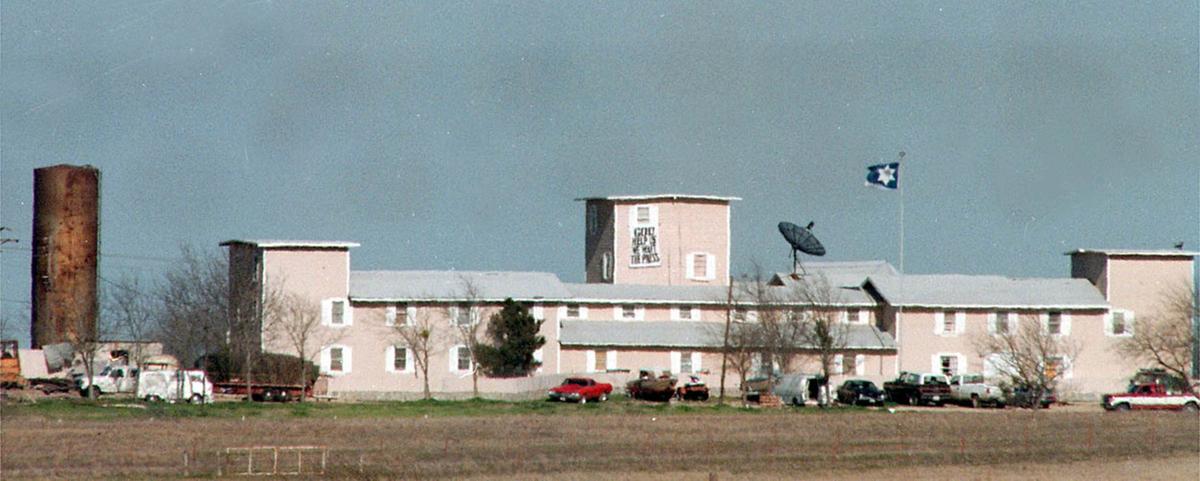
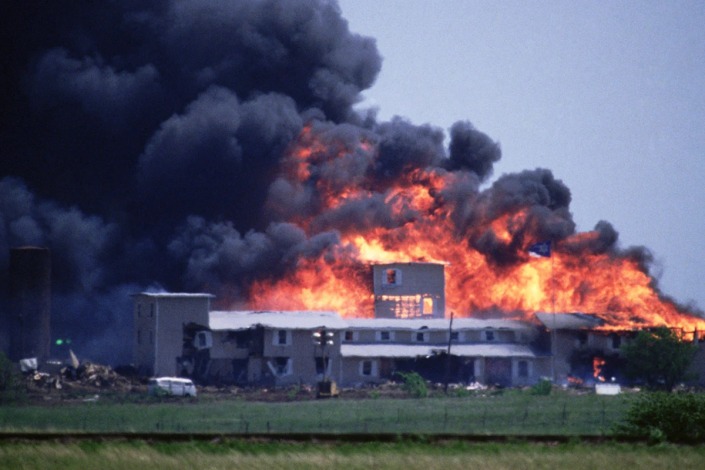
Branch Davidian Compound during 1993 siege.
Sheet says: “God help us. We want the press.”
The ATF made contact with David Koresh (Vernon Wayne Howell) inside and, the FBI moved in and took over the operation. Early on, 25 FBI negotiators nearly had Koresh agreeing to the Davidians leaving peacefully in exchange for a recorded message of his being released via radio. After the recording was aired, Koresh changed his mind and, stated that ‘God’ had told him to stay and wait. Despite the reversal, nineteen children were released and, interviewed regarding alleged physical and sexual abuse. Koresh gave phone interviews to the local media until the FBI cut all communication.
Photo Credit: rollingstone.com
The stand-off lasted 51 days, culminating in a deadly fire on April 19. Seventy-six Branch Davidian members died. Autopsies revealed some died due to collapsed concrete walls, others by gun shots (either self-inflicted or consensual execution) and, there was one stabbing. Autopsy photographs of some children seemed to indicate cyanide poisoning.
The raid was criticized extensively. A slew of controversies emerged. There was no meth lab and no evidence of child abuse. Despite the Danforth Report, the whitewash of bureaucratic misconduct fueled resentment. The Oklahoma City Bombing occurred on the second anniversary of the Waco fire.
The Nineteenth Amendent to the U.S. Constitution was ratified on August 18, 1920, with Tennessee being the last state to vote in favor of, achieving the 3/4 majority needed to amend. One would think that this event would have been the end of any argument against a woman’s right to vote but, one more hurdle had to be cleared.
Ninety-seven years ago, today, the U.S. Supreme Court made a ruling on the constitutionality of the amendment.
On October 12, 1920, Cecilia Streett Waters and Mary D. Randolph, citizens of Maryland, applied for and were granted registration as qualified voters in Baltimore City. To have their names stricken from the list Oscar Leser and others brought this suit in the court of common pleas. The only ground of disqualification alleged was that the applicants for registration were women, whereas the Constitution of Maryland limits the suffrage to men. Ratification of the proposed amendment to the federal Constitution, now known as the Nineteenth, 41 Stat. 362, had been proclaimed on August 26, 1920, 41 Stat. 1823, pursuant to Revised Statutes, § 205 (Comp. St. § 303). The Legislature of Maryland had refused to ratify it. The petitioners contended, on several grounds, that the amendment had not become part of the federal Constitution. […] the case comes here on writ of error. That writ must be dismissed but, the petition for a writ of certiorari, also duly filed, is granted. The laws of Maryland authorize such a suit by a qualified voter against the board of registry. Whether the Nineteenth Amendment has become part of the federal Constitution is the question presented for decision.
Photo Credit: law.edu
There were three claims: [1] The power to amend the Constitution did not cover this amendment due to its character.
“[…] the amendment “destroyed State autonomy” because it increased Maryland’s electorate without the state’s consent.”
[2] Several states that had ratified the amendment had constitutions that prohibited women from voting, rendering them unable to ratify an amendment to the contrary.
[3] The ratifications of Tennessee and West Virginia were invalid, because they were adopted without following the rules of legislative procedure in place in those states.
Justice Brandeis delivered the opinion of the Court:
[1] This amendment is in character and phraseology precisely similar to the Fifteenth. For each, the same method of adoption was pursued. One cannot be valid and the other invalid. That the Fifteenth is valid, although rejected by six states, including Maryland, has been recognized and acted on for half a century.
[2] […] But the function of a state Legislature in ratifying a proposed amendment to the federal Constitution, like the function of Congress in proposing the amendment, is a federal function derived from the federal Constitution and, it transcends any limitations sought to be imposed by the people of a state.
[3] The question raised may have been rendered immaterial by the fact that since the proclamation the Legislatures of two other states—Connecticut and Vermont—have adopted resolutions of ratification. But, a broader answer should be given to the contention. The proclamation by the Secretary certified that, from official documents on file in the Department of State, it appeared that the proposed amendment was ratified by the Legislatures of 36 states and, that it ‘has become valid to all intents and purposes as a part of the Constitution of the United States.’ As the Legislatures of Tennessee and of West Virginia had power to adopt the resolutions of ratification, official notice to the Secretary, duly authenticated, that they had done so, was conclusive upon him, and, being certified to by his proclamation, is conclusive upon the courts.
“So, while the 19th Amendment granted women the right to vote, Leser made sure that the right could actually be used, even where the state constitution said otherwise. It’s not one of the more famous Supreme Court decisions in American history but, without it, the electorate would be, well, lesser.”
As an addendum to the above, Maryland finally ratified the amendment on March 29, 1941 but, didn’t certify that until February 25, 1958, two days shy of an exact 36 year delay. And, I am sad to say that my home state of North Carolina didn’t ratify until May 6, 1971, making it third to last behind South Carolina (ratified July 1, 1969 but, not certified until August 22, 1973) and Mississippi (ratified March 22, 1984).
Little video snippet regarding this case:
And, I grew up watching Schoolhouse Rock, I just had to put this up:
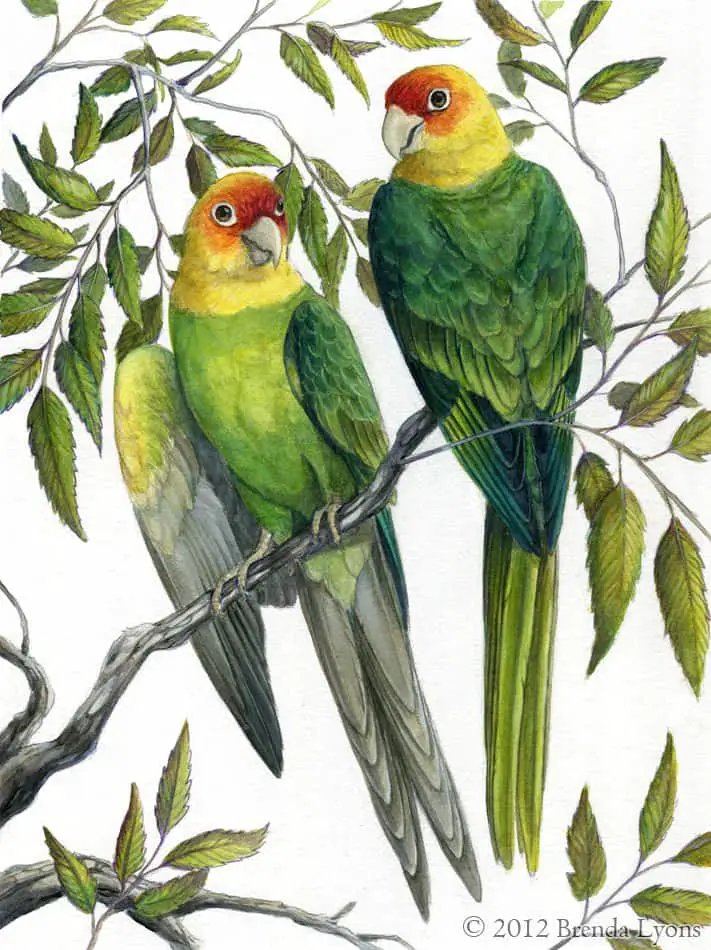
It was the only indigenous parrot to the Mid-Atlantic, Southeast & Midwest states. They ranged from southern New York, to the southern tip of Wisconsin, to Eastern Colorado, down to Central & Eastern Texas, across the Gulf of Mexico to the seaboard and all parts in-between. Also called a Carolina Conure (conuropsis carolinensis), they had a bright yellow head with a reddish-orange face and a pale beak.
[…] lived in old forests along rivers. It is the only species classified in the genus Conuropsis. It was called puzzi la née (“head of yellow”) or pot pot chee by the Seminole and, kelinky in Chickasaw.
The last known wild specimen was killed in Okeechobee County, Florida, in 1904, and the last captive bird died at the Cincinnati Zoo on February 21, 1918. This was the male specimen, called “Incas”, who died within a year of his mate, “Lady Jane”. Coincidentally, Incas died in the same aviary cage in which the last Passenger Pigeon, “Martha“, had died nearly four years earlier. It was not until 1939, however, that it was determined that the Carolina Parakeet had become extinct. Some theorists at this time, though, believed a few may have been smuggled out of the country in mid 20th century and may have repopulated elsewhere, although the odds of this are extremely low. Additional reports of the bird were made in Okeechobee County, Florida, until the late 1920s, but these are not supported by specimens.
Image Credit: cornell.edu & birdsna.org
The Carolina Parakeet is believed to have died out because of a number of different threats. To make space for more agricultural land, large areas of forest were cut down, taking away its habitat. The bird’s colorful feathers (green body, yellow head and red around the bill) were in demand as decorations in ladies’ hats. The birds were also kept as pets and could be bred easily in captivity. However, little was done by owners to increase the population of tamed birds. Finally, they were killed in large numbers because farmers considered them a pest, although many farmers valued them for controlling invasive cockleburs. It has also been hypothesized that the introduced honeybee helped contribute to its extinction by taking many of the bird’s nesting sites.
A factor that contributed to their extinction was the unfortunate flocking behavior that led them to return immediately to a location where some of the birds had just been killed. This led to even more being shot by hunters as they gathered about the wounded and dead members of the flock.
This combination of factors extirpated the species from most of its range until the early years of the 20th century. However, the last populations were not much hunted for food or feathers, nor did the farmers in rural Florida consider them a pest, as the benefit of the birds’ love of cockleburs clearly outweighed the minor damage they did to the small-scale garden plots. The final extinction of the species is somewhat of a mystery but, the most likely cause seems to be that the birds succumbed to poultry disease, as suggested by the rapid disappearance of the last, small but, apparently healthy and reproducing flocks of these highly social birds. If this is true, the very fact that the Carolina Parakeet was finally tolerated to roam in the vicinity of human settlements proved its undoing. The fact remains, however, that persecution significantly reduced the bird’s population over many decades.
A consumer of sandspurs, cockleburs, thistles, pine seeds and bald cypress balls, as well as fruits, buds and seeds of many other plant species, the Carolina Parakeet was evidently a fairly typical psittacid with catholic feeding habits, loud vocalizations and highly social tendencies. However, unlike many other parrots, it was clearly a species well adapted to survive cold winter weather. Although generally regarded with favor by early settlers, the parakeet was also known locally as a pest species in orchards and fields of grain and, was persecuted to some extent for crop depredations. Its vulnerability to shooting was universally acknowledged and was due to a strong tendency for flocks not to flee under fire but, to remain near wounded con-specifics that were calling in distress.
[…] there are no known ways to evaluate many issues in Carolina Parakeet biology except through extrapolations from the biology of closely related species and through reasoned interpretations of the fragmentary writings of observers who have long since passed from the scene. Fortunately, early naturalists prepared a few accounts with substantial amounts of useful information.
Outside of the breeding season the parakeet formed large, noisy flocks that fed on cultivated fruit, tore apart apples to get at the seeds and, ate corn and other grain crops. It was therefore considered a serious agricultural pest and was slaughtered in huge numbers by wrathful farmers. This killing, combined with forest destruction throughout the bird’s range and, hunting for its bright feathers to be used in the millinery trade, caused the Carolina Parakeet to begin declining in the 1800s. The bird was rarely reported outside Florida after 1860 and was considered extinct by the 1920s.
I had no idea that my area of the U.S. had a native parrot species. It is a crying shame that this beautiful, lively bird was driven to extinction. They were easily tamed and had long life spans. Perhaps, there are some still in existence and carefully hidden. ~Vic
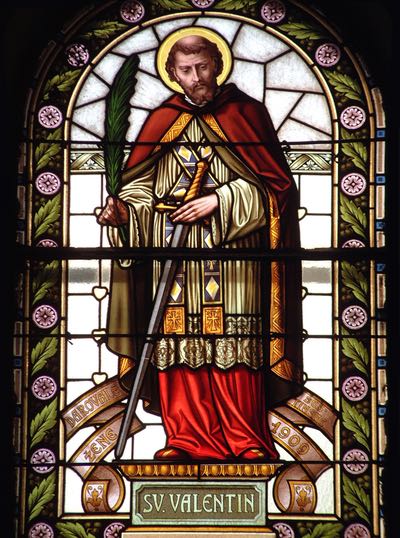
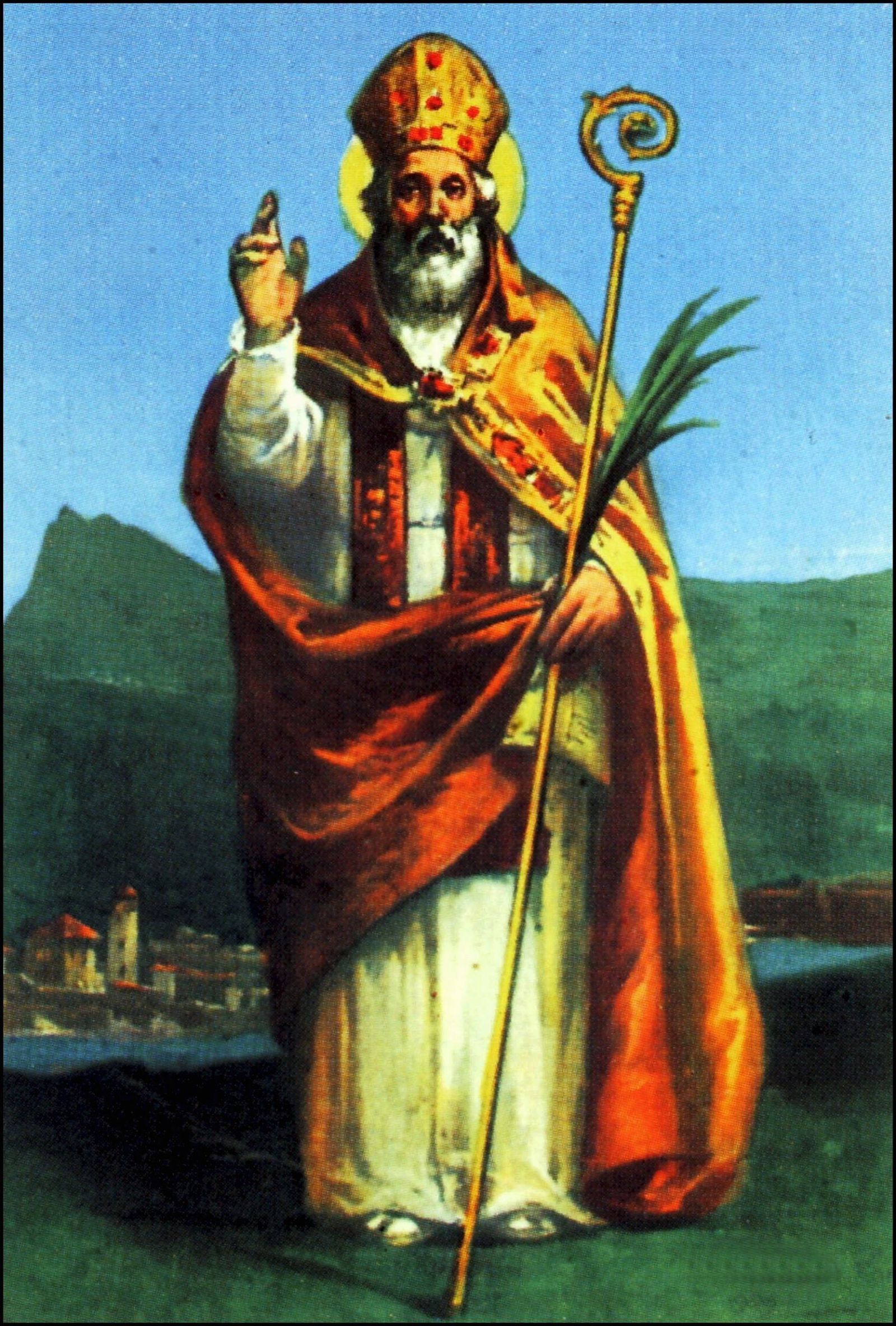
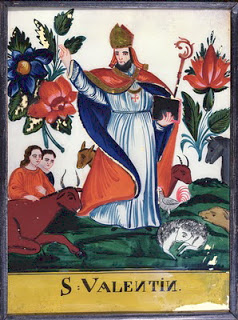
There are SO many stories regarding the origins of the Valentine’s Day we celebrate. The most common story about this elusive man was that he was a priest and bishop in Rome in the 3rd century. The Roman Emperor of the time was Claudius Gothicus (Claudius II), the first of the tough, soldier emperors, that ruled with an iron fist and was known for his cruelty. From The History Channel:
Under the rule of Claudius the Cruel, Rome was involved in many unpopular and bloody campaigns. The emperor had to maintain a strong army but, was having a difficult time getting soldiers to join his military leagues. Claudius believed that Roman men were unwilling to join the army because of their strong attachment to their wives and families. To get rid of the problem, Claudius banned all marriages and engagements in Rome. Valentine, realizing the injustice of the decree, defied Claudius and continued to perform marriages for young lovers in secret. When Valentine’s actions were discovered, Claudius ordered that he be put to death. Valentine was arrested and dragged before the Prefect of Rome who condemned him to be beaten to death with clubs and, to have his head cut off. The sentence was carried out on February 14, on or about the year 270. Legend also has it that while in jail, Valentine left a farewell note for the jailer’s daughter, who had become his friend, and signed it “From Your Valentine.”
[…] he was arrested and thrown in prison by Emperor Claudius II. He was put under vigilance of prefect Asterius, director of the confine who had challenged Valentine, before, regarding his alleged healing powers. Asterius, a ruthless man, requested Valentine to restore the gift of sight to his daughter, Julia, who was born a blind girl. Valentine placed his hands over her eyes, prayed to God and Julia was able to see. Asterius, in awe of Valentine’s power converted to Christianity, along with 46 members of his family. He, then, also freed all Christians who were confined in his prison. The emperor, aware of what had happened, ordered Valentine and Asterius to be beheaded. The penalty was probably executed, on February 14, 271 AD. Sometime before his execution, Valentine wrote a letter, signed “from your Valentine”, saying goodbye to Julia, the daughter of Asterius with whom he had fallen in love. This would become the first record in history of a “Valentine’s Day letter”.
According to the popular hagiographical identity, and what is believed to be the first representation of St. Valentine, the Nuremberg Chronicle, St. Valentine was a Roman priest martyred during Claudius’ reign. […] A relationship between the saint and emperor began to grow, until Valentine attempted to convince Claudius of Christianity. Claudius became (en)raged and sentenced Valentine to death, commanding him to renounce his faith or be beaten with clubs and beheaded. St. Valentine refused to renounce his faith and, Christianity, and was executed outside the Flaminian Gate on February 14, 269. However, other tales of St. Valentine’s life claim he was executed either in the year 269, 270, 273 or 280. Another variation of the legend of St. Valentine says he refused to sacrifice to pagan gods, was imprisoned and, while imprisoned, he healed the jailer’s blind daughter. Whoever he was, Valentine did really exist, because archaeologists have unearthed a Roman catacomb and an ancient church dedicated to St. Valentine. In 496AD, Pope Gelasius marked February 14th as a celebration in honor of his martyrdom.
The Catholic Church’s official list of recognized saints, the Roman Martyrology, lists seven Valentines: a martyr (a possible Roman priest or Terni bishop) buried on the Via Flaminia (February 14); a priest from Viterbo (November 3); a bishop from Raetia who died in about 450 (January 7); a fifth-century priest and hermit (July 4); a Spanish hermit who died in about 715 (October 25); Valentine Berrio Ochoa, martyred in 1861 (November 24); and Valentine Jaunzarás Gómez, martyred in 1936 (September 18). Valentine did not appear in the official Church calendar for centuries, however “Martyr Valentinus the Presbyter and those with him at Rome” remains on the list of saints proposed for veneration by Catholics. In the Eastern Orthodox Church, Saint Valentine the Presbyter is celebrated on July 6, and Hieromartyr Saint Valentine (Bishop of Interamna, Terni in Italy) is celebrated on July 30. Clearly they are viewed as two separate people. Notwithstanding that, conventionally, members of the Greek Orthodox Church named Valentinos (male) or Valentina (female) celebrate their name on February 14th.
The Modern
So, how did we get the day of celebration we have now? That is nearly as obscure as the saint that the day is based on.
English 18th-century antiquarians Alban Butler and Francis Douce, noting the obscurity of Saint Valentine’s identity, suggested that Saint Valentine’s Day was created as an attempt to supersede the pagan holiday of Lupercalia (mid-February in Rome). This idea has lately been dismissed by other researchers, such as Professor Jack B. Oruch of the University of Kansas, Henry Ansgar Kelly of the University of California, Los Angeles and Associate Professor Michael Matthew Kaylor of the Masaryk University. Many of the current legends that characterize Saint Valentine were invented in the 14th century in England, notably by Geoffrey Chaucer and his circle, when the feast day of February 14 first became associated with romantic love.
[…] University of Kansas English professor, the late Jack B. Oruch, had a different theory […] Through research, he determined that the poet Geoffrey Chaucer linked love with St. Valentine for the first time in his 14th-century works “Parlement of Foules” and “The Complaint of Mars.” Therefore, Oruch claimed that Chaucer invented Valentine’s Day as we know it today. At the time, February 14 also happened to be considered the first day of spring since it was the beginning of birds’ mating season—perfectly appropriate for a celebration of affection.
Addendum
According to Catholic Online and Catholic Saints, Saint Valentine is the Patron Saint of epilepsy, fainting, (a non-specific) plague, bee keepers, affianced couples, betrothed couples, engaged couples, love, lovers, happy marriages, young people and travelers. Whew! That is quite a lot to keep up with.












 Cosmic-Observation