drama
Music Monday: Victim Of Love (Eagles) 1976
For the New Year, I will be doing some blog-housekeeping. I have a tendency to stretch myself thin with headings and posts. I will be doing some consolidating. Song Sunday, News of the Day (NOTD) & Word of the Day (WOTD) are gone. I jettisoned some other headings about a year, ago. On to the show…~Vic

Returning to my Samsung playlist, submitted for your approval…
“Tell me your secrets, I’ll tell you mine…”
The second track, on side two, from the album Hotel California, Victim of Love was never released as a single. It was the B-Side to New Kid in Town, released December 7, 1976 and did get some airplay as an album track over the years.
By the time the Eagles reached the mid-1970s, they were on top of the world. They had been sorting their way through every rock trope they could think of and the album One of These Nights spawned three different singles. With success also comes pressure, though and the band had their backs against the wall when it came time to make Hotel California. When talking about making the concept for the album, Don Henley mentioned wanting to say something about the state of Hollywood, saying, “There’s a fine line between the American dream and the American nightmare.” The rest of the band were more than willing to comply, with Joe Walsh coming up with the original lick for Life in the Fast Lane on a whim.
Walsh had claimed to use the lick as a warm-up exercise but, it turned into its own piece once Glenn Frey got the title for the song. While guitarist Don Felder came up with the main chord progression for the title track, he had his sights on another song that he wrote for the album. Midway through recording, Felder said that he wanted to sing the track Victim of Love, which he claimed to have written by himself. As Henley remembers, what Felder presented the band with was just a collection of riffs, which was then turned into a song by Frey and J.D. Souther.
After one butchered take after the next, the band told Felder that it would be better if he didn’t sing the song, only for Felder to put his foot down. The band acquiesced and let Felder do his own take on the song but, they were also keeping a close eye on their manager as well. As the sessions were winding down, the band gave manager Irving Azoff a job…take Felder out to dinner while they re-recorded the entire track. When Felder found out that he was being erased from the song, he mentioned feeling betrayed…”It was like Don was taking that song from me. I had been promised a song on the next record.”
While Henley, to this day, disputes that there were no promises made to Felder, this started the dividing line between the band. As the touring got bigger and bigger, Felder started to get more resentful towards Frey and Henley for getting all of the songwriting royalties. By the time the band pulled into Long Beach for a benefit concert, Felder took it one step too far after making an off-handed remark to Senator Alan Cranston about the free show. Compared to the petty squabbling behind the scenes, there was audio taken of the infamous gig, which led to Frey and Felder threatening to kill each other onstage. When the house lights went out that night, Felder took his guitar, smashed it and drove off, never to be heard from again.
Once bassist Timothy B. Schmidt called Frey about the next rehearsals, he confirmed the worst. The band was history. The Eagles’ music may have reeked of California sunshine but, their final days ended with plotting, resentment and some of the worst drama a band could ask for.
Victim Of Love: The Song That Broke Up The Eagles
Tim Coffman
Far Out Magazine UK
February 12, 2023
♦The Treacherous Feud (Far Out Magazine UK/Arun Starkey/September 24, 2022)
Movie Monday: Holly 2006

“Out of thousands, he tried to save one.”
Fifteen years ago, today, the drama film Holly debuted at the Edinburgh International Film Festival. Directed by Guy Moshe and, written by Moshe and Guy Jacobson, it starred Ron Livingston, Chris Penn, Virginie Ledoyen, Udo Kier and Jacquie “Thuy” Nguyen as Holly.
Shot on location in Cambodia, including many scenes in actual brothels in the notorious red light district of Phnom Penh, “Holly” is a captivating, touching and emotional experience. Patrick, an American card shark and dealer of stolen artifacts, has been ‘comfortably numb’ in Cambodia for years when he encounters Holly, a 12-year-old Vietnamese girl in the K-11 red light village. The girl has been sold by her impoverished family and smuggled across the border to work as a prostitute. Holly’s virginity makes her a lucrative prize and, when she is sold to a child trafficker, Patrick embarks on a frantic search, through both the beautiful and sordid faces of the country, in an attempt to bring her to safety. Harsh, yet poetic, this feature forms part of the ‘K-11’ Project, dedicated to raising awareness of the epidemic of child trafficking and the sex slavery trade through several film projects. The film’s producers endured substantial hardships in order to be able to shoot in Cambodia and have also founded the Redlight Children Campaign, […] a worldwide grassroots initiative generating conscious concern and, inspiring immediate action against child sex-ploitation.
IMDb Summary from Anonymous
Trivia Bits:
♦ Tom Sizemore was originally slated to play Freddie but, after being arrested for failing several drug tests, he was dropped from the production and replaced by Chris Penn.
♦ This was one of Chris Penn’s last films.
Hans 2021 Movie Draft: Round One-Pick Six-Hereafter 2010

Hanspostcard has a movie draft challenge. This is my Round One pick.
Category: Drama/Mystery
Film: Hereafter
Directed by Clint Eastwood, it was written by Peter Morgan and, produced by Eastwood, Kathleen Kennedy and Robert Lorenz. It stars Matt Damon (George), Cécile de France (Marie), Jay Mohr (Billy), Bryce Dallas Howard (Melanie) and, Frankie & George McLaren (twins Jason & Marcus). The film was released September 12, 2010, at the Toronto International Film Festival.
Marie is a French TV journalist that has a near death experience after nearly drowning during a tsunami. George is a psychic medium but, works in a factory and tries to avoid talking to dead people. Twins Jason & Marcus have a drug-addicted, alcoholic mom and, when Jason is killed, accidentally, Marcus is sent to a foster home. Melanie meets George in a cooking class and a psychic reading ends badly. When George is laid off, his brother Billy tries to get him to revive his psychic practice. After an impromptu trip to London, George crosses paths with Marie and Marcus. Death surrounds the three main characters and their reactions to it unfolds, slowly.
Clint Eastwood’s Hereafter considers the idea of an afterlife with tenderness, beauty and a gentle tact. I was surprised to find it enthralling. I don’t believe in woo-woo but, then, neither, I suspect, does Eastwood. This is a film about the afterlife that carefully avoids committing itself on such a possibility. The closest it comes is the idea of consciousness after apparent death. This is plausible. Many near-death survivors report the same memories, of the white light, the waiting figures and a feeling of peace.
Roger Ebert
October 19, 2010
I absolutely love this movie. It’s a thoughtful drama, without being over-the-top, with an inherent mystery built into the story line. I’m not a big Damon fan but, I am an Eastwood fan. ~Vic
TV Tuesday: The Man Who Stroked Cats 1955

Sixty-five years ago, today, the black & white short drama The Man Who Stroked Cats appeared on BBCtv. Based on the short story The Young Man Who Stroked Cats by Morley Roberts, it was adapted and directed by Anthony Pelissier. It starred Tony Britton as the main character Tom Meredith, Josephine Griffin as The Girl, Dorice Fordred as The Daily Woman and John Gatrell as the Doctor.
There are no pictures or video clips associated with this TV short and IMDb has no written plot, summary or synopsis.

1907
Image Credit: Wikipedia & Wikimedia
From Scribd:
[Thomas] Meredith finds himself the recipient of a very mysterious and unexpected gift…[a] Persian kitten in a basket. More mysterious still, the note accompanying it only reads: For the young man who strokes cats.
Thomas is indeed a cat-lover and, is both delighted and intrigued by his new present. But, before long, things take another strange turn. He receives a mysterious anonymous phone call from a dying woman…and this turns out to be the start of a bizarre nightly telephone romance.
From BBC Genome/Radio Times Magazine (Issue 1672/November 25, 1955):
It has been said that the world is divided into two main classes of people […] those who love cats and those who don’t. Among those who do is Tom, a young man who can’t resist giving a friendly word and a quick stroke to every stray he meets on his way to work, with results that even the most superstitious of black-cat lovers couldn’t possibly have foreseen…
Additional Reading:
A Philosophy of Tramping: Morley Roberts (Cynical Reflections)
Audible Audiobook
BBC Genome Beta
HathiTrust Digital Library
Morley Roberts (Wikipedia)
Scribd Audiobook
Flick Friday: Captain Eddie 1945

Seventy-five years ago, today, the drama film Captain Eddie was released. Directed by Lloyd Bacon and produced by Winfield Sheehan, it starred Fred MacMurray, Lynn Bari, Charles Bickford, Thomas Mitchell and Lloyd Nolan. Based on Seven Came Through (by Eddie Rickenbacker) and We Thought We Heard The Angels Sing (by James Whittaker), John Tucker Battle wrote/adapted the screenplay. A biopic of Rickenbacker, it reflects his experiences as a flying ace during World War I to his later involvement as a pioneering figure in civil aviation.
In World War II, while serving as a United States Army Air Forces officer, famed World War I pilot Eddie Rickenbacker (Fred MacMurray) is assigned to tour South Pacific bases. On October 21, 1942, his Boeing B-17 Flying Fortress has to ditch at sea, forcing Rickenbacker, pilot Lt. James Whittaker (Lloyd Nolan), co-pilot Capt. Bill Cherry (Richard Crane) and other crew members to survive for 19 days on a tiny rubber raft. While awaiting their rescue, Rickenbacker recalls his other adventures that have highlighted a remarkable life.
Full Synopsis (TCM)

Review:
It seems as though someone is kidding…kidding in more ways than one. For Captain Eddie, which came yesterday to the Roxy, is not the story it promises to be of Capt. Eddie Rickenbacker, ace of World War I and commercial airline executive who holds some rather rigid social views. Nor is it precisely the saga of the middle-aged flier who was lost at sea two years ago in the South Pacific and spent three harrowing weeks on a raft. It is just another sentimental comedy about a kid who jumped off the barn in his youthful passion for flying and courted his girl in a merry Oldsmobile. [This] is not the story of Rickenbacker…not the significant story, anyhow.
Bosley Crowther
The New York Times
August 9, 1945
Trivia Bits:
♦ Crash survivor Lt. James Whittaker was […] temporarily assigned to the production to serve as a technical advisor.
♦ The film’s premiere was held in Rickenbacker’s hometown of Columbus, Ohio. In attendance were politicians and celebrities, including Carole Landis, as well as family members.
Nomination:
♡ Best Special Effects (Academy Awards 1946)
I can’t find a trailer to the movie on YouTube but, the entire movie appears to be uploaded in Russia. ~Vic
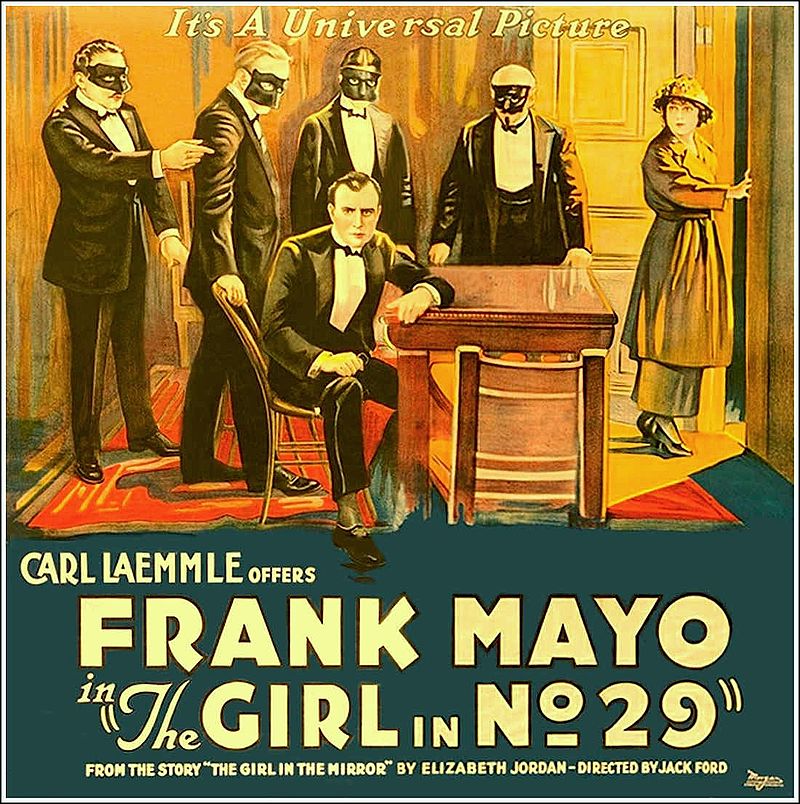
Flick Friday: The Girl In Number 29 1920
wikipedia.org & wikimedia.org
One-hundred years ago, today, the silent black & white drama film The Girl In Number 29 premiered (though not released, widely). Directed by John Ford and written by Philip D. Hurn, it was based upon the novel The Girl In The Mirror (1919) by Elizabeth Jordan. Starring Frank Mayo, Elinor Fair, Claire Anderson, Robert Bolder and Bull Montana, it is considered a lost film.

Image Credit: Motion Picture News
wikipedia.org & wikimedia.org
From AFI:
After turning out a successful drama, young playwright Laurie Devon settles down to a life of idleness. Alarmed and disgusted, his friends make every effort to get him to work again but, he refuses. One evening, while glancing into his mirror, Laurie sees a beautiful girl in the apartment across the way, holding a revolver to her head. Dashing out of his apartment house, he prevents her from pulling the trigger. He learns that her name is Doris Williams and discovers that her plight is caused by a man named Shaw. Soon after, Shaw and his thugs abduct her, and Laurie comes to her rescue, shooting her tormentor. Returning home, he confesses his crime to his sister and friends, and learns that the whole incident was a trick to restore his interest in life. The plot succeeds and Laurie writes another hit play in which his new wife Doris is the star.
From MPN:
Laurie Devon (Mayo) is a New York playwright who, having had one success, refuses to work on another play. One night he sees a woman (Anderson) in an apartment across the street take out a gun and place it to her forehead. He reaches her in time to save her and she tells him that she is under some terrible evil influence, which she will not disclose. Devon attempts to untangle the mystery and is led on an adventure. The woman is taken to a house on Long Island, where Devon, after a fight, rescues her. He takes out the revolver and shoots one of the pursuers, who falls to the ground. On returning home, he is heartbroken and tells his sister Barbara (Fair) and his friends that he is a murderer. His sister, and two of his friends, then confess that the whole thing was a frame-up. [T]hey had hired some actors to stage everything and that it was an attempt to get the ambitionless [sic] author to write again. The revolver used in the suicide attempt by the woman, and in the later shooting, had blanks. Devon and the woman from the apartment melt into each other’s arms at the final fade-out.

Image Credit: Exhibitors Herald
archive.org
wikipedia.org & wikimedia.org
Additional Reading & Sources
American Film Institute
IMDB
Web Archive
Wikipedia
TV Tuesday: The Wright Verdicts 1995
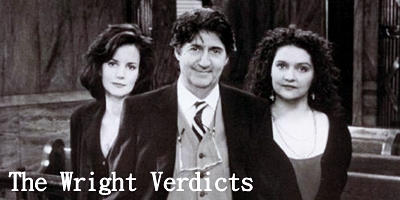
Twenty-five years ago, today, the television series The Wright Verdicts debuted on CBS. Created and executive-produced by Dick Wolf, it starred Tom Conti, Margaret Colin and Aida Turturro as the main cast (Variety also lists John Glover but, IMDB does not.). Notable guest stars were Candy Clark, Peter Facinelli, Allison Janney and Leslie Mann.
There were only six episodes that aired between March 31 and June 11 with a seventh episode intended for a May slot, never airing. It’s first episode was on a Friday, the second episode aired the following Wednesday, the third episode went back to Friday, the following week and the fourth episode showed up on a Sunday, the next week. The last two aired episodes were on Sundays in June. [No wonder it failed. ~Vic]
Legal drama with Charles Wright, an Englishman, working as a lawyer in New York City. Sandy Hamar is an ex-NYPD detective who serves as the mandatory private eye and Lydia is the super efficient secretary.

The Wright Verdicts is mature in the best sense. [I]t’s smart, has no false innocence and has the right amount of fun. Criminal lawyer Charles Wright (Tom Conti) will win juries over like clockwork and the series should likewise charm viewers. The character’s chief skill is blarney or, as his investigator puts it, shucking and jiving. Charles is bumbling and self-deprecating one minute, erudite and mischievous the next. Conti brings off Wright’s sense of humor and his status as a ladies’ man. The dynamic between Conti and his two female employees […] needs some work. [T]here’s so much flirtation that the relationships in this office triangle seem headed in only one direction.
The hour has a surplus of spectacular aerial shots of Manhattan.
With crimes revolving around designer drugs and cellular phones, the show poses itself as a Perry Mason for the ’90s. It’s about as conventional and formulaic as that old warhorse. The parlor-game plotting is more than passable but, the writing is undistinguished. Only Conti’s malty voice and trilling accent are enough to elevate the program’s mark a little.
Executive producer Dick Wolf has cannily combined two genres…Murder, She Wrote’s warm coziness and his own Law & Order’s cold, complex cases…and come up with a lukewarm show that’s nonetheless pretty irresistible.
Opening Credits
 Cosmic-Observation