IMDb
Movie Monday: The Brash Drummer & The Nectarine 1914

One-hundred, five years ago, today, The Brash Drummer and The Nectarine was released. A short, silent, black & white comedy, it was written and directed by George Ade, a popular American humorist for his time and a follower of Mark Twain. Starring Wallace Beery and Bevery Bayne, this piece was one of Ade’s Fables in Slang.
Summary:
Gabby Gus made the town regularly every month. He was a swell guy and thought he could cop most any Jane that he took a liking to. Clara Louise Willoughby, a farmer’s daughter with a pretty face and figure, took the salesman’s eye. He looked the old gent up in Dunn and Bradstreet and, discovered that the old boy was worth some coin. Then, he set his traps for the daughter. Dad, however, sent her away to boarding school and when she returned, she was the swellest peach in the orchard. They all fell for her. Gus hastened to her home where he discovered she was some lemon when it came to the country stuff and that she was a real ‘highfalutin’ society butterfly now. […] her aspirations were higher than a poor hick drummer. She made him feel awfully small. [Source]
I can’t find a video clip of this film but, I did find Ade’s Fables in Slang in audio book form. It has 26 stories and was published in 1899. [Disclaimer: It is nearly two hours long.] ~Vic
Movie Monday: Cripple Creek Bar Room Scene 1899

Photo Credit: pinterest.com
One-hundred, twenty years ago, in May, Edison’s Black Maria Studio, considered to be the first movie studio in America, produced the short, non-actuality film Cripple Creek Bar-Room Scene.
An IMDB Summary:
A vignette of a bar-room/liquor-store in the West [with] no plot, per se. However, this short is usually regarded as the first “Western” in the sense that it depicts a western scene.
The film lasted one minute, had no action and the role of a barmaid was played by a man.
Summary From The Library of Congress:
Shows tap room of the “Miners Arms”, stout lady at the bar and three men playing stud horse. Old toper with a silk hat asleep by the stove. Rough miner enters, bar maid serves him with Red Eye Whiskey and he proceeds to clean out the place. Barmaid takes a hand with a siphon of vichy and, bounces the intruder with the help of the card players, who line up before the bar and take copious drinks on the house.

Photo Credit: silentology.wordpress.com & pinterest.com
From Silentology:
So the film’s supposed to be set in one of the rough mining towns that were part of the Wild West. Also, it was definitely named “Cripple Creek” for a reason. Cripple Creek, Colorado, was a real-life ranch town that experienced a major gold rush in the late 19th century. In 1890, Robert Miller Womack struck gold and, six years later, the town had swelled from a mere 500 souls to well over 30,000 gold-fevered prospectors. All in all, something in the range of a half-billion dollars worth of gold would be extracted from the area.
The Black Maria was completed in early 1893 in West Orange, NJ and, when Edison built a new, rooftop movie studio in New York City, it ceased operation in January 1901. It was torn down in 1903.
Movie Monday: Eugen Sandow 1894

Specific dates are a little hard to come by but, one-hundred, twenty-five years ago in May, Edison Studios produced three silent actuality films of German bodybuilder Eugen Sandow (born Friedrich Wilhelm Müller). It was directed by Scottish mutoscope inventor, photographer and Edison employee William K. L. Dickson.
From Wikipedia:
Florenz Ziegfeld wanted to display Sandow at the 1893 World’s Columbian Exposition in Chicago. Ziegfeld found that the audience was more fascinated by Sandow’s bulging muscles than by the amount of weight he was lifting so, Ziegfeld had Sandow move in poses which he dubbed “muscle display performances”…and the legendary strongman added these displays in addition to performing his feats of strength with barbells. He added chain-around-the-chest breaking and other colorful displays to Sandow’s routine and Sandow quickly became Ziegfeld’s first star. The [Edison] film was of only part of his act and featured him flexing his muscles rather than performing any feats of physical strength.

From Film Threat:
Did you ever stop and say to yourself: “Hey, who was the very first movie star?” You never did? That’s funny, because I did. In researching the answer, I found myself going all the way back to the dawn of motion pictures, where a scantily clad muscleman flexing his biceps was the unlikely pioneer in the realm of celluloid stardom. The year was 1894 and the American motion picture industry consisted solely of Thomas Edison and his team of inventors. Edison had the technology in place but, he was missing one key element: the film contents. […] there was one man who had no problem filling that void. In between the expected presentations for feats of strength, there were posing sequences where Sandow arched and twisted his body in a manner that detailed the excesses of his musculature. Today, we call that bodybuilding, and no one thinks twice about it but, in the 1890s, it was a startling and exciting physical display. Reportedly, Sandow made a nice side business by accepting money from women who wanted to feel his mighty muscles! Sandow’s fame in the United States grew fairly quickly and he became a major headliner on the vaudeville circuit. Edison realized he could also cash in on Sandow’s fame and, in early 1894, he sent word to Ziegfeld about having Sandow appear in a kinetoscope film. Edison then handed Sandow over to William K.L. Dickson, who was in charge of the film production at Edison’s studio. Sandow stripped off his clothing, donned his tighty-whitey posing trunks and stood before the hand-cranked kinetoscope camera. And, to employ the ultimate cliché, history was made.
Movie Monday: Leisurely Pedestrians 1889

I am going WAY back this time…back to the days of moving pictures and short films. Sticking with my five year increments, one-hundred & thirty years ago, William Friese-Greene, an English inventor, and professional photographer, shot a silent, actuality film in the Autumn of 1889. It was titled Leisurely Pedestrians, Open Topped Buses and Hansom Cabs with Trotting Horses.
From Wikipedia:
[…] shot by inventor and film pioneer William Friese-Greene on celluloid film using his ‘machine’ camera, the 20 feet of film […] was shot […] at Apsley Gate, Hyde Park, London. [It] was claimed to be the first motion picture [but] Louis Le Prince successfully shot on glass plate before 18 August 1887 and on paper negative in October 1888. It may, nonetheless, be the first moving picture film on celluloid and the first shot in London.
It is now considered a lost film with no known surviving prints and only one possible still image extant.

An article in This Is Bristol UK from December 17, 2009, (via The Wayback Machine) has an interview with David Friese-Greene, the great-grandson. From the article:
My great-grandfather was an idealist and a brilliant inventor, with 71 patents to his name but, he was a dreadful businessman. He died without ever having made a penny out of his inventions. He married his first wife Helena Friese when he was just 19 and incorporated her surname with his, because he felt it sounded more impressive. Tragically, Helena died at the age of 21 […].
It was during the late 1880s, shortly after Helena’s death, that Friese-Greene first began to experiment with the idea of creating moving pictures. […] in 1890, he patented [a] new device, which he dubbed the chronophotographic camera. Unfortunately, he was so pleased with his creation that, he wrote to the great American inventor, Thomas Edison, telling him what he had come up with and, even, included plans and designs […]. William never heard back from the inventor of the electric light bulb, though, the following year, Edison patented his own version of a movie camera and went down in many history books as the inventor of cinema.
In fact, William died a pauper but, [was] still passionate about his most famous creation. He was at a cinema industry meeting in London, which had been called to discuss the poor state of the British film industry in 1921. He had got to his feet to speak about his vision of how film could be used to create educational documentaries when he fell down dead. It is said he had just 21 pence in his pockets when he died.
In 1951, the movie The Magic Box was released. Starring Robert Donat, it was a biographical piece about Friese-Greene’s life.
There is additional information on this WordPress blog: William Friese-Greene & Me
Movie Monday: 17 Again 2009

Ten years ago, today, the #1 movie at the box office was 17 Again, a comedy starring Zac Efron, Matthew Perry, Leslie Mann, Thomas Lennon, Michelle Trachtenberg, Jim Gaffigan, Margaret Cho & Melora Hardin. Released April 17, it was directed by Burr Steers (Gore Vidal‘s nephew).

At 17 Mike O’Donnell is on top of the world: he’s the star of his high school basketball team, is a shoo-in for a college scholarship, and is dating his soul-mate, Scarlet. But, at what’s supposed to be his big game where a college scout is checking him out, Scarlet reveals that she’s pregnant. Mike decides to leave the game and asks Scarlet to marry him, which she does. During their marriage, Mike can only whine about the life he lost because he married her so, she throws him out. When he also loses his job, he returns to the only place he’s happy at, his old high school. While looking at his high school photo, a janitor asks him if he wishes he could be 17 again and he says yes. One night while driving he sees the janitor on a bridge ready to jump and goes after him. When he returns to his friend Ned’s house, where he has been staying, he sees that he is 17 again. He decides to take this opportunity to get the life he lost.
Trivia Bits:
♦ Visual effects were not used when Zac Efron does the basketball tricks during the cafeteria scene. He really did accomplish them on his own.
♦ This is a remake of the 1986 Disney TV movie “Young Again” starring a very young Keanu Reeves in one of his earliest roles.
♦ In one scene, Mike wakes up and begins describing his “dream” of being in high school again only to find his daughter, Maggie, caring for him. This is an homage to the counterpart scene in Back to the Future (1985), in which Marty McFly wakes up and finds his teen-aged mother caring for him.
Movie Monday: The Passion of The Christ 2004

Fifteen years ago, today, the #1 film at the box office was The Passion of the Christ, a biblical drama starring Jim Caviezel, Maia Morgenstern, Monica Bellucci, Claudia Gerini and Sergio Rubini. Directed by Mel Gibson, the screenplay was co-written by Gibson and Benedict Fitzgerald. Released February 25, it was based on The Passion of Jesus in the New Testament and Clemens Brentano‘s The Dolorous Passion of Our Lord Jesus Christ, the first volume of his records (notes) from conversations regarding meditations by Anne Catherine Emmerich, a canoness, mystic, visionary and stigmatist. John Debney was composer and cinematographer was Caleb Deschanel (father of Emily & Zooey Deschanel).
The Passion of the Christ focuses on the last twelve hours of Jesus of Nazareth’s life. The film begins in the Garden of Gethsemane where Jesus has gone to pray after sitting [at] the Last Supper. Jesus must resist the temptations of Satan. Betrayed by Judas Iscariot, Jesus is then arrested and taken within the city walls of Jerusalem where leaders of the Pharisees confront him with accusations of blasphemy and, his trial results in a condemnation to death.

Quotes
From Roger Ebert:
If ever there was a film with the correct title, that film is Mel Gibson’s “The Passion of the Christ.” The movie is 126 minutes long and, I would guess that at least 100 of those minutes, maybe more, are concerned, specifically and graphically, with the details of the torture and death of Jesus. This is the most violent film I have ever seen.
What Gibson has provided for me, for the first time in my life, is a visceral idea of what the Passion consisted of. That his film is superficial in terms of the surrounding message — that we get only a few passing references to the teachings of Jesus — is, I suppose, not the point. This is not a sermon or a homily but, a visualization of the central event in the Christian religion. Take it or leave it.
David Ansen, a critic I respect, finds in Newsweek that Gibson has gone too far. “The relentless gore is self-defeating,” he writes. “Instead of being moved by Christ’s suffering or awed by his sacrifice, I felt abused by a filmmaker intent on punishing an audience, for who knows what sins.” This is a completely valid response to the film, and I quote Ansen because I suspect he speaks for many audience members, who will enter the theater in a devout or spiritual mood and emerge deeply disturbed. You must be prepared for whippings, flayings, beatings, the crunch of bones, the agony of screams, the cruelty of the sadistic centurions, the rivulets of blood that crisscross every inch of Jesus’ body. Some will leave before the end.
*David Edelstein with Slate Magazine
* Jami Bernard with New York Daily News
Trivia Bits
♦ On February 11, 2008, Benedict Fitzgerald filed a lawsuit against Mel Gibson and the production company Icon Productions, alleging the unfair deprivation of compensation and deception on the overall expense of the film production budget after the blockbuster box office success of the film The Passion of the Christ, including, but not limited to, “fraud, breach of contract & unjust enrichment” seeking unspecified damages.
♦ Jim Caviezel experienced a shoulder separation when the 150lbs cross dropped on his shoulder. The scene is still in the movie.
♦ In an interview with Newsweek magazine, Jim Caviezel spoke about a few of the difficulties he experienced while filming. This included being accidentally whipped twice, which has left a 14-inch scar on his back. Caviezel also admitted he was struck by lightning while filming the Sermon on the Mount and during the crucifixion, experienced hypothermia during the dead of winter in Italy.
Nominations, Awards & Other Accolades
Movie Monday: Major League II 1994
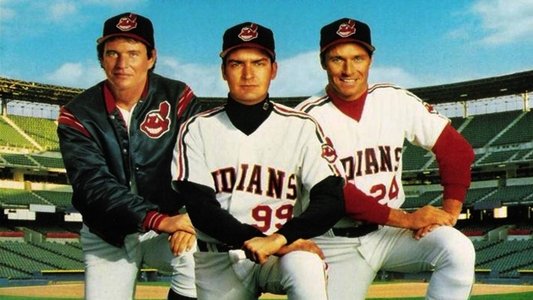
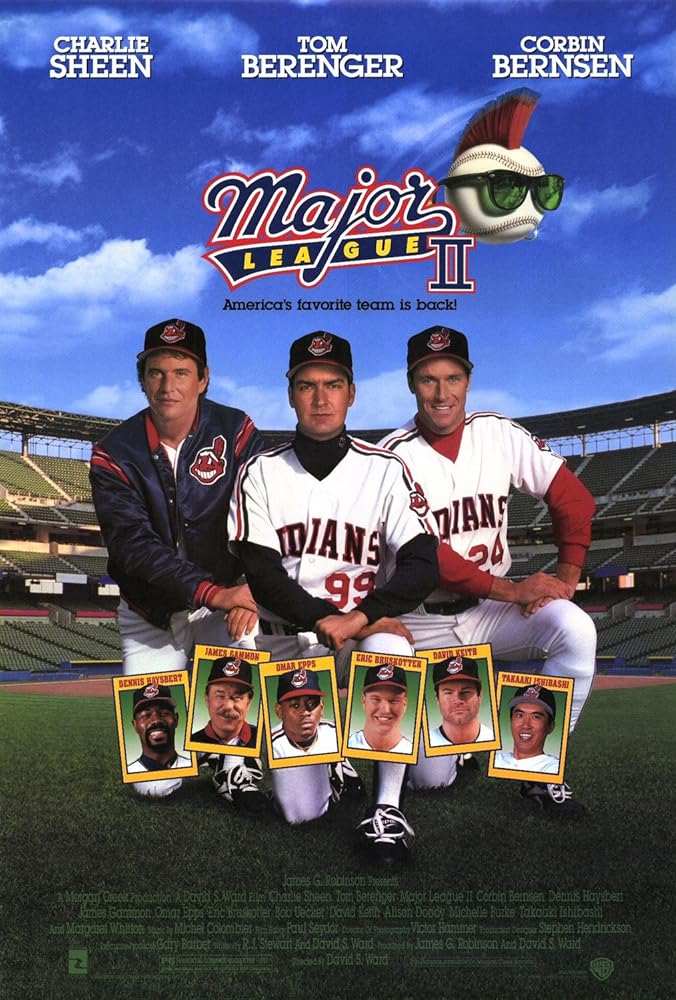
Twenty-five years ago, today, the #1 film at the box office was Major League II, a sports-comedy starring Charlie Sheen, Tom Berenger, Corbin Bernsen, Dennis Haysbert, James Gammon, Omar Epps, Alison Doody, David Keith, Bob Uecker, Jay Leno (as himself), Jesse Ventura (as himself), Randy Quaid (uncredited) and Rene Russo (uncredited). Released on March 30, it was a sequel to Major League (1989). David Ward directed both and most of the same cast remained. Omar Epps replaced Wesley Snipes in the role of Willie Mays Hayes.
After winning the division the previous year, the Cleveland Indians return the following season with a new-found confidence. Their previously ragtag players are now stars. Roger Dorn has gone from player to owner, removing the unhealthy management and influence of Rachel Phelps. New players have been contracted and the team roster looks stronger than ever. What could possibly go wrong?
Quote
From Peter Rainer (Los Angeles Times):
Except for the fact that it was a commercial hit, the 1989 baseball movie “Major League” was not the sort of film that cried out to be sequelized. But, a lot can happen in five years…for one thing, baseball movies seem to be hanging in there. So, here’s another go-round with the cloddy, come-from-behind Cleveland Indians sluggers who once again stumble in pursuit of the American League Eastern Division championship. Bob Uecker, as the Indians’ perpetually bedraggled play-by-play radio announcer, puts in another appearance, dressing down from his Liberace-like duds to a T-shirt as the Indians slide into the cellar. (His aghast expostulations are the film’s highlight.) We learn all sorts of homiletic life lessons about the value of sportsmanship and Being True to Yourself. Why do sports movies always have to devolve into civics lessons? To its credit, “Major League II” doesn’t go in for a lot of moony sentiment about America’s past-time but, it ends up tenderized anyway.
Trivia Bits:
♦ Opened the same weekend as D2:The Mighty Ducks, a sports comedy sequel which starred Charlie Sheen’s brother Emilio Estevez.
♦ In the outfield during their second game there is a sign that says “Emilio’s Repo Depot“. Charlie Sheen’s brother Emilio Estevez was in the movie Repo Man (1984).
♦ One of two films released in 1994 to feature the Chicago White Sox as the arch-rival team. The other was Angels In The Outfield.
Award
♠ Worst Sequel (David S. Ward & James G. Robinson/1994 The Stinkers Bad Movie Awards)
Nomination
♠ The Sequel Nobody Was Clamoring For (David S. Ward & James G. Robinson/1994 The Stinkers Bad Movie Awards)
Movie Monday: Splash 1984

“She was the woman of his dreams… she had large dark eyes, a beautiful smile and a great pair of fins.”
Thirty-five years ago, today, the #1 film at the box office was Splash, starring Tom Hanks, Daryl Hannah, Eugene Levy, John Candy, Dody Goodman, Shecky Greene, Rance Howard, Cheryl Howard, Clint Howard and Bill Smitrovich. A Rom-Com fantasy, it was directed by Ron Howard, produced by Brian Grazer and, the story was developed by Grazer and Bruce Jay Friedman. The screenplay was written by Lowell Ganz and Marc ‘Babaloo’ Mandel with music by Lee Holdridge.
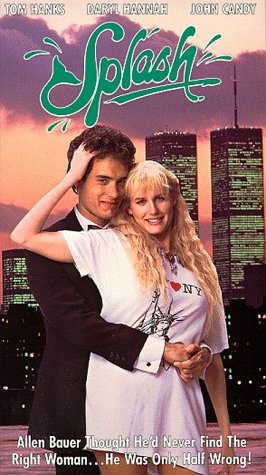
Alan [sic] Bauer nearly drowned as a child but, has memories of being saved by a young mermaid. He manages his family’s wholesale fruit and vegetable business and, continues his search to find true love. Along with his feelings, Allen must also contend with his womanizing older brother Freddie, who takes love less seriously than his brother. When he is jilted as an adult and loses his wallet in the surf, the young mermaid tries to return it. They are soul mates who have been meant for each other but, Madison fears how he will react when he finds out she is not human.
Quotes
From Brian Grazer:
“Tom came in wearing these 501 Levi’s and construction boots and a T-shirt. He wasn’t nervous at all – and here’s a guy who had never had a major movie. I thought, why is this guy so calm? But we read him and we liked him and we hired him right away.”
On Hannah’s abilities, Grazer states “[…] while we were testing Daryl [Hannah] in her tail underwater, we noticed how well she swam. Then we realized that she was as good, if not better, than her stunt doubles. Her endurance was actually better than theirs. We began wondering if Daryl couldn’t do all the scenes herself and she happily agreed, which certainly helped the movie’s credibility.
From Tom Hanks:
“They’re very, very funny guys (Candy & Levy). But my job in Splash was not to be particularly funny. That’s what Ron [Howard] kept drilling into me.”
Learning a valuable lesson from Howard, he recalls being unprepared…”It took longer to shoot than it should have, and when we were done with the scene, Ron said, “You know, you should have been a little more prepared.” He didn’t yell at me. He probably knew that if he had yelled, I’d be paste for the rest of the day. He just let me know in no uncertain terms that I was starring in this movie and with that comes huge responsibilities, and one of them is to be ready to go. I’ve never forgotten that.”
From Daryl Hannah:
[…] having to lie still for three hours every day for technicians to put her into the 35 lbs. rubber fin, she states “At lunch they’d yank me out on a crane and plop me on the deck. I couldn’t eat because I couldn’t go to the bathroom. I just lay there shivering with barnacles in my hair, soaking wet. And underwater it was difficult because I was not able to see since I couldn’t wear a mask. I had to trust the guys to get air to me. It was difficult and we worked long hours but, it seemed more like playing than work. It was real magical down there.”
Trivia Bits:
♦ This film was the first to be released by the new Touchstone Films.
♦ According to the Biography Channel, Bill Murray and P.J. Soles (Stripes) were considered for the roles of Allen and Madison, but Murray turned it down.
♦ Daryl Hannah swam with the mermaid tail so fast that her safety team could not keep pace with her.
♦ A vegetarian, Hannah refused to eat real lobster for the restaurant scene. The crew scooped out the insides of real, cooked lobsters and filled them with a thick, tofu-like paste. Ron Howard said [she] cried after each take over the deaths of the lobsters for their shells.
♦ Tom Hanks had trouble with the water scenes, partly because he was a smoker.
The movie received twelve nominations including the Academy Award for Best Original Screenplay and the Golden Globe for Best Motion Picture – Musical or Comedy. It won a National Society of Film Critics (NSFC) award for Best Screenplay and Daryl Hannah won the Saturn Award for Best Actress.
Love Came For Me Theme Song by Rita Coolidge
Movie Monday: Blazing Saddles 1974

Forty-five years ago, today, the most popular film at the box office was Blazing Saddles, a satirical Mel Brooks-directed western starring Cleavon Little, Gene Wilder, Slim Pickens, Harvey Korman, Madeline Kahn, Mel Brooks (three on-screen characters), Alex Karras, David Huddleston, John Hillerman, Dom DeLuise, Count Basie (as himself), Rodney Allen Rippy (as a young Bart), with uncredited appearances by Anne Bancroft, Aneta Corsaut (Helen Crump) and Patrick Labyorteaux (JAG TV series). Released February 7, it was produced by Michael Hertzberg and based on a story by Andrew Bergman. Bergman collaborated with Brooks, Richard Pryor, Norman Steinberg and Al Uger to craft the screenplay and, John Morris (The Woman in Red & Dirty Dancing) was composer.
The Ultimate Western Spoof. A town where everyone seems to be named Johnson is in the way of the railroad. In order to grab their land, Hedley Lemar [sic] (Harvey Korman), a politically connected nasty person, sends in his henchmen to make the town unlivable. After the sheriff is killed, the town demands a new sheriff from the Governor (Mel Brooks). Hedley convinces him to send the town the first Black sheriff (Cleavon Little) in the west. Bart is a sophisticated urbanite who will have some difficulty winning over the townspeople.
Quotes:
From Vincent Canby (The New York Times):
“[…] comedies, like Mel Brooks’s “Blazing Saddles,” the best title of the year to date, are like Chinese food. A couple of hours later you wonder where it went. You wonder why you laughed as consistently as you did. [It] is every Western you’ve ever seen turned upside down and inside out, braced with a lot of low burlesque […]. The trouble is that [it] has no real center of gravity. Harvey Korman, a gifted comic actor who is so fine as Carol Burnett’s television co‐star, tries very hard to be funny as a crooked businessman and sometimes succeeds. But, it’s apparent that he’s hard put to keep up with the movie’s restless shifting from satire to parody to farce to blackout sketch. [It] has no dominant personality and, it looks as if it includes every gag thought up in every story conference. Whether good, bad or mild, nothing was thrown out.”

From Roger Ebert:
“It’s a crazed grab bag of a movie that does everything to keep us laughing except hit us over the head with a rubber chicken. At its best, his comedy operates in areas so far removed from taste that (to coin his own expression) it rises below vulgarity. One of the hallmarks of Brooks’ movie humor has been his willingness to embrace excess.”
From Mel Brooks (Interview at Creative Screen Writing):
“The writing process on Blazing Saddles was the complete opposite of the writing process on Young Frankenstein. Blazing Saddles was more or less written in the middle of a drunken fistfight. There were five of us all yelling loudly for our ideas to be put into the movie. Not only was I the loudest but, luckily, I also had the right as director to decide what was in or out.”
Trivia Bits:
♦ James Earl Jones was to be the original Sheriff. Richard Pryor was next in line but, the studio wouldn’t finance it due to Pryor’s background.
♦ Gig Young was originally cast as the “Waco Kid” but, collapsed on set and was replaced with Wilder.
♦ Warner Bros. almost didn’t release the film. The executives thought it too vulgar for the American public.
♦ Governor William J. Le Petomane (Brooks) was a take-off on the stage name of a French Flatulist.
Nominated for three Academy Awards and two BAFTAs. It won three awards. Recognized by the American Film Institute, it is listed as #6 of the 100 funniest American films.
Movie Monday: Shoulder Arms 1918

Today, we are going waaaaaaay back…to 1918. On this date, Shoulder Arms, a Charlie Chaplin piece, was a very popular film. Was it a ‘number one’? Hard to tell. This film pre-dates the Academy Awards by 11 years. Starring Sir Charles Spencer Chaplin, Edna Purviance, Sydney Chaplin (Charlie’s elder, half-brother) and Tom Wilson, it is, primarily, a dream sequence set in France during World War I.
Plot from IMDB:
Charlie is in boot camp in the “awkward squad.” Once in France, he gets no letters from home. He finally gets a package containing limburger cheese, which requires a gas mask and which he throws over into the German trench. He goes “over the top” and captures thirteen Germans (“I surrounded them”) then, volunteers to wander through the German lines disguised as a tree trunk. With the help of a French girl, he captures the Kaiser and the Crown Prince and, is given a statue and victory parade in New York. Then…fellow soldiers wake him from his dream. [edited for grammar]
From an archived New York Times article:
“”The fool’s funny,” was the chuckling observation of one of those who saw Charlie Chaplin’s new film. “Shoulder Arms”, at the Strand, yesterday and, apparently, that’s the way everybody felt. There have been learned discussions as to whether Chaplin’s comedy is low or high, artistic or crude but, no one can deny that when he impersonates a screen fool, he is funny. Most of those who go to find fault with him remain to laugh. They may still find fault but, they will keep on laughing. In “Shoulder Arms”, Chaplin is as funny as ever.” [edited for grammar]
Trivia Bits:
♦ Many in Hollywood were nervous that one of their most famous peers was going to tackle the subject of WWI. It was released shortly before the Armistice so, it did not help boost national morale but, it did end up as one of Charles Chaplin’s most popular films and, it was particularly popular with returning doughboys.
♦ Released two weeks and one day before the end of World War I.
Tune Tuesday: The Wild Wild West 1988

Thirty years ago, today, the #1 Billboard Hot 100 song was The Wild, Wild West by The Escape Club, an English pop-rock band out of London (Est. 1983). Curiously, the album and the single didn’t chart in the UK, their home turf.
Nominations:
☆ Breakthrough Video (1989 MTV Video Music (VMA) Awards)
☆ Best Post-Modern Video (1989 MTV VMA)
☆ Best Special Effects In A Video (Nicholas Brandt & Bridget Blake-Wilson/1989 MTV VMA)
Flick Friday: Dickie Roberts 2003

It’s Flick Friday! The 1# movie fifteen years ago, today, was Dickie Roberts: Former Child Star. The list of cameos is interesting.
I haven’t the first clue… But, I will say that the trailer offered a nice view of an older Leif Garrett and Barry Williams. Bonaduce? I’ve seen enough of him, already. Ditto Alyssa Milano. ~Victoria
- ← Previous
- 1
- …
- 6
- 7
 Cosmic-Observation