John Lennon bought a 1964 Mulliner Park WardPhantom V, finished in [Valentine Black]. Everything was black except for the radiator, even the wheels. Lennon asked for the radiator to be black as well but, Rolls-Royce refused. Originally, the car was customised from Park Ward with black leather upholstery, cocktail cabinet with fine-wood trim, writing table, reading lamps, a seven-piece his-and-hers black-hide luggage set and a Perdio portable television. A refrigeration system was put in the boot and it was one of the first cars in England to have tinted windows. In December 1965, Lennon made a seven-page list of changes […].
“You swine! How dare you do that to a Rolls-Royce!”…so screamed an outraged Englishwoman as John Lennon’s Phantom V cruised past on London’s posh Piccadilly promenade in the Summer of 1967. The ornately decorated limousine, sprayed an electric yellow and bedecked with colorful floral tendrils, Romany scrolls and, zodiac symbols like a hallucinatory gypsy caravan, so offended her sensibilities that she briefly attacked it with an umbrella…or, at least, that’s the way Lennon always told the story.
Much as the length of the Beatles’ mop-tops had done, Lennon’s choice to express himself through his automobile triggered a generational clash, enraging those who felt the tripped-out paintjob had subverted a British icon.
In the 50 years since it outraged the Establishment, Lennon’s Rolls-Royce Phantom V is now embraced as a masterpiece of design and a jewel of the Swinging Sixties.
For all of the paperwork accumulated during the car’s construction, the total price of the vehicle is not recorded. [With] publicity at a premium and Lennon being one of the most famous people on the planet, odds are good that he received some sort of Beatle discount. Ironic considering the significant expenditure, Lennon was unable to drive when he first ordered the Phantom V. He wouldn’t pass his “L-Test” until February 15th, 1965 at age 24, becoming the last Beatle to do so. That same day, the Beatles began work on a new song, Ticket to Ride, a prophetic title considering the number of citations Lennon eventually racked up during his road hours. By all accounts, including his own, he was a horrendous driver, far too myopic to read signs, too distracted to recall routes and too impractical to troubleshoot even the simplest mechanical issue.
Exactly how Lennon decided on the lurid Romany floral/zodiac hybrid is subject to some debate. [Les] Anthony recalls Ringo Starr planting the seed of the idea during a drive in early 1967. However, others say the idea was suggested by Marijke Koger, of the Dutch design collective The Fool, who would also paint Lennon’s piano that summer, after Lennon commissioned a refurbished 1874 gypsy caravan as a present for his young son, Julian.
After spraying the body of the car yellow, local artist Steve Weaver was tasked with painting the red, orange, green & blue art nouveau swirls, floral side panels and Lennon’s astrological symbol, Libra, on the roof. On May 24th, Weaver submitted an invoice for 290 pounds and, the following day [May 25], the car was ready for pickup.
“John Lennon chose an automotive piece as his canvas, using all the symbols of wealth and other messages that go along with the Rolls-Royces of that period. He was certainly getting fed up with conforming at that time. It was a classic artistic statement.”
Reactions were mixed, depending on which side of the generation gap you happened to stand. The Daily Mail reported that the shrieking yellow vehicle elicited jeers from the assembled crowd and Beatles Book Monthly [July 1967] claimed that a local traffic official feared the loud colors would be a dangerous distraction to drivers on the road. Delivered days before the Sgt. Pepper’s Lonely Hearts Club Band was issued, its official maiden voyage took place on May 28th, leading a fleet of friends to Epstein’s new country home for a combined album release party and housewarming.
Image Credit: Weird Universe
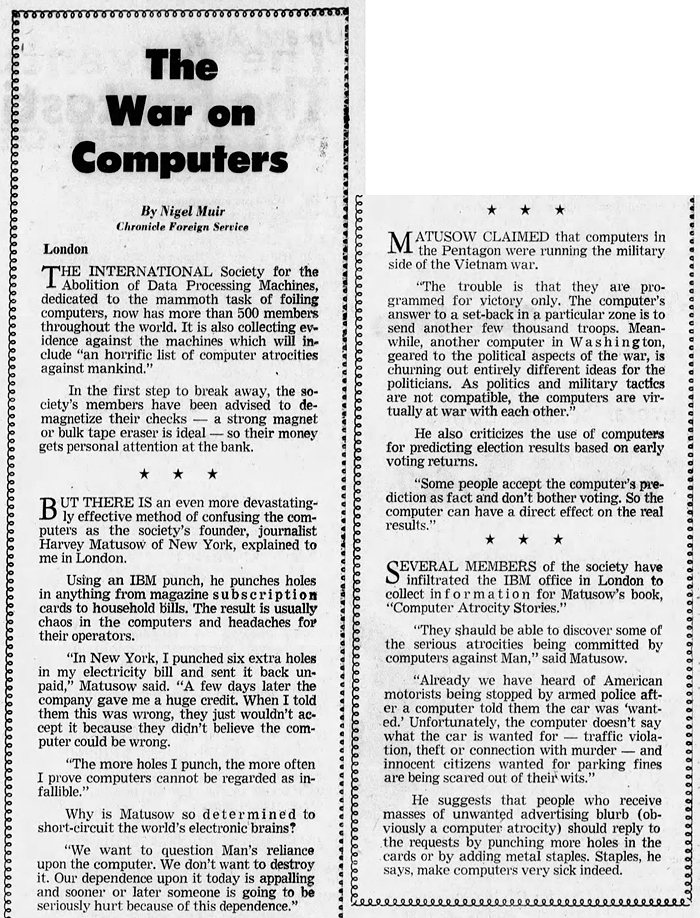
San Francisco Examiner
10-27-1968
The International Society for the Abolition of Data-Processing Machines […] was founded by Harvey Matusow in the late 1960s. Its aim was “to conduct guerrilla warfare against the computer by such means as sending a penny too much or too little when paying a utility bill.”
Matusow also authored The Beast of Business, which was supposed to serve as a manual for the guerrilla warfare against the computer. I wonder if any of the techniques he detailed would still work today?
However, Matusow is best known for giving evidence in court against individuals during the McCarthy era. Later, he claimed that the FBI had paid him to give false testimony and he detailed these allegations in his book False Witness.
A rare documentary by Scottish folk singer Donovan P. Leitch. Insights into his life with rare recordings from the beginning of his career as a folk singer. Portions of the film was [sic] filmed on St. Ives, Cornwall on Porthminster [B]each in 1966.
It shows Donovan’s life before becoming famous, when he was busking and living in Saint Ives with his friend Gypsy Dave. And, then, when the fame came in with Ready Steady Go! Donovan and his friends are seen smoking marihuana [sic], very shocking for its time. This warned the police to keep him under surveillance and ended up arresting him for drugs [sic] possession in mid-1966.
Born Donovan Philips Leitch in Glasgow, Scotland on May 10, 1946, Donovan was part of the British folk scene and the British music invasion in America. His style was distinctive and incredibly eclectic. As a child, Donovan was vaccinated with the polio vaccine and contracted polio. Though the vaccine was later made safer with the Sabin oral vaccine, the disease and treatment left Donovan with a limp. The public never knew this.
[E]arly on, he was compared with Bob Dylan […]. By 1966, [he] had become one of the first British pop musicians to adopt the flower power image. His music contained many drug references during this time. His recordings were also the first pop music to contain the sound of the sitar, later copied by other famed music groups. [He] was the first high-profile British pop star to be arrested for possession of marijuana. Though Donovan’s drug use appeared to have been moderate, and his drug use was not on the scale of others such as Jimi Hendrix and Brian Jones who later died from overdoses, his use of LSD is referred to in many of his lyrics. Public attention was drawn to his drug use by [the] TV documentary, A Boy Called Donovan, which was broadcast during that year and newspaper coverage of the drug scene in England.
The Hurdy Gurdy Man of the Psychedelic Sixties: Donovan Leitch Felice Prager
[…] it was the first Beatles record to be made using four-track equipment. It was also the group’s first American number one, entering the Billboard Hot 100 chart on 18 January 1964 at number forty-five and starting the British Invasion of the American music industry.
“A telegram came through to Brian from Capitol Records of America. He came running in to the room saying, ‘Hey, look. You are number one in America!’ I Want To Hold Your Hand had gone to number one. Well, I can’t describe our response. We all tried to climb onto Big Mal’s back to go round the hotel suite: ‘Wey-hey!’ And that was it, we didn’t come down for a week.”
“It was such a buzz to find that it had gone to number one. We went out to dinner that evening with Brian and George Martin. George took us to a place which was a vault, with huge barrels of wine around. It was a restaurant and its theme was… well, the bread rolls were shaped like penises, the soup was served out of chamber pots and the chocolate ice cream was like a big turd. And, the waiter came ’round and tied garters on all the girls’ legs. I’ve seen some pictures of us. There is a photograph around of Brian with the pot on his head. It was a great feeling because we were booked to go to America directly after the Paris trip, so it was handy to have a number one. We’d already been hired by Ed Sullivan so, if it had been a number two or number ten we’d have gone anyway but, it was nice to have a number one. We did have three records out in America before this one. The others were on two different labels. It was only after all the publicity and the Beatlemania in Europe that Capitol Records decided, ‘Oh, we will have them.’ They put out I Want To Hold Your Hand as our first single but, in fact, it was our fourth.”
Will We All Become Beatle Nuts?
Here’s What the Reviewers Say…
“Anyone who is not a teenage girl obviously is unqualified to comment on the sight of The Beatles in action. Heaven knows we’ve heard them enough. It has been impossible to get a radio weather bulletin or time signal without running into “I Want To Hold Your Hand.” And now, having seen the four performers on Ed Sullivan’s show Sunday night, Beatlemania is even more of a mystery to an elderly viewer.”
~Cynthia Lowry (Associated Press)
“It is now clear why President de Gaulle has been giving England such a hard time about the Common Market. He undoubtedly saw The Beatles and decided nothing doing. As you certainly know, America saw the four-member rock’n’roll British group live on television last night. Pandemonium reigned. Vive La France.”
~Rick DuBrow (United Press International)
“”You can tell right away its The Beatles and not anyone else,” is the opinion of a 15-year-old specialist on the topic who saw them on the Ed Sullivan show. The age of 15 (or 16, or 14 or 13) is essential in Beatle experts. And, so, taking the above axiom as gospel, an attempt was made to find out just what is musically unique about the English group that is now visiting our shores.”
~Theodore Strongin (The New York Times)
“It seems The Beatles came, sang and conquered…all that is but, the TV reviewers. Most of the time, these reviewers have real troubles finding something to write about. Ask them… When Elvis Presley first appeared on the popular musical scene and made his TV début, did they praise him? No. In fact, most beat singers who come under the TV reviewer’s eagle eye rarely receive a word of praise. It seems obvious the reviewers came to bury the teenage favorites and not to praise them. Again, the teenage taste has been mocked. As long as this superior feeling is put across, the younger generation will continue to make their idols…and won’t give a darn who likes them.”
[…] it was the first Beatles record to be made using four-track equipment. It was also the group’s first American number one, entering the Billboard Hot 100 chart on 18 January 1964 at number forty-five and starting the British Invasion of the American music industry.
“A telegram came through to Brian from Capitol Records of America. He came running in to the room saying, ‘Hey, look. You are number one in America!’ I Want To Hold Your Hand had gone to number one. Well, I can’t describe our response. We all tried to climb onto Big Mal’s back to go round the hotel suite: ‘Wey-hey!’ And that was it, we didn’t come down for a week.”
“It was such a buzz to find that it had gone to number one. We went out to dinner that evening with Brian and George Martin. George took us to a place which was a vault, with huge barrels of wine around. It was a restaurant and its theme was… well, the bread rolls were shaped like penises, the soup was served out of chamber pots and the chocolate ice cream was like a big turd. And, the waiter came ’round and tied garters on all the girls’ legs. I’ve seen some pictures of us. There is a photograph around of Brian with the pot on his head. It was a great feeling because we were booked to go to America directly after the Paris trip, so it was handy to have a number one. We’d already been hired by Ed Sullivan so, if it had been a number two or number ten we’d have gone anyway but, it was nice to have a number one. We did have three records out in America before this one. The others were on two different labels. It was only after all the publicity and the Beatlemania in Europe that Capitol Records decided, ‘Oh, we will have them.’ They put out I Want To Hold Your Hand as our first single but, in fact, it was our fourth.
Will We All Become Beatle Nuts?
Here’s What the Reviewers Say…
“Anyone who is not a teenage girl obviously is unqualified to comment on the sight of The Beatles in action. Heaven knows we’ve heard them enough. It has been impossible to get a radio weather bulletin or time signal without running into “I Want To Hold Your Hand.” And now, having seen the four performers on Ed Sullivan’s show Sunday night, Beatlemania is even more of a mystery to an elderly viewer.”
~Cynthia Lowry (Associated Press)
“It is now clear why President de Gaulle has been giving England such a hard time about the Common Market. He undoubtedly saw The Beatles and decided nothing doing. As you certainly know, America saw the four-member rock’n’roll British group live on television last night. Pandemonium reigned. Vive La France.”
~Rick DuBrow (United Press International)
“”You can tell right away its The Beatles and not anyone else,” is the opinion of a 15-year-old specialist on the topic who saw them on the Ed Sullivan show. The age of 15 (or 16, or 14 or 13) is essential in Beatle experts. And, so, taking the above axiom as gospel, an attempt was made to find out just what is musically unique about the English group that is now visiting our shores.”
~Theodore Strongin (The New York Times)
“It seems The Beatles came, sang and conquered…all that is but, the TV reviewers. Most of the time, these reviewers have real troubles finding something to write about. Ask them… When Elvis Presley first appeared on the popular musical scene and made his TV début, did they praise him? No. In fact, most beat singers who come under the TV reviewer’s eagle eye rarely receive a word of praise. It seems obvious the reviewers came to bury the teenage favorites and not to praise them. Again, the teenage taste has been mocked. As long as this superior feeling is put across, the younger generation will continue to make their idols…and won’t give a darn who likes them.”
Lyrics: Oh yeah, I’ll tell you something,
I think you’ll understand,
Then I’ll say that something,
I wanna hold your hand,
I wanna hold your hand,
I wanna hold your hand.
Oh please say to me
You’ll let me be your man,
And please say to me,
You’ll let me hold your hand,
Now let me hold your hand,
I wanna hold your hand.
And when I touch you
I feel happy inside,
It’s such a feeling
That my love I can’t hide,
I can’t hide, I can’t hide.
Yeah, you got that something,
I think you’ll understand,
When I feel that something,
I wanna hold your hand,
I wanna hold your hand,
I wanna hold your hand.
And when I touch you
I feel happy inside,
It’s such a feeling
That my love I can’t hide,
I can’t hide, I can’t hide.
Yeah, you got that something,
I think you’ll understand,
When I feel that something,
I wanna hold your hand,
I wanna hold your hand,
I wanna hold your hand.
Fifty years ago, today, the #1 Billboard Hot 100 song was Hey Jude. Written by Paul McCartney but, credited to Lennon-McCartney, Paul was on the way to see John’s soon-to-be ex-wife Cynthia and their son Julian. Starting out with “Hey Jules”, it evolved to “Hey Jude” as Paul attempted to try and help Julian through his parents’ separation.




 Cosmic-Observation