As described in a film magazine review, Count Gorfa, anarchist leader, steals the private records of a Senate Investigative Committee, the loss of which threatens the political fortunes of Senator Belgrave, whose daughter the Count wishes to wed. The Senator’s son, the young George Washington Belgrave and his friend Robert Lee Hopkins trail the anarchists. After many adventures and burlesques of historical fables, the documents are recovered and the Senator is saved.
A senator is trying to get his niece to marry a foreign count. The senator’s teenage son finds out that the count is not only a phony but, an international criminal. The boy sets out to break up the impending marriage, save his father from ruin and, his cousin from marrying a man she doesn’t love.
IMDb Storyline
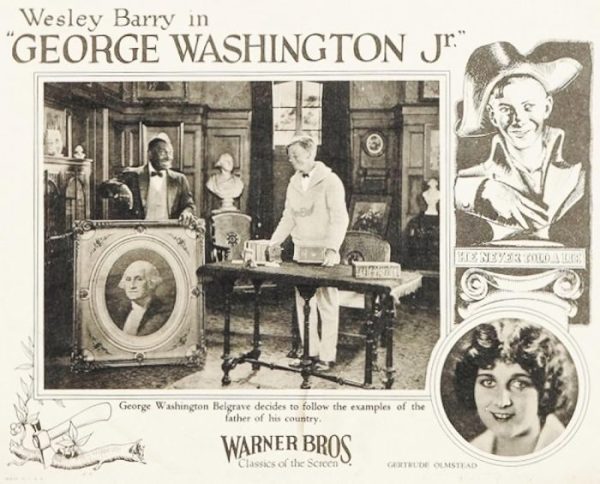
George Belgrave is guided by George Washington’s principles of integrity and honesty. He exposes his cousin Dolly’s fiancé, Count Tyrola, to be a bogus count and an internationally sought criminal. [As] the leader of the Vassalini gang, [he] steals a secret treaty from George’s father, a United States senator. It is Tyrola’s intention to use the treaty to cause political strife in Bessarabia. George, his friend Bob, and Ham, the negro butler, subdue the Vassalini gang and, after recovering the treaty, lock them up. Tyrola’s treachery is revealed seconds before the wedding ceremony. George, to save his father embarrassment, tells his only lie in giving him credit for the whole “plan” to capture Tyrola. Cousin Dolly marries friend Bob.
One hundred years, ago, today, the black & white silent film [The] Forbidden Lover was released. Brackets around “THE” is a product of the differences of the title from data sources. This film is an edited version of The Power of Love, the very first 3-D movie, released on September 27, 1922 at the Ambassador Hotel Theater in Los Angeles. Both films are believed lost.
Yankee sea captain lands on the coast during the old Spanish days to trade with the ranch owners. He meets a girl who is betrothed to a man she loathes. After a series of adventures and narrow escapes, he shows up the unscrupulous ranch owner and wins the girl.
Still Image
The Power Of Love
Image Credit: IMDb & Amazon
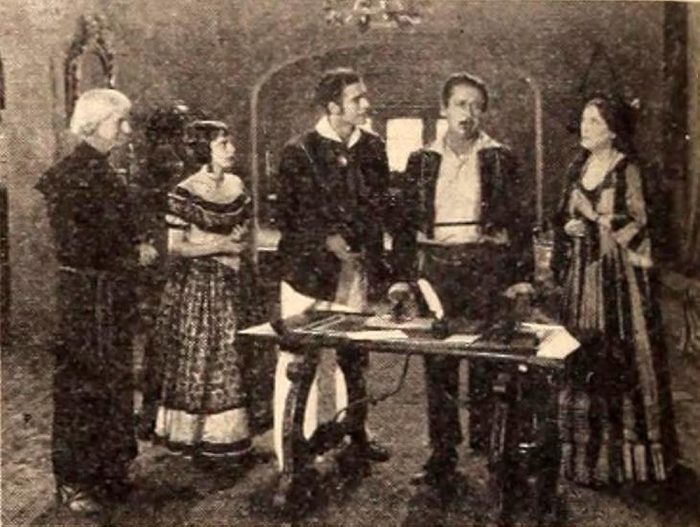
Because of his financial trouble, Don Almeda promises his daughter, Maria, to Don Alvarez but, Maria does not love [him]. In fact, she falls in love with Terry O’Neil, a stranger who has been wounded by robbers associated with Alvarez. O’Neil takes Alvarez’s place at a masked ball. Alvarez, in turn, robs the old Padre of some pearls and stabs him to death with O’Neil’s knife. He then accuses O’Neil of the murder and tries to shoot him but, wounds Maria instead, having thrown herself in front of him. Maria recovers and, after proving that Alvarez is a thief and a killer, weds O’Neil.
IMDb The Power of Love Storyline Moving Picture World
October 1922 Production Company:Perfect Pictures Tagline: A pair of spectacles will be handed to you as you enter the theatre, through which you will view the new sterescopic pictures.
The Power of Love was screened in front of a live audience at the Ambassador Hotel Theater […]. It was projected dual-strip in the red/green anaglyph format, making it both the earliest known film that utilized dual strip projection and the earliest known film in which anaglyph glasses were used. The camera rig used to shoot the film was made by the producers themselves and as you can imagine, it was far from perfect. Simply put, the film was not a success. It was screened, again, for exhibitors, and press, in New York City and, then, almost immediately fell out of sight. It was not booked again by other exhibitors. Unfortunately, we may never see what this movie looked like.
3-D TV & Movies
The first stereoscopic image dates to 1844, which makes 3-D images as old as the art of photography. [No] less a personage than Queen Victoria was photographed in 1854 in stereoscopic 3-D. 3-D stereoscopic moving images date to the 1850s with what was called the Kinetamatoscope [sic]. The first public display of a 3-D movie came in 1922 with The Power of Love […]. The film received a decent review in Moving Pictures World, then promptly disappeared from history by changing its title to Forbidden Lover and touring the country in a 2-D version. It was too complex and costly at the time to take 3-D on the road.
Randome
Looking Up/My Daily Plant Blogspot (Blogger) Cirque de 3-D
March 6, 2009
Virtuous Mabel rejects the improper advances of a villainous cad. The furious villain, and his henchmen, then seize Mabel and chain her to a railroad track. Mabel’s anxious boyfriend turns for help to the great Barney Oldfield, who jumps in his racing car and speeds to the rescue.
IMDb Storyline
A lady, Mabel Sweet and Lovely, is courted by a gentleman, A Bashful Suitor. He offers her a corsage, which she accepts. They coyly share a kiss. After the Suitor leaves, the Villain appears and grabs the lady. She hits him and escapes. This angers the Villain and he vows to get his way. At the next opportunity, the Villain, once again, kidnaps the lady, this time with the help of two henchmen and chains her to the railway tracks.
The three villains travel by handcar to the station, where they assault two workers and steal a locomotive engine. The villains drive the train back towards the location of Mabel, who is still tied to the tracks. The railyard worker alerts the Suitor about the situation, who then rushes to ask his friend, racecar driver, Barney Oldfield for help.
The two friends jump in the automobile and race the speeding hi-jacked locomotive to rescue the damsel in distress. Mabel is dramatically saved at the last moment and is carried away to safety. The foiled villain kills his accomplice and shoots five Keystone Cops arriving by handcar to arrest him. Finally, he turns the gun on himself but, upon discovering the bullet chamber empty, he drops dead in a rage.
One hundred, ten years ago, today, the B&W silent, short comedy film Suffrage and the Man was released. Produced by the French company Eclair, in conjunction with the Women’s Political Union, its original title was Suffrage Wins Herbert.
A young man learns that his betrothed is leaning toward the suffragette cause. He remonstrates with her father to be told “My butler and my bootblack may vote, why not my wife and daughter?” He cannot agree, however and their quarrel brings about a broken engagement. Disappointed and unhappy, he seeks forgetfulness by going to a summer resort. There, he succumbs to the wiles of a designing mother and, caught in an embarrassing position, her daughter “feinting a faint” in his arms, he permits their engagement to be announced. He learns, by an accidental eavesdropping, of the mother’s trickery. He loses no time to denounce the deception and withdraw his offer of marriage. The mother and daughter promptly start suit tor breach of promise. In the meantime, votes have been won for women. The trial of the suit comes up before a mixed jury of men and women with the old sweetheart as forewoman of the twelve peers. Their verdict is acquittal and, as might be expected, “Suffrage Wins Herbert” with a permanently happy result in his reconciliation and marriage.
According to Silent Era, the director is unknown, the cast is unknown and the film’s survival status is unknown. There is one trivia bit…it is based on a story written by playwright Dorothy Steele. ~Vic
Lady Gwen, the last of the sporting Grayles, falls in love with Donald MacAllan, a bright young medical student far below her station. Gwen’s father, who opposes the match, introduces her to Prince Carlos, who wishes to marry her in order to pay off his creditors.
Photo Credit: imdb.com & amazon.com
Donald enlists during the World War and Carlos continues his courtship. When Donald returns from the fighting, Carlos tells him that he is engaged to Gwen and Donald, therefore, makes no attempt to see her. Gwen mistakes Donald’s seeming indifference for contempt and seeks to forget him by living riotously in several European capitals. Having exhausted her fortune, and ruined her health, Gwen returns to Scotland and goes to live in the same cottage where Donald used to study. She becomes ill and, in delirium, calls for Donald. Her old nurse goes to fetch him at the Grayle estate, which, having become wealthy, he has just bought. Donald rescues Gwen, who has wandered out in a storm, and nurses her back to health.
A Hollywood conception of Scotsmen who wear the kilt but, whose complexions betray nary a sign of the ruddy ruggedness due to Highland rain and wind, is to be seen at the Capitol this week in a picture called “The Sporting Venus” […]. [There] is a question [of] whether the Wallaces, the Bruces, the Watts and the McTavishes will smile with any satisfaction upon it. Not that they are intentionally maligned in this story but, that the men from the land of the heather are portrayed with studio-blanched complexions and, in one or two instances, wearing brocaded silk dressing gowns.
Marshall Neilan, the director of this celluloid effusion, in his desire to depict Lady Grayle (Blanche Sweet) as a plucky person at the eleventh hour of a fast life, shows her ladyship smoking a cigarette before she breathes her last. Ronald Colman is undoubtedly a bonnie actor but, you just know that he never was born to wear a kilt, [though], he does for a few scenes. He impersonates Donald McAllen, frequently alluded to as a commoner.
Donald and the capricious lassie, Lady Gwendolyn, are happy in Scotland until the coming of Prince Carlos […]. This Prince, played by Lew Cody, is a man of many debts and a faithful valet. His creditors see only one way to get back their money and that is to have the oily gentleman marry a wealthy wife. Donald goes to France to fight, and when he returns on leave, [believes] the Prince’s story […] that [he], more or less, is to wed Lady Gwendolyn.
Lady Gwendolyn […] becomes […] a flighty young woman who gambles in millions. The young hero goes back to France, and as a surgeon, makes a great name for himself. He purchases Grayloch, the great estate of the Grayles.
With the background of Scotland, Mr. Neilan ought to have been able to make a production far stronger than this effort, which, at best, is only a mediocre diversion. It is true that it has some beautiful scenery and the settings are quite pleasing.
This film survived but, I can’t find any clips of it. Silent Era states that a premiere took place on May 10, 1925, at the Capitol Theatre in New York City and was released May 17, 1925. AFI disagrees. ~Vic
Oh, it has been work looking for a film for today’s date. IMDB had plenty to choose from but, I couldn’t seem to get any further information from the others…Wikipedia, American Film Institute, Turner Classic Movies… Even the Silent Era site and Silent Hollywood were slim pickings and, Silentology had nothing.
The discovery that detectives are on their trail causes Doyle, Broden and Etzer, counterfeiters, to pack their paraphernalia into a trunk and express it to Lone Point. Upon its arrival at that station, a corner of the trunk is smashed. Helen thus learns of its contents. The telegrapher immediately wires to Savage, a railroad detective. The latter, accompanied by Duncan, a Secret Service detective, hastens to the scene. At their suggestion, Helen arranges a trap for the counterfeiters. When the latter appear, they are set upon by the officers. Etzer is captured but, his pals get away. Doyle eludes pursuit but, Broden later falls into Savage’s hands. Helen, watching the pursuit, ventures on the high trestle which crosses the dry bed of the Loro River. Doyle, who is hiding, sees Helen. Overpowered by a desire for revenge, the man attacks the telegrapher and makes her a prisoner. A rope lies nearby. Binding Helen, Doyle suspends his victim from the trestle and fastens the end of the line around the rails. Duncan sees this from afar. Although he rushes forward, he knows that the Keene local, due any moment, will cut the rope as it crosses the trestle. Meanwhile, Helen, after a tremendous effort, frees her hands. There is one chance for life. The girl commences swinging her body. Each time, she [manages] a wider arc. The train is crossing the trestle when Helen swings toward a beam. The engine wheels sever the rope. Helen flies through the air and reaches the beam. Doyle is captured. Savage and Duncan raise Helen to the tracks and find her uninjured.
Moving Picture World
This is one of the lost pieces so, there isn’t a YouTube clip and I could only find one picture. ~Vic
Perhaps the most attractive feature of this picture is the reproduction of early Roman costumes and Roman surroundings. It is a story of political intrigue, with all the contests and disagreeable features, connected therewith in the ancient city. But, the reproduction of manners and customs and, the historically correct scenery and settings, add immensely to the interest and, insure attention when, perhaps, the mere political story would scarcely be considered. The greatest service the motion picture can do is in the direction of educating the people, and a film like this, which faithfully illustrates long past and, perhaps, partially forgotten life, is of vast importance and, deserves a cordial reception. The Selig players have brought enthusiasm to their work and, have put much ability and life into the interpretation of this play.
This film may have been based on the 1835 novel Rienzi, the Last of the Tribunes, by Edward Bulgar-Lytton [sic]. An advertisement in the [February] 19, 1910, Film Index billed Bosworth above the title, “Hobart Bosworth in The Roman,” and labeled the movie “Film De Art of the Classics,” declaring: “Its teachings are based upon the scriptures and traditions of the early history of the eternal city.” The advertisement also suggested that theater owners book The Roman as a “Special Lenten Picture.”
A young woman [orders] her girl slave to deposit in the waters of the Tiber a child which she has cause to be rid of. The infant is found by one of the aristocracy and adopted. In later years she is betrothed but, just before the wedding, the ruler of the land claims the young woman, on the ground that she was born in slavery. By military force, she is torn from the arms of her foster father and taken to the ruling house where she is held captive for only a few hours, as the father and young lover, have aroused a popular rebellion which overthrows the ruler, end[ing] in his death and the defeat of his defenders. (Variety February 19, 1910)
One Trivia Bit:
♦ Per [Hobart] Bosworth, first picture made at Selig’s (Studio at 1845 Allesandro Street, now Glendale Blvd.) in the Edendale (now Silver Lake) plant of Los Angeles.
[There was not much written about this film and no video clip(s). The image, above, doesn’t seem to jive with the TCM synopsis. But, that is all I could find.
Addendum: I continued to dig and found the, above, write-ups via the Internet Archive database and AFI. Turner Classic Movies synopsis was WAY off. ~Vic]



 Cosmic-Observation