Thoughts
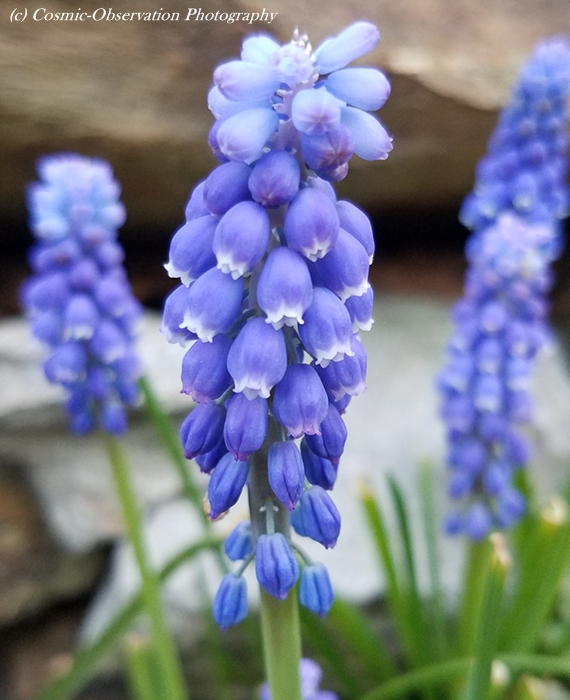
FFTD: Grape Hyacinth
I had intended to post my museum pictures but, I’ve been too busy. I thought this might be a Bluebell but, it isn’t. I’m still trying to identify it. ~Vic
Update:
It’s a Grape Hyacinth!
03-06-2020
Flower for the Day
Vernal Equinox 2020
Well, Spring has finally sprung and not a moment too soon. I’m sitting in my Adirondack chair, with my bare feet on the ground, watching the sunset through the limbs of my Hackberry tree. Yes, I have short feet. Shut up. (All photos are my personal collection. ©)

According to the Farmers’ Almanac 1818, this is the earliest First Day of Spring in 124 years. Yahoo! Maybe some warm, beautiful weather will offset the corona beer virus and this needless, manufactured hysteria that has appeared with it.

Hackberry in the background.
I did a Vernal Equinox post last year when it coincided with the Full Worm Moon. In our area, it was as high as 80° and I was out in it. My buddy Ray had some errands to run so, off we went to the county north of us. Once the errands were completed, we headed to downtown Roxboro for lunch & a minor visit to their museum (pictures coming tomorrow).

From Farmers’ Almanac 1818:
[Spring] will occur at 11:50 p.m. EDT for those of us in the Northern Hemisphere […]. Traditionally, we celebrate the first day of spring on March 21 but, astronomers and calendar manufacturers, alike, now say that the spring season starts on March 20th, in all time zones in North America. And, in 2020, it’s even a day earlier than that…something that hasn’t happened since 1896.
There are a few reasons why seasonal dates can vary from year to year. The first is that a year is not an even number of days and neither are the seasons. Another reason is that the earth’s elliptical orbit is changing its orientation (skew), which causes the earth’s axis to constantly point in a different direction, called precession. Since the seasons are defined as beginning at strict 90-degree intervals, these positional changes affect the time the earth reaches each 90-degree location in its orbit around the sun. The pull of gravity from the other planets also affects the location of the earth in its orbit.
Cheers! ~Vic
Additional Interesting Reading:
First Day of Spring (The Old Farmer’s Almanac 1792)
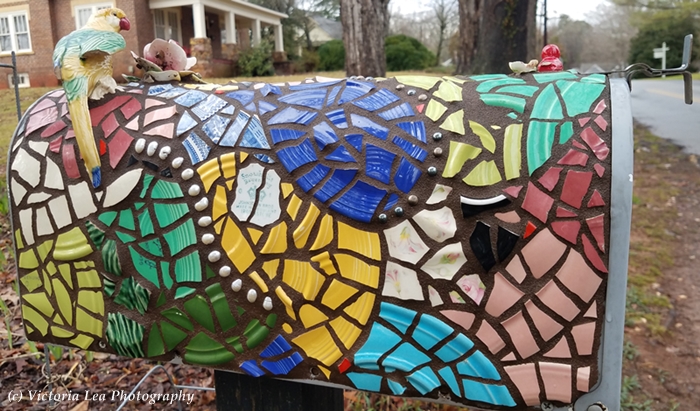
POTD: Colorful Mailbox
Out on a neighborhood walk, I couldn’t help but admire the mosaic handywork, along with the bird and flower. It’s definitely an original. ~Vic
Shutterbug Saturday: Sky Gazing 3.0
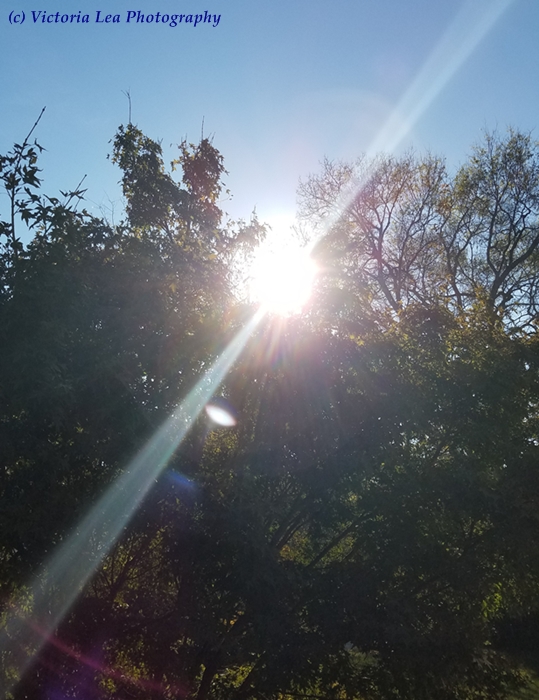
More submissions of the beauty of our sun and sky. All photos are my personal collection. © ~Vic
10-20-2017
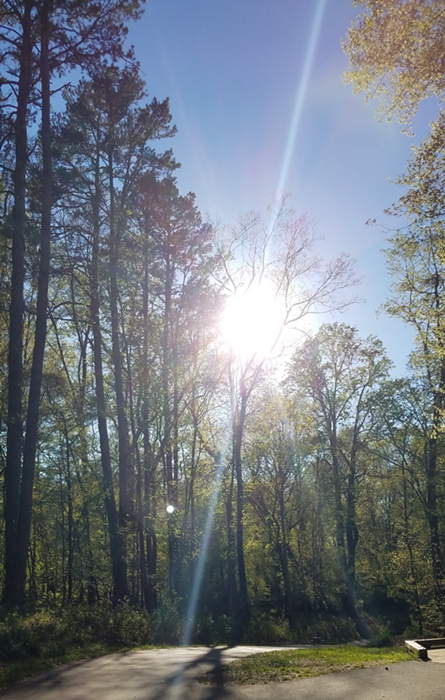
04-15-2019
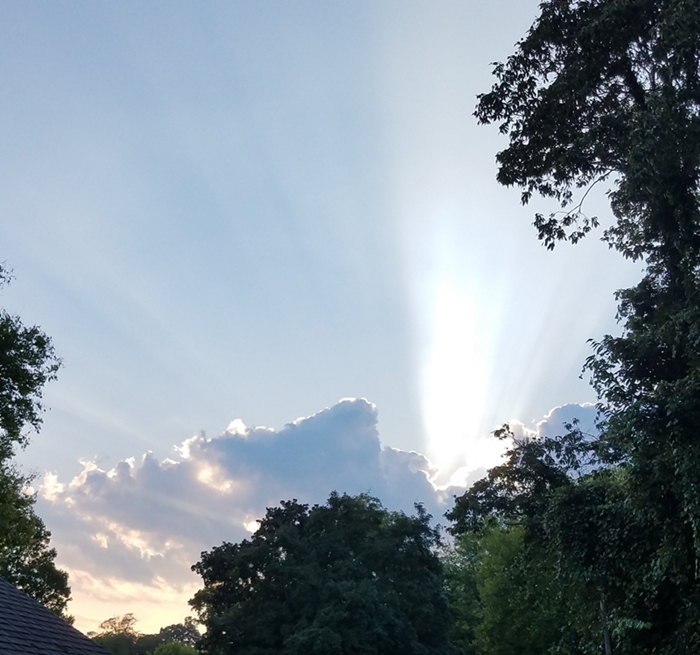
09-12-2019

09-12-2019
Flashback Friday: Uranus & Pluto
It’s Friday the 13th! Eek! Everybody…RUN! Hide! Yeah, well, enough of the hysteria. We have plenty of that going on with the corona beer virus. Sugar, rice, pasta, Clorox & Lysol hand wipes, bleach, hand sanitizer and toilet paper doesn’t stand a chance. Now, we have to deal with the dreaded number 13. E-gads! The humanity!
March 13 has been a rather busy day in history. Curiously, Uranus and Pluto are involved.

Image Credit: mirror.co.uk
Uranus is the seventh planet from the sun. The name of Uranus references the ancient Greek deity of the sky Uranus, the father of Cronus (Saturn) and grandfather of Zeus (Jupiter) […]. It has the third-largest planetary radius and fourth-largest planetary mass in [our] solar system and, […] is the only planet whose name is derived directly from a figure of Greek mythology. Uranus is similar in composition to Neptune and, both have bulk chemical compositions which differ from that of the larger gas giants Jupiter and Saturn. Uranus’ atmosphere is similar to Jupiter’s and Saturn’s in its primary composition of hydrogen and helium but, it contains more “ices” such as water, ammonia and methane […]. It has the coldest planetary atmosphere in the solar system […]. Like the other giant planets, Uranus has a ring system, a magnetosphere and numerous moons. The Uranian system has a unique configuration because its axis of rotation is tilted sideways, nearly into the plane of its solar orbit. Its north and south poles, therefore, lie where most other planets have their equators. Voyager 2 remains the only spacecraft to visit the planet.
Like the classical planets, Uranus is visible to the naked eye but, it was never recognised as a planet by ancient observers because of its dimness and slow orbit. [Two hundred, thirty-nine years ago, today], Sir William Herschel first observed Uranus on March 13, 1781 (from the garden of his house at 19 New King Street in Bath, Somerset, England, now the Herschel Museum of Astronomy), leading to its discovery as a planet, expanding the known boundaries of the solar system for the first time in history and making Uranus the first planet classified as such with the aid of a telescope.
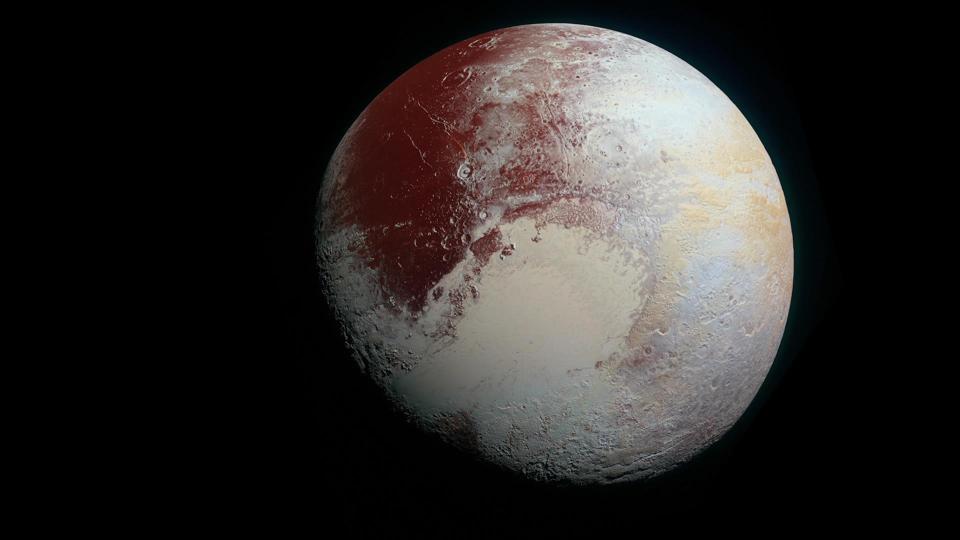
Photo Credit: forbes.com
Pluto is an icy dwarf planet in the Kuiper belt, a ring of bodies beyond the orbit of Neptune. It was the first Kuiper belt object to be discovered and is the largest known dwarf planet. Pluto was discovered by Clyde Tombaugh in 1930 as the ninth planet from the Sun. After 1992, its status as a planet was questioned following the discovery of several objects of similar size in the Kuiper belt. In 2005, Eris, a dwarf planet in the scattered disc which is 27% more massive than Pluto, was discovered. This led the International Astronomical Union (IAU) to define the term “planet”, formally, in 2006, during their 26th General Assembly. That definition excluded Pluto and reclassified it as a dwarf planet.
It is the ninth-largest and tenth-most-massive known object directly orbiting the Sun. It is the largest known trans-Neptunian object by volume but, is less massive than Eris. Like other Kuiper belt objects, Pluto is primarily made of ice and rock and, is relatively small…about one-sixth the mass of the Moon and one-third its volume. It has a moderately eccentric and inclined orbit […]. This means that Pluto periodically comes closer to the Sun than Neptune but, a stable orbital resonance with Neptune prevents them from colliding.
[Observations] of Neptune in the late 19th century led astronomers to speculate that Uranus’s orbit was being disturbed by another planet besides Neptune. In 1906, Percival Lowell, a wealthy Bostonian who had founded [the] Lowell Observatory in Flagstaff, Arizona, in 1894, started an extensive project in search of a possible ninth planet, which he termed “Planet X“. Lowell and his observatory conducted his search until his death in 1916 but, to no avail. Unknown to Lowell, his surveys had captured two faint images of Pluto on March 19 and April 7, 1915 but, they were not recognized for what they were.
Percival’s widow, Constance Lowell, entered into a ten-year legal battle with the Lowell Observatory over her husband’s legacy and the search for Planet X did not resume until 1929. [23-year-old] Clyde Tombaugh, who had just arrived at the observatory, discovered a possible moving object on photographic plates on February 18, 1930. After the observatory obtained further confirmatory photographs, news of the discovery was telegraphed to the Harvard College Observatory ninety years ago, today, on March 13, 1930. Pluto has yet to complete a full orbit of the Sun since its discovery, as one Plutonian year is 247.68 years long.
The discovery made headlines around the globe. Lowell Observatory, which had the right to name the new object, received more than 1,000 suggestions from all over the world, ranging from Atlas to Zymal. Constance Lowell proposed Zeus, then Percival and finally Constance. These suggestions were disregarded. The name Pluto, after the god of the underworld, was proposed by Venetia Burney (1918–2009), an eleven-year-old schoolgirl in Oxford, England, who was interested in classical mythology.
Additional Reading:
Voyager 2 in the Uranium System (Zenodo site)
Uranus (NASA site)
Uranus (MIRA site)
Bath Preservation Trust
Eleven Awesome Facts About Pluto (geek.com)
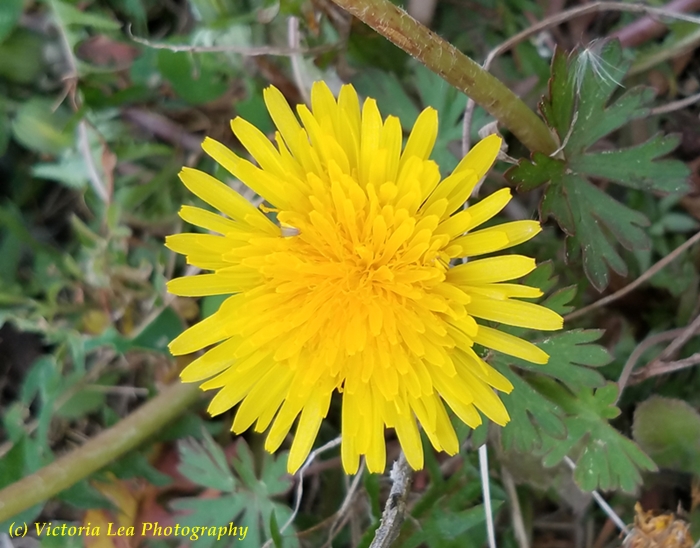
FFTD: A Dandy Lion
They are all over my yard. They are so happy. This one is from last year. ~Vic
Flower for the Day
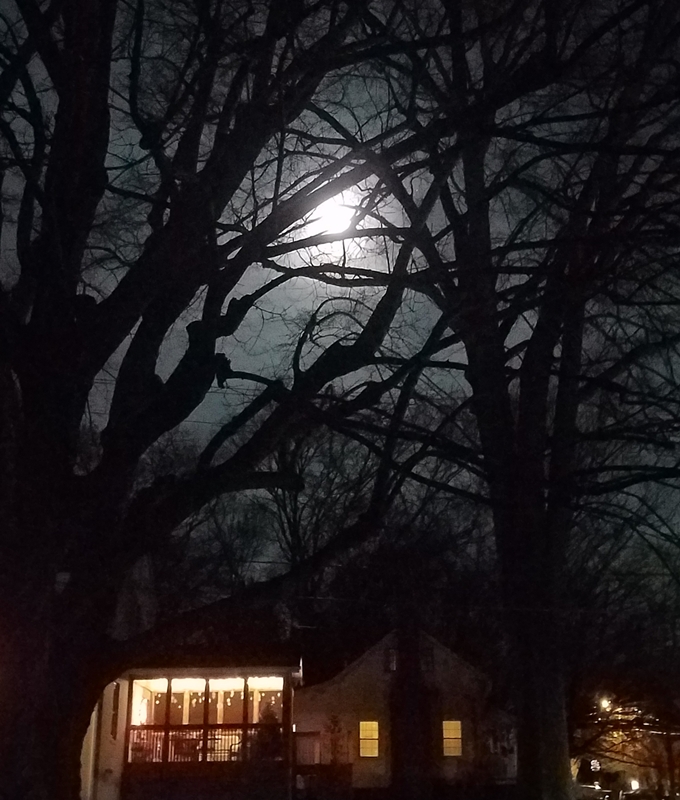
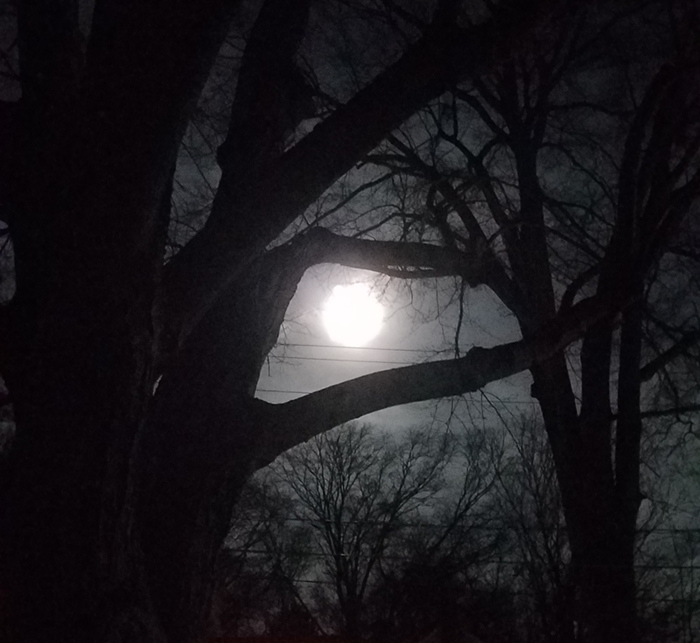
Worm Moon 2020

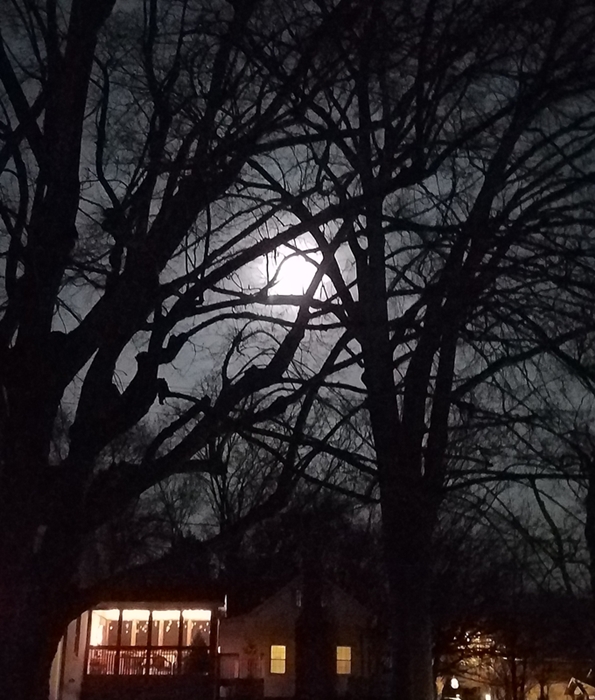
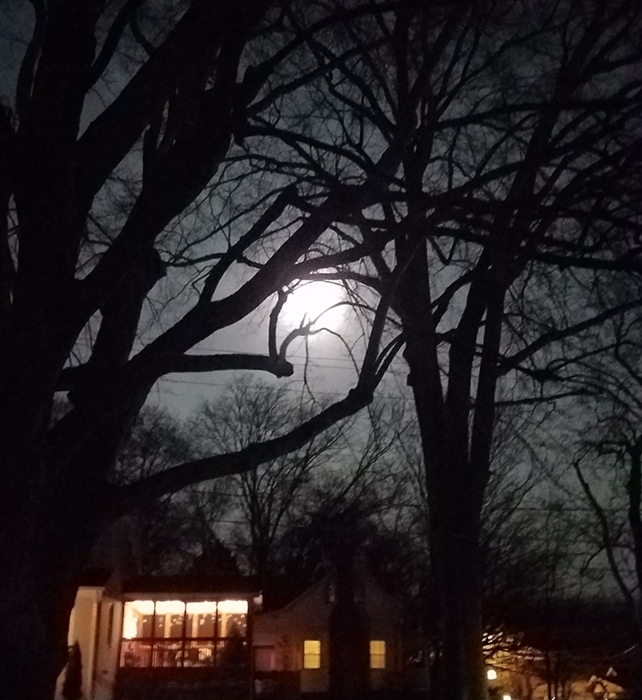
Last year, the Full Worm Moon coincided with the Vernal Equinox. This year, the Worm Moon will be at full illumination at 1:47pm, today. I got some shots of it, earlier (actually, wee hours of the morning).
I did a complete write-up on the Worm Moon on my 2019 post with all of the interesting and varied Native American names. This year, our Worm Moon is a Supermoon, though that isn’t really a true and official ‘astronomical’ term. It’s more of an astrological description and, apparently, was coined by astrologer Richard Nolle. The technical term is perigee syzygy, with perigee referring to the closeness of the Moon to the Earth and syzygy referring to a straight-line astronomical configuration of three celestial bodies. Depending upon that configuration, there might be a solar eclipse or a lunar eclipse. Supermoons also bring higher tides. This Moon is the last full moon of Winter. Howl for me! ~Vic
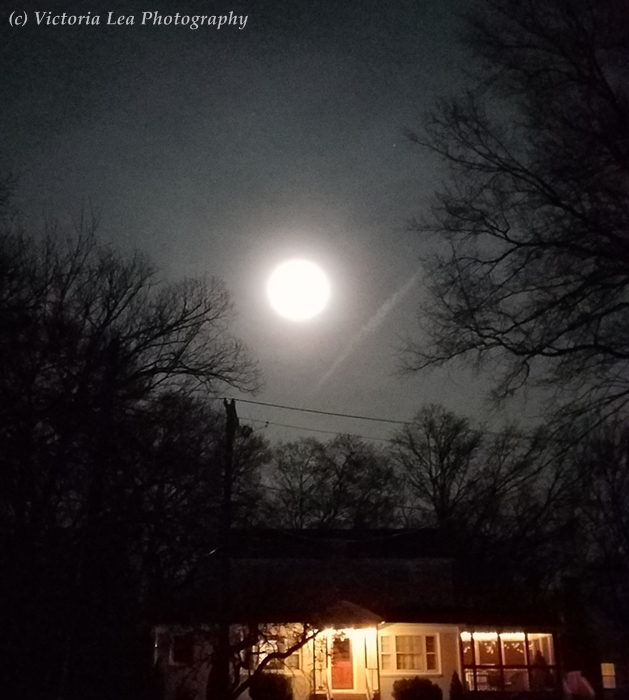
From my driveway.

Shutterbug Saturday: Rogue Artistes 5.0
It’s been nearly a year since I made my first post on our local artwork. Here are parts two, three and four. I’ve gathered up some more, below. All photos are my personal collection. © ~Vic
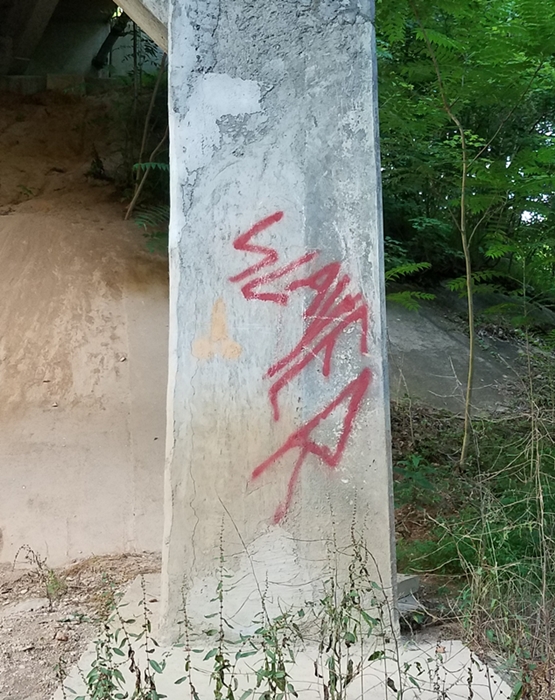
06-23-2019

What the critter is, I don’t know.
07-25-2019

Howie?
Wowie?
10-04-2019

10-10-2019

Captured well after Halloween.
It appears to be prints of a one-legged man?
There’s a foot print and a dot.
What do you think?
11-26-2019

With a “V”?
This one was hard to get.
02-22-2020
Flick Friday: The Death Train 1915

A Silent Film Rule:
Pies Go Splat But Damsels Never Do
Oh, it has been work looking for a film for today’s date. IMDB had plenty to choose from but, I couldn’t seem to get any further information from the others…Wikipedia, American Film Institute, Turner Classic Movies… Even the Silent Era site and Silent Hollywood were slim pickings and, Silentology had nothing.
Anyway, one hundred, five years ago, today, Episode #17 of The Hazards of Helen, The Death Train, was released. Similar to The Perils of Pauline, The Hazards of Helen was a film serial or series that ran from November 7, 1914 to February 24, 1917.
There were 119 episodes that were 12 minutes long, most of which have been lost. Based upon a novel written by John Russell Corvell and a play written by Denman Thompson, W. Scott Darling adapted the material for the silent screen and Edward T. Matlack wrote The Death Train, specifically. Directors were J. P. McGowan (1-48) and J. Gunnis Davis for the rest. The original actress was Helen Holmes (1-48), followed by Helen Gibson for the remainder of the series, with Anna Nilsson filling in for Holmes for Episode #18.
This episode also starred Rex Downs, M. J. Murchison, Edmund ‘Hoot’ Gibson, Leo D. Maloney and George A. Williams. Helen Holmes did most of her own stunts.
The discovery that detectives are on their trail causes Doyle, Broden and Etzer, counterfeiters, to pack their paraphernalia into a trunk and express it to Lone Point. Upon its arrival at that station, a corner of the trunk is smashed. Helen thus learns of its contents. The telegrapher immediately wires to Savage, a railroad detective. The latter, accompanied by Duncan, a Secret Service detective, hastens to the scene. At their suggestion, Helen arranges a trap for the counterfeiters. When the latter appear, they are set upon by the officers. Etzer is captured but, his pals get away. Doyle eludes pursuit but, Broden later falls into Savage’s hands. Helen, watching the pursuit, ventures on the high trestle which crosses the dry bed of the Loro River. Doyle, who is hiding, sees Helen. Overpowered by a desire for revenge, the man attacks the telegrapher and makes her a prisoner. A rope lies nearby. Binding Helen, Doyle suspends his victim from the trestle and fastens the end of the line around the rails. Duncan sees this from afar. Although he rushes forward, he knows that the Keene local, due any moment, will cut the rope as it crosses the trestle. Meanwhile, Helen, after a tremendous effort, frees her hands. There is one chance for life. The girl commences swinging her body. Each time, she [manages] a wider arc. The train is crossing the trestle when Helen swings toward a beam. The engine wheels sever the rope. Helen flies through the air and reaches the beam. Doyle is captured. Savage and Duncan raise Helen to the tracks and find her uninjured.
Moving Picture World
This is one of the lost pieces so, there isn’t a YouTube clip and I could only find one picture. ~Vic
Additional Reading
Lost Films (European Union/German site)
Silent Era
Silent Hollywood (More on Helen Holmes)
POTD: Old Hydrant
This comes under the heading of “things you don’t see everyday.” I was out on a walk around our old cotton mill complex and stumbled across it. I have no idea how old this thing is but, it appears to have been manufactured in Tennessee. ~Vic

POTD: First Snow 2020
As I was posting last weekend of no snow this year, I spoke too soon. We got about three inches, yesterday. It started rolling in around 4:30 or 5:00pm. There is a little bit left but, the higher accumulations were east of here. ~Vic

02-20-2020
Shutterbug Saturday: Snow Pix
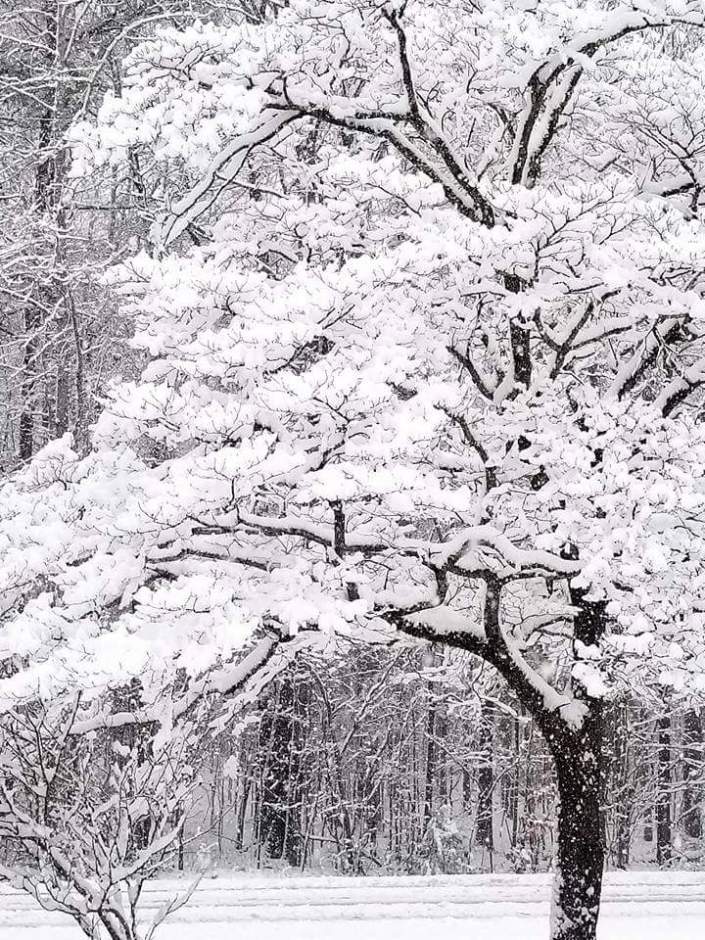
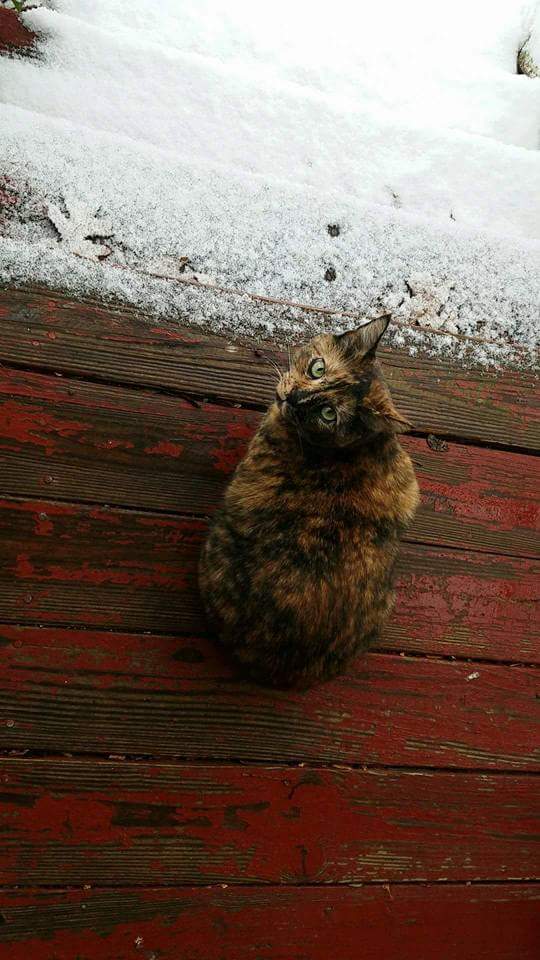
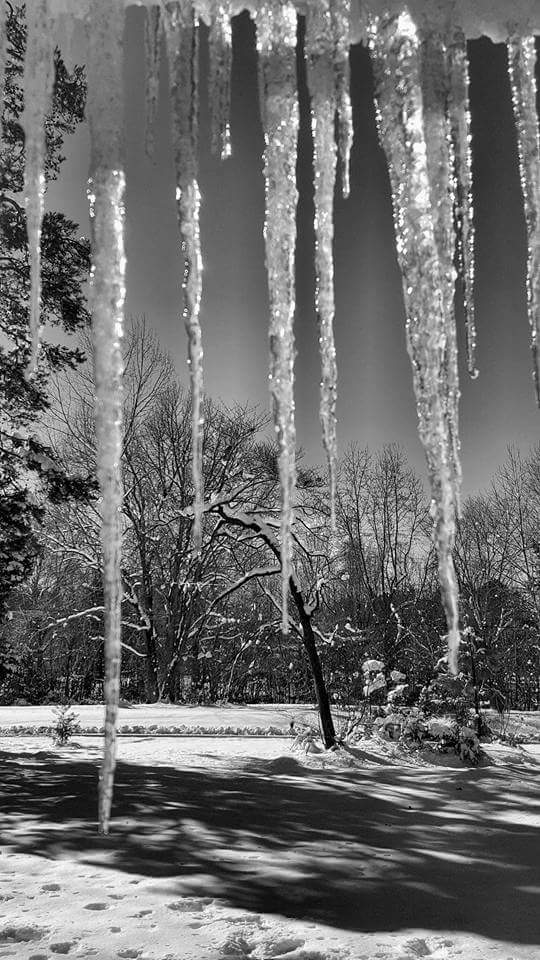
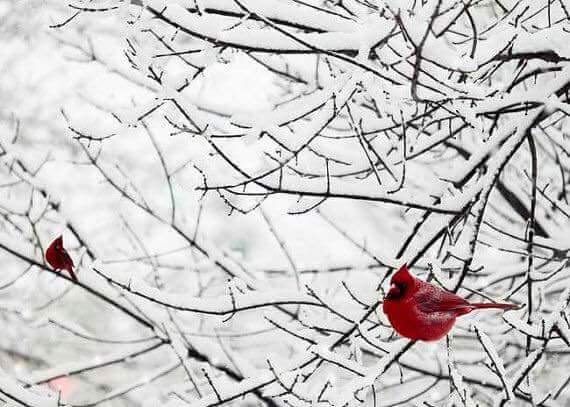
We’ve had cold temps here and plenty of rain but, the two haven’t combined to give us any frozen precipitation. Don’t me wrong. I’m not complaining. I like a good snow storm, here and there but, I don’t like the mess. That being said, since we haven’t had any of the white stuff, I submit…for your approval…some pix I harvested from a FakeBook group back in 2018, when we had two snow bombs. I posted my own photos on December 9, 2018 and added some of my stuff to the same group. These are really good and photographer credit is listed. I will post the rest, tomorrow. ~Vic

Snow Moon 2020
I did a Snow Moon post last year on February 18. I covered all the unique names and the history. I won’t repeat the information here.
100% illumination occurred at 02:33am EST. Howl for me!
All photos are my personal collection. © ~Vic


Snapshots Sunday: Alamance Battleground 2.0
Two months ago, on December 7, 2019, I visited Alamance Battleground with my buddy Ray. I posted the first batch of pictures on December 8, intending to post the rest on December 14. For obvious reasons, that didn’t happen so, here are the rest.
All photos are my personal collection. © ~Vic

Originally located at Guilford Courthouse Military Park
Moved in 1962, “on indefinite loan.”


It is claimed that the battle was the first of the Revolutionary War.
It was actually the last battle of the War of Regulation,
which lead to the Revolutionary War.

James Hunter
General of the Regulators

North Carolina Timeline
1774 North Carolina Provincial Congress
The Mecklenburg Declaration 1775
Battle of Moore’s Creek Bridge 1776
North Carolina is the first to call for independence
with the Halifax Resolves 1776

Six were executed.
“Our blood will be as good seed in good ground,
that will soon produce one hundred fold.”
James Pugh June 19, 1771



Dates reflect the Mecklenburg Declaration of Independence (disputed but,
possibly Mecklenburg Resolves) and
the Halifax Resolves.
FFTD: Narcissus
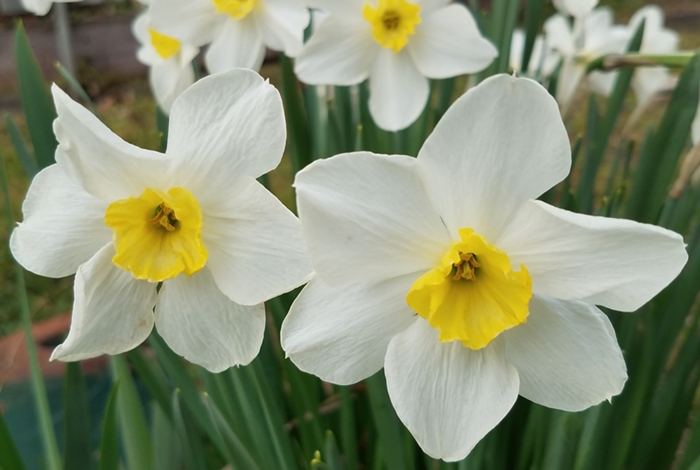
I haven’t gotten a shot of our now-blooming Narcissus. They started coming up last month. They seem to enjoy the cold weather. I’ve seen them bloom with ice on the ground. ~Vic

Flower for the Day
 Cosmic-Observation