You’ve probably heard of ChatGPT, a computer program that is trained to follow your instruction and provide a variety of wide ranging responses. As someone that has spent some time actually using the AI, I have to say, the results it produces can be eerily human but, did you know that computer scientists have been working alongside chatbots as early as the 1960s?
It was the late 1960’s and Joseph Weizenbaum, an MIT computer scientist, had just completed work on his revolutionary chatbot ELIZA. Weizenbaum was born in Berlin, Germany, in 1923 and fled the country with his family in 1935 to escape the political turmoil. Weizenbaum came to the United States where his road to computer science would ultimately begin. After time spent in the Air Force, Weizenbaum would go on to study as a computer scientist and eventually work in the industry. You have to remember, computers at that time were not portable devices that could fit in our pockets. In fact, they often barely fit into a room! As an associate Professor at MIT, Weizenbaum became obsessed with the way computers could directly interact with humans through language. It was this early through line between computers and human language that would work to lay the foundation for his own chatbot and eventually lay the groundwork for the AI development of programs such as ChatGPT, Siri and Alexa.
Eliza was completed in 1966 and Weizenbaum offered MIT students the opportunity to interact with the chatbot. This process consisted of messages typed into the computer by students and, responses would then be provided by ELIZA, […] routed to an electronic typewriter and printer. Weizenbaum was initially happy with the response that was garnered from users’ experience with ELIZA but, there was one thing he did begin to notice that he viewed as considerably concerning. Overtime, Weizenbaum made note of users starting to divulge deep personal information, looking for help similar to that of a therapy session. This observation ended up pushing Weizenbaum to advocate for caution when relying too heavily on computers for human thought…
“There are aspects to human life that a computer cannot understand—cannot. It’s necessary to be a human being. Love and loneliness have to do with the deepest consequences of our biological constitution. That kind of understanding is in principle impossible for the computer.”
Jeannette Rankin was an American politician and women’s rights advocate and, the first woman to hold federal office in the United States. She was elected to the U.S. House of Representatives as a Republican from Montana in 1916 and, again, in 1940. As of 2022, Rankin is still the only woman ever elected to Congress from Montana.
A suffragist during the Progressive Era, Rankin organized and lobbied for legislation enfranchising women in several states including Montana, New York and North Dakota. While in Congress, she introduced legislation that eventually became the 19th Constitutional Amendment, granting unrestricted voting rights to women nationwide. She championed a multitude of diverse women’s rights and civil rights causes throughout a career that spanned more than six decades.
Rankin was born on June 11, 1880, to John and Olive Rankin at Grant Creek Ranch near Missoula, in what was then the Montana Territory. She was the first of seven children […] in a prosperous family. Her father […] was a rancher and builder who had come to Montana from Canada. Her mother […] had moved from New Hampshire to teach before marrying John Rankin and becoming a housewife. Jeannette attended Montana State University in Missoula (now the University of Montana) and graduated in 1902 with a degree in biology. [Her] career in politics began as a student volunteer with a local women’s suffrage campaign in Washington State, preparing for a referendum on voting rights. [In] February 1911, she became the first woman to address the Montana legislature when she testified in support of women’s suffrage.
Jeannette Rankin
History, Art & Archives
United States House of Representatives
Rankin held office in her first term from March 4, 1917, one-hundred and five years, ago, today, to March 3, 1919. Her second term was from January 3, 1941 to January 3, 1943. Powerful enemies made sure she could not get re-elected. Twenty-four years later, she reclaimed her seat. She never married and passed away May 18, 1973 at the age of 92. ~Vic
Membra Jesu Nostri [or The limbs of our Jesus], BuxWV 75, is a cycle of seven cantatas composed by Dieterich Buxtehude in 1680 and dedicated to Gustaf Düben. The full Latin title Membra Jesu Nostri Patientis Sanctissima translates to “The most holy limbs of our suffering Jesus”. This work is known as the first Lutheran oratorio. The main text are stanzas from the Medieval hymn Salve Mundi Salutare, also known as the Rhythmica Oratio, a poem formerly ascribed to Bernard of Clairvaux but, now thought more likely to have been written by Medieval poet Arnulf of Leuven […]. It is divided into seven parts, each addressed to a different part of Christ’s crucified body: feet, knees, hands, sides, breast, heart and face. In each part, biblical words referring to the limbs frame verses of the poem.
Biopic of the wartime exploits of Audie Murphy (played by himself), the most decorated US soldier in World War II. Starting with his boyhood in Texas, where he became the head of his family at a young age, the story follows his enrollment in [the] Army where he was assigned to the 3rd Division. He fought in North Africa, Sicily and Italy, before landing in southern France and, eventually, fighting in Germany. A Medal of Honor recipient, he also received battle honors from the French and Belgian government.
The highly variable Audie Murphy delivers his best screen performance as “himself” in Universal‘s To Hell and Back. Based on the star’s autobiography, this is the story of how Murphy became America’s most-decorated soldier during WW II. After dwelling a bit on Murphy’s hard-scrabble Texas upbringing, the story moves ahead to 1942, when, as a teenager, Audie joined the army. Within a year, he was a member of the 7th Army, serving in North Africa, Italy, France and, ultimately, Germany and Austria. One by one, the members of Murphy’s Company B are killed in the war, until only three men from the original company are left. [The] others appear at the finale as ghostly images […]. The bulk of the film is given over to Murphy’s conspicuous acts of combat bravery and his killing of 240 enemy soldiers. Highlighted by excellent battle sequences, To Hell and Back is a serviceable tribute to a most complex individual.
Date: 1948
Photo Author: Fort Detrick
Wikipedia & Wikimedia
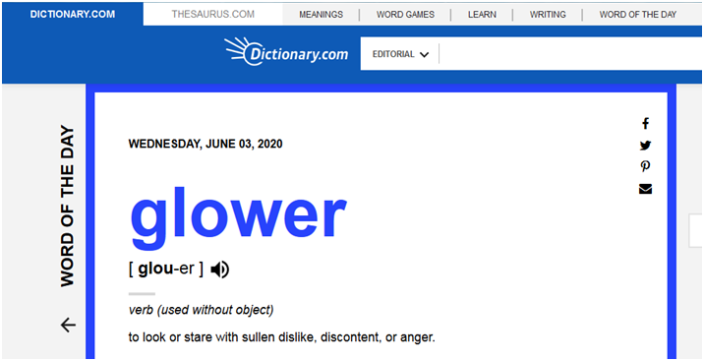
The verb glower, “to look or stare with sullen dislike” comes from Middle English gloren [or] glouren “to shine, gleam, glow, stare, stare at fixedly.” The Middle English forms are mostly from the north (Yorkshire) and Scotland. [T]he sense “to stare at fixedly” is Scottish. The source of gloren and glouren is obscure but, possibly, Scandinavian, e.g., Icelandic [as] glóra “to glow (like a cat’s eyes)” [or] Swedish and Norwegian dialect glora “to glow, stare.” The source of gloren [and] glouren may also be from Middle Low Germanglūren “to be overcast” or Dutchglueren “to leer, peep.” Glower entered English in the 15th century.
This is very similar to our “glaring at someone” which has its roots in Middle English, Middle Dutch and Middle Low German.
I’ve been doing a lot of glowering and glaring, lately. The whole world has gone insane-stupid. ~Vic
[T]he largest dirigible ever built, [it burst] into flames upon touching its mooring mast […]. There were 35 fatalities (13 passengers and 22 crewmen) from the 97 people on board (36 passengers and 61 crewmen) and an additional fatality on the ground.
The rigid airship, often known as the Zeppelin after the last name of its innovator, Count Ferdinand von Zeppelin, was developed by the Germans in the late 19th century. [It] had a light framework of metal girders that protected a gas-filled interior [of] highly flammable hydrogen gas, vulnerable to explosion.
On May 3, the Hindenburg left Frankfurt, Germany, for a journey across the Atlantic to Lakehurst’s Navy Air Base. While attempting to moor, […] the airship suddenly burst into flames, probably after a spark ignited its hydrogen core. Rapidly falling 200 feet to the ground, the hull of the airship incinerated within seconds. [M]ost of the survivors suffered substantial injuries.
The disaster was the subject of newsreel coverage, photographs and [radio announcer] Herbert Morrison‘s recorded […] eyewitness reports from the landing field, which were broadcast the next day. He is known for his famous emotional declaration “Oh, the humanity!”
A variety of hypotheses have been put forward for both the cause of ignition and the initial fuel for the ensuing fire. The event shattered public confidence in the giant, passenger-carrying rigid airship and marked the abrupt end of [that] era.







 Cosmic-Observation