In a New York hotel, the body of Steven Humbolt is discovered and Chief Inspector Decker Dawes is called to investigate. After a brief inspection of Humbolt’s belongings, Dawes and Sergeant Meed determine that Humbolt had fifteen wives, three of whom…Sybilla Crum, a well-known reformer, wealthy Carol Arnold, and Ruby Cotton…live in New York. Dawes first questions the still devoted Sybilla, then quizzes Jason Getty, a florist who had sent Humbolt a funeral wreath hours before his death was discovered. While Meed checks out Getty’s lead that the wreath was ordered in Philadelphia, Dawes interrogates Carol Arnold. Carol tells Dawes that Humbolt had robbed, and deserted her, after three weeks of marriage and, that, a year later, she had received a letter from South America informing her of his demise. Just after Carol had married wealthy Gregory Arnold, Humbolt contacted her with blackmail demands but, according to Carol, she never saw him before his murder. Although Dawes doubts Carol’s story, he leaves her to talk to a chemist about a broken glass globe that was found near Humbolt’s body.
Image Credit: imdb.com
The chemist reveals that the globe, a Helmholtz Resonator, contained a lethal dose of hydrocynanic acid gas that was released when the glass was broken. Once Dawes determines that the globe came from Philadelphia, he demonstrates how a radio performer known as The Electric Voice, whose fiancée is Ruby Cotton, could have broken the globe during a broadcast. Dawes arrests The Voice and Ruby but, returns to question Carol, who he discovers is hiding a child she had by Humbolt. Then, Dawes receives a message from Sybilla about a clue she unearthed at Humbolt’s funeral. While at Sybilla’s home, Dawes discovers that florist Getty is impersonating the reformer and that he is wearing a pair of gloves similar to a pair Humbolt was wearing in his coffin. Suspicious, Dawes orders Humbolt’s coffin exhumed, which causes Getty, who needed the gloves to hide his amputated fingers, to panic. [He] confesses that he killed Sybilla and had used The Electric Voice’s broadcast to kill Humbolt out of revenge for stealing his wife in Australia. After thwarting Getty’s escape attempt, Dawes telephones Carol, who is divorcing [Gregory] Arnold and proposes that they leave for Europe together.
Disclamer:
The Internet Movie Database (IMDB) and Wikipedia state that this film was released July 15, 1934. The American Film Institute (AFI) and Turner Classic Movies (TCM) state that it was released June 1, 1934. I have no way of verifying either. I also can’t find any video clips. ~Vic
This is the second half of a two-part interview with Psychic Healer & Akashic Reader Chris Thomas. This was posted to Miles’ channel on August 28, 2010.
Big grasshopper.
Taken with my old Samsung Alias II.
Nature Preserve
Round Rock, TX
10-25-2008Another shot of the blue tail.
05-06-2019Tiny bee in my side yard.
05-13-2019On the Riverwalk, headed to Gold Park.
Love the Ladybugs.
05-13-2019Dragonfly in the Butterfly Garden.
He looks like a Skivvy Waver.
05-17-2019Wolf spider running on the Riverwalk.
05-19-2019Hungry Bumbles
05-31-2019Young Preying Mantis on a Black-Eyed Susan.
Riverwalk
05-31-2019
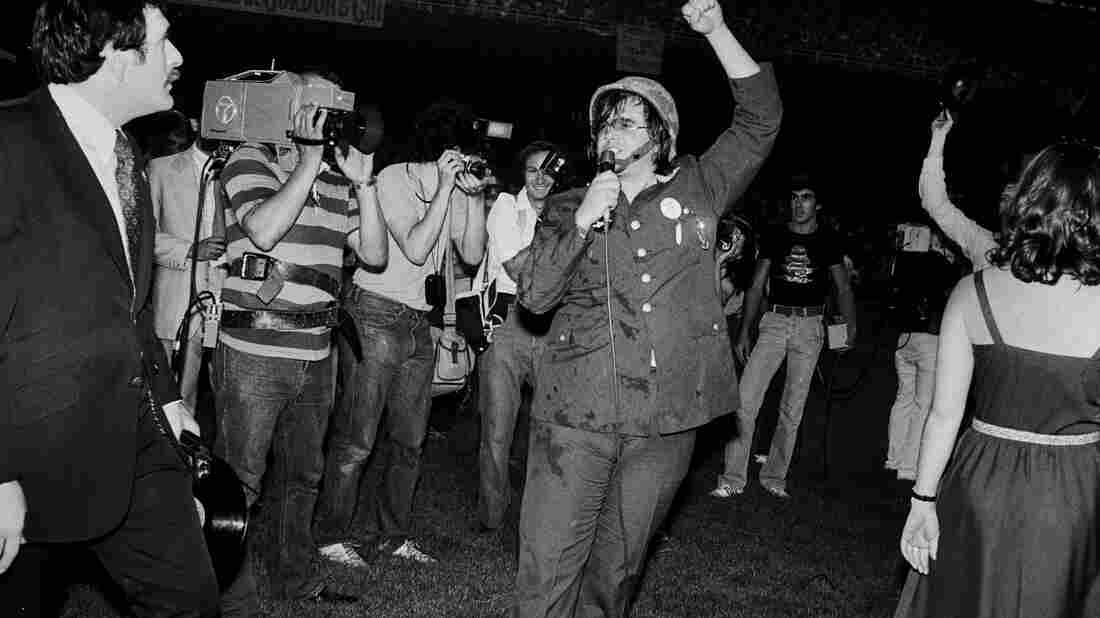
Forty years ago, today, the Disco Demolition took place at Chicago’s Comiskey Park. What started out as a baseball promotion turned into a mêlée that damaged the field.
[..] disco didn’t quite die a natural death by collapsing under its own weight. Instead, it was killed by a public backlash that reached its peak on this day in 1979 […]. That incident, which led to at least nine injuries, 39 arrests and, the cancellation and forfeit of a Major League Baseball game, is widely credited […] or, blamed for […] dealing disco its death blow.
The event was the brainchild of Steve Dahl and Garry Meier, popular disk jockeys on Chicago’s WLUP “The Loop” FM. […] many […] rock DJs were displaced by disco [but], only Dahl was inspired to launch a semi-comic vendetta aimed at “the eradication and elimination of the dreaded musical disease.”
On May 2, the rainout of a game between the Chicago White Sox and the Detroit Tigers led to the scheduling of a doubleheader on July 12. Dahl and Meier approached the White Sox with a rather unorthodox idea for an attendance-boosting promotion […]. […] allow Dahl to blow up a dumpster full of disco records between games of the doubleheader. White Sox executive Mike Veeck embraced the idea […].
[…] organizers […] grossly [underestimated] the appeal of the 98-cent discount tickets offered to anyone who brought a disco record to the park to add to the explosive-rigged dumpster. WLUP and the White Sox expected perhaps 5,000 more fans than the average draw of 15,000 or so […]. What they got, instead, was a raucous sellout crowd of 40,000+ and an even more raucous overflow crowd of as many as 40,000 more outside on Shields Avenue.
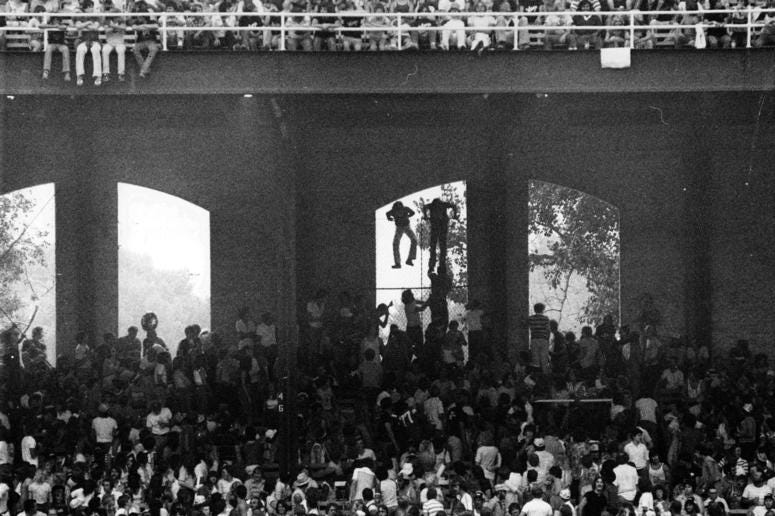
What followed was utter chaos, as fans by the thousands stormed the field, […] began to wreak havoc, shimmying up the foul poles, tearing up the grass and lighting vinyl bonfires on the diamond while the stadium scoreboard implored them to return to their seats. Conditions were judged too dangerous for the scheduled game to begin and the Detroit Tigers were awarded a win by forfeit.
In the weeks before the event, Dahl invited his listeners to bring records they wanted to see destroyed to Comiskey Park. Owner Bill Veeck was concerned the promotion might become a disaster […]. His fears were substantiated when he saw the people walking towards the ballpark that afternoon. […] many carried signs that described disco in profane terms.
Some leapt turnstiles, climbed fences and entered through open windows. Attendees were supposed to deposit their records into a large box [but], once the box was overflowing, many people brought their discs to their seats. Many of the records were not collected by staff and were thrown like flying discs from the stands. Tigers designated hitter Rusty Staub remembered that the records would slice through the air and land sticking out of the ground. He urged teammates to wear batting helmets when playing their positions. “It wasn’t just one, it was many. Oh, God almighty, I’ve never seen anything so dangerous in my life.” Attendees also threw firecrackers, empty liquor bottles and lighters onto the field. The game was stopped several times because of the rain of foreign objects.
Dozens of hand-painted banners with such slogans as “Disco Sucks” were hung from the ballpark’s seating decks. Dahl set off the explosives, destroying the records and tearing a large hole in the outfield grass. […] the first of 5,000 to 7,000 attendees rushed onto the field […]. The batting cage was destroyed and, the bases were pulled up and stolen. Among those taking to the field was 21-year-old aspiring actor Michael Clarke Duncan […]. Duncan slid into third base, had a silver belt buckle stolen and went home with a bat from the dugout. Some attendees danced in circles around the burning vinyl shards.
Chicago police in full riot gear arrived (9:08pm) to the applause of the baseball fans remaining in the stands. Those on the field hastily dispersed upon seeing the police. Tigers manager Sparky Anderson refused to allow his players to take the field […] due to safety concerns. Anderson […] demanded that the game be forfeited to the Tigers. He argued that, under baseball’s rules, a game can only be postponed due to an Act of God, and that, as the home team, the White Sox were responsible for field conditions.
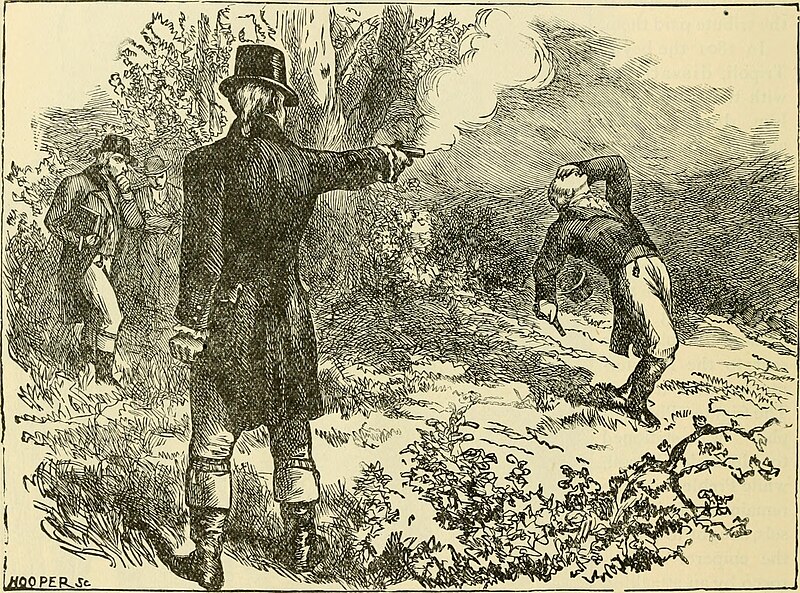
Two-hundred, fifteen years ago, today, Vice President Aaron Burr shot former Secretary of the Treasury Alexander Hamilton in a duel in Weehawken, New Jersey.
At dawn on the morning of July 11, […] political antagonists, and personal enemies, Alexander Hamilton and Aaron Burr met on the heights of Weehawken […], to settle their longstanding differences with a duel. The participants fired their pistols in close succession. Burr’s shot met its target immediately, fatally wounding Hamilton and leading to his death the following day. Burr escaped unharmed. This tragically extreme incident reflected the depth of animosity aroused by the first emergence of the nation’s political party system. Both men were political leaders in New York: Burr, a prominent Republican, and Hamilton, leader of the opposing Federalist Party. Burr had found himself the brunt of Hamilton’s political maneuvering on several occasions, including the unusual presidential election of 1800, in which vice-presidential candidate Burr almost defeated his running mate, presidential candidate Thomas Jefferson. In 1804, Hamilton opposed Burr’s closely fought bid for governor of New York. On the heels of this narrow defeat, Burr challenged Hamilton to a duel on the grounds that Hamilton had publicly maligned his character.
Alexander Hamilton, the chief architect of America’s political economy, was born on the Caribbean island of Nevis [and] came to the American colonies in 1773 as a poor immigrant. (There is some controversy as to the year of his birth, but it was either 1755 or 1757.) In 1776, he joined the Continental Army in the American Revolution and his […] remarkable intelligence brought him to the attention of General George Washington. Aaron Burr, born into a prestigious New Jersey family in 1756, was also intellectually gifted and [..] graduated from the College of New Jersey (later Princeton) at the age of 17. He joined the Continental Army in 1775 […]. In 1790, he defeated Alexander Hamilton’s father-in-law in a race for the U.S. Senate. Hamilton came to detest Burr, whom he regarded as a dangerous opportunist, and […] often spoke ill of him.
In the 1800 election, Jefferson and Burr became running mates […]. Under the electoral procedure then prevailing, president and vice president were voted for, separately. […] the candidate who received the most votes was elected president, and the second in line, vice president. What at first seemed but an electoral technicality […] developed into a major constitutional crisis when Federalists in the lame-duck Congress threw their support behind Burr. After a remarkable 35 tie votes, a small group of Federalists changed sides and voted in Jefferson’s favor. Alexander Hamilton, who had supported Jefferson as the lesser of two evils, was instrumental in breaking the deadlock.
The duel was fought at a time when the practice was being outlawed in the northern United States and it had immense political ramifications. Burr survived the duel and was indicted for murder in both New York and New Jersey, though these charges were later either dismissed or resulted in acquittal. The harsh criticism and animosity directed toward him following the duel brought an end to his political career. The Federalist Party was already weakened by the defeat of John Adams in the presidential election of 1800 and was further weakened by Hamilton’s death.
[Burr] spent [many] years in Europe. He finally returned to New York City in 1812, where he resumed his law practice and spent the remainder of his life in relative obscurity.
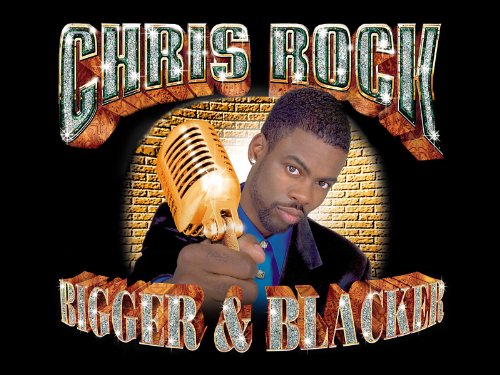
In his third HBO stand-up special, Chris Rock brings his critically acclaimed brand of social commentary-themed humor to this 1999 stand-up comedy presentation. Also released as an album, Chris Rock: Bigger and Blacker features Rock on-stage extolling his razor-sharp wit and wisdom on such topics as gun control, President Clinton, homophobia, racism, black leaders and relationships.
Lon Chaney plays Grumpy Anderson, a railroad engineer with an obsession for running his train on time. His slavishness to promptness causes several tragedies which alienate him from his family. By the story’s end, the engineer restores their faith in him and validates his obsession by forcing his train through a flood to bring badly needed Red Cross supplies to the victims.
“Grumpy” Anderson is an old railroad engineer that is obsessed with keeping his train on schedule, no matter the cost. His two sons are also railmen but, don’t share his single mindedness, which leads to one son’s death and a fight with the other on the first son’s funeral car. [This] leads to a crash and demotion of Grumpy to mechanic in the yards. His redemption comes during the Mississippi flood when he is, again, pressed into service to pilot a relief train along with his surviving son.
On the way to the restaurant I mentioned in my post, yesterday, there was a pit stop for gas. Not only was this a cool looking older truck, the adorable pooch waiting patiently for his owner was so sweet.
This is the first half of a two-part interview with Psychic Healer & Akashic Reader Chris Thomas. Miles Johnston’s YouTube channel has had 14+ million views. The Bases Project is his website. Miles posted this to his channel on August 27, 2010.
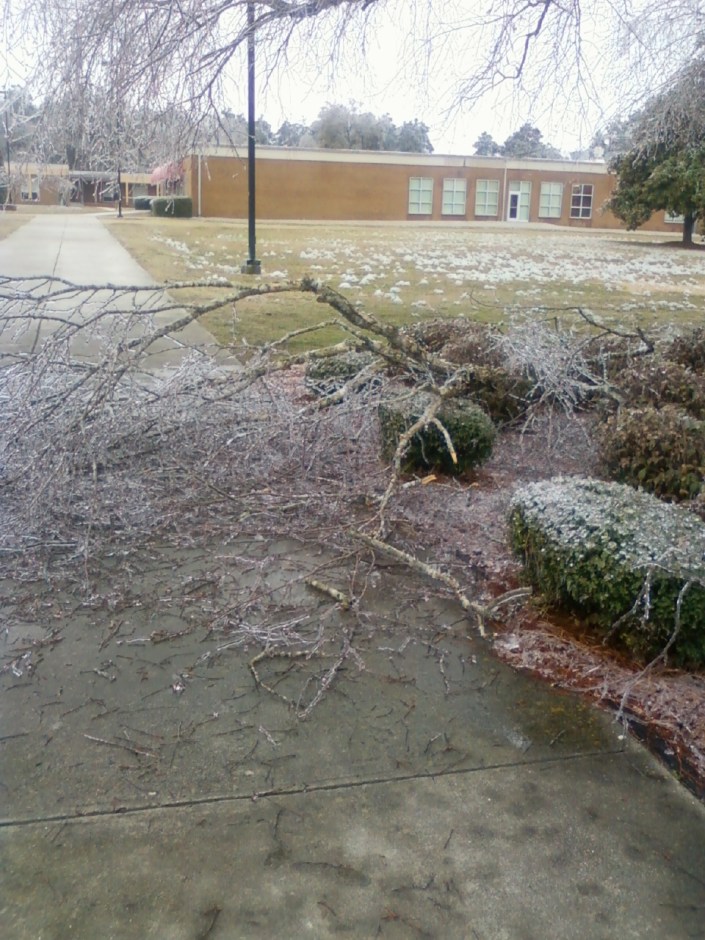
Continuing from yesterday’s post, this was an ice storm that occurred when I was in Examiner School. This area is in the Eastern part of the state, a half an hour due East of Fayettenam (Fayetteville/Fort Bragg) and 75 miles NNW of Wilmington. Basically, it’s in the middle of nowhere. It was all I could do to not bust my ass walking to class.
These and yesterday’s pix were taken with my old Samsung Alias II. ~Vic
Ice Branches
02-17-2015Lost a limb.Frozen grass clumps.Ice tree in front of the library.
02-18-2015Looks like glass.Sun DevilGlass DaggersFrozen fountain outside of a steakhouse in Roseborough. Railroad Street Steakhouse
02-19-2015
Since we are in the 90s+, here are some pix of cooler weather. We got a lot of these things back in the 70s when I was a kid. They are a little more rare, now. ~Vic
Ice all bunched up on the back of my, then, 2010 Chevy Cobalt.
03-07-2014Sugar Maple encased in ice.Ice branches.
Narcissus in the process of blooming. They don’t care.Icy bushes.



















 Cosmic-Observation