Memorial Day, as celebrated, has come and gone. The weekend BBQs and party gatherings are over. Some folks have returned to work after their Monday off while others took the entire week off and, possibly, headed to the beach to herald the “summer season”. I am posting, today, because from 1868 to 1970, Memorial Day was observed on May 30.
So, what IS the origin of our Memorial Day? That’s a good question and the following took two days to research.
May we remember them, ALL. ~Vic
Warrenton, Virginia 1861
A newspaper article from the Richmond Times-Dispatch in 1906 reflects Warrenton‘s claims that the first Confederate Memorial Day was June 3, 1861…the location of the first Civil War soldier’s grave ever to be decorated.
Arlington Heights, Virginia 1862
On April 16, 1862, some ladies and a chaplain from Michigan […] proposed gathering some flowers and laying them on the graves of the Michigan soldiers that day. They did so and the next year, they decorated the same graves.
Savannah, Georgia 1862
Women in Savannah decorated soldiers’ graves on July 21, 1862 according the the Savannah Republican.
Gettysburg, Pennsylvania 1863
The November 19, 1863, cemetery dedication at Gettysburg was a ceremony of commemoration at the graves of dead soldiers. Some have, therefore, claimed that President Abraham Lincoln was the founder of Memorial Day.
Jackson, Mississippi 1865
The incident in Mrs. [Sue Landon Adams] Vaughan’s life, which assured her name a permanent place in history, occurred at Jackson […] when she founded Decoration Day by first decorating the graves of Confederate and Federal soldiers alike, in a Jackson cemetery on April 26, 1865.
Kingston, Georgia 1865
An historic road-side marker indicates Kingston as the location of the “First Decoration, or Memorial Day” (Late April 1865).
Columbus, Georgia 1866
To the State of Georgia belongs the credit of having inaugurated what has since become the universal custom of decorating annually the graves of the heroic dead. The initial ceremonies which ushered Memorial Day into life were held in Linnwood Cemetery, at Columbus, on April 26, 1866.
Memphis, Tennessee 1866
Yesterday was the day appointed throughout the South as a day of sweet remembrance for our brothers who now sleep their last long sleep, the sleep of death. That day (the 26th day of April) has, and will be, set apart, annually, as a day to be commemorated by all the purely Southern people in the country, as that upon which we are to lay aside our usual vocations of life and, devote to the memory of our friends, brothers, husbands and sons, who have fallen in our late struggle for Southern independence.
Carbondale, Illinois 1866
A stone marker in Carbondale claims that place as the location of the first Decoration Day, honoring the Union soldiers buried there. General John A. Logan, who would later become commander-in-chief of the Grand Army of the Republic, the largest of the Union veterans’ organizations, officiated at the ceremony (April 29, 1866).
Richmond, Virginia 1866
The anniversary of the death of Stonewall Jackson was observed to-day by floral decorations of the graves of Confederate soldiers at Hollywood and Oakwood (May 10, 1866).
May 3, 1866 [they] formed the Ladies’ Hollywood Memorial Association, with the immediate aim of caring for and commemorating the graves of Confederate soldiers. All disposed to co-operate with us will repair, in such groups and at such hours as may be convenient, on Thursday, May 31st, 1866, to Hollywood Cemetery, to mark, by every appropriate means in our power, our sense of the heroic services and sacrifices of those who were dear to us in life and we honored in death.
Petersburg, Virginia 1866
It was in May of this year, 1866, that we inaugurated, in Petersburg, the custom, now universal, of decorating the graves of those who fell in the Civil War. Our intention was simply to lay a token of our gratitude and affection upon the graves of the brave citizens who fell June 9, 1864, in defence of Petersburg…
Dinner on the grounds is not a phrase I hear these days. Just reading the phrase takes me back to those times with my grandmother at her church on […] Decoration Day Sunday. I grew up in north Alabama in the 1960s. Dinner on the grounds was a special occasion that followed the work of cleaning up the graveyard and placing fresh flowers beside the headstones. It provided a time to remember and celebrate the lives of the dear departed. ~Betsy Sanders
Today, we are here to eat, remember and bask in the Southern fascination of death […]. It’s Decoration Day. The South claims death with as much loyalty as we claim our children. J.T. Lowery, a former pastor […] misses when Decoration Day meant keeping company with headstones during dinner on the ground. Opal Flannigan is depending on women […] to uphold a tradition so old it’s hard to say when it emerged. German and Scots-Irish immigrants who birthed much of the Southern Appalachia’s culture in Virginia, Tennessee and the Carolinas likely brought these traditions [with them]. ~Jennifer Crossley Howard
Many rural community cemeteries in western North Carolina hold “decorations.” A decoration is a religious service in the cemetery when people decorate graves to pay respect to the dead. The group assembles at outdoor tables, sometime in an outdoor pavilion, for the ritual “dinner on the ground.” There are variations of this pattern but, the overall pattern is fairly consistent.
By proclamation of General John A. Logan of the Grand Army of the Republic, the first major Memorial Day observance is held to honor those who died “in defense of their country during the late rebellion.” Known to some as “Decoration Day,” mourners honored the Civil War dead by decorating their graves with flowers. On the first Decoration Day, General James Garfield made a speech at Arlington National Cemetery, after which 5,000 participants helped to decorate the graves of the more than 20,000 Union and Confederate soldiers buried in the cemetery.
The 1868 celebration was inspired by local observances that had taken place in various locations in the three years since the end of the Civil War. In fact, several cities claim to be the birthplace of Memorial Day, including Columbus, Mississippi; Macon, Georgia; Richmond, Virginia; Boalsburg, Pennsylvania; and Carbondale, Illinois. In 1966, the federal government, under the direction of President Lyndon B. Johnson, declared Waterloo, New York, the official birthplace of Memorial Day. They chose Waterloo, which had first celebrated the day on May 5, 1866, because the town had made Memorial Day an annual, community-wide event, during which businesses closed and, residents decorated the graves of soldiers with flowers and flags.
One of four Admiral-class battlecruisers ordered in mid-1916, [she was] commissioned in 1920 [and] named after 18th-century Admiral Samuel Hood. Despite the appearance of new and, more modern ship designs over time, Hood remained the largest and most powerful warship in the world for 20 years after her commissioning. […] her prestige was reflected in her nickname, “The Mighty Hood”. She was scheduled to undergo a major rebuild in 1941 to correct [some] issues but, the outbreak of World War II in September 1939 forced the ship into service without the upgrades.
In May, [she and] the battleshipPrince of Wales were ordered to intercept the German battleship Bismarck and, the heavy cruiserPrinz Eugen, which were en route to the Atlantic where they were to attack convoys. When Bismarck sailed for the Atlantic […], Hood, together with […] Prince of Wales, was sent out in pursuit along with several other groups of British capital ships to intercept the German ships before they could break into the Atlantic […]. Hood was commanded by Captain Ralph Kerr and was flying the flag of Vice-Admiral Lancelot Holland. The German ships were spotted by two British heavy cruisers (Norfolk & Suffolk) on 23 May and Holland‘s ships intercepted Bismarck, and her consort, Prinz Eugen, in the Denmark Strait between Greenland and Iceland.
Bismarck
Image Credit: pinterest.com
On 24 May 1941, early in the Battle of the Denmark Strait, less than 10 minutes after the British opened fire, a shell from Bismarck struck Hood near her aft ammunition magazines. Soon afterwards, Hood exploded and sank within three minutes, with the loss of all but three of her crew. Prince of Wales continued to exchange fire with Bismarck but, suffered serious malfunctions in her main armament. The British battleship had only just been completed in late March 1941 and used new quadruple gun turrets that were unreliable. [She] soon broke off the engagement.
Due to [the] perceived invincibility of the Hood, the loss affected British morale.
On this day in 1941, Germany’s largest battleship, the Bismarck, sinks the pride of the British fleet, HMS Hood.
The Bismarck was the most modern of Germany’s battleships, a prize coveted by other nation’s navies, even while still in the blueprint stage (Hitler handed over a copy of its blueprints to Joseph Stalin as a concession during the days of the Hitler-Stalin Neutrality Pact). The HMS Hood, originally launched in 1918, was Britain’s largest battlecruiser (41,200 tons) but, also capable of achieving the relatively fast speed of 31 knots. The two met in the North Atlantic, northeast of Iceland, where two British cruisers had tracked down the Bismarck. Commanded by Admiral Gunther Lutjens, Commander-in-Chief of the German Fleet, the Bismarck sunk the Hood, resulting in the death of 1,500 of its crew. Only three Brits survived. Captain Kerr was one of the casualties.
During the engagement, the Bismarck‘s fuel tank was damaged. Lutjens tried to make for the French coast but, was sighted, again, only three days later. Torpedoed to the point of incapacity, the Bismarck was finally sunk by a ring of British war ships. Admiral Lutjens was one of the 2,300 German casualties.
Having grown up listening to Johnny Horton, one of my favorite songs of his is, of course, Sink the Bismarck, released in 1960 (a #1 single in Canada). ~Vic
Lyrics In May of 1941 the war had just begun
The Germans had the biggest ship that had the biggest guns
The Bismarck was the fastest ship that ever sailed the sea
On her decks were guns as big as steers and shells as big as trees
Out of the cold and foggy night came the British ship the Hood
And every British seaman he knew and understood
They had to sink the Bismarck the terror of the sea
Stop those guns as big as steers and those shells as big as trees
We’ll find the German battleship that’s makin’ such a fuss
We gotta sink the Bismarck ’cause the world depends on us
Yeah hit the decks a runnin’ boys and spin those guns around
When we find the Bismarck we gotta cut her down
The Hood found the Bismarck and on that fatal day
The Bismarck started firing fifteen miles away
We gotta sink the Bismarck was the battle sound
But when the smoke had cleared away the mighty Hood went down
For six long days and weary nights they tried to find her trail
Churchill told the people put every ship asail
Cause somewhere on that ocean I know she’s gotta be
We gotta sink the Bismarck to the bottom of the sea
We’ll find the German battleship that’s makin’ such a fuss
We gotta sink the Bismarck ’cause the world depends on us
Yeah hit the decks a runnin’ boys and spin those guns around
When we find the Bismarck we gotta cut her down
The fog was gone the seventh day and they saw the morning sun
Ten hours away from homeland the Bismarck made its run
The Admiral of the British fleet said turn those bows around
We found that German battleship and we’re gonna cut her down
The British guns were aimed and the shells were coming fast
The first shell hit the Bismarck they knew she couldn’t last
That mighty German battleship is just a memory
Sink the Bismarck was the battle cry that shook the seven seas
We found the German battleship ’twas makin’ such a fuss
We had to sink the Bismarck cause the world depends on us
We hit the deck a runnin’ and we and spun those guns around
Yeah we found the mighty Bismarck and then we cut her down
We found the German battleship ’twas makin’ such a fuss
We had to sink the Bismarck cause the world depends on us
We hit the deck a runnin’ and we and spun those guns around
We found the mighty Bismarck and then we cut her down
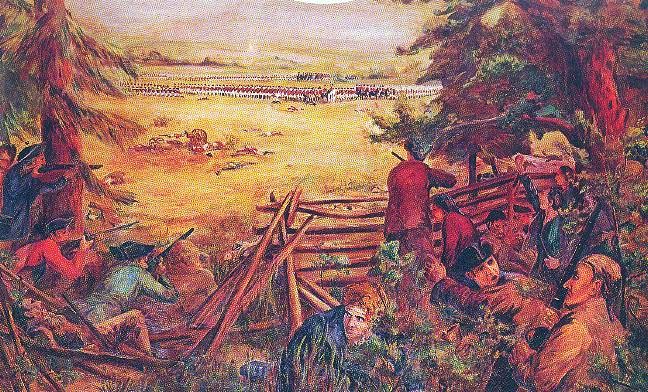
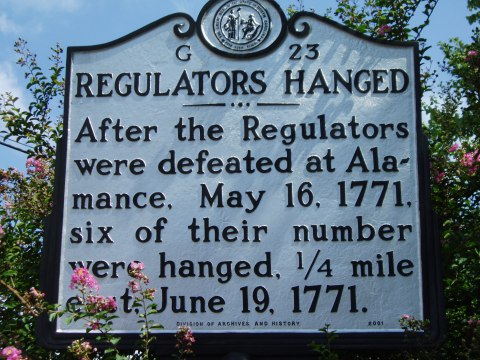
On a field in [the] Piedmont [of] North Carolina, Regulators clashed with North Carolina militia on May 16, 1771. Many probably had predicted the day when public disagreements, political protests and riots would one day escalate into an armed conflict. For a couple decades, tensions had been mounting. Piedmont farmers believed that they were being overtaxed and had been paying excessive fees to local sheriffs, and the colonial government. Piedmont farmers started demanding changes to the law and, publicly humiliating, intimidating and sometimes, flogging officials whom they deemed to be corrupt…Judge Richard Henderson and Sheriff Edmund Fanning are two examples.
After the Johnston [Riot] Act was passed, Rowan Regulators deemed it “riotous,” writes historian William Powell and, “swore that they would pay no more taxes.” Similar sentiment spread throughout the backcountry, so, in 1771, Governor Tryon flexed his executive muscle and ordered a special court in Hillsborough. Predicting that disgruntled Regulators would protest this action, Tryon sent out militia to the courthouse to quell any rebellious activity or interference with court sessions.
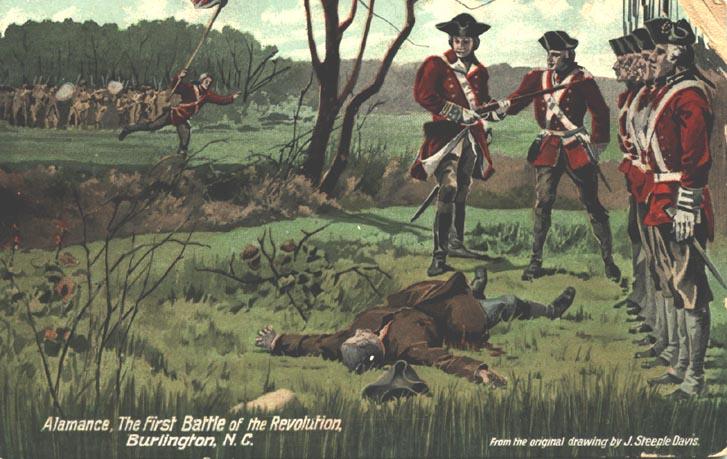
Image Credit: wikipedia.org & J. Steeple Davis
As the militia marched westward, approximately 2,000 Regulators assembled and, converged and met the militiamen camping beside Great Alamance Creek. On May 16, the Regulators relayed to Governor Tryon that they wanted to discuss their differences with government officials. Tryon scoffed at the suggestion and returned a message stating that a prerequisite for such an audience necessitated that the Regulators disarm. The royal governor gave the Regulators one hour to surrender. Their reply: “Fire and be damned.” No doubt believing the other side to be condemned to eternal fire, Tryon and the militia answered with cannon fire.
The Battle of Alamance lasted for two hours. The Regulators fired weapons behind trees and large rocks [but] their effort lacked organization. Sometimes when a Regulator would run out of ammunition, he left the field of battle. As to be expected, the militia was more organized in its attack, and maneuvers, and Tryon defeated the Regulators.
The War of the Regulation which culminated in the Battle of Alamance is one of the most controversial events in the history of North Carolina.
A great many of the people of North Carolina in the years just before the American Revolution were restless and dissatisfied with the state of affairs in their province. Their grievances were serious and affected their daily lives. Royal governors sent from outside the province were not able to maintain peace and quiet but, instead, frequently gave the people further cause for discontent. The outstanding group opposing the ruling class represented by the governor and his friends were known as Regulators.
It was a movement based upon the social and economic differences between the tidewater section and the back country of North Carolina. In the East, the people were almost entirely of English descent. It was here that an aristocratic form of society prevailed, based upon large plantations and slave labor. This area had taken on many of the forms and luxuries of older societies. The people looked to Virginia, and the mother country, for its social, intellectual and political standards. In the West, Scotch-Irish and German ancestries were predominant. Here, plantations were small and slaves were few in number. For the most part, the West was still in the pioneer stage. The forms and ideals of society were democratic. Philadelphia was the principal center for the interchange of ideas, as well as of produce. With slight intercourse between them, the two sections felt but little sympathetic interest in each other.
[…] North Carolina’s Governor Tryon built himself a mansion of grandiose proportions from those unfair taxes levied on struggling farmers. At this point emerged the Regulators. A group formed to protest these abuses, initially to print petitions, distribute pamphlets, advertise their demands for fair hearing and tax.
What started as a war of words swiftly moved to confrontation in the North Carolina courthouse of Hillsborough when a mob took over the building and removed the judge. Governor Tryon immediately passed a law making membership in the Regulators an act of treason.
One man from the Regulators, attempting to negotiate peace, crossed to Tryon who took a gun from one of his militiamen and shot the man dead. An order to ‘Fire and be damned’ was given and the Battle of Alamance ensued. The Regulators, though not outnumbered, were without sufficient arms and ammunition and, the outcome was swift. Governor Tryon took 13 prisoners and six were later executed in nearby Hillsborough.
[Historical records of the casualties are disputed. The numbers of dead range from nine to 27 and the wounded range from 61 to 300. Historians of the time claim that this was, indeed, the beginning of the American Revolution. Modern historians disagree with this.
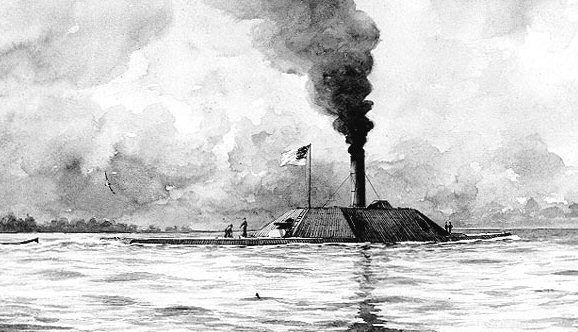
In a combined operation with the ironclad ram CSS Albemarle, Confederate forces under Maj. Gen. Robert F. Hoke, attacked the Federal garrison at Plymouth, North Carolina, on April 17. On April 19, the ram appeared in the river, sinking the USS Southfield, damaging the USS Miami and driving off the other Union Navy ships (USS Ceres & USS Whitehead) supporting the Plymouth garrison. Confederate forces captured Fort Comfort, driving defenders into Fort Williams. On April 20, the garrison surrendered.
*************
Construction of the ironclad began in January 1863 and continued on during the next year. Word of the gunboat reached the Union naval officers stationed in the region, raising an alarm. They appealed to the War Department for an overland expedition to destroy the ship, to be christened Albemarle after the body of water into which the Roanoke emptied but, the Union Army never felt it could spare the troops needed to carry out such a mission. It was a decision that would prove to be very short-sighted.
In April 1864, the newly commissioned Confederate States Steamer Albemarle, under the command of Captain James W. Cooke, got underway down-river toward Plymouth, North Carolina. Its mission was to clear the river of all Union vessels so that General Robert F. Hoke‘s troops could storm the forts located there.
[…] two paddle steamers, USS Miami and USS Southfield, lashed together with spars and chains, approached from up-river, attempting to pass on either side of Albemarle in order to trap her between them.
Image Credit: sonofthesouth.net
The sinking of the USS Southfield.
Captain Cooke turned heavily to starboard, getting outboard of [the] Southfield but, running dangerously close to the southern shore. Turning back sharply into the river, he rammed the Union side-wheeler, driving her under. Albemarle’s ram became trapped in Southfield’s hull from the force of the blow and her bow was pulled under as well. As [the] Southfield sank, she rolled over before settling on the riverbed. This action released the death grip that held the new Confederate ram.
Miami fired a shell into Albemarle at point-blank range while she was trapped by the wreck of Southfield but, the shell rebounded off Albemarle’s sloping iron armor and exploded on [the] Miami, killing her commanding officer, Captain Charles W. Flusser. Miami’s crew attempted to board Albemarle to capture her but, were soon driven back by heavy musket fire. [The] Miami then steered clear of the ironclad and escaped into Albemarle Sound.
With the river now clear of Union ships, and with the assistance of Albemarle’s rifled cannon, General Hoke attacked and took Plymouth and, the nearby forts.
Image Credit: emergingcivilwar.com & Miller’s Photographic History
CSS Albemarle shortly after the battle.
Confederate forces attack Plymouth, North Carolina, in an attempt to recapture ports lost to the Union two years before. The four-day battle ended with the fall of Plymouth but, the Yankees kept the city bottled up with a flotilla on nearby Albemarle Sound.
In 1862, the Union captured Plymouth and several other points along the North Carolina coast. In doing so, they deprived the Confederacy of several ports for blockade-runners and the agricultural products from several fertile counties. In the spring of 1864, the Confederates mounted a campaign to reverse these defeats. General George Pickett led a division to the area and launched a failed attack on New Bern in February. Now, General Robert Hoke assumed command and moved his army against Plymouth, fifty miles north of New Bern. He planned an attack using the C.S.S. Albemarle, an ironclad that was still being built on the Roanoke River inland from Plymouth.
With 7,000 men, Hoke attacked the 2,800-man Union garrison at Plymouth on April 17. His troops began to capture some of the outer defenses but, he needed the Albemarle to bomb the city from the river. The ironclad moved from its makeshift shipyard on April 17 but, it was still under construction. With workers aboard, Captain James Cooke moved down the Roanoke. The Albemarle‘s rudder broke and the engine stalled, so it took two days to reach Plymouth. When it arrived, the Rebel ship took on two Yankee ships, sinking one and forcing the other to retreat. With the ironclad on the scene, Hoke’s men captured Plymouth on April 20.
The Rebel victory was limited by the fact that the Albemarle was still pinned in the Roanoke River.
Image Credit: sonofthesouth.net
Original Harper’s Weekly leaflet.
Confederate batteries firing on Fort Sumter.
The illustration above captures the first significant battle of the Civil War.
S. C. Major Anderson had long urged his government, but in vain, to strengthen the military works in Charleston Harbor. The burden of the few replies was: “Be prudent; be kind; do nothing to excite the South Carolinians. It will not do to send you reinforcements, for that might bring on hostilities.” At length he was satisfied that the people were about to attempt to seize Fort Sumter.
[..] he resolved to take position in Sumter before it should be too late. He was commander of all the defenses of the harbor, and, in the absence of orders to the contrary, he might occupy any one he chose.
Governor Pickens sent a message to Anderson demanding his immediate withdrawal from [the fort]. The demand was politely refused and, the Major was denounced in the State convention, in the legislature, in public and private assemblies, as a “traitor to the South,” […]. The Confederates in Charleston and Washington were filled with rage.
[Secretary of War] Floyd declared the “solemn pledges of the government” had been violated by Anderson and he demanded of the President [Buchanan] permission to withdraw the garrison from Charleston Harbor. The President refused; a disruption of the cabinet followed. Floyd fled; and Anderson received (Dec. 31) from Secretary of War [Joseph] Holt —a Kentuckian like himself— an assurance of his approval of what he had done.
Governor Pickens, nettled by Anderson’s refusal to give up Sumter, treated him as a public enemy within the domain of South Carolina. Armed South Carolinians had been sent to take possession of Fort Moultrie, where they found the works dismantled.
On February 7, […] seven states adopted a provisional constitution for the Confederate States of America and established their temporary capital at Montgomery, Alabama. A February peace conference met in Washington, D.C. but, failed to resolve the crisis. The remaining eight slave states declined pleas to join the Confederacy.
The seceding states seized numerous Federal properties within their boundaries, including buildings, arsenals and fortifications. President James Buchanan protested but, took no military action in response. Buchanan was concerned that an overt action could cause the remaining slave states to leave the Union and, while he acknowledged there was no constitutional authority for a state to secede, he could find no constitutional authority for him to act to prevent it.
South Carolina authorities considered Anderson’s move to be a breach of faith. Governor [Francis W.] Pickens believed that President Buchanan had made implicit promises to him to keep Sumter unoccupied and suffered political embarrassment as a result of his trust in those promises. Buchanan, a former U.S. Secretary of State and diplomat, had used carefully crafted ambiguous language to Pickens, promising that he would not “immediately” occupy it. From Major Anderson’s standpoint, he was merely moving his existing garrison troops from one of the locations under his command to another.
Governor Pickens […] ordered that all remaining Federal positions except Fort Sumter were to be seized.
President Buchanan was surprised and dismayed at Anderson’s move to Sumter, unaware of the authorization Anderson had received. Nevertheless, he refused Pickens’s demand to evacuate Charleston harbor. Since the garrison’s supplies were limited, Buchanan authorized a relief expedition of supplies, small arms, and 200 soldiers. […] an unarmed civilian merchant ship, Star of the West [was sent], which might be perceived as less provocative to the Confederates. As Star of the West approached the harbor entrance on January 9, 1861, it was fired upon by a battery on Morris Island, […] staffed by cadets from The Citadel […].
In a letter delivered January 31, 1861, Governor Pickens demanded of President Buchanan that he surrender Fort Sumter because, “I regard that possession is not consistent with the dignity or safety of the State of South Carolina.”
On March 4, 1861, Abraham Lincoln was inaugurated as president. He was almost immediately confronted with the surprise information that Major Anderson was reporting that only six weeks of rations remained at Fort Sumter. A crisis similar to the one at Fort Sumter had emerged at Pensacola, Florida, where Confederates threatened another U.S. fortification — Fort Pickens. Lincoln and his new cabinet struggled with the decisions of whether to reinforce the forts, and how. They were also concerned about whether to take actions that might start open hostilities and which side would be perceived as the aggressor as a result. Similar discussions and concerns were occurring in the Confederacy.
After the formation of the Confederate States of America in early February, there was some debate among the secessionists whether the capture of the fort was rightly a matter for South Carolina or for the newly declared national government in Montgomery, Alabama. South Carolina Governor Pickens was among the states’ rights advocates who thought that all property in Charleston Harbor had reverted to South Carolina upon that state’s secession as an independent commonwealth.
The South sent delegations to Washington, D.C. and, offered to pay for the Federal properties and enter into a peace treaty with the United States. Lincoln rejected any negotiations with the Confederate agents because he did not consider the Confederacy a legitimate nation and making any treaty with it would be tantamount to recognition of it as a sovereign government.
On April 6, Lincoln notified Governor Pickens that “an attempt will be made to supply Fort Sumter with provisions only and, that, if such attempt be not resisted, no effort to throw in men, arms or ammunition will be made without further notice, [except] in case of an attack on the fort.”
Lincoln’s notification had been made to the Governor of South Carolina, not the new Confederate Government, which Lincoln did not recognize. Pickens consulted with [P. G. T.] Beauregard, the local Confederate commander. Soon, President Davis ordered Beauregard to repeat the demand for Sumter’s surrender and, if it did not, to reduce the fort before the relief expedition arrived.
Beauregard dispatched aides […] to Fort Sumter on April 11 to issue the ultimatum. Anderson refused, although he reportedly commented, “I shall await the first shot and, if you do not batter us to pieces, we shall be starved out in a few days.”
At 1 a.m. on April 12, the aides brought Anderson a message from Beauregard: “If you will state the time which you will evacuate Fort Sumter, and agree in the meantime that you will not use your guns against us unless ours shall be employed against Fort Sumter, we will abstain from opening fire upon you.”
Maj. Anderson replied that he would evacuate Sumter by noon, April 15, unless he received new orders from his government or additional supplies.
Aide Col. Chesnut considered this reply to be too conditional and [replied] to Anderson: Sir, by authority of Brigadier General Beauregard, commanding the Provisional Forces of the Confederate States, we have the honor to notify you that he will open fire of his batteries on Fort Sumter in one hour from this time.”
Anderson escorted the officers back to their boat, shook hands with each one, and said “If we never meet in this world again, God grant that we may meet in the next.”
Although the Union garrison returned fire, they were significantly outgunned and, after 34 hours, Major Anderson agreed to evacuate. There were no deaths on either side as a direct result of this engagement, although a gun explosion during the surrender ceremonies on April 14 caused two Union deaths.
From Son of the South:
The fort had been evacuated, not surrendered. Anderson bore away the flag of Sumter, which was used as his winding-sheet, and was buried with him.
[…] Veterans of this time period are gaining the respect that was not so freely given upon their return. Involving five U.S. presidents, crossing nearly two decades and 500,000 U.S.military personnel, it left an indelible mark on the American psyche. Returning Veterans did not always receive respectful welcomes upon their arrive on American soil. There were 58,000 killed, never to return. National Vietnam War Veterans Day recognizes the military service of these men and women who answered the call to service their country when she needed them. They didn’t make the decisions to go to war.
U.S. Sens. Pat Toomey, R-Pa., and Joe Donnelly, D-Ind., introduced legislation in 2017 to honor Vietnam Veterans with a day on the anniversary of the withdrawal of military units from South Vietnam. President Donald Trump signed the Vietnam War Veterans Day Act on March 28, 2017, calling for U.S. flags to be flown on March 29 for those who served.
[…] in January 1973, representatives of the United States, North and South Vietnam and, the Vietcong signed a peace agreement in Paris, ending the direct U.S. military involvement in the Vietnam War. Its key provisions included a cease-fire throughout Vietnam, the withdrawal of U.S. forces, the release of prisoners of war and, the reunification of North and South Vietnam through peaceful means. The South Vietnamese government was to remain in place until new elections were held and North Vietnamese forces in the South were not to advance further nor be reinforced.
Two months after the signing of the Vietnam peace agreement, the last U.S. combat troops [left] South Vietnam as Hanoi [freed] the remaining American prisoners of war held in North Vietnam. In Saigon, some 7,000 U.S. Department of Defense civilian employees remained behind to aid South Vietnam in conducting what looked to be a fierce and ongoing war with communist North Vietnam. […] before the last American troops departed on March 29, the communists violated the cease-fire and, by early 1974, full-scale war had resumed. At the end of 1974, South Vietnamese authorities reported that 80,000 of their soldiers and civilians had been killed in fighting during the year […].
On April 30, 1975, the last few Americans still in South Vietnam were airlifted out of the country as Saigon fell to communist forces.
Addendum
I live with a Vietnam Seabee Veteran. He was in-country at Camp Haskins, Red Beach, Da Nang harbor during Khe Sanh, Tet and the Battle of Hue. Thankfully, he was not directly affected but, he was nearly blown out of a guard tower when the USMC Da Nang Air Base was attacked in January 1968. He keeps a wad of shrapnel and an empty grenade in the office as a reminder of what nearly got him. He’s told me stories of returning home and being flipped off by civilians. He was never spit on, like some stories I’ve heard but, he certainly wasn’t welcomed back. ~Vic
The Battle of New Bern (also known as the Battle of New Berne) was fought on 14 March 1862, near the city of New Bern, North Carolina, as part of the Burnside Expedition of the American Civil War. The US Army’s Coast Division, led by Brigadier General Ambrose Burnside and accompanied by armed vessels from the North Atlantic Blockading Squadron, were opposed by an undermanned and badly trained Confederate force of North Carolina soldiers and militia led by Brigadier General Lawrence O’B. Branch. Although the defenders fought behind breastworks that had been set up before the battle, their line had a weak spot in its center that was exploited by the attacking Federal soldiers. When the center of the line was penetrated, many of the militia broke, forcing a general retreat of the entire Confederate force. General Branch was unable to regain control of his troops until they had retreated to Kinston, more than 30 miles (about 50 km) away. New Bern came under Federal control, and remained so for the rest of the war.
Hatteras Island, on the outer shore of North Carolina, fell to Union forces in August, 1861. Roanoke Island, just to the north, was captured on February 8, 1862. Elizabeth City on the mainland followed days later. With the freedom to navigate unmolested through Albemarle and Pamlico Sounds, Brig. Gen. Ambrose E. Burnside’s command looked for other strategic targets of opportunity. The city of New Bern was a significant target, as the Atlantic and North Carolina Railroad that connected the coast with the interior passed through there. On March 11, 1862, Burnside’s force embarked from Roanoke Island to rendezvous with Union gunboats at Hatteras Inlet for a joint expedition against New Bern. On March 13th, the fleet sailed up the Neuse River and disembarked infantry south of the Confederate defenses, about 4,000 men behind breastworks at Fort Thompson. The defenders, a mix of North Carolina infantry, cavalry and artillery, were commanded by Brig. Gen. Lawrence Branch. On March 14th, the brigades of Brig. Gens. John G. Foster, Jesse Reno, and John G. Parke attacked along the railroad and after four [sic] hours of fighting, drove the Confederates out of their fortifications. The Federals captured several nearby gun positions and occupied a base that they would hold to the end of the war, in spite of several Confederate attempts to recapture it.
On March 13th 1862, 11,000 Union troops led by General Ambrose Burnside, along with 13 heavily-armed gunboats led by Commodore Stephen Rowan, landed at Slocum’s Creek, now part of the Cherry Point Marine Corps Air Station. Their objective was [the] capture of the town of New Bern because of its strategic position and the fact that the Atlantic and North Carolina railroad was also located here. Union strategists hoped to use New Bern as a stepping off point to cutting off the main Confederate north-south railroad supply line at Goldsboro.
Awaiting the Union forces were about 4,500 inexperienced and ill-equipped Confederate troops commanded by General Laurence [sic] O’Bryan Branch, a politician with virtually no military experience. Branch positioned his infantry regiments, one cavalry regiment, local militia and three gun batteries to defend a line extending from Fort Thompson on the Neuse River and running approximately one mile west to the Weatherby Road at the eastern edge of Brice’s Creek. Extending Branch’s right wing to the railroad tracks was the 26th North Carolina Regiment commanded by Colonel Zebulon Vance, later governor of North Carolina.
Despite support from Commodore Rowan’s gunboats, this attack stalled. However, a regiment of General Parke’s brigade flanked the position of a militia battalion in the vicinity of Wood’s brickyard adjoining the railroad. Parke’s infantry drove these poorly armed, fresh militiamen from their position leaving the right flank of the 35th North Carolina Regiment exposed. The Confederate line was broken between the 26th and the 35th regiments, and the Union forces pushed through forcing the retreat of the Confederate troops.
The Battle of New Bern was the baptism of fire for the 26th North Carolina. Later, in July 1863, the 26th lost 588 of 800 men at the Battle of Gettysburg, sustaining the largest numerical losses of any unit, North or South, during the entire course of the war.
Estimated casualties for the battle: 1080 total. The fierce battle in the swamps and along the railroad five miles south of New Bern, proved to be a major victory for the Union and led to the ensuing occupation of New Bern for the remainder of the Civil War. Although Union forces never seized and held the rail line at Goldsboro, their presence in New Bern required the Confederacy to divert troops to the railroad’s defense that might have been used in the critical battles in Virginia. For General Ambrose Burnside, the New Bern victory was a factor in his subsequently being given command of the Army of the Potomac and leadership in the Union disaster at Fredericksburg.
One-hundred and fifty-seven years ago, today… ~Vic
The proposals called for the Central Intelligence Agency (CIA), or other U.S. government operatives, to commit acts of terrorism against American civilians and military targets, blaming them on the Cuban government and, using it to justify a war against Cuba. The plans detailed in the document included the possible assassination of Cuban émigrés, sinking boats of Cuban refugees on the high seas, hijacking planes, blowing up a U.S. ship and orchestrating violent terrorism in U.S. cities. The proposals were rejected by [The President].
Today, we are going waaaaaaay back…to 1918. On this date, Shoulder Arms, a Charlie Chaplin piece, was a very popular film. Was it a ‘number one’? Hard to tell. This film pre-dates the Academy Awards by 11 years. Starring Sir Charles Spencer Chaplin, Edna Purviance, Sydney Chaplin (Charlie’s elder, half-brother) and Tom Wilson, it is, primarily, a dream sequence set in France during World War I.
Charlie is in boot camp in the “awkward squad.” Once in France, he gets no letters from home. He finally gets a package containing limburger cheese, which requires a gas mask and which he throws over into the German trench. He goes “over the top” and captures thirteen Germans (“I surrounded them”) then, volunteers to wander through the German lines disguised as a tree trunk. With the help of a French girl, he captures the Kaiser and the Crown Prince and, is given a statue and victory parade in New York. Then…fellow soldiers wake him from his dream. [edited for grammar]
“”The fool’s funny,” was the chuckling observation of one of those who saw Charlie Chaplin’s new film. “Shoulder Arms”, at the Strand, yesterday and, apparently, that’s the way everybody felt. There have been learned discussions as to whether Chaplin’s comedy is low or high, artistic or crude but, no one can deny that when he impersonates a screen fool, he is funny. Most of those who go to find fault with him remain to laugh. They may still find fault but, they will keep on laughing. In “Shoulder Arms”, Chaplin is as funny as ever.” [edited for grammar]
Trivia Bits:
♦ Many in Hollywood were nervous that one of their most famous peers was going to tackle the subject of WWI. It was released shortly before the Armistice so, it did not help boost national morale but, it did end up as one of Charles Chaplin’s most popular films and, it was particularly popular with returning doughboys.
♦ Released two weeks and one day before the end of World War I.
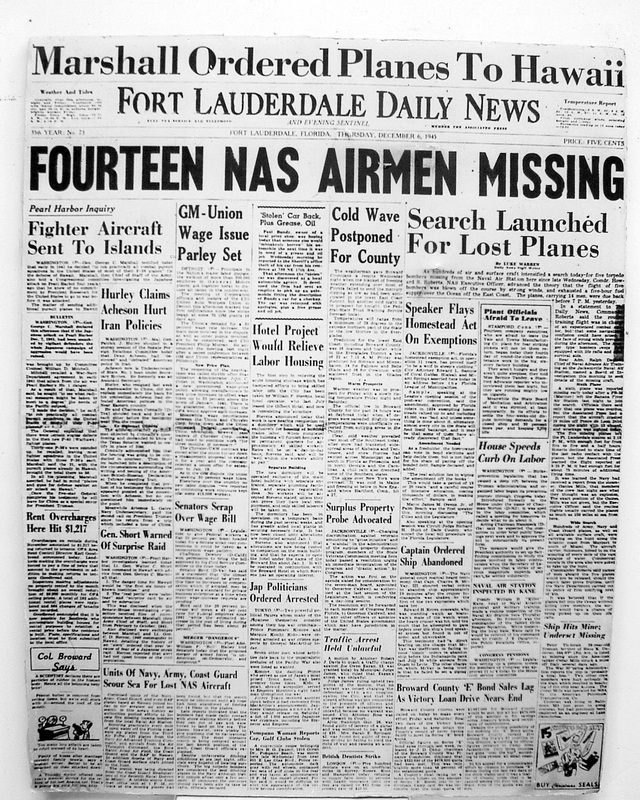
Seventy-three years ago, today, the infamous Flight 19 disappeared over the Bermuda Triangle in what was supposed to be a routine, three-hour exercise of combat training and navigation. Four TBM-1Cs and one TBM-3 Grumman Avenger torpedo bombers took off from NAS Fort Lauderdale at 14:10pm. Twenty-seven year old Navy Lieutenant Charles Carroll Taylor was the flight leader and pilot of FT-28, the TBM-3.
“Two hours after the flight began, the leader of the squadron, who had been flying in the area for more than six months, reported that his compass and back-up compass had failed and, that his position was unknown. The other planes experienced similar instrument malfunctions. Radio facilities on land were contacted to find the location of the lost squadron but, none were successful. After two more hours of confused messages from the fliers, a distorted radio transmission from the squadron leader was heard at 18:20pm, apparently calling for his men to prepare to ditch their aircraft simultaneously because of lack of fuel.”
“Radio conversations between the pilots were overheard by base and other aircraft in the area. The practice bombing operation is known to have been carried out because at about 15:00pm, a pilot requested and was given permission to drop his last bomb. Forty minutes later, another flight instructor, Lieutenant Robert F. Cox in FT-74, forming up with his group of students for the same mission, received an unidentified transmission.
Photo Credit: nasflmuseum.com
An unidentified crew member asked Powers (Marine Corps Captain Edward Joseph Powers, Jr., pilot of FT-36), for his compass reading. Powers replied: “I don’t know where we are. We must have got lost after that last turn.” Cox then transmitted: “This is FT-74, plane or boat calling ‘Powers’ please identify yourself so someone can help you.” The response after a few moments was a request from the others in the flight for suggestions. FT-74 tried again and a man identified as FT-28 (Lt. Taylor) came on. “FT-28, this is FT-74, what is your trouble?” “Both of my compasses are out”, Taylor replied, “and I am trying to find Fort Lauderdale, Florida. I am over land but it’s broken. I am sure I’m in the Keys but, I don’t know how far down and, I don’t know how to get to Fort Lauderdale.”
FT-74 informed the NAS that aircraft were lost, then advised Taylor to put the sun on his port wing and fly north up the coast to Fort Lauderdale. […] no bearings could be made on the flight and the IFF (transmitter) could not be picked up. Taylor was told to broadcast on 4805 kHz. This order was not acknowledged so he was asked to switch to 3000 kHz, the search and rescue frequency. Taylor replied: “I cannot switch frequencies. I must keep my planes intact.”
As the weather deteriorated, radio contact became intermittent and it was believed that the five aircraft were actually, by that time, more than 200 nmi (230 mi; 370 km) out to sea east of the Florida peninsula. Taylor radioed “We’ll fly 270 degrees west until landfall or running out of gas” and requested a weather check at 17:24pm. By 17:50pm, several land-based radio stations had triangulated Flight 19’s position as […] north of the Bahamas and well off the coast of central Florida.”
There is some question as to the exact time of Taylor’s last transmission (18:20pm or 19:04pm) but, he was heard saying “All planes close up tight…we’ll have to ditch unless landfall…when the first plane drops below 10 gallons, we all go down together.” By that time, the sun had set and the weather was much worse.
“Two PBM Mariner flying boats were dispatched from NAS Banana River in Melbourne, Florida (now Patrick Air Force Base), carrying rescue equipment. Less than a half hour after take-off (at approximately 19:27), one of the PBM’s (Trainer 49/BuNo 59225) radioed the tower that they were nearing Flight 19’s last assumed position. The rescue plane with a crew of 13 men was never heard from again.”
“At 21:15pm, the tanker SS Gaines Mills reported it had observed flames from an apparent explosion leaping 100 ft (30 m) high and burning for 10 minutes. Captain Shonna Stanley reported unsuccessfully searching for survivors through a pool of oil and aviation gasoline. The escort carrier USS Solomons also reported losing radar contact with an aircraft at the same position and time.”
A 500 page Navy investigation was published a few months later. Initially, blame was placed upon Lt. Taylor for mistaking the Bahamas for the Florida Keys and not listening to his subordinate officers. The report was amended to ’cause unknown’ when Taylor’s mother stated that the Navy had no evidence for their conclusions…no planes and no bodies. Lt. Taylor was listed as ‘not at fault’ as his compasses were not working. The disappearance of PBM-5 Trainer 49 was attributed to a mid-air explosion.
“The first minute of silence was to indicate gratitude for those who had returned alive…the second to remember the fallen.”
Edward George Honey, an Australian journalist, was the gentleman whom first proposed a moment of silence. The two-minute silence, practiced today, originated in Cape Town, South Africa, via that town’s then Mayor, Sir Harry Hands.
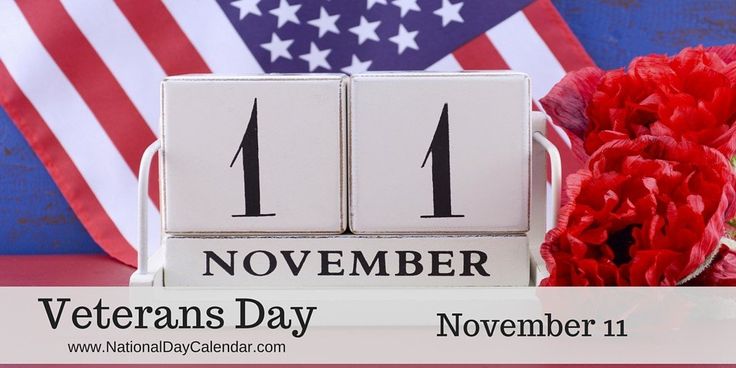
We, here in the U.S., at the behest of several veterans organizations, changed Armistice Day to Veterans Day in 1954 to honor all veterans, regardless of a specific war. It is a national holiday and different from Memorial Day (last Monday in May), which honors those whom died while serving and, Armed Forces Day (also in May but, the third Saturday), honoring those currently serving.
Image Credit: Pinterest
In Flanders Fields
In Flanders fields the poppies blow
Between the crosses, row on row,
That mark our place; and in the sky
The larks, still bravely singing, fly
Scarce heard amid the guns below.
We are the Dead. Short days ago
We lived, felt dawn, saw sunset glow,
Loved and were loved, and now we lie
In Flanders fields.
Take up our quarrel with the foe:
To you from failing hands we throw
The torch; be yours to hold it high.
If ye break faith with us who die
We shall not sleep, though poppies grow
In Flanders fields.
Oh! you who sleep in Flanders Fields,
Sleep sweet – to rise anew!
We caught the torch you threw
And holding high, we keep the Faith
With All who died.
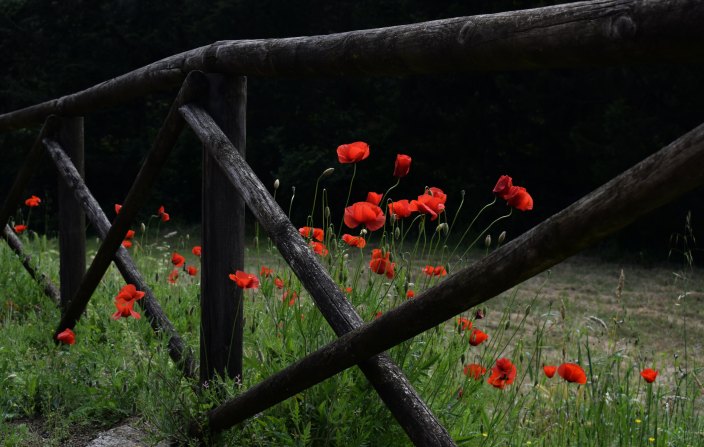
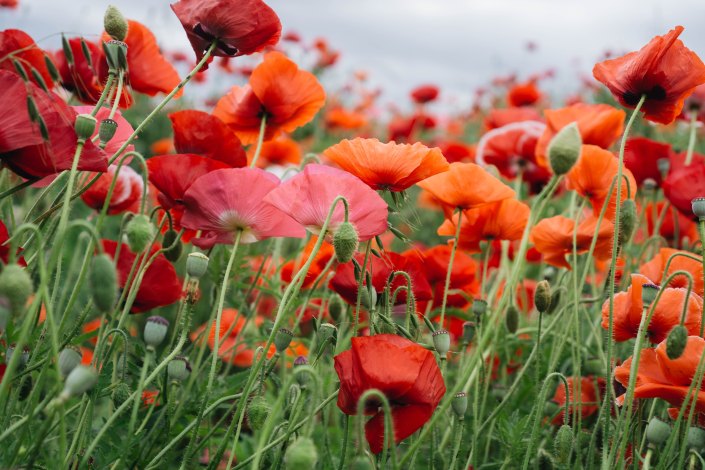
We cherish, too, the poppy red
That grows on fields where valor led;
It seems to signal to the skies
That blood of heroes never dies,
But lends a lustre to the red
Of the flower that blooms above the dead
In Flanders Fields.
And now the Torch and Poppy Red
We wear in honor of our dead.
Fear not that ye have died for naught;
We’ll teach the lesson that ye wrought
In Flanders Fields.
In a previous post, I talked about nearly being an Army brat. I also could have potentially been fatherless as 2nd Lieutenants had short life spans in Vietnam, but…that was not my fate…nor, the fate of my father.
I do not personally know anyone that died in Vietnam. I have no names to scratch for my own memories but, my partner, my ‘significant other’ knew many that perished as he was in country 1967-1968 with the Naval Mobile Construction Battalion 74 (PDF) at Camp Haskins-South, Red Beach, Da Nang . There will be a future post on him.
A veteran named Dave. He was grieving and I gave him a copy of this.A veteran named Travis (left). A veteran named Mark. Each received a copy.Mother and daughter. I tried to share to the daughter but, I messed up the phone number.
Ray scanning names.
The little ones with their Mom. She wanted them to understand.Veteran Travis left a ball cap/cover for his USS Oriskany shipmates that perished in a fire in 10-26-1966. The two reflections are me & veteran Travis.Dale R. Buis, the first casualty.Richard Van De Geer, the last ‘known’ casualty.Army, Navy, Air Force, Marines & Coast Guard (right to left).
[From: Wikipedia & The History Channel] One hundred and sixty-five years ago, today, The Battle of Antietam, also known as the Battle of Sharpsburg, particularly in the Southern U.S., occurred September 17, 1862, at Antietam Creek near Sharpsburg, Maryland. It pitted Confederate General Robert E. Lee’s Army of Northern Virginia against Union General George McClellan’s Army of the Potomac and was the culmination of Lee’s attempt to invade the north. The battle’s outcome would be vital to shaping America’s future and it remains the deadliest one-day battle in all American military history, with a combined tally of 22,717 dead, wounded or missing.
McClellan had halted Lee’s invasion of Maryland but, Lee was able to withdraw his army back to Virginia without interference from the cautious McClellan. McClellan’s refusal to pursue Lee’s army led to his removal from command by President Abraham Lincoln in November. Although the battle was tactically inconclusive, the Confederate troops had withdrawn first from the battlefield and abandoned their invasion, making it a Union strategic victory. It was a sufficiently significant victory to give Lincoln the confidence to announce his Emancipation Proclamation, which discouraged the British and French governments from pursuing any potential plans to recognize the Confederacy.
Photo Credit: loc.gov
[From: Emerging Civil War…another take…]
Fortunately, for the sake of debate, the outcome of Civil War battles is not as clear-cut as that of a football game, where one can look at the scoreboard at the end of the game and easily determine who won, who lost, or, in some cases, if the outcome was a draw. Historians endlessly debate whether certain battles were overwhelming victories, marginal victories, or draws. Perhaps no other battle’s tactical outcome is more misunderstood than the bloodiest single day battle of the war: Antietam.
No one would doubt Antietam’s significance in the larger picture of the war. However, the common conception of Antietam is that the battle was tactically a draw, with neither side having gained a significant enough of an advantage to have claimed the victory. This article will challenge that commonly held belief, using particular instances from the battle and the Maryland Campaign to demonstrate the Army of the Potomac’s victory at Antietam.
[Had this battle been a Confederate victory, this country might look very, very different. ~Victoria]
One hundred years ago, today, August 13, 1918, Opha May (Jacob) Johnson, born May 4, 1879, enlisted in the Marine Corps Reserve during World War I. She just happened to be the first one in line with 300+ other women behind her.
At the onset and throughout the First World War, women in the United States were still denied the same basic rights and privileges as male citizens, including the right to vote. Suffragists would continue to battle on through this time, but their efforts would not culminate into a constitutional revision until 1920. Not only was the political arena considered off-limits for women, but military service was also denied to them. Though legends of women dressing as males to fight for the United States had been spoken of since the Revolution, women were not allowed to legally enlist in the armed services, the Marine Corps being no exception. By the summer of 1918 however, the Corps was in need of more soldiers, many of whom occupied vital administrative and clerical positions throughout the war department at the time. The idea was circulated and eventually approved to allow women into the marines to fill these non-combat positions, relieving this men to head for the front. From Kokomo, Indiana, Opha May Johnson was first in line when the recruiting station in Washington D.C. opened its doors to women and would become a legend as the first woman Marine.
She passed away August 11, 1955 but, her funeral services were held on August 13, 1955…37 years to the day that she first stood in line.









 Cosmic-Observation