On May 17, 1673, Louis Jolliet and Jacques Marquette departed from St. Ignace, Michigan, with two canoes and five other voyageurs of French-Indian ancestry. The group sailed to Green Bay. They paddled upstream (southward) on the Fox River to the site now known as Portage, Wisconsin. There, they portaged a distance of slightly less than two miles through marsh and oak forest to the Wisconsin River. Europeans eventually built a trading post at that shortest convenient portage between the Great Lakes and Mississippi River basins. On June 17, the canoeists ventured onto the Mississippi River near present-day Prairie du Chien, Wisconsin.
The Jolliet-Marquette expedition paddled along the west bank of the Mississippi until mid-July. When they passed the mouth of the Arkansas River, they became satisfied that they had established that the Mississippi flowed into the Gulf of Mexico.
The voyageurs then followed the Mississippi back to the mouth of the Illinois River, which friendly natives told them was a shorter route back to the Great Lakes. Following the Illinois river upstream, they turned up its tributary, the Des Plaines River near modern-day Joliet, Illinois. They continued up the Des Plaines River and portaged their canoes, and gear, at the Chicago Portage. They followed the Chicago River downstream until they reached Lake Michigan near the location of modern-day Chicago. Father Marquette stayed at the mission of St. Francis Xavier at the southern end of Green Bay, which they reached in August. Jolliet returned to Quebec to relate the news of their discoveries. On his way through the Lachine Rapids, Jolliet’s canoe overturned and his records were lost. His brief narrative, written from memory, is in essential agreement with Marquette’s, the chief account of the journey.
While Hernando de Soto was the first European to make official note of the Mississippi River by discovering its southern entrance in 1541, Jolliet and Marquette were the first to locate its upper reaches and, travel most of its length, about 130 years later. De Soto had named the river Rio del Espiritu Santo but, tribes along its length called it “Mississippi”, meaning “Great River” in the Algonquian languages.
I haven’t posted any critter shots in 3 1/2 years. Previous post, here. ~Vic
Small bug that looks like a leaf.
05-31-2019
Click for a larger view.Got a bee’s face!
05-31-2019
Click for a larger view.Cute bug but, I have no idea.
04-30-2019
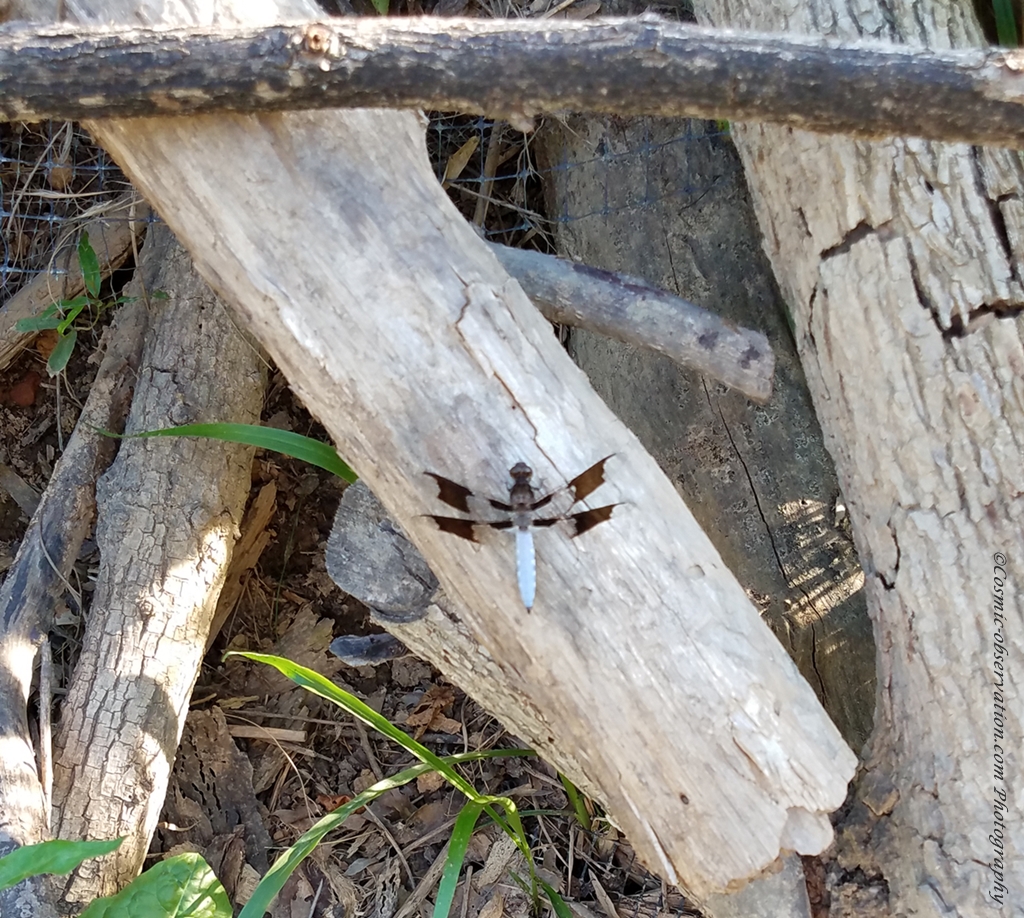
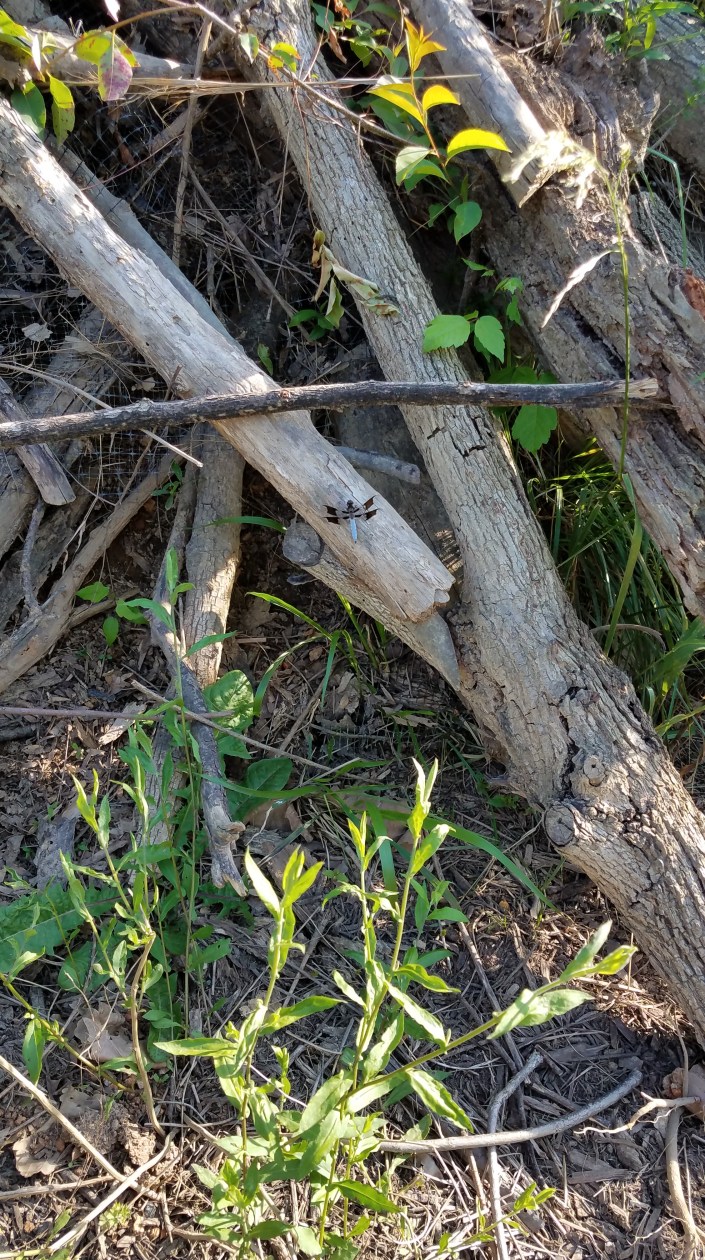
Click for a larger view.Skivvy waver dragonfly. LOL!
Brighter shot than the original.
05-17-2019
Click for a larger view.Young mantis.
Different angle from the original.
05-31-2019
Click for a larger view.Beautiful web.
Where is the spider?
10-13-2018
Click for a larger view.
I did a pretty extensive write-up last year with Native American names and two videos. I won’t repeat all that here. I am including a shot from 2017 (before I was blogging again) and a shot from 2019 that wasn’t part of the previous post.
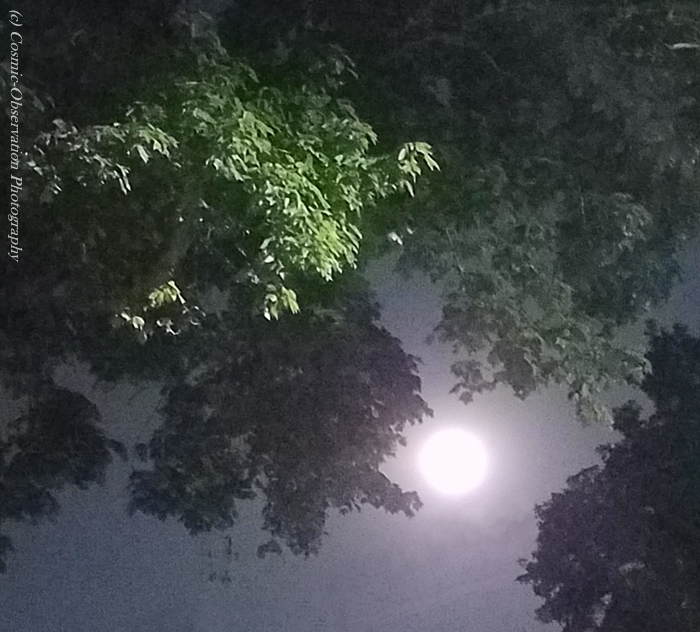
Full illumination occurred at 6:45am EDT. Howl for me! ~Vic
From this evening…Peek-a-BooI caught the Moon with the setting sun.
It’s a little hard to see.
05-17-2019More Peek-a-Boo
05-11-2017
Lady Gwen, the last of the sporting Grayles, falls in love with Donald MacAllan, a bright young medical student far below her station. Gwen’s father, who opposes the match, introduces her to Prince Carlos, who wishes to marry her in order to pay off his creditors.
Photo Credit: imdb.com & amazon.com
Donald enlists during the World War and Carlos continues his courtship. When Donald returns from the fighting, Carlos tells him that he is engaged to Gwen and Donald, therefore, makes no attempt to see her. Gwen mistakes Donald’s seeming indifference for contempt and seeks to forget him by living riotously in several European capitals. Having exhausted her fortune, and ruined her health, Gwen returns to Scotland and goes to live in the same cottage where Donald used to study. She becomes ill and, in delirium, calls for Donald. Her old nurse goes to fetch him at the Grayle estate, which, having become wealthy, he has just bought. Donald rescues Gwen, who has wandered out in a storm, and nurses her back to health.
A Hollywood conception of Scotsmen who wear the kilt but, whose complexions betray nary a sign of the ruddy ruggedness due to Highland rain and wind, is to be seen at the Capitol this week in a picture called “The Sporting Venus” […]. [There] is a question [of] whether the Wallaces, the Bruces, the Watts and the McTavishes will smile with any satisfaction upon it. Not that they are intentionally maligned in this story but, that the men from the land of the heather are portrayed with studio-blanched complexions and, in one or two instances, wearing brocaded silk dressing gowns.
Marshall Neilan, the director of this celluloid effusion, in his desire to depict Lady Grayle (Blanche Sweet) as a plucky person at the eleventh hour of a fast life, shows her ladyship smoking a cigarette before she breathes her last. Ronald Colman is undoubtedly a bonnie actor but, you just know that he never was born to wear a kilt, [though], he does for a few scenes. He impersonates Donald McAllen, frequently alluded to as a commoner.
Donald and the capricious lassie, Lady Gwendolyn, are happy in Scotland until the coming of Prince Carlos […]. This Prince, played by Lew Cody, is a man of many debts and a faithful valet. His creditors see only one way to get back their money and that is to have the oily gentleman marry a wealthy wife. Donald goes to France to fight, and when he returns on leave, [believes] the Prince’s story […] that [he], more or less, is to wed Lady Gwendolyn.
Lady Gwendolyn […] becomes […] a flighty young woman who gambles in millions. The young hero goes back to France, and as a surgeon, makes a great name for himself. He purchases Grayloch, the great estate of the Grayles.
With the background of Scotland, Mr. Neilan ought to have been able to make a production far stronger than this effort, which, at best, is only a mediocre diversion. It is true that it has some beautiful scenery and the settings are quite pleasing.
This film survived but, I can’t find any clips of it. Silent Era states that a premiere took place on May 10, 1925, at the Capitol Theatre in New York City and was released May 17, 1925. AFI disagrees. ~Vic
Buddy came to me (and an ex) as a little thing. He had been born under a home 75 miles east and his mother had to leave him behind. The guy living there heard the crying mews and went to investigate. He found tiny Buddy in an upright cinder block, pulled him out and realized he was a newborn with his eyes still closed. He sought help from a veterinarian and began to feed him. Fast forward five weeks and the guy contacts my ex. “You want a kitten? I can’t handle him, anymore.” He shows up with this gi-normous litter box with a cover, that little Buddy could barely jump in and out of, a box of various toys and a gallon container of kitten food. The guy lived alone and traveled a lot so, he felt Buddy would be better off with us. I had lost my very first cat six months prior so, Buddy’s arrival was cause for celebration. He was my baby for nine years. (1997-2006). All photos are my personal collection. ~Vic
He loved to be held.
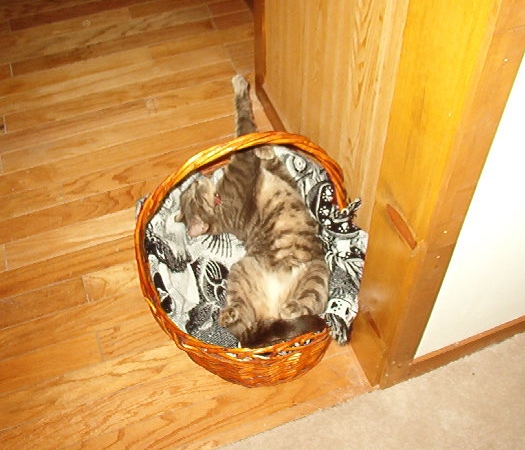
09-06-2004I found him napping in my sewing basket.
09-06-2004Kitty in his box.
05-17-2005I gave him my basket.
I had no choice.
09-13-2004These are my gifts.
This was his last Christmas.
12-18-2005.
Big grasshopper.
Taken with my old Samsung Alias II.
Nature Preserve
Round Rock, TX
10-25-2008Another shot of the blue tail.
05-06-2019Tiny bee in my side yard.
05-13-2019On the Riverwalk, headed to Gold Park.
Love the Ladybugs.
05-13-2019Dragonfly in the Butterfly Garden.
He looks like a Skivvy Waver.
05-17-2019Wolf spider running on the Riverwalk.
05-19-2019Hungry Bumbles
05-31-2019Young Preying Mantis on a Black-Eyed Susan.
Riverwalk
05-31-2019
Anarchy!
Even man-hole openings need decoration.
04-15-2019Crying man-hole.
Maybe its the smell?
04-22-2019Happy man-hole.
This one must smell better.
05-07-2019Love animals.
Covered walkway to Gold Park.
05-17-2019Save Earth.Go vegan.
Yes. He’s dead…by his own admission. I heard him say he was born in 1735 when addressing his tour subjects. He was pleased that I wished to photograph him. I guess the lantern adds to the spookiness.
The town I live in is haunted…in some places. It’s pretty common knowledge. It is an old town. During the summer, there are ghost tours. I’m not kidding. I might take a tour one day. ~Vic
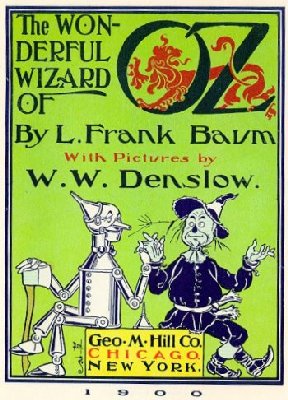
The story chronicles the adventures of a young farm girl named Dorothy in the magical Land of Oz after she and her pet dog Toto are swept away from their Kansas home by a cyclone.
The book is one of the best-known stories in American literature and has been widely translated. The Library of Congress has declared it “America’s greatest and best-loved homegrown fairytale.” Its groundbreaking success and the success of the Broadway musical adapted from the novel led Baum to write thirteen additional Oz books that serve as official sequels to the first story.
Baum dedicated the book “to my good friend & comrade, My Wife,” Maud Gage Baum. In January 1901, George M. Hill Company completed printing the first edition, a total of 10,000 copies, which quickly sold out. It sold three million copies by the time it entered the public domain in 1956.
Image Credit: wikipedia.org
The Wonderful Wizard of Oz is considered the first American fairy tale because of its references to clear American locations such as Kansas and Omaha. Baum agreed with authors such as Carroll that fantasy literature was important for children, along with numerous illustrations but, he also wanted to create a story that had recognizable American elements in it such as farming and industrialization. Baum did not offer any conclusive proof that he intended his novel to be a political allegory.
The Wonderful Wizard of Oz has become an established part of multiple cultures, spreading from its early young American readership to becoming known throughout the world. It has been translated or adapted into well over fifty languages, at times being modified in local variations. For instance, in some abridged Indian editions, the Tin Woodman was replaced with a horse. In Russia, a translation by Alexander Melentyevich Volkov produced six books, The Wizard of the Emerald City series, which became progressively distanced from the Baum version, as Ellie and her dog Totoshka travel throughout the Magic Land. More recently, the story has become an American stage production (The Wiz) with an all-black cast, set in the context of modern African-American culture.
Here in North Carolina, we have the Land of Oz at Beech Mountain. I went there in 1973 with my parents and, again, in 2017. ~Vic




















 Cosmic-Observation