Author: The Hinoeuma
Movie Monday: A Letter To Three Wives 1949

Seventy years ago, today, the #1 film at the box office was A Letter to Three Wives, starring Jeanne Crain, Linda Darnell, Ann Sothern, Kirk Douglas, Paul Douglas and Jeffrey Lynn. Celeste Holm provided the uncredited voice of Addie Ross. Directed by Joseph L Mankiewicz, the movie was adapted by Vera Caspary from a 1945 John Klempner Cosmopolitan magazine novel titled A Letter to Five Wives. Mankiewicz also wrote the screenplay.
Just as they are leaving with a group of orphans for a Hudson River outing, three suburban housewives receive a note from Addie Ross, a friend against whom each woman measures herself. Addie claims to have run off with one of the women’s husbands. As they try to get through the day, each thinks back on her marriage, considering the likely reason her husband would have run off with the other woman. Deborah (Jeanne Crain) remembers the disappointment her husband felt when he discovered the chic WAVE he fell for during World War II was a simple farm girl who could barely keep up with the educated Addie. Radio writer Rita (Ann Sothern) thinks her career as a radio writer has led her to neglect her husband (Kirk Douglas), who may have been drawn to the more attentive Addie. Social climber Lora Mae (Linda Darnell) recalls how she trapped department store magnate Porter Hollingsway (Paul Douglas) into marrying her when he had hoped to wed the more socially upright Addie. As the day finally ends, each returns home to prepare for the opening of the social season, the big country club dinner at which one of their husbands will not be present.
Trivia Bits:
♦ The identity of the actress Celeste Holm who did the voice-over for Addie Ross was kept secret when the film was released. The studio held a number of “Who is Addie?” contests around the country where moviegoers could guess the actress’ name.
♦ General Douglas MacArthur was so confused by the ending that he had his aide write Joseph L. Mankiewicz a letter asking with whom Addie had, in fact, run off.
♦ The film actually went into production in 1946 as “A Letter to Five Wives” from a script by Melville Baker and Dorothy Bennett. Gene Tierney, Linda Darnell, Maureen O’Hara, Dorothy McGuire and Alice Faye were all earmarked to play the wives but, this version was quickly shelved until Joseph L. Mankiewicz retooled it in 1948.
♦ Both Joan Crawford and Ida Lupino were considered for Addie’s off-screen voice before Celeste Holm was cast. When Mankiewicz offered Holm a role that would never be seen in the film, she quipped, “Oh my, that’s wonderful. My wooden leg won’t have to show.” (Holm, quoted in Geist). She consented when he told her Crawford was after the role.
♦ When Ann Sothern’s look of joyful surprise on finding her husband hadn’t run off with Addie wasn’t strong enough, Mankiewicz had Kirk Douglas jump up from behind the set’s sofa (out of camera range) in only his underwear.
Awards
♥ Best Director & Best Writing/Screenplay (Joseph L. Mankiewicz/1950 Academy Awards)
♥ Best Written American Comedy (Joseph L. Mankiewicz & Vera Caspary/1950 Writers Guild of America (WGA) Award)
♥ Outstanding Directorial Achievement in Motion Pictures (Joseph L. Mankiewicz & Gaston Glass/1949 Directors Guild of America (DGA) Award)
♥ Top Ten Films (1949 National Board of Review (NBR) Award)
Nomination
♢ Best Picture (Sol C. Siegel/1950 Academy Awards)
Fem-fluenza & The Petersons
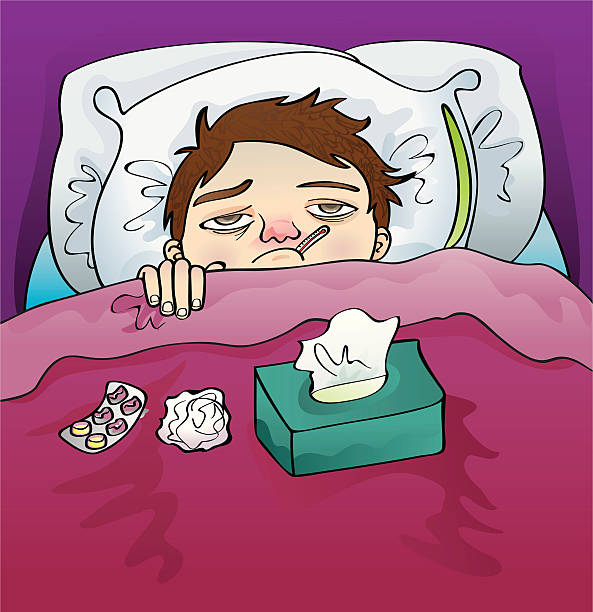
I got waylaid by a nasty flu bug that I am still not quite over, yet. Right around Christmas, my neck became very stiff and I had a hard time turning my head from side to side. I visit a chiropractor regularly and this wasn’t spine-related. Having had an allergic reaction to a hair product over a decade ago, I recognized the feeling of lymph node activation. Not good. After my last post on January 14, I was run over by a fully loaded dump truck and didn’t get the license plate number. Fem-fluenza seemed to be altogether fitting and proper after fellow blogger Britchy battled ‘Manbola’.
My new friend gifted me with exhaustion, a sore throat, a strange colored goo-substance in my sinuses and a headache from hell. I can count on one hand how many times in my 52 years I have had a headache. I’m not prone to them. The closest I get is one (or the other) temple will get sore when I need an adjustment. This? My entire skull hurt. My temperature jumped up and down between 99.8 and 101.6, my ears got really hot (there is a joke in there, somewhere) and my eyes ached. I’m not talking scratchy eyes or itchy eyes, I’m talking total eye-socket pain…and, they were hot, too.

There was a three-day stretch where the fever stayed around 101 and eating was just out of the question. I didn’t even have the strength to lift my head, much less chew. My stomach & lungs stayed busy with whatever alien potion was sliding out of my head (which I continue to hack up). In the middle of this waking nightmare, there was entertainment…1000s of channels to stare at while your brain cooks, your eyes weep, your nose runs and you fade in & out of consciousness.
I happened to be catching a repeat episode of Forensic Files on HLN in a lucid moment and came to a common sense conclusion despite my condition. I’m not fond of the last name Peterson. I will explain further.
The particular episode I am referring to is about Michael Peterson and the murder of his wife Kathleen. He was a novelist, wrote columns in the Durham Herald-Sun and was, supposedly, a Marine Vietnam Veteran. The murder took place in Durham in December 2001 and he was convicted in October 2003. There is still some question as to whether or not he was guilty for another woman’s death but, I’m not going to cover his case here. During the show, it hit me. That last name…
I’m sure everyone remembers the Scott Peterson/Laci Peterson murder case. He was convicted in 2004 and sits on death row at San Quentin awaiting a lethal injection while his case is being appealed to California’s Supreme Court. Then…there’s ex-cop Drew Peterson. He came on the scene when his fourth wife Stacy disappeared without a trace in 2007. That lead to a re-opening of his third wife’s death, Kathleen, in 2003. He was convicted of her murder in 2012 and got added time at Terre Haute Penitentiary for attempting to have the Prosecutor in his case killed. What a charmer he is.
After the episode was over, all I could think was “Don’t marry anyone with the last name Peterson, especially if your name is Kathleen.” Sheesh.
Chris Thomas: Soul Reintegration & Illness
A PDF Essay From: The Chris Thomas Files

Introduction
We have travelled a long way along the path to achieving soul re-integration. Many millions of people are ready, or nearly ready, to make the final step into full consciousness. Just when we will, collectively, make that final step is still not fully determined. When the time is right, we will all take that step together. In order to be “ready” to take that final step, we need to be as clean and clear of all of our “issues” as it is possible to be. We need this full clearance in order to make enough “space” to allow the higher self unrestricted access into the physical body. So what are these “issues” and how do we clear them? How do I know if I have any unresolved “issues”? The answer is within the body itself…symptoms of ill-health.
The Root Causes of Illness
To understand the root causes of illness, we need to first understand how the body works and, more importantly, how the soul, the higher self, uses the body to communicate to us. The author has worked as a healer and a psychic surgeon for over thirty years, exploring how symptoms of illness arise, how they can be healed and how the body can be brought back into balance. Essentially, that is what an illness is…an imbalance in the energy patterns of the body. Bring the energies back to balance and the symptoms of illness disappear. It really is that simple.
When we first divided the soul into two, 7,000 years ago, forming the physical self and the higher self, we also provided ourselves with a “route-map” of how we determined if we were following the dictates of the higher self and lived through the experiences that we had planned for each successive lifetime. This “route-map” is given form through the body’s seven primary chakras.

The Seven Primary Chakras
Over the 7,000 years of the Human Plan, many individuals, and many cultures, have been aware of the chakras and the function they play in our everyday lives. Unfortunately, when the knowledge of the chakras was brought to the west, that knowledge became “westernised” and watered down into something romantic. In many, many instances, the true connection that the chakras have between the body and the soul have become lost.
The seven primary chakras are located on the spine and not in individual organs. The chakras look like “ice-cream-cones” of energy, spinning vortices, and not like a rose or a lotus blossom opening. There has also been a great deal of speculation as to the number of chakras ranging from 4 to 13, all located somewhere along the spine. There are only 7 primary chakras along the spine, however, there are a total of 238 chakras located in the body and these additional 231 are usually known as the acupuncture points [or meridians].
The body is constructed around the soul with the main concentration of soul energy being down the spine. At relevant positions along the spine, the soul energy opens up into distinct vortices of energy and each of these vortices (chakras) relates to specific organs and to specific regions of our lives. Every single person on the planet has these chakras in exactly the same location and, each chakra relates to the same organs and the same regions of our lives. Nobody is any different.
The First Chakra
The first chakra is located at the very bottom of the spine. The energy flow from the soul is directed from the higher self through the top of the head and down the spine. That soul energy then connects into the planet’s own consciousness energy through the first chakra. This is why this chakra is also sometimes known as the “root” chakra as it literally “roots” the soul to the planet. As this chakra’s primary function is to connect us with the planet, it deals with our sense of security. This is the chakra that deals with our “fight or flight” response to whatever situation we find ourselves in. This first chakra relates to the skin, the muscles and to the skeleton. It also relates to the kidneys, the urinary tract and the adrenal glands.
The way in which it works is this:
If we are in a situation where we feel mildly insecure (stressed) and we want someone to give us reassurance, the skin becomes affected with eczema. If we are not reassured, the muscles become stiff. If we feel insecure over a prolonged period of time, the skeleton (particularly the spine) becomes affected resulting in osteoporosis. The first chakra can also become imbalanced in more immediate ways through the kidneys and urinary tract. If we suddenly feel insecure and do not know where to turn for reassurance, we can urinate. This is why the young and the elderly can become incontinent.
There are several ways in which the first chakra can be re-balanced…doing something practical, something that makes us feel “grounded”. This can be things like washing dishes by hand instead of using a dishwasher, taking up a hobby such as sewing or carpentry…walking in a garden, particularly in bare feet, to help re-connect with the ground. Use a meditation that works with and re-balances all of the chakras, paying particular attention to the first chakra. [Note: If you use a chakra balancing meditation, you must balance all of the chakras during the meditation. It is no good just working on one chakra. All must be worked on or you will create a greater imbalance in the energies of the chakras.]
The Second Chakra
The second chakra, also called the sacral chakra, is located where the spine meets the pelvis and opens equally both front and back of the spine. In other words, the vortex of energy extends to the front as well as to the back of the spine. In order to avoid confusion, the illustration above only shows the back view. This chakra relates to the lower spine, the pelvis, uterus and ovaries in women and, testicles and prostate in men.
The second chakra has two functions, primary and secondary. Its primary function is to do with our creativity and its secondary function is with our sexual (husband and wife-type) relationships. Virtually all of the problems people experience with this chakra are connected to relationship problems.
For example:
Lower back pain is short-term insecurity within a relationship. Hip pain is long-term insecurity within a relationship. Problems with the ovaries and/or the uterus are related to the withdrawal of a woman’s sense of nurture from a relationship. Problems with the testes and the prostate are related to a man’s withdrawal from a relationship.
All of these relationship problems can be overcome if you begin to work with the chakra’s primary function by taking up a creative hobby. The deeper the relationship problems, the more creative you will need to become to overcome the physical symptoms. You will also need to make use of the giveaway – see below.
The Third Chakra
The third chakra, also called the solar plexus chakra, is located just above the tummy button. Again, it is located on the spine and opens equally front and back of the body. The primary function is to do with personal power and its secondary function is to do with the emotions we either do, or do not, express in personal power situations. The chakra relates to the mid to lower spine, the liver, gall bladder, pancreas, spleen and, through the spleen, the lower body lymphatic system, the stomach and, both large and small intestines.
To continue reading (it’s 12 pages), download the PDF version HERE.
[Note: This PDF was originally posted on the One-Vibration Forum on December 4, 2011.]
Movie Monday: Kentucky 1939

Eighty years ago, today, the #1 film at the box office was Kentucky, a Romeo & Juliet type film with elements of the Hatfields & McCoys thrown in. Starring Loretta Young, Richard Greene and Walter Brennan, the backdrop of the story is horseracing.
During the Civil War, two of the oldest families in Kentucky, the Dillons and the Goodwins, begin a long and bitter feud that has lasted into 1938. When Jack Dillon refuses to enter his father’s banking business he, under an assumed name, gets a job as a trainer in Sally Goodwin’s stables. A romance develops between them. When Sally’s father dies, the entire estate, including the horses, has to be sold at auction to pay his debts. A note turns up left by Sally’s father that, according to a wager made between him and the elder Dillon, any one horse in the Dillon stable can be claimed by the Goodwins. Complications arise when Sally finds out that Jack is a Dillon.
Trivia Bits:
♦ A number of famous Kentucky-bred champion racehorses are presented including Gallant Fox, Omaha, Hard Tack, Chance Play and Man of War, who is called the greatest racehorse.
♦ Two Kentucky Derby winners, Willie “Smokey” Saunders and Charlie Burrell, were employed for the film.
♦ Don Ameche was originally cast for the male lead but, was replaced by Richard Greene after undergoing a tonsillectomy.
♦ Arleen Whelan was originally scheduled for the female lead.
Award:
♥ Best Supporting Actor (Walter Brennan/1939 Academy Awards)
There’s not really a trailer for this movie but, I did find this:
DNA: Two, 12 or 13 Strands?
A PDF Essay From: The Chris Thomas Files
Understanding DNA
We are all aware of DNA (deoxyribonucleic acid) but, very few of us actually know what it does in the cell structures of the body. Medically, it is described as:
“The very long molecule that winds up to form a chromosome and that contains the complete code for the automatic construction of the body. The molecule has a double helix skeleton of alternating sugars (deoxyribose) and phosphates…”
But this is far from being the whole story.
In recent years, we have seen an increase in the number of workshops being offered, sometimes at considerable expense, to help people raise their number of DNA strands from the traditional two to twelve. So, what is the benefit of changing our DNA in this way? Is it a benefit, or even desirable, to change the coding “for the automatic construction of the body”? To understand these questions, we first must understand what DNA actually is.
The Construction of the Human Body
We are used to hearing from scientists that the body is a collection of cells which seem to follow some sort of pattern, of which DNA plays a part, and somewhere or other, we have a consciousness. From a religious viewpoint, we are told that we are a body that has, somewhere or other, a soul. The terms “consciousness” and “soul” mean very much the same thing but, are used separately to differentiate between the scientific view and the religious view. Most people believe that we are a body that has a soul (consciousness) but, are unsure of where that soul is. The reality is that we are a soul that builds for itself a body…not a body that has a soul but, a soul that has a body.
In order for the soul to take on a physical body, it borrows the “etheric template” of a human body, makes a copy and begins to build the body inside the womb. When the father’s sperm meets the mother’s egg, an automatic process is begun that is a function of the fertilisation process (the soul does not connect at this stage) and all that really happens is that the egg begins to divide. From both parents, the new foetus “borrows” some aspects of both parent’s DNA. These are basic characteristics such as skin colour and hair colour…no more than that, everything else about the foetus is determined by the soul of the incoming child. After about 800 cell divisions, the soul of the foetus makes its first connection to the growing bundle of dividing cells. At this stage, the soul is not connected to the cells but, begins to imprint the etheric template. After about 16 days, the soul’s connection to the foetus begins to strengthen and it is at this stage that DNA begins to play its role.

At this stage in a foetus’s development, DNA breaks down into 2 separate parts:
[1] Seventy-five percent of the total DNA is the storage of memories from past lives. If an experience in a past life needs to be resolved within the body during this lifetime then, the memories of that past life trauma are added at this point. These memories can take the form of a disability, such as a missing limb or, they can be as a result of the past life event imprinted into the body for this life. For example, if a previous life ended by your being shot to death, the memory of the bullet wounds can show themselves as moles on the skin.
[2] The remaining 25 percent of the total DNA is needed to construct the physical tissues of the body around the etheric template. As the foetus grows, this percentage gradually drops until, at birth, only about ten percent is needed to continue the body’s development. At puberty, when the body has effectively stopped growing, the percentage drops to about three percent. This three percent is the amount of DNA that keeps the body functioning for the remainder of its life. When doctors claim that they have worked out how DNA works, it is this three percent of which they speak whilst claiming that the remaining 97 percent is “junk”.
However, from puberty onwards, the function of DNA breaks down like this:
[1] Seventy-five percent is the storage of past life memories.
[2] Three percent maintains the body’s physical processes.
[3] Twenty-two percent records memories of the events that take place in this lifetime.
Physical memories are only stored in the brain for very short-term periods, only a couple of years at most. Long term memory is stored within the DNA. This is the reason why the elderly can remember very little of their recent lives but, can remember their earlier life in great detail. As the cell structures of the brain begin to break down as we become older, much of the short-term memory is lost whereas the long-term, DNA, memory is fully intact and becomes easier for the elderly to access these memories as their brain cells become less efficient. This is the actual make up of DNA. It is principally memory.
The Higher Self and The Physical Self
A Human Being is defined, by the Earth, as a physical being that contains the whole of the soul. When we first came to Atlantis, this is the state in which humans were. However, we encountered problems and, eventually, decided to divide the soul into two parts. The soul was to be divided into the “physical self”, about 25 percent of the total soul and, the “higher self”, the remaining 75 percent of the soul. This division took place about 7,000 years ago and we have been in this divided state ever since (see Synthesis). However, we set ourselves a time limit of 7,000 years to find a way to re-merge the two aspects of the soul back into the physical body. This is the process we are currently undergoing.
To understand what this means, we need to take a further look at the body/soul connection. As can be seen from earlier, the soul begins to make a very tentative connection with the growing foetus at about 800 cell divisions following egg fertilisation. The connection of the soul to the developing foetus remains limited until about 16 weeks into the pregnancy. As the foetus develops in the womb, all of the past life memories, or disabilities, are incorporated. After about 16 weeks, the soul decides whether all of the memories to be incorporated into the foetus have worked correctly. If they have not incorporated correctly, the foetus is miscarried. If incorporated correctly, the soul begins to draw itself into the body.
This drawing into the body by the soul has three stages:
[1] At about 16 weeks, the foetus is given life and begins to respond to the mother.
[2] At birth, or just before, enough of the soul is drawn into the body to be independent of the mother.
[3] At puberty, the final piece of the soul, that is to be incorporated into the body for this lifetime, is drawn in.
The soul is not located in a particular region of the body. The soul infuses every single body cell. The body takes the shape of the soul and the soul inhabits the body…or, at least, the “physical aspect” of the soul inhabits the body. The “higher aspect”, or higher self, remains outside of the physical body but, very closely connected with it.
However, in this lifetime, we are re-writing the rules.
To continue reading (it’s 12 pages), download the PDF version HERE.
[Note: This PDF was originally posted on the One-Vibration Forum (now defunct) on October 4, 2011.]
Shutterbug Saturday: Tribute Pictures 5.0

1st Street Bridge
Town Lake (Colorado River)
Photo Credit: Carlos Delgado on Unsplash
It appears that I have more Patton pictures than I realized. Some of them are of him, not by him. Nevertheless, this is looking like a seven part series, now.
♦ Part I
♦ Part II
♦ Part III
♦ Part IV

06-04-2008

08-27-2008

02-24-2009




05-08-2008

More to come… ~Vic
Foto Friday: Tribute Pictures 4.0

This is part four of a five, possibly, six part series showcasing my former supervisor W. H. Patton’s photography. The first post is here. The second post is here. The third post is here.
Round four…

10-09-2008

10-09-2008

02-21-2008

02-27-2008

03-07-2009
03-07-2009

05-18-2008

05-18-2008
Throwback Thursday: Silent Sentinels 1917
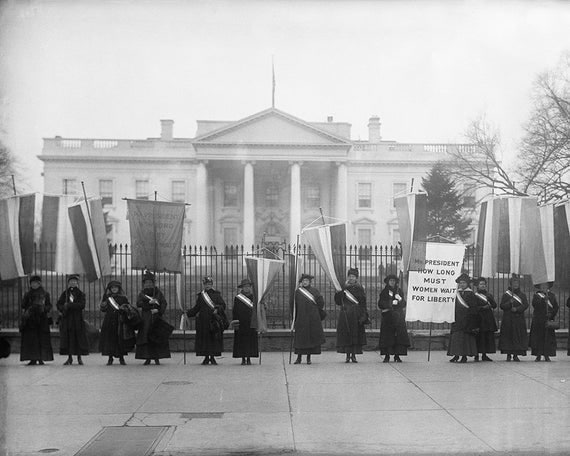
One hundred and two years ago, today, a group of women, organized by Women’s Rights Activist Alice Paul and the National Woman’s Party (NWP), began a picketing and protest campaign in front of the White House during the Wilson Presidency. Known as the Silent Sentinels, the protest began after a meeting with the President regarding suffrage proved fruitless with Wilson stating to the women to “…concert public opinion on behalf of women’s suffrage.” The silent protest was a new strategy for the National Suffrage Movement and served as a constant reminder of Wilson’s lack of support.

Originally founded as the Congressional Union for Woman Suffrage (CUWS) after the 1913 woman suffrage parade, they broke away from the National American Woman Suffrage Association (NAWSA), a more moderate group. CUWS only lasted three years and morphed into the NWP. The Suffragist was their weekly newsletter, containing essays, progress reports and notes on the President’s continuing indifference.
There were differing public reactions. Some approved, assisting with holding banners, bringing beverages and donating money. Some opposed their actions, including the leader of the NAWSA, Carrie Chapman Catt, whom preferred political tactics via individual states instead of a national amendment. She feared a male voter backlash.

Anti-suffragist mobs could be violent (worsening after the US entered World War I) spurred by the more insulting banners that compared Wilson to Kaiser Wilhelm. The New York Times called the protests “…silly, silent and offensive.” Massachusetts Representative Joseph Walsh referred to them as “…bewildered, deluded creatures with short skirts and short hair…” and “…nagging, iron-jawed angels.”
They were harassed, arrested, tortured and abused. Hunger strikes were met with forced feeding. On the night of November 14, 1917, known as the “Night of Terror“, the superintendent of the Occoquan Workhouse (prison), W.H. Whittaker, ordered the nearly forty guards to brutalize the suffragists. The treatment stories angered many Americans, creating more support. The protesters were finally released November 27 & 28, 1917, Alice Paul having spent five weeks there.
President Wilson finally announced his amendment support on January 8, 1918. The House barely passed the amendment the next day but, the Senate waited until October to vote. It failed by two votes. Protester arrests resumed August 6, 1918 and, by December, protestors were starting fires and burning Wilson effigies in front of the White House. Alice Paul encouraged people to vote against anti-suffrage Senators during the 1918 elections. The House, again, passed the amendment on May 21, 1919 and the Senate followed June 4 ending the six-day-a-week protest. The Nineteenth Amendment was adopted August 18, 1920.
See Iron Jawed Angels film.

Wayback Wednesday: Apple iTunes & iPhones

January 9 has been a very special day to Apple, Inc. On this day in 2001, Apple announced iTunes at MacWorld San Francisco, an application for Internet radio, music playing, ripping music from CDs and maintaining a library. The software ran on MacOS and Windows and, in 2003, you could download media from the iTunes Store. In 2005, Apple extended functionality for video and podcasts…University lectures in 2007 and, books in 2010. iTunes Radio, free music streaming, came in 2013 followed by Apple Music, paid music streaming, in 2015.

Apple has come under criticism for its digital rights management (DRM) encryption FairPlay. The protection of the music greatly limited what devices could play the files and brought about a movement to remove the restrictions. Steve Jobs penned an open letter to the music industry in February 2007. By April, non-DRM music appeared for download and the entire music catalog was DRM-free in January 2009.

On this day in 2007, Apple announced their first smartphone…again, at the MacWorld Conference & Expo in San Francisco. Quote from Steve Jobs:
“This is a day that I have been looking forward to for two and a half years. Today, Apple is going to reinvent the phone.”
From Wikipedia:
Apple created the device during a secretive and unprecedented collaboration with AT&T, formerly Cingular Wireless. The development cost of the collaboration was estimated to have been $150 million over a thirty-month period. Apple rejected the “design by committee” approach that had yielded the Motorola ROKR E1, a largely unsuccessful collaboration with Motorola. Instead, Cingular Wireless gave Apple the liberty to develop the iPhone’s hardware and software in-house. The whole effort was called Project Purple 2 and began in 2005. Six weeks before the iPhone was to be released, the plastic screen was replaced with a glass one, after Jobs was upset that the screen of the prototype he was carrying in his pocket had been scratched by his keys.
With the iPhone X costing $1,000 dollars, Apple rules the world.
Tune Tuesday: Eddie Cantor 1929

Ninety years ago, today, the #1 song playing was Makin’ Whoopee, a jazzy-blues piece performed by Eddie Cantor from the Broadway musical comedy Whoopee! The musical was written by William Anthony McGuire, composed by Walter Donaldson (Carolina In The Morning & My Mammy), with lyrics by Gus Kahn (It Had To Be You & Dream A Little Dream Of Me). It was based on the 1923 play The Nervous Wreck by Owen Davis.
American Theatre critic Brooks Atkinson of The New York Times praised Cantor for:
“…a comedian of deftness and appealing humor. He is sad. He is preoccupied. He is apprehensive or insinuating with those floating eyes… In the past he has been funny, clever and ludicrous. But, he has never been so enjoyable.”
Of the music, he states:
“Walter Donaldson has composed an appropriate score worthy of better singing than it falls heir to.”
Apparently, Mr. Atkinson disliked Cantor’s singing ability.
The musical was made into a movie in 1930, also pre-code and Eddie Cantor reprised his role from the musical. There was also a 1979 Broadway revival that did very well.
Synopsis From Wikipedia:
In California, Sheriff Bob Wells and the daughter of a rancher, Sally Morgan, are getting married. She is in love with Wanenis, whose part-Indian heritage presents social difficulties for their romance. Sally abandons Sheriff Bob and their wedding, catching a ride with Henry Williams. As a hypochondriac, Henry has problems of his own but, Sally adds to his problems when she leaves a note saying they have eloped. A chase ensues with the jilted Bob, Mary, Henry’s nurse (who is in love with him) and a cast of others. Along the way, they arrive at the Indian Reservation where Wanenis lives. The movie star Leslie Daw enters the proceedings and sings the torchy, sentimental “Love Me, or Leave Me.”
Trivia Bits:
♦ Eddie Cantor invented the name The March of Dimes for the donation campaigns of the National Foundation for Infantile Paralysis (polio), a play on the “March of Time” newsreels. He began the first campaign on his own radio show in January 1938, asking people to mail a dime to the nation’s most famous polio victim, President Franklin D. Roosevelt. Other entertainers joined in the appeal via their own shows and the White House mail room was deluged with 2,680,000 dimes.
♦ At one time, when the rights to The Wizard of Oz (1939) were owned by Samuel Goldwyn, Cantor was considered for the role of the Scarecrow. Goldwyn eventually sold the rights to Metro-Goldwyn-Mayer.
♦ Quote: “Marriage is an attempt to solve problems together which you didn’t have when you were on your own.”
Movie Monday: Design For Living 1934
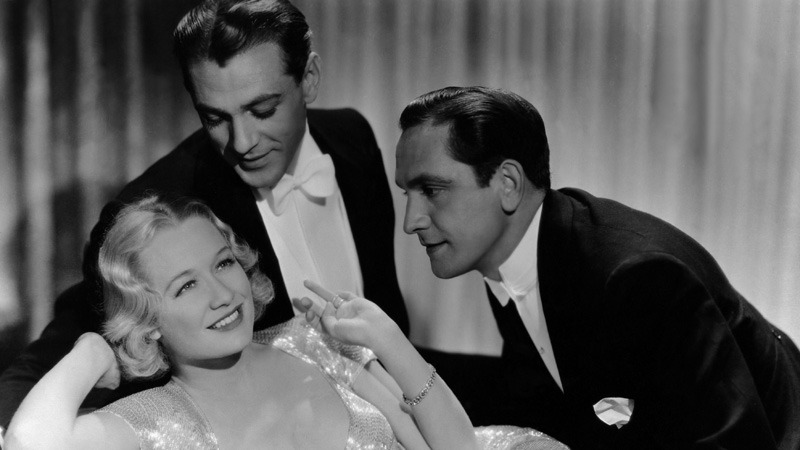
Eighty-five years ago, today, the #1 film at the box office was the menage a trois comedy Design For Living. Released on December 29, 1933, it starred Fredric March, Gary Cooper and Miriam Hopkins. It was based, loosely on a play written by Noël Coward in 1932. It was very risqué for its time and, was a pre-code movie produced and released before strict enforcement of the Motion Picture Production Code, the censorship guidelines demanded by American Roman Catholics. Interestingly, the critical response to the film was more about its gutting of the original material than of its questionable morality.
Two Americans sharing a flat in Paris, playwright Tom Chambers and painter George Curtis, fall for free-spirited Gilda Farrell. When she can’t make up her mind which one of them she prefers, she proposes a “gentleman’s agreement”: She will move in with them as a friend and critic of their work but, they will never have sex. When Tom goes to London to supervise a production of one of his plays, leaving Gilda alone with George, how long will their gentleman’s agreement last?
Trivia Bits:
♦ Gary Cooper spoke fluent French and was able to use it for the first time in this film.
♦ Lubitsch [then] asked Douglas Fairbanks Jr. to play George, and he accepted but, he contracted pneumonia just before filming was to start and he was replaced by Gary Cooper.
♦ Writer Ben Hecht and producer-director Ernst Lubitsch retained only one line from the original play by Noël Coward: “For the good of our immortal souls!”
♦ Considerable censorship difficulties arose because of sexual discussions and innuendos, although the Hays Office eventually approved the film for release. However, it was banned by the Legion of Decency and was refused a certificate by the PCA for re-release in 1934, when the production code was more rigorously enforced.
Nominations:
♥ American Film Institute (AFI) 100 Years…100 Passions
♥ American Film Institute (AFI) 10 Top 10: Romantic Comedy
Chris Thomas: Time-Lines
A PDF Essay From: The Chris Thomas Files
There is a great deal of confusion raging over the issue of time and whether there are alternate time-lines at work on Earth and, if so, will these alternate time-lines have any affect on the changes in consciousness we are currently undergoing. To begin with, we need to understand the nature of time and how it affects our lives, whether on Earth or in the Universe beyond. On Earth, we are used to understanding time as being a linear progression. Our Earth revolves around the sun on an orbit that takes a regular, measurable, quantity of time to complete. We take this orbital time as one year. Each year is sub-divided in ways which depend upon the amount of sunlight received by regions of the planet…these are the four seasons.
Next, the Earth revolves on its own axis, producing periods of day light and periods of darkness, called night. We have divided this regular day-time/night-time pattern into 24 hours, each hour being divided into 60 minutes which are further sub-divided into 60 seconds. So, as far as the inhabitants of Earth are concerned, time is divided into a series of regular units which count off the time-span of our lives. Ultimately, this form of measurement and division is dependent on light and the speed at which it travels. In our solar system, light has been measured to travel at 30,000,000 metres per second or 186,000 miles per hour…or thereabouts. However, we live in a solar system which is unique and the speed at which light travels is not the constant that scientists like to think it is once we leave the solar system.
Time As An Energy
To begin to understand how everything fits together, we have to step away from the limited scientific ways of gaining knowledge and turn to the “memory” that is a fundamental part of the structure of this Universe. This “memory” is more usually called “The Akashic”. The Akashic contains the record of everything that has ever occurred within this Universe. As someone who has the ability to access this record keeping aspect of the Universe, the author has spent thirty years exploring this information source to try to find answers to the problems we have been encountering on Earth. When it comes to understanding the workings of the Universe, the Akashic is a totally reliable source and is totally contradictory to the way in which scientists have theorised its workings over the centuries.
We live in an energetic Universe. This means that all that we see in the night skies is comprised of energy. The same applies to Earth. Everything we think of as being physical is not actually solid but, comprised of energy. Our brains and senses work in such a way as to make us believe that we live in a physical world whereas, all is energy of different, and differing, frequencies which our brains interpret as being solid. In this sense, we tend to experience time as a solid thing…one second follows another as the Earth revolves and the sky darkens or lightens. Time “feels” physical to us.
However, if we step outside of our solar system, everything begins to change. Light travels at different speeds and, therefore, our perception of time alters and linear measurements of time do not necessarily apply…and certainly do not apply in the way in which we measure time on Earth. If it were possible to stand at a point which was at the centre of the Universe, we would see time as two energy spirals…one stretching behind us, back in time and, one stretching in front of us which would represent the future. If we had sufficient energy potential, we could travel backwards in time but, we could not travel forwards…we cannot travel to a time which does not yet exist.

Quantum Physics’ Alternate Universes
Most of the explanations provided by scientists are based on the world being a physical place as theorised by Isaac Newton in the 1700’s. Science sees the conditions that exist on Earth and tries to apply those same conditions to the Universe as a whole. The scientific view began to change about 100 years ago when they started to explore that which exists at levels below the size of an atom. The term “quantum” means the smallest quantity of some physical attribute that a process or system contains.
In this new realm, everything that they thought applied to the world had to be newly explored and understood. As far as science is concerned, the quantum world bears little resemblance to the world outside, the world they thought they understood. As their exploration of the quantum progressed, they began to develop new theories to make their experiments explainable. One thing they did find was that the scientist could create his own reality. If a scientist “thought” that light travelled in particles, his experiments “proved” that light travelled in particles. If a scientist believed that light travelled in waves, his experiments “proved” that it travelled in waves. In other words, the experimenter “created” his own reality.
The experiments and observations carried out into quantum phenomena showed, time and time again, that it is what the scientist believed the outcome would be that determined what actually happened. This led to a great deal of theorising about how the world, and the Universe at large, actually works. As they daydreamed about the nature of reality and how the scientist could create their own, they began to postulate about “alternate” realities. Quite why they should do this is not explained given that they have not even begun to understand our current reality.
Essentially, scientists studying the quantum world started thinking about their experiments. If what I think is going to occur does occur, what happens to all of the answers received by other scientists? To try to make sense of this, they came up with the idea that every scientist’s experiment formed its own reality and these alternate realities must exist somewhere. If the nature of the Universe is determined by how someone thinks it works, then, all of the other theories must create a universe of their own. And, if new universes were created, then, there must be different time-lines running parallel to ours. So this is how the concept of alternate, parallel universes arose and, how the concept of alternate and parallel time-lines fitted in with it.
The alternate, parallel universe concept runs something like this:
If I am faced with making a decision, I consider all of the possible alternate options I am aware of. I consider all of these alternative answers and choose one which I believe will work and, then, act on it. Taking action on my decision fits into the current time-line. But, what of all of the alternate options that I rejected? Each of those answers were viable in some way and could have resolved the problem I needed to decide on. Therefore, each possible option could lead to a different solution to the problem and, that alternative solution must exist somewhere…which runs on its own independent time-line. This, obviously, does not encroach on our current time-line, therefore, it must exist in an alternate universe!
The author’s own research into this theory would indicate that it is a hangover from too many post-conference alcoholic beverages.
To return to reality and the Akashic…
To continue reading (it’s eight pages), download the PDF version HERE.
[Note: This PDF was originally posted on The Spirit Guides UK website on August 23, 2011.]
Shutterbug Saturday: Christmas Local 2.0

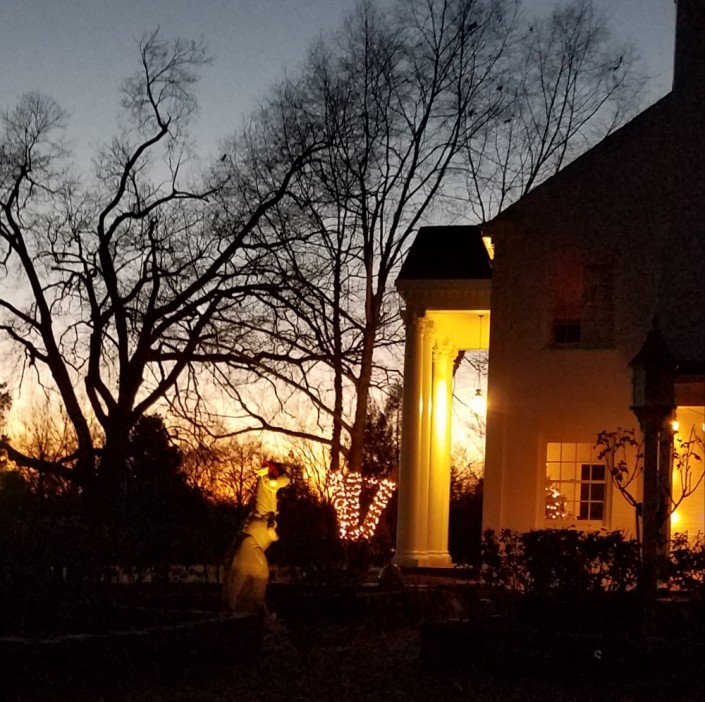
Beautiful home a block away.
Part II of 2018 Christmas reflections.



Registered National Historic Landmark
Built in 1772 by Francis Nash
Was home to William Hooper 1782-90





Foto Friday: Christmas Local

Iron Reindeer & Sled
Foto Friday, local flair…something a little different from Shutterbug Saturday.

Iron Sled & Reindeer in the background.


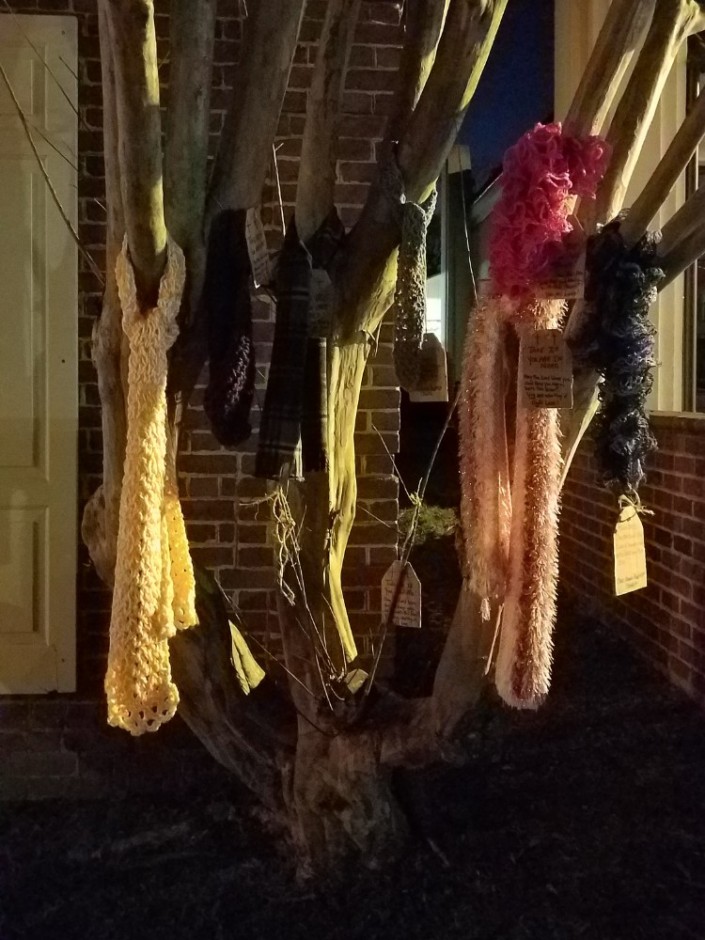

More to come… ~Vic
Wayback Wednesday: Speed Law 1974

Forty-five years ago, today, President Richard Nixon signed The Emergency Highway Energy Conservation Act which created the National Maximum Speed Law, prohibiting speed limits higher than 55 miles per hour (90 km/h). If states wished to receive any federal funds for highway repair, they were forced to comply.
The legislation was created in an effort to conserve gasoline after the OPEC oil crisis embargo started the previous October. This oil shock had its roots in two issues:
(1) The US pull-out of the Bretton Woods Accord, detaching the dollar from the price of gold, depreciated the currency and oil producers lost money.
(2) Nations supporting Israel during the Yom Kippur War were targeted.
The embargo ended in March of 1974 but, the price of oil had quadrupled by then. The Strategic Petroleum Reserve started in 1975 as a second response. The Department of Energy in 1977 and the National Energy Act of 1978 followed via President Jimmy Carter.
The Speed Limit Law was made permanent by President Gerald Ford via the Federal-Aid Highway Amendments of 1974.
All speed limit controls were lifted with the National Highway System Designation Act of 1995 via President Bill Clinton on November 28, 1995.
 Cosmic-Observation