blogger
Flick Friday: [The] Forbidden Lover 1923

One hundred years, ago, today, the black & white silent film [The] Forbidden Lover was released. Brackets around “THE” is a product of the differences of the title from data sources. This film is an edited version of The Power of Love, the very first 3-D movie, released on September 27, 1922 at the Ambassador Hotel Theater in Los Angeles. Both films are believed lost.
Directed by Nat G. Deverich and, written by Kate Corbaley & Caroline Crawford, it starred Elliot Sparling, Barbara Bedford, Noah Beery, Aileen Manning, Albert Prisco and John Herdman.
Yankee sea captain lands on the coast during the old Spanish days to trade with the ranch owners. He meets a girl who is betrothed to a man she loathes. After a series of adventures and narrow escapes, he shows up the unscrupulous ranch owner and wins the girl.
IMDb [The] Forbidden Lover Storyline
Motion Picture News Booking Guide
October 1923
Production Company: Sierra Productions
Tagline: A Romance Of Early California
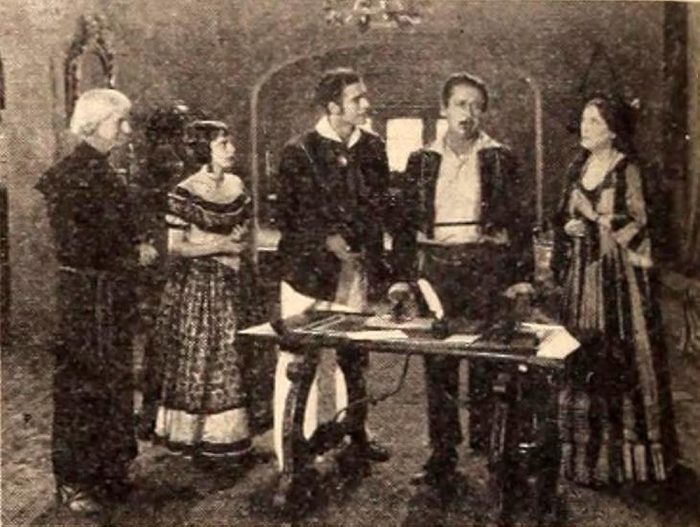
The Power Of Love
Image Credit: IMDb & Amazon
Because of his financial trouble, Don Almeda promises his daughter, Maria, to Don Alvarez but, Maria does not love [him]. In fact, she falls in love with Terry O’Neil, a stranger who has been wounded by robbers associated with Alvarez. O’Neil takes Alvarez’s place at a masked ball. Alvarez, in turn, robs the old Padre of some pearls and stabs him to death with O’Neil’s knife. He then accuses O’Neil of the murder and tries to shoot him but, wounds Maria instead, having thrown herself in front of him. Maria recovers and, after proving that Alvarez is a thief and a killer, weds O’Neil.
IMDb The Power of Love Storyline
Moving Picture World
October 1922
Production Company: Perfect Pictures
Tagline: A pair of spectacles will be handed to you as you enter the theatre, through which you will view the new sterescopic pictures.
The Power of Love was screened in front of a live audience at the Ambassador Hotel Theater […]. It was projected dual-strip in the red/green anaglyph format, making it both the earliest known film that utilized dual strip projection and the earliest known film in which anaglyph glasses were used. The camera rig used to shoot the film was made by the producers themselves and as you can imagine, it was far from perfect. Simply put, the film was not a success. It was screened, again, for exhibitors, and press, in New York City and, then, almost immediately fell out of sight. It was not booked again by other exhibitors. Unfortunately, we may never see what this movie looked like.
3-D TV & Movies
The first stereoscopic image dates to 1844, which makes 3-D images as old as the art of photography. [No] less a personage than Queen Victoria was photographed in 1854 in stereoscopic 3-D. 3-D stereoscopic moving images date to the 1850s with what was called the Kinetamatoscope [sic]. The first public display of a 3-D movie came in 1922 with The Power of Love […]. The film received a decent review in Moving Pictures World, then promptly disappeared from history by changing its title to Forbidden Lover and touring the country in a 2-D version. It was too complex and costly at the time to take 3-D on the road.
Randome
Looking Up/My Daily Plant Blogspot (Blogger)
Cirque de 3-D
March 6, 2009
What Was The First 3D Movie? (3D TV & Movies/Web Archive/06-02-2011)
A Tour Through The History Of 3-D Movies (Reelz/Jeff Otto/01-22-2009/Web Archive/07-20-2012)
Forbidden Lover (Silent Era/06-08-2013)
The Power of Love (Silent Era/10-16-2011)
Forbidden Lover (TCM)
The Forbidden Lover (AFI Catalog)
The Power of Love (AFI Catalog)
The Shot Of The Year (The Dissolve/Calum Marsh/12-19-2014)
Wayback Wednesday: International Webloggers Day 2004

International Weblogger’s Day, also known as InWeDay, is celebrated on June 14 every year. This unofficial holiday was created to bring together bloggers from around the world and, to promote blogging as a way to express yourself and engage in dialogue with people from different countries and backgrounds.
A blog (short for “weblog“) is an online diary consisting of discrete, often informal entries called posts. Most blogs are primarily textual but, they may include other types of content such as images, videos, music and audio.
The term “weblog” was coined [by Jorn Barger] in 1997 [December 17] and its short form, “blog“, was first used [by Peter Merholz when he playfully broke the word into “we blog“] in 1999. That same year, Pyra Labs launched Blogger, one of the first blog-publishing platforms that allow users to create and run blogs for free without any programming background.
In 2004, around 500 bloggers from over 40 countries supported the idea of creating a holiday that would unite blogging enthusiasts from around the world. The inaugural International Weblogger’s Day was held on June 14, 2004. On the occasion of the holiday, bloggers write special posts for their online diaries. In some cities, special meetings are organized where bloggers can meet “offline”.
Unfortunately, the popularity of International Weblogger’s Day has decreased considerably over the recent years.
Anyday Guide
Additional:
♦ Peter Merholz (Blog)
♦ Blogs Turn 10 ~ Who’s The Father (CNET News/Declan McCullagh/Anne Broache/March 20, 2007/ Web Archive Version)
♦ It’s The Links, Stupid (The Economist/Special Report/April 22, 2006)
♦ Robot Wisdom Weblog (Jorn Barger/Wayback Machine/August 15, 2000)
♦ Carolyn’s Diary (Early Online Diary/Carolyn Burke/April 1997)
♦ Scripting News (Longest Running Weblog/Dave Winer/September 1997)
♦ Blogger (Created By Three Friends/San Francisco Pyra Labs/August 1999)
♦ Weblog Awards (Bloggies/2001)
♦ WordPress Available Now (First Official Version/Matt Mullenweg/May 27, 2003)
♦ Steve Garfield (Early Video Blog/January 2004)
♦ AOL Snaps Up Weblogs (CNET/Dawn Kawamoto/October 7, 2005)
♦ Full Time Blogger Kottke Throws In The Towel (CNET/Graeme Wearden/February 23, 2006)
POTD: Lost Booties
[Update… blogger and skincare specialist Ruth has pointed out my terrible storytelling and possible crimes against proper sentence structure (I’m so laughing, Ruth…). No, I didn’t find these booties walking down the sidewalk all by themselves. I should have inserted “while I was” ahead of “walking”, hopefully indicating that *I* was doing the walking, not the empty booties. Thanks, Ruth. I really must behave myself in the future!]
Found these […] walking on the sidewalk. The stone on this wall is at the corner of the James Cheek house property (c. 1875). I guess they weren’t wanted anymore.
I am forever finding strange things in this town. ~Vic

08-16-2020
Picture of the Day
Wayback Wednesday: Gulliver’s Travels 1726
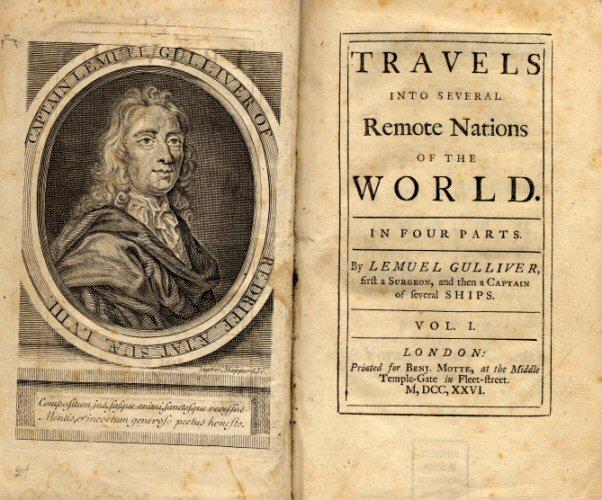
Two-hundred, ninety-four years ago, today, the book of satirical stories, Gulliver’s Travels was published. Written by Irish clergyman Jonathan Swift, the original title was Travels into Several Remote Nations of the World. In Four Parts. By Lemuel Gulliver, First a Surgeon, and then a Captain of Several Ships. That has to be the longest book title in existence. I’ve never read any of it, nor have I seen the various movies that have been put out. That being said, there are several well written summaries and opinions on the material and, I’m not reinventing the wheel. ~Vic
Gulliver’s Travels Study Guide on Grade Saver:
Gulliver’s name probably is an allusion to King Lemuel of Proverbs 31, who was a weak-minded prophet. Swift may also be connecting his character to a common mule, a half-ass, half-horse animal that is known for being stubborn and stupid. A gull is a person who is easily fooled or gullible. At the same time, Gulliver represents the everyman with his average intelligence and general good humor. The reader is able to identify with him and join him in his travels. Even though Swift constantly alludes to events that were happening while he was alive, the story rings true today, bringing light to our own societal issues and to patterns of human nature. Throughout Gulliver’s voyages, Swift goes to great lengths to scrutinize, parody, and satire various aspects of human, and often English, society.
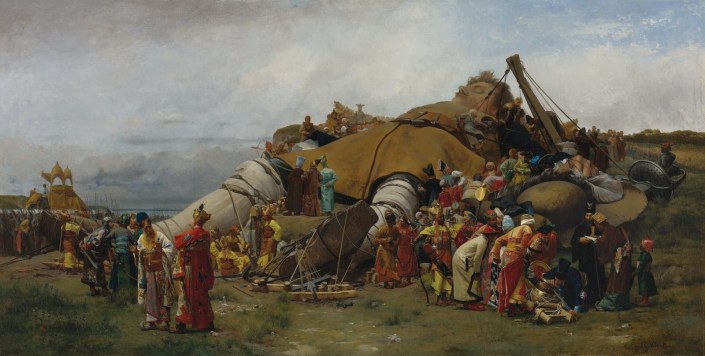
A mock work of travel literature, Jonathan Swift’s famous novel is a far deeper work than one of just Juvenalian and Horatian satire. It is an indictment against the prevailing spirit of Enlightenment philosophy and utopianism, an esoteric defense of Christianity against its Enlightenment critics, and a prophetic vision into the future degeneration of humanity in following the dictates of the natural philosophers of modernity. Swiftian irony is one of the great joys of the work. [Where] traditional literary narrative has the travelling protagonist return home to comfort and love, Swift’s Gulliver returns home deranged and a hater of humanity.
Additional Reading:
1939 Animated Movie (IMDb)
1977 UK Movie (IMDb)
1996 TV Mini-Series (IMDb)
20th Century Fox 2010 Movie (IMDb)
Britannica
Gulliver’s Travels (Wikipedia)
Jonathan Swift (Wikipedia)
Wikisource Text of the Book
POTD: Hiatus
I’m taking a break from blogging for a while. I’m kinda burned out. In fact, I’m burned out on a lot of things. I’m not sure when I will return. ~Vic

02-25-2020
Picture of the Day
FFTD: Ruellia
A member of the Acanthaceae family, this could be a Ruellia Simplex or Mexican Petunia, Mexican Bluebell or Britton’s Wild Petunia. It could be a Ruellia Tuberosa or Minnieroot, Fever Root, Snapdragon Root or Sheep Potato. Honestly, they look the same to me. ~Vic

Click for a larger view.
Flower for the Day
Throwback Thursday: SN 1054

While my nation celebrates its Independence Day (and twenty-six other nations in the month of July), nine-hundred & sixty-five years ago, today, Supernova 1054 was discovered.
SN 1054 is a supernova that was first observed on 4 July 1054 and remained visible for around two years. The event was recorded in contemporary Chinese astronomy [..]. [There is] a pictograph associated with the Ancestral Puebloan (Anasazi) culture found near the Peñasco Blanco site in New Mexico. The remnant of SN 1054, which consists of debris ejected during the explosion, is known as the Crab Nebula (M1). It is located in the sky near the star Zeta Tauri (ζ Tauri) The core of the exploding star formed a pulsar called the Crab Pulsar. When the French astronomer Charles Messier watched for the return of Halley’s Comet in 1758, he confused the nebula for the comet as he was unaware of the former’s existence. Motivated by this error, he created his catalogue of non-cometary nebulous objects, the Messier Catalogue, to avoid such mistakes in the future. The nebula is catalogued as the first Messier object […].
[Source]

Chinese astronomers watching the sky on July 4, 1054, noted the appearance of a new or guest star just above the southern horn of Taurus. Other observations of the explosion were recorded by Japanese, Arabic and Native American stargazers. In 1731, British astronomer John Bevis observed a cloudy blob in the sky and added it to his star atlas. Although [Messier] credited himself with its discovery in his first publication of the Messier Catalog, he acknowledged Bevis’ original finding in subsequent versions after receiving a letter from the astronomer. Around 1844, [Irish] astronomer William Parsons, the third Earl of Rosse, sketched the nebula. The resemblance of the image to a crustacean led to M1’s other name, the Crab Nebula. In the early 20th century, astronomers (Carl Lampland/1921 & Edwin Hubble/1928, included) were able to take more detailed measurements of M1 and determined that it is expanding. Working backwards, they determined its origination date and matched the explosion up with observations from Chinese and Native American records.
[Source]

Alex Marentes
flickr.com
earthsky.org
It is likely that skywatchers of the Anasazi People in the American Southwest also viewed the bright new star in 1054. Historic research shows that a crescent moon was visible in the sky very near the new star on the morning of July 5, the day following the observations by the Chinese. The pictograph above, from Chaco Canyon in New Mexico, is believed to depict the event. The multi-spiked star to the left represents the supernova near the crescent moon. The handprint above may signify the importance of the event, or may be the artist’s “signature.”
[Source]
Happy 4th, everyone! ~Vic
Movie Monday: A Butterfly’s Metamorphosis 1904
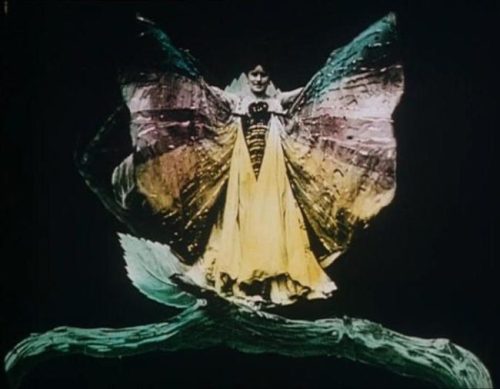
One hundred, fifteen years ago, in June, the short, French film La métamorphose du papillon or, A Butterfly’s Metamorphosis was released. The two-minute silent was directed by Gaston Velle, produced by Pathé Frères and, one of the distribution companies for the US was Edison Manufacturing Company.
From Wikipedia:
Gaston Velle was a French silent film director, and pioneer of special effects, who was prominent in early French and Italian cinema during the first two decades of the 20th century. Gaston began his career as a travelling magician before putting his illusionist skills to work in cinema and, ultimately, creating more than fifty films between 1903 and 1911. He worked under Auguste and Louis Lumière before serving as the head of production for the Italian film studio Cines. […] he is best remembered for his work at Pathé where he was hired to produce trick films that might rival those of his contemporary, Georges Méliès […]. Velle also created some of the first Féerie films […]. [He] mysteriously retired from film production in 1913 and little is known about the last several decades of his life.
[Disclaimer: Very little is known about this film and the above Wikipedia information is presented without any citations.]
National Mad Hatter Day
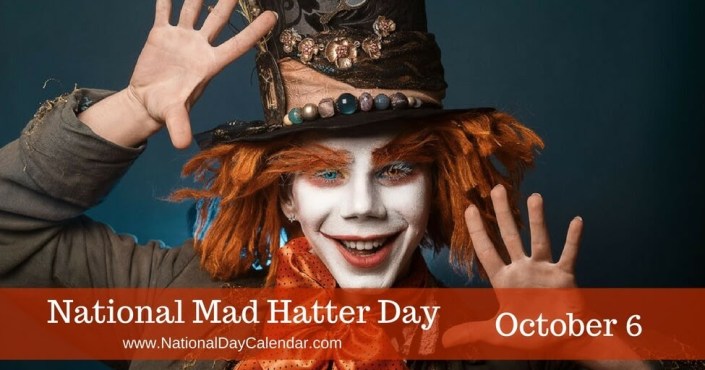
Oh, I just couldn’t pass this one up.
October 6 has four celebrations and a brand new one. Today is National Mad Hatter Day, which is àpropos to this being the month of Halloween. Considering recent political dramas, theatre of the absurd also applies.
Being ‘mad as a hatter’ was a real thing at one time, all silliness aside. During the late 18th and early 19th centuries, mercury nitrate was used extensively by haberdasheries in the production of felt. The symptoms of mercury poisoning or, Erethism were a myriad of crazy behaviors due to the neurological damage.
But, in the case of today’s Mad Hatter Day, grab a top hat and be ridiculous. Celebrate Lewis Carroll’s colorful character and be an “Alice in Wonderland” if you so choose.
Also celebrated today:
National Plus Size Appreciation Day
National German-American Day
National Noodle Day (I’m not kidding)
National Orange Wine Day (Founded by The Real House Wine to bring awareness to, of course, orange wines. It was proclaimed, today, by the Registrar at National Day Calendar.)
Cheers and enjoy!
 Cosmic-Observation