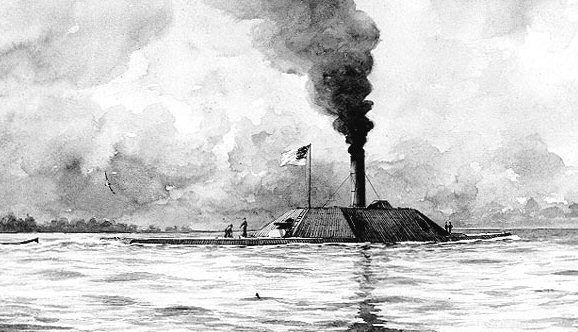
In a combined operation with the ironclad ram CSS Albemarle, Confederate forces under Maj. Gen. Robert F. Hoke, attacked the Federal garrison at Plymouth, North Carolina, on April 17. On April 19, the ram appeared in the river, sinking the USS Southfield, damaging the USS Miami and driving off the other Union Navy ships (USS Ceres & USS Whitehead) supporting the Plymouth garrison. Confederate forces captured Fort Comfort, driving defenders into Fort Williams. On April 20, the garrison surrendered.
*************
Construction of the ironclad began in January 1863 and continued on during the next year. Word of the gunboat reached the Union naval officers stationed in the region, raising an alarm. They appealed to the War Department for an overland expedition to destroy the ship, to be christened Albemarle after the body of water into which the Roanoke emptied but, the Union Army never felt it could spare the troops needed to carry out such a mission. It was a decision that would prove to be very short-sighted.
In April 1864, the newly commissioned Confederate States Steamer Albemarle, under the command of Captain James W. Cooke, got underway down-river toward Plymouth, North Carolina. Its mission was to clear the river of all Union vessels so that General Robert F. Hoke‘s troops could storm the forts located there.
[…] two paddle steamers, USS Miami and USS Southfield, lashed together with spars and chains, approached from up-river, attempting to pass on either side of Albemarle in order to trap her between them.
Image Credit: sonofthesouth.net
The sinking of the USS Southfield.
Captain Cooke turned heavily to starboard, getting outboard of [the] Southfield but, running dangerously close to the southern shore. Turning back sharply into the river, he rammed the Union side-wheeler, driving her under. Albemarle’s ram became trapped in Southfield’s hull from the force of the blow and her bow was pulled under as well. As [the] Southfield sank, she rolled over before settling on the riverbed. This action released the death grip that held the new Confederate ram.
Miami fired a shell into Albemarle at point-blank range while she was trapped by the wreck of Southfield but, the shell rebounded off Albemarle’s sloping iron armor and exploded on [the] Miami, killing her commanding officer, Captain Charles W. Flusser. Miami’s crew attempted to board Albemarle to capture her but, were soon driven back by heavy musket fire. [The] Miami then steered clear of the ironclad and escaped into Albemarle Sound.
With the river now clear of Union ships, and with the assistance of Albemarle’s rifled cannon, General Hoke attacked and took Plymouth and, the nearby forts.
Image Credit: emergingcivilwar.com & Miller’s Photographic History
CSS Albemarle shortly after the battle.
Confederate forces attack Plymouth, North Carolina, in an attempt to recapture ports lost to the Union two years before. The four-day battle ended with the fall of Plymouth but, the Yankees kept the city bottled up with a flotilla on nearby Albemarle Sound.
In 1862, the Union captured Plymouth and several other points along the North Carolina coast. In doing so, they deprived the Confederacy of several ports for blockade-runners and the agricultural products from several fertile counties. In the spring of 1864, the Confederates mounted a campaign to reverse these defeats. General George Pickett led a division to the area and launched a failed attack on New Bern in February. Now, General Robert Hoke assumed command and moved his army against Plymouth, fifty miles north of New Bern. He planned an attack using the C.S.S. Albemarle, an ironclad that was still being built on the Roanoke River inland from Plymouth.
With 7,000 men, Hoke attacked the 2,800-man Union garrison at Plymouth on April 17. His troops began to capture some of the outer defenses but, he needed the Albemarle to bomb the city from the river. The ironclad moved from its makeshift shipyard on April 17 but, it was still under construction. With workers aboard, Captain James Cooke moved down the Roanoke. The Albemarle‘s rudder broke and the engine stalled, so it took two days to reach Plymouth. When it arrived, the Rebel ship took on two Yankee ships, sinking one and forcing the other to retreat. With the ironclad on the scene, Hoke’s men captured Plymouth on April 20.
The Rebel victory was limited by the fact that the Albemarle was still pinned in the Roanoke River.
Weatherly told Tom Roland in The Billboard Book of Number One Country Hits that he wrote the song in 1971 and let his father-in-law first record it as a Christmas present for the latter’s wife. “I thought it was really strange that nobody’d written a song with that title — possibly somebody had but, I’d never heard it — so, I just sat down and let this stream of consciousness happen. I basically wrote it in a very short period of time, probably 30 minutes or an hour.”
The Passion of the Christ focuses on the last twelve hours of Jesus of Nazareth’s life. The film begins in the Garden of Gethsemane where Jesus has gone to pray after sitting [at] the Last Supper. Jesus must resist the temptations of Satan. Betrayed by Judas Iscariot, Jesus is then arrested and taken within the city walls of Jerusalem where leaders of the Pharisees confront him with accusations of blasphemy and, his trial results in a condemnation to death.
If ever there was a film with the correct title, that film is Mel Gibson’s “The Passion of the Christ.” The movie is 126 minutes long and, I would guess that at least 100 of those minutes, maybe more, are concerned, specifically and graphically, with the details of the torture and death of Jesus. This is the most violent film I have ever seen.
What Gibson has provided for me, for the first time in my life, is a visceral idea of what the Passion consisted of. That his film is superficial in terms of the surrounding message — that we get only a few passing references to the teachings of Jesus — is, I suppose, not the point. This is not a sermon or a homily but, a visualization of the central event in the Christian religion. Take it or leave it.
David Ansen, a critic I respect, finds in Newsweek that Gibson has gone too far. “The relentless gore is self-defeating,” he writes. “Instead of being moved by Christ’s suffering or awed by his sacrifice, I felt abused by a filmmaker intent on punishing an audience, for who knows what sins.” This is a completely valid response to the film, and I quote Ansen because I suspect he speaks for many audience members, who will enter the theater in a devout or spiritual mood and emerge deeply disturbed. You must be prepared for whippings, flayings, beatings, the crunch of bones, the agony of screams, the cruelty of the sadistic centurions, the rivulets of blood that crisscross every inch of Jesus’ body. Some will leave before the end.
Trivia Bits
♦ On February 11, 2008, Benedict Fitzgerald filed a lawsuit against Mel Gibson and the production company Icon Productions, alleging the unfair deprivation of compensation and deception on the overall expense of the film production budget after the blockbuster box office success of the film The Passion of the Christ, including, but not limited to, “fraud, breach of contract & unjust enrichment” seeking unspecified damages.
♦ Jim Caviezel experienced a shoulder separation when the 150lbs cross dropped on his shoulder. The scene is still in the movie.
♦ In an interview with Newsweek magazine, Jim Caviezel spoke about a few of the difficulties he experienced while filming. This included being accidentally whipped twice, which has left a 14-inch scar on his back. Caviezel also admitted he was struck by lightning while filming the Sermon on the Mount and during the crucifixion, experienced hypothermia during the dead of winter in Italy.
First of all, I have to say that I am not an expert on the Mayan Calendar. I am aware of the “epochs” and “rounds” of the Calendar but, not the workings of the “tuns” and “bactuns” that make the Calendar work. Having said that, the only date within the Mayan Calendar that seems to have captured everyone’s imagination, and concern, is that of the 21st of December 2012 (21/12/12 or 12/21/12 depending on which country you live in).
The Mayan Calendar is not the only ancient calendar that exists on the planet. The ancient Egyptians had their own calendar form but, this is largely lost to us as academics and “pyramidiots”, sorry Egyptologists, have kept it from non-specialist eyes. However, the Egyptian Calendar also notes a major shift in our existence towards the end of 2012. The Chinese also have their own calendar system going back at least 5,000 years. Their calendar is known in the west but, has been reduced to a fortune-telling tool – the I Ching. The I Ching also foretells of major changes at the end of 2012. There are a number of other ancient calendar systems from around the world but, most have been lost or have been deliberately destroyed to hide their contents away from the westernised world.
As far as the Akashic is concerned, the most important date occurred at the end of 2011. This was the completion of The Human Plan, which has been in operation for 7,000 years.
Background
Our solar system is unique in that it is the only place within our Universe where life exists at a level of energy compaction we call “physical”. In all other parts of our Universe, life exists at energy levels that are considered “non-physical” or “semi-physical”. I am not going to describe those states of being here as they are fully covered by my books and previous essays. Virtually all of the souls that exist in human form have originated from the non-physical or semi-physical regions of our Universe. In other words, their “soul origins” are not of this solar system but, have chosen to come to Earth to experience what it is to be physical.
There are souls whose soul origin is Earth but, they are outside of the scope of this essay.
Originally, every planet in our solar system supported physical life as well as a version of the life-forms we call human. 3.6 million years ago, this situation changed and the only planet within our solar system that continued to support life since then has been our Earth.
Life has continued on one of Jupiter’s moons but, that is outside of the scope of this essay.
The primary purpose of our solar system is to explore the possibility of developing and sustaining a form of life that is capable of containing the whole of a soul within it. On Earth, this life-form we know [is] Human Beings. Please note the capitol [sic] letters. Again, I am not going into the complexities of Human existence in this essay as that history is detailed in my books and previous essays.
The full state of being Human we achieved on Atlantis but, for various reasons, we destroyed that continent 65,000 years ago. Following the destruction, we returned to Earth 25,000 years ago and started again. At that time we were also a full Human, the whole of the soul within the physical body but, we began to lose our “higher” faculties. […] so, we developed a strategy for how we could explore the possibilities and potential that Earth presented and, also to find a way to achieve full Human status again. Essentially, the loss of our higher faculties amounted to a loss of some elements of the soul from the body. The strategy we developed was designed to help us find a way of re-merging the whole of the soul back into the physical.
This strategy we named “The Human Plan” and we began working with it 7,000 years ago.
Image Credit: mnn.com
The Human Plan
The definition of a Human Being is a “physical” being that contains the whole of the soul. By the time we put The Human Plan into operation, our souls were divided into two: the “physical self” and the “higher self”. This divided soul state meant that the Earth considered us to be “sub-human”. That is human with a small “h”. The Human Plan was very simple:
We would live a series of lifetimes experiencing all that there is to experience by being in a physical body living on a physical planet and, collectively, we would pool our gained knowledge until we found a way of returning the whole of the soul back into the body…become Human again. In order to achieve this, the Earth’s consciousness gave us a time limit of 7,000 years. That 7,000 year period finished on the 29th of October 2011.
At the same time as we set The Human Plan into action, all of the ancient calendar systems were begun. Given that most of these ancient calendars have been lost to us, in one way or another, the only one that remains is the Mayan Calendar.
The Mayan Calendar
The Mayan Calendar was actually begun 7,000 years ago but, it spans a time-frame of roughly 26,000 years. The basis of Mayan traditions is connected with the phases of development that our solar system underwent. Each stage required differing energy potentials and these potentials were supplied by our sun. Therefore, the Mayan Calendar records sun cycles and, according to Mayan traditions, we are approaching the end of the “5th Sun”. This means that we are leaving the current phase of energy requirements, supplied by our sun and, are about to enter into a new phase of development which requires a different combination of energy frequencies…a “6th Sun”.
In comparison with The Human Plan, the Mayan Calendar appears to be out of sync. The Human Plan came to its completion at the end of 2011 (according to the Akashic), whilst the Calendar comes to its completion on the 21st of December 2012. To understand this, we need to look at the Calendar as a whole. Again, I must state that I am no expert on the intricacies of the Calendar with only a basic understanding of its cycles. I am sure that there are many people reading this essay who have greater knowledge of the full workings of the Calendar, so, I apologise in advance if I have some of the detail wrong. My intention is to show some of the basic workings and put it into context within The Human Plan in relation to the 21st December.
We are used to using calendars in our daily lives as a means of counting off the days from the start of the year or of counting the days until an event is due to occur. The Mayan Calendar is different. It does count off the number of days but, it also contains predictive elements, in that it predicts cycles and major events known as “Epochs”. When the Calendar is worked backwards, it can be used to go backwards for many thousands, if not millions, of years and it has been shown to predict some events, in that those events occur at the end of the cycles built into the Calendar. These ends of cycles, or the markers of major events, are even more pronounced when the cycle marks the end of an Epoch.
To continue reading (it’s 4 pages), download the PDF version HERE.
[Note: This PDF was originally posted on the One-Vibration Forum Blog on December 11, 2012.]
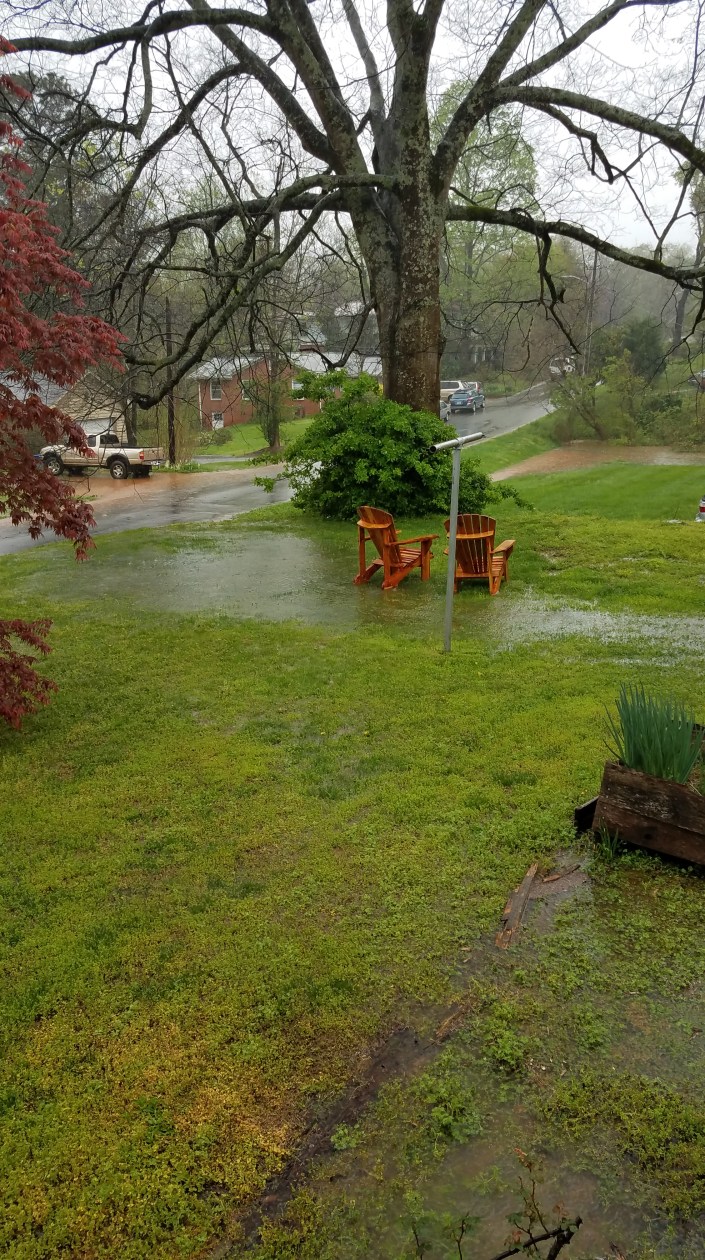
Or, Toad Strangler or, Gully Washer… My dad was fond of the frog saying and my maternal grandfather always used the latter. All three are good descriptions of the storm that just swept through here, today. I haven’t seen this much water since Hurricane Matthew in 2016. Have mercy… ~Vic
I thought my chairs might float away.
The backdoor neighbor had his own mini-river.Patio at the side door looks like a mini-swimming pool.
Water from the next door neighbor’s poor drainage…The gold pick-up in the first photo…this is his backyard.
The Eno hasn’t crested, yet and, the water is at his backdoor right now.Bench at Turnip Patch Park didn’t fare well.Entrance to Gold Park underwater.
One sewer access is over-flowing.Underwater graffiti.
See my previous post on this. Picture #2
Image Credit: sonofthesouth.net
Original Harper’s Weekly leaflet.
Confederate batteries firing on Fort Sumter.
The illustration above captures the first significant battle of the Civil War.
S. C. Major Anderson had long urged his government, but in vain, to strengthen the military works in Charleston Harbor. The burden of the few replies was: “Be prudent; be kind; do nothing to excite the South Carolinians. It will not do to send you reinforcements, for that might bring on hostilities.” At length he was satisfied that the people were about to attempt to seize Fort Sumter.
[..] he resolved to take position in Sumter before it should be too late. He was commander of all the defenses of the harbor, and, in the absence of orders to the contrary, he might occupy any one he chose.
Governor Pickens sent a message to Anderson demanding his immediate withdrawal from [the fort]. The demand was politely refused and, the Major was denounced in the State convention, in the legislature, in public and private assemblies, as a “traitor to the South,” […]. The Confederates in Charleston and Washington were filled with rage.
[Secretary of War] Floyd declared the “solemn pledges of the government” had been violated by Anderson and he demanded of the President [Buchanan] permission to withdraw the garrison from Charleston Harbor. The President refused; a disruption of the cabinet followed. Floyd fled; and Anderson received (Dec. 31) from Secretary of War [Joseph] Holt —a Kentuckian like himself— an assurance of his approval of what he had done.
Governor Pickens, nettled by Anderson’s refusal to give up Sumter, treated him as a public enemy within the domain of South Carolina. Armed South Carolinians had been sent to take possession of Fort Moultrie, where they found the works dismantled.
On February 7, […] seven states adopted a provisional constitution for the Confederate States of America and established their temporary capital at Montgomery, Alabama. A February peace conference met in Washington, D.C. but, failed to resolve the crisis. The remaining eight slave states declined pleas to join the Confederacy.
The seceding states seized numerous Federal properties within their boundaries, including buildings, arsenals and fortifications. President James Buchanan protested but, took no military action in response. Buchanan was concerned that an overt action could cause the remaining slave states to leave the Union and, while he acknowledged there was no constitutional authority for a state to secede, he could find no constitutional authority for him to act to prevent it.
South Carolina authorities considered Anderson’s move to be a breach of faith. Governor [Francis W.] Pickens believed that President Buchanan had made implicit promises to him to keep Sumter unoccupied and suffered political embarrassment as a result of his trust in those promises. Buchanan, a former U.S. Secretary of State and diplomat, had used carefully crafted ambiguous language to Pickens, promising that he would not “immediately” occupy it. From Major Anderson’s standpoint, he was merely moving his existing garrison troops from one of the locations under his command to another.
Governor Pickens […] ordered that all remaining Federal positions except Fort Sumter were to be seized.
President Buchanan was surprised and dismayed at Anderson’s move to Sumter, unaware of the authorization Anderson had received. Nevertheless, he refused Pickens’s demand to evacuate Charleston harbor. Since the garrison’s supplies were limited, Buchanan authorized a relief expedition of supplies, small arms, and 200 soldiers. […] an unarmed civilian merchant ship, Star of the West [was sent], which might be perceived as less provocative to the Confederates. As Star of the West approached the harbor entrance on January 9, 1861, it was fired upon by a battery on Morris Island, […] staffed by cadets from The Citadel […].
In a letter delivered January 31, 1861, Governor Pickens demanded of President Buchanan that he surrender Fort Sumter because, “I regard that possession is not consistent with the dignity or safety of the State of South Carolina.”
On March 4, 1861, Abraham Lincoln was inaugurated as president. He was almost immediately confronted with the surprise information that Major Anderson was reporting that only six weeks of rations remained at Fort Sumter. A crisis similar to the one at Fort Sumter had emerged at Pensacola, Florida, where Confederates threatened another U.S. fortification — Fort Pickens. Lincoln and his new cabinet struggled with the decisions of whether to reinforce the forts, and how. They were also concerned about whether to take actions that might start open hostilities and which side would be perceived as the aggressor as a result. Similar discussions and concerns were occurring in the Confederacy.
After the formation of the Confederate States of America in early February, there was some debate among the secessionists whether the capture of the fort was rightly a matter for South Carolina or for the newly declared national government in Montgomery, Alabama. South Carolina Governor Pickens was among the states’ rights advocates who thought that all property in Charleston Harbor had reverted to South Carolina upon that state’s secession as an independent commonwealth.
The South sent delegations to Washington, D.C. and, offered to pay for the Federal properties and enter into a peace treaty with the United States. Lincoln rejected any negotiations with the Confederate agents because he did not consider the Confederacy a legitimate nation and making any treaty with it would be tantamount to recognition of it as a sovereign government.
On April 6, Lincoln notified Governor Pickens that “an attempt will be made to supply Fort Sumter with provisions only and, that, if such attempt be not resisted, no effort to throw in men, arms or ammunition will be made without further notice, [except] in case of an attack on the fort.”
Lincoln’s notification had been made to the Governor of South Carolina, not the new Confederate Government, which Lincoln did not recognize. Pickens consulted with [P. G. T.] Beauregard, the local Confederate commander. Soon, President Davis ordered Beauregard to repeat the demand for Sumter’s surrender and, if it did not, to reduce the fort before the relief expedition arrived.
Beauregard dispatched aides […] to Fort Sumter on April 11 to issue the ultimatum. Anderson refused, although he reportedly commented, “I shall await the first shot and, if you do not batter us to pieces, we shall be starved out in a few days.”
At 1 a.m. on April 12, the aides brought Anderson a message from Beauregard: “If you will state the time which you will evacuate Fort Sumter, and agree in the meantime that you will not use your guns against us unless ours shall be employed against Fort Sumter, we will abstain from opening fire upon you.”
Maj. Anderson replied that he would evacuate Sumter by noon, April 15, unless he received new orders from his government or additional supplies.
Aide Col. Chesnut considered this reply to be too conditional and [replied] to Anderson: Sir, by authority of Brigadier General Beauregard, commanding the Provisional Forces of the Confederate States, we have the honor to notify you that he will open fire of his batteries on Fort Sumter in one hour from this time.”
Anderson escorted the officers back to their boat, shook hands with each one, and said “If we never meet in this world again, God grant that we may meet in the next.”
Although the Union garrison returned fire, they were significantly outgunned and, after 34 hours, Major Anderson agreed to evacuate. There were no deaths on either side as a direct result of this engagement, although a gun explosion during the surrender ceremonies on April 14 caused two Union deaths.
From Son of the South:
The fort had been evacuated, not surrendered. Anderson bore away the flag of Sumter, which was used as his winding-sheet, and was buried with him.
“I don’t think I stole from them [at] all but, that’s my favorite theme of all time. There’s not a similarity, and yet, you can understand what I was thinking about and where I was coming from.”
Lyrics: Babe, somewhere I know I’m gonna find it, babe
It’ll have my love behind it
And it will be a symphony of all you mean to me
A Very Special Love Song
And babe, if there’s a way you know I’m gonna say it babe
If there’s a melody I’ll play it
I’ll play it through especially for you and all the words are true
A Very Special Love Song
So don’t be surprised if you’re sittin’ alone and you hear it
‘Cause I’m goin’ to sing it to the whole big lonely world
So turn your radio way down low and get near it
And I’ll tell the world I love you, girl
Babe, if there’s an ounce of love I’m gonna give it to you
Babe, if there’s a breath of life I’m gonna live it every day for you
And all the whole night through, singin’ just for you
[The movie] depicts a dystopian future in which humanity is unknowingly trapped inside a simulated reality called the Matrix, created by thought-capable machines (artificial beings) to control humans while using their bodies as an energy source. Hacker and computer programmer, Neo, learns this truth and “is drawn into a rebellion against the machines”, which involves other people who have been freed from the Matrix.
The film is an example of the cyberpunk subgenre. The Wachowskis’ approach to action scenes drew upon their admiration for Japanese animation and martial arts films and, the film’s use of fight choreographers and wire fu techniques from Hong Kong action cinema, influenced subsequent Hollywood action film productions. The Matrix is known for popularizing a visual effect known as “bullet time“, in which the heightened perception of certain characters is represented by allowing the action within a shot to progress in slow-motion while the camera’s viewpoint appears to move through the scene at normal speed. The film contains numerous allusions to philosophical and religious ideas, including existentialism, Marxism, feminism, Buddhism, nihilism and postmodernism.
“The Matrix” is a visually dazzling cyberadventure, full of kinetic excitement but, it retreats to formula just when it’s getting interesting. It’s kind of a letdown when a movie begins by redefining the nature of reality and ends with a shoot-out. We want a leap of the imagination, not one of those obligatory climaxes with automatic weapons fire.
I’ve seen dozens if not hundreds of these exercises in violence, which recycle the same tired ideas: Bad guys fire thousands of rounds but, are unable to hit the good guy. Then, it’s down to the final showdown between good and evil…a martial arts battle in which the good guy gets pounded until he’s almost dead, before he finds the inner will to fight back. Been there, seen that (although rarely done this well).
“The Matrix” did not bore me. It interested me so much, indeed, that I wanted to be challenged even more. I wanted it to follow its material to audacious conclusions, to arrive not simply at victory but, at revelation.
“I walked out of The Matrix with Jared and I was thinking, ‘What kind of science fiction movie can people make now?'” Aronofsky says. “The Wachowskis basically took all the great sci-fi ideas of the 20th century and rolled them into a delicious pop culture sandwich that everyone on the planet devoured. Suddenly Philip K. Dick‘s ideas no longer seemed that fresh. Cyberpunk? Done.”
[…] Mr. Shyamalan is not much of a cinema historian. Among the directors he admires are Peter Weir, Cameron Crowe, Alfred Hitchcock and the Wachowski Brothers. “Whatever you think of ‘The Matrix,’ every shot is there because of the passion they have! You can see they argued it out!”
Trivia Bits:
♦ For the cell phone conversation scene between Neo and Morpheus in the MetaCortex office, Keanu Reeves actually climbed up the window without a stuntman, which was 34 floors up.
♦ Will Smith was approached to play Neo but, turned down the offer in order to star in Wild Wild West (1999). He later admitted that, at the time, he was “not mature enough as an actor” and that, if given the role, he “would have messed it up”. He had no regrets, saying that “Keanu was brilliant as Neo.”
♦ In an online interview when the film was first released, the Wachowskis revealed that they’d both take the Blue Pill when given Neo’s choice.











 Cosmic-Observation